Browsed by
Category: Vintage Treasures

Elric and Me

Elric and Me

Elric of Melnibone-small The Sailor on the Seas of Fate-small

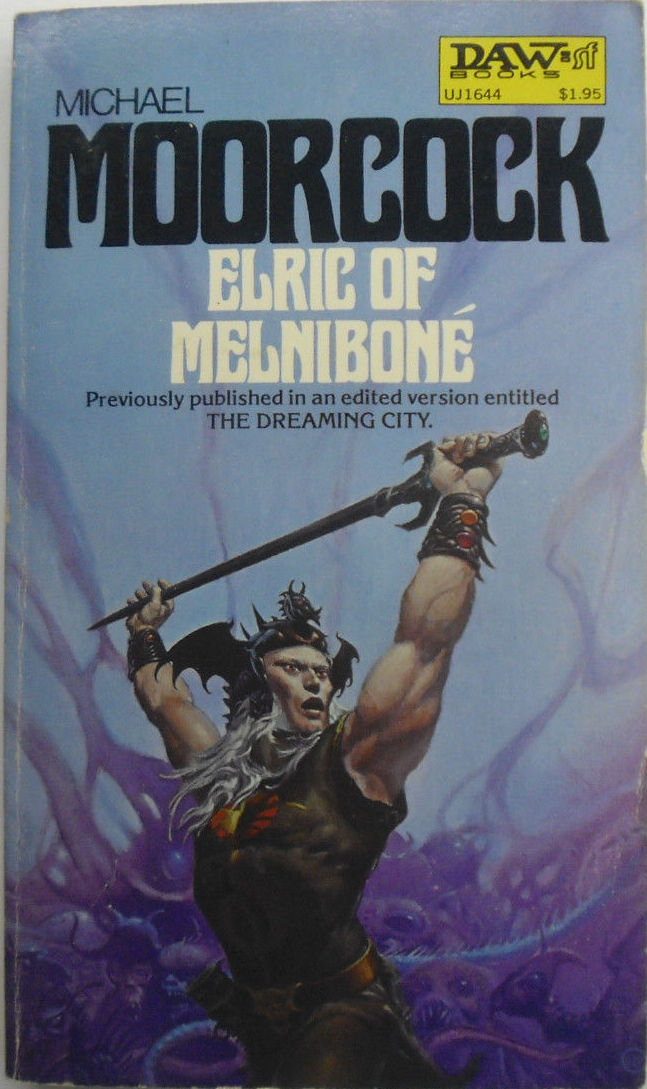
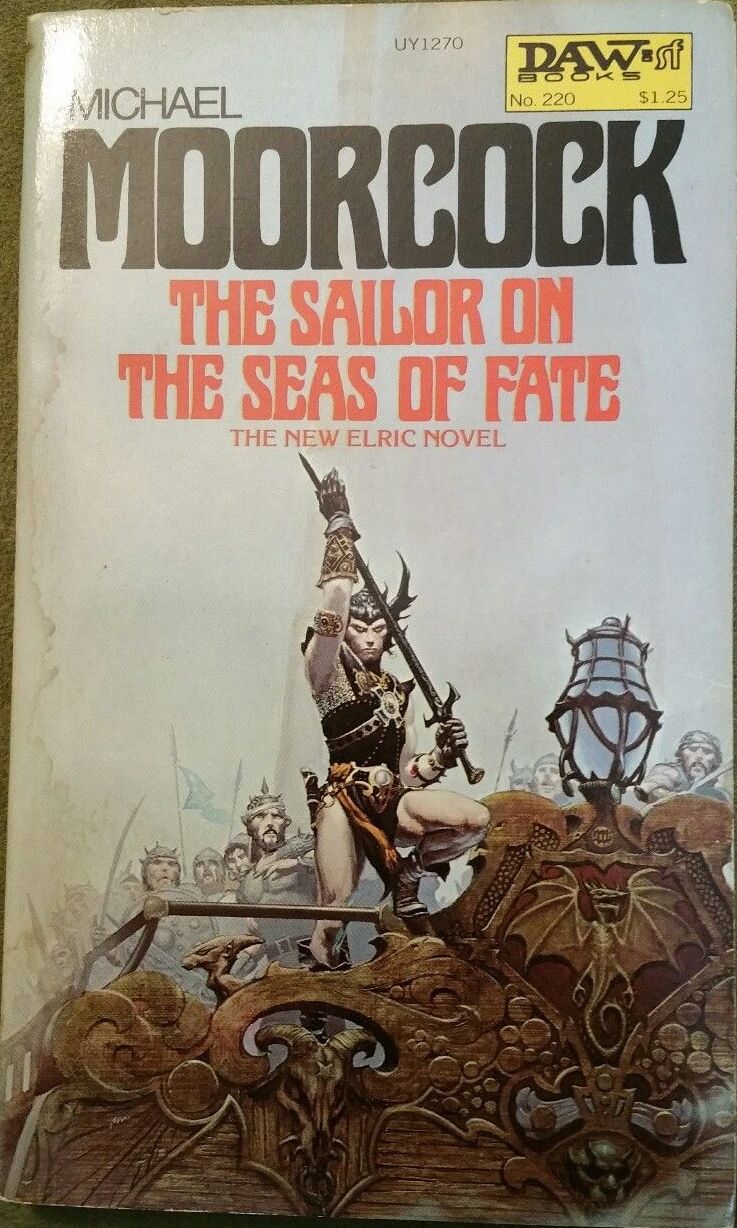
My introduction to Michael Moorcock’s Elric came from a single line in the Advanced Dungeons and Dragons Dungeon Master Guide. Gary Gygax included a note in Appendix N that Michael Moorcock’s Stormbringer and Stealer of Souls, as well as the first three books of the Hawkmoon series, influenced the game. I sought out the Elric cycle (as well as the Hawkmoon, Corum, Erekosë, etc.) in the DAW editions with cover art by Michael Whelan.

It was a great time to discover the books, since they were all in print and relatively easy to obtain. I worked my way through as many of Moorcock’s books as I could find, including his Dancers at the End of Time series, Michael Kane/Warrior of Mars series, and even books like The Black Corridor, The Wrecks of Time, and The Shores of Limbo. I remember my elation upon finding a used copy of The Ice Schooner in a used bookstore in New Haven, CT after searching for it through several states in those pre-internet days.

Read More Read More

Vintage Treasures: The Folk of the Air by Peter S. Beagle

Vintage Treasures: The Folk of the Air by Peter S. Beagle

The Folk of the Air-small The Folk of the Air-back-small

Peter S. Beagle burst on the scene in 1960 with A Fine and Private Place, the tale of a man quietly living in a cemetery for decades. Written while he was still a teenager, the novel established Beagle immediately as a major American fantasist. He followed it with The Last Unicorn (1968), which placed fifth in the 1987 Locus Poll for All-Time Best Fantasy Novel, sold more than five million copies, and was made into a popular animated film by Rankin/Bass in 1982.

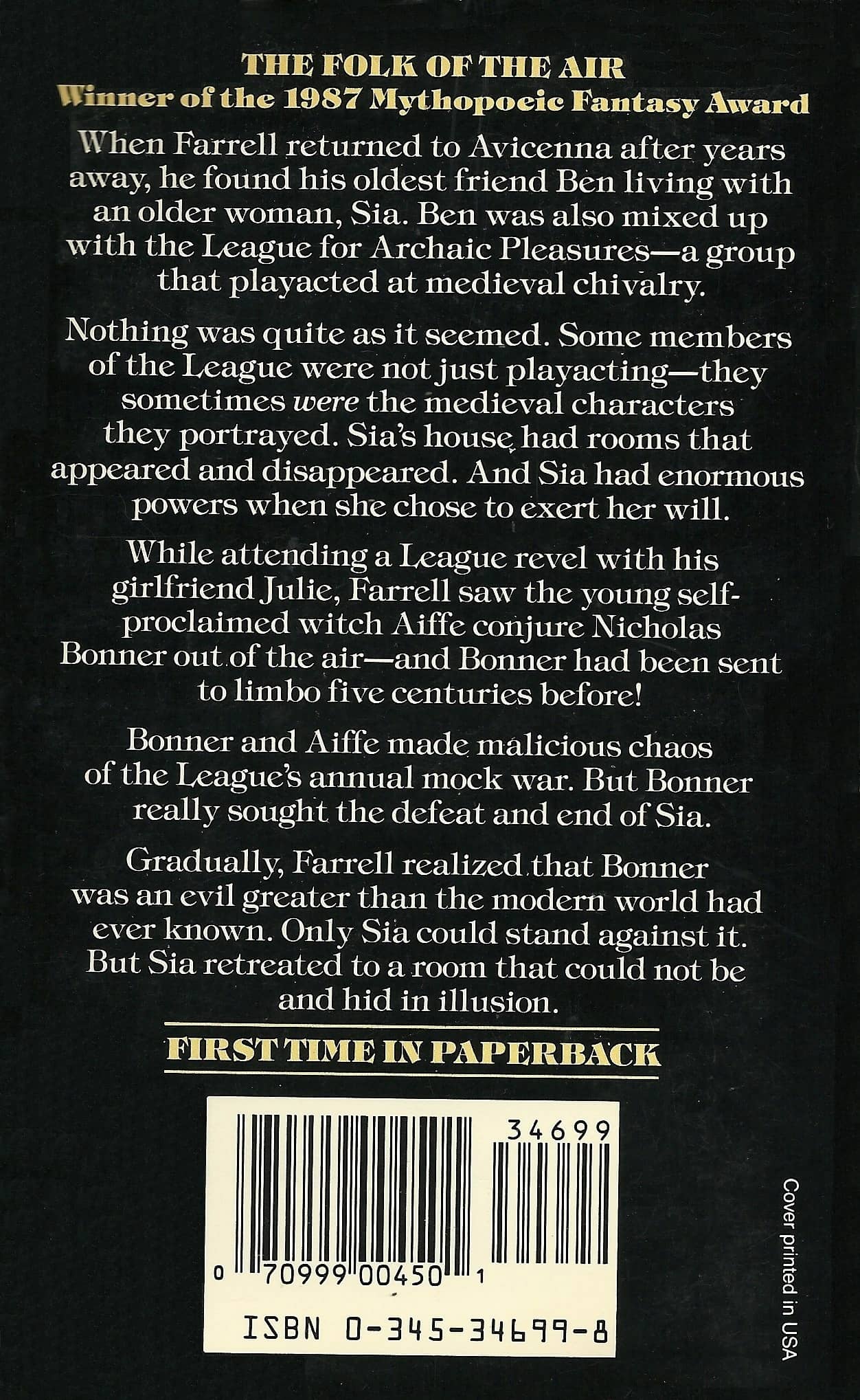
In 1969 Beagle wrote one of his most popular short stories, “Lila the Werewolf” (first published in Guabi #1, and in Terry Carr’s New Worlds of Fantasy #3), featuring the character Sam Farrell. Two decades later Farrell returned in Beagle’s third novel The Folk of the Air, which won the Mythopoeic Fantasy Award and was called “Peter Beagle’s Silmarillion” in the Mythopoeic Society review.

The publication of The Folk of the Air is an Event, no doubt about it… it is easily the best new fantasy novel I read last year… The main character is Joe Farrell, who first appeared as the hero of a short story called “Lila the Werewolf” (which may be found in the omnibus volume The Fantasy Worlds of Peter S. Beagle). It’s several years after “Lila”, and Farrell is making his first visit in a long time to his old stomping grounds in Avicenna, California…

If The Folk of the Air had been published five years ago, it would by now be seen as a foundation stone in the currently flourishing subgenre of contemporary urban fantasy — books like Moonheart by Charles de Lint, Tea with the Black Dragon by R.A. MacAvoy, and Brisingamen by Diana Paxson… Beagle has captured the style of the subgenre perfectly. From the beginning, where the sense of something magical and uncanny is in the air nearly from the start, long before the supernatural actually rears its head, to the end, which features a bang-up magical battle between two of the principal characters while the others look on in dazed wonder, this book has everything to capture the interest of fantasy readers who like a magical tale in the here and now.

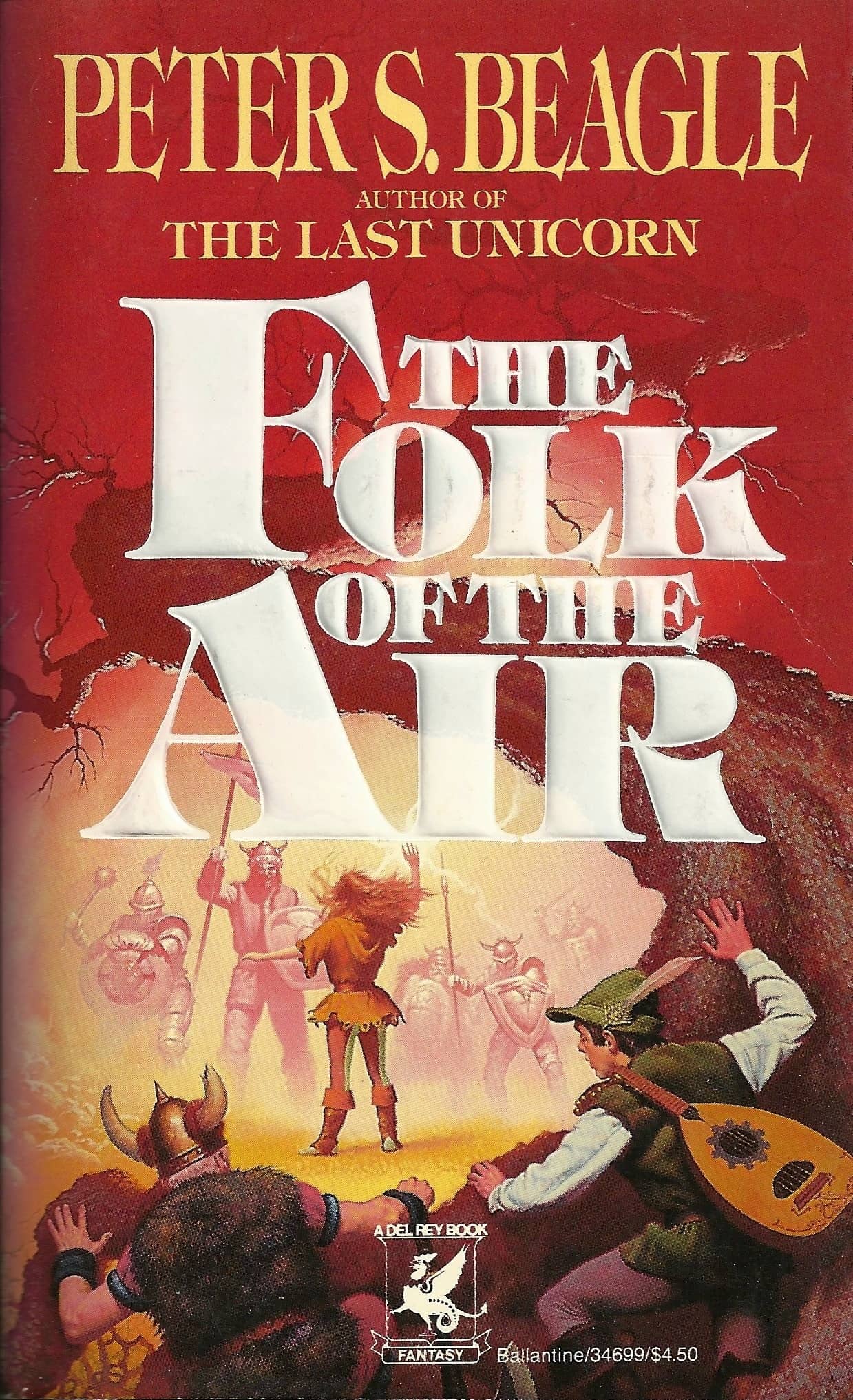
The book has held up very well over the decades (SF Reviews recently called it “top-drawer, comparable to the best of Tim Powers”), although Beagle has reportedly been working on a revised edition, to be called Avicenna, for some time. Whatever the case, the book has been out of print in the US since the 1988 Del Rey paperback, pictured above. I found this copy at the Windy City Pulp and Paper show here in Chicago earlier this year, where I paid $2 for it. It is 375 pages, with a cover price of $4.50. The cover is by Romas. There is no digital edition. See our previous coverage of Peter Beagle here.

The Road of Azrael by Robert E. Howard

The Road of Azrael by Robert E. Howard

TRDOZRL1979I can remember when my dad brought home The Road of Azrael (1979) and Sowers of the Thunder (1980), collections of Robert E. Howard’s historical adventure tales. My reading tastes were so exclusively fantasy and science fiction then, I couldn’t imagine wasting any time on boring, mundane stories. No wizards, no demons? What the heck was anybody thinking?

I grew out of that attitude a few years later and read both volumes. I remember liking them, but if you asked me for details on either one, I couldn’t have told you a thing. I read them once and never again. In fact, until recently I hadn’t read any other historical adventure even though, theoretically at least, I was a fan. I mean, it’s one of the primary root sources of swords & sorcery. At a very basic level, Robert E. Howard took the historical adventures of writers like Harold Lamb and Talbot Mundy and added magic and monsters.

It wasn’t until I started blogging about swords & sorcery and started getting all sorts of recommendations for the stuff that I looked into the genre again. With my review of Henry Treece’s The Great Captains four years ago, I started including some novels in my writing for Black Gate. I’ve been including a taste every month or so (most recently Purity of Blood by Arturo Pérez-Reverte), and it’s gone over well.

One of the pledges I made to myself at the start of my Black Gate tenure four years ago, was to avoid the big names of swords & sorcery. No one, I felt, needed another article about Michael Moorcock, or Fritz Leiber, or especially Robert E. Howard. Considering I wrote about Karl Edward Wagner’s Night Winds for my very first full review, THAT promise didn’t last very long, but I have tried to keep my focus on lesser-known or forgotten authors in my reviews of older works. Since then, I’ve reviewed a Moorcock book, a new one by Charles Saunders, and several more Wagner books, but until now I’ve steered clear of REH (especially because Bob Byrne has done a terrific job writing about him here at BG in his ongoing Discovering Robert E. Howard columns). It’s too hard to completely avoid the foundational figures of swords & sorcery when writing as often as I do, but I try to keep it to a minimum.

All this is a complicated way to say I’m reviewing The Road of Azrael by Robert E. Howard, and feel fully justified in doing so. It collects five historical tales of varying quality.

The paperback edition I read has execrable cover art, which did nothing to add appeal for me. Fortunately, the first thing in the book is a laudatory introduction by Gordon Dickson, no slouch of a storyteller himself, praising REH’s storytelling talents. Not that I need reminding of just how good Howard could be, but it’s always nice to see him get the praise he deserves. Unfortunately, I did not like the opening story, “Hawks Over Egypt.”

Read More Read More

Vintage Treasures: Sword & Sorceress, edited by Marion Zimmer Bradley

Vintage Treasures: Sword & Sorceress, edited by Marion Zimmer Bradley

Sword & Sorceress Anthologies-small

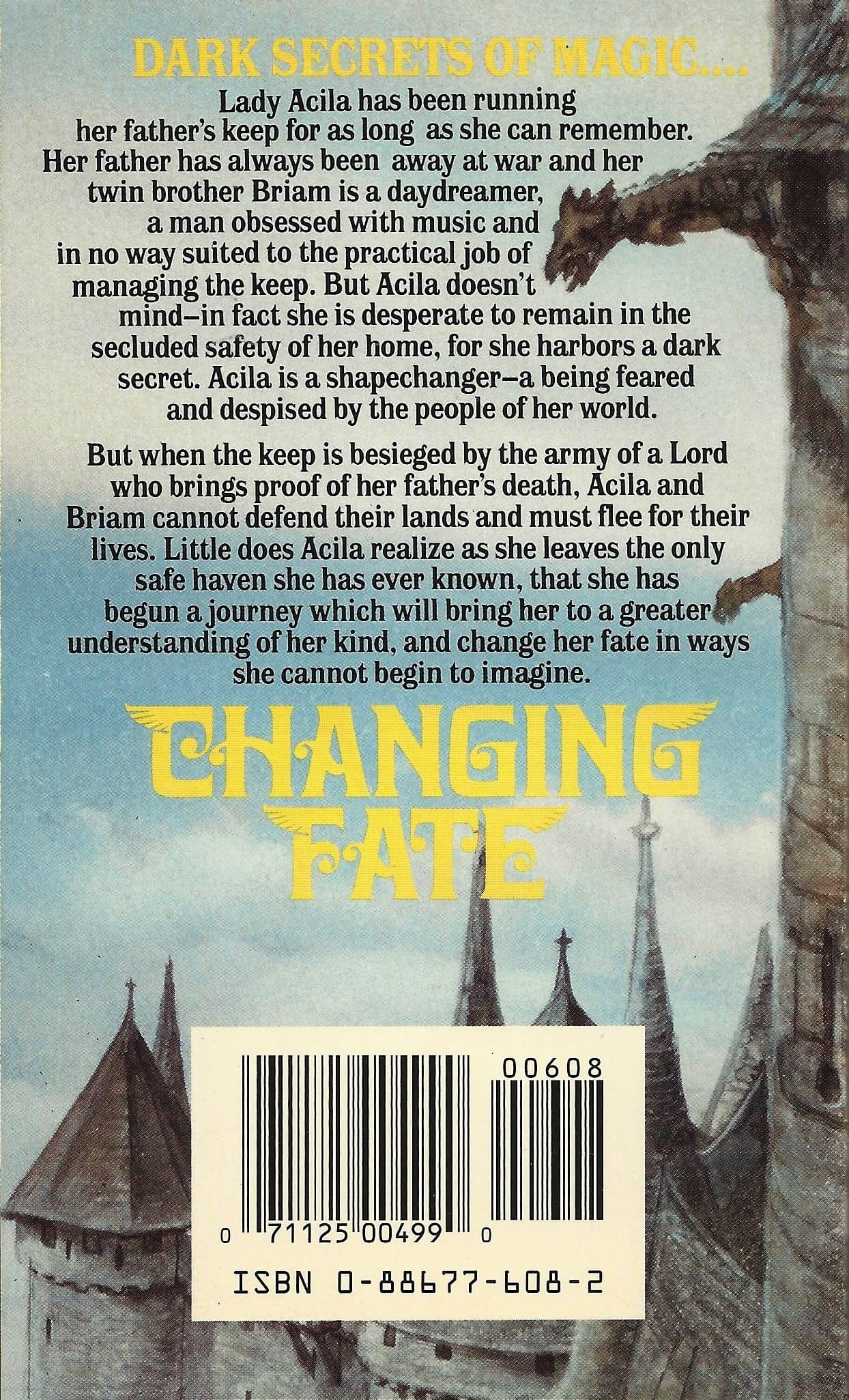
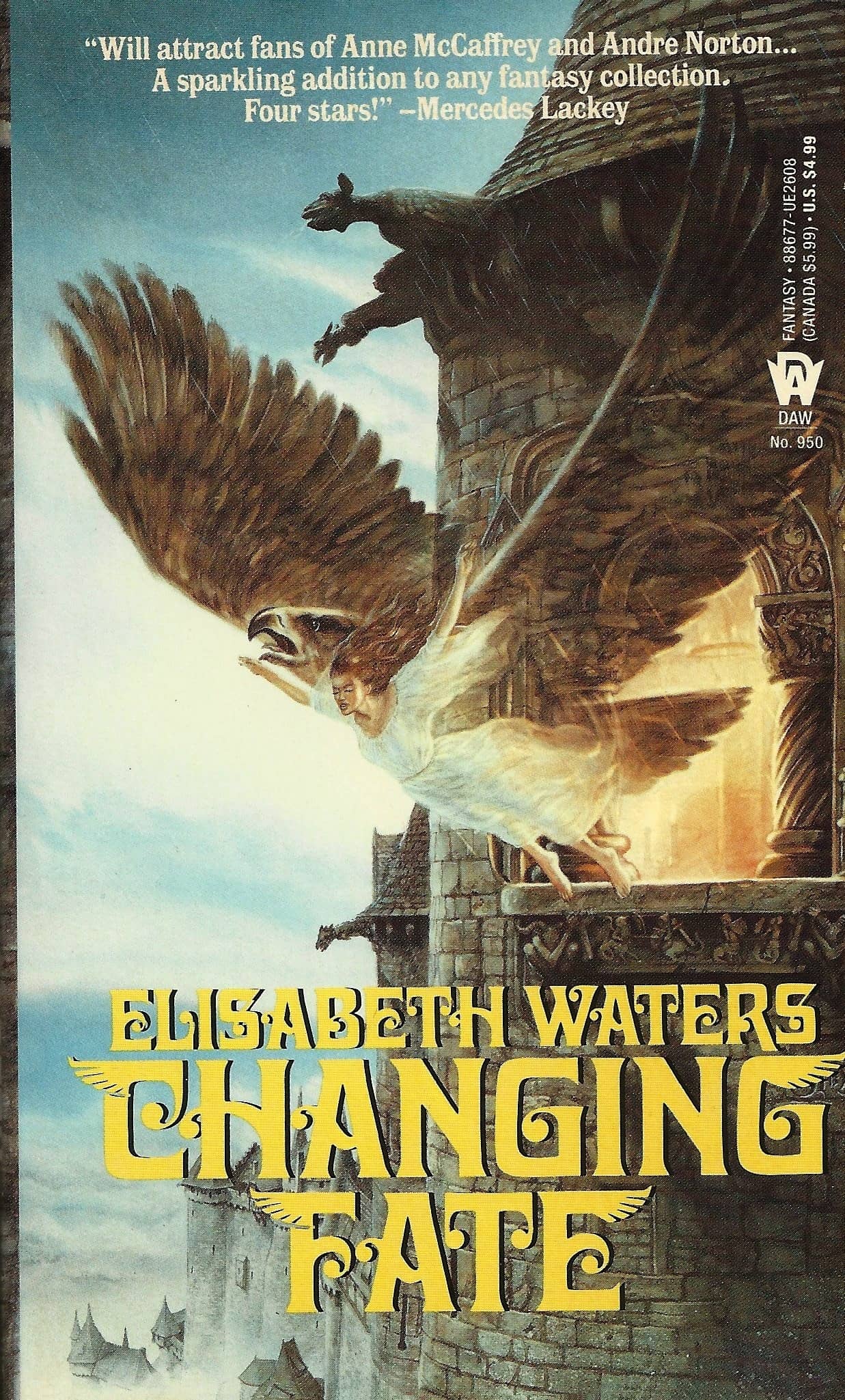
Sword and Sorcery has a rich history of anthology series. Lin Carter’s seminal Flashing Swords and Andy Offutt’s Swords Against Darkness are probably the most famous examples, but in terms of longevity and influence on the field I think they’re both eclipsed by Marion Zimmer Bradley’s Sword & Sorceress anthologies. The first one appeared from DAW Books in 1984, and there’s been a new volume every year since, with a single three-year gap between 2004-07. Last year’s Marion Zimmer Bradley’s Sword and Sorceress, edited by Elisabeth Waters, was #31.

The series is critical to the history of the field for more than its longevity, however. Unlike Carter and Offutt, who invited established authors to fill their pages, Bradley and her fellow editors opened their volumes up to submissions, and the results were pretty extraordinary. Numerous young writers who would go on to great things, many of them women, were discovered or promoted very early in their career in the pages of S&S, including Emma Bull, Mercedes Lackey, Jennifer Roberson, Diana L. Paxson, Laurell K. Hamilton, Phyllis Ann Karr, Rachel Pollack, Vera Nazarian, Deborah J. Ross, Elizabeth Moon, Janet Fox, Laura J. Underwood, Rosemary Edghill, Syne Mitchell, Devon Monk, Carrie Vaughn, and many, many others. You could make a pretty compelling case that Sword & Sorceress (together with its sister publication, Marion Zimmer Bradley’s Fantasy Magazine) dramatically remade modern fantasy, and may be the single greatest influence on 21st Century American fantasy so far.

The first volumes of S&S came out just as I entered grad school and my reading time dropped precipitously. So I missed out on al the excitement, but it’s not too late to catch up. I found the above collection of the first nine volumes (plus VIII and XV) in great shape on eBay, and bought it for $20, about two bucks per book — about half the original cover price. That’s a heck of a bargain for a lot of great reading.

Read More Read More

I Was Paper Trained by Philip K. Dick

I Was Paper Trained by Philip K. Dick

Blade-Runner-2049-Hero-small

My oldest son Sam loves the movie Blade Runner above almost any other, and so he was at least provisionally interested when the recent and long-delayed sequel, Blade Runner 2049 hit the theaters. Myself, I didn’t care much one way or the other. I like the original movie well enough (though it’s not the touchstone for me that it seems to be for many others) but as for the sequel, well… the two hours that will forever go down in infamy as Prometheus did a lot to damage my moviegoing relationship with Ridley Scott, which was never that warm to begin with. (I know Scott was “just” the executive producer on 2049, but still. Once someone has charged you twelve dollars for the privilege of farting in your face, you don’t forget it.)

In any case, the merits of the movies are beside the point. It has long irked me, as a science fiction fan and as a father, that Sam’s enthusiasm for Blade Runner has always been untempered by any encounter with Philip K. Dick’s actual novel, Do Androids Dream of Electric Sheep? or indeed, with anything by the man who I regard as the greatest of all science fiction writers. Before you call Child Protective Services, please know that I didn’t fail in every way as a parent — Sam has a wife and a home and a job, he can tie his shoes and put together a coherent English sentence, he’s kind to animals and considerate to everyone he meets, at least until he finds out who they voted for, and he’s a hell of a cook. He’s a fine and productive person and my pride in him is unbounded… but really, c’mon — Phillip K. Dick!

Read More Read More

Edgar Rice Burroughs’s Pellucidar Saga: Series Wrap-Up

Edgar Rice Burroughs’s Pellucidar Saga: Series Wrap-Up

at-the-earths-core-frank-frazetta-interior

Last week I concluded my book-by-book look at Edgar Rice Burroughs’s Pellucidar novels, the prehistoric world inside the Earth’s crust where the stationary sun eradicates the passage of time. The complete series consists of seven books:

Compared to Burroughs’s other two long-running science-fiction series, Mars/Barsoom and Venus/Amtor, Pellucidar is more difficult to summarize. The Venus novels were written over a short period of time during the end of Burroughs’s career and all feature the same hero, Carson Napier. There are no Venus classics, with the best (Lost on Venus) only middling and the rest ranging from bland to unreadable. The Mars series presents a vast canvas that arcs across Burroughs’s career, but it’s the most consistently high quality of any of his series, including the Tarzan novels, so it’s not too difficult to give it a broad analysis that primarily looks at changes in protagonists.

The Pellucidar books, however, present conundrums when consumed in a short period. Like Mars, Pellucidar spans the major phases of ERB’s career: success in the ‘teens, a stabilizing period in the twenties, a steepening decline throughout the thirties, a World War II revival, and a “lost” story and final volume published posthumously in the sixties. Unlike Mars, Burroughs visited Pellucidar sporadically, with a fourteen-year lapse after the first two paired novels, and later a seven-year gap.

Read More Read More

Vintage Treasures: The Cockatrice Boys by Joan Aiken

Vintage Treasures: The Cockatrice Boys by Joan Aiken

The Cockatrice Boys Joan Aiken-back-small The Cockatrice Boys Joan Aiken-small

Twenty years ago this week I received the artifact above in the mail, with a news release from Tor Books tucked inside: a trade paperback re-issue of Joan Aiken’s The Cockatrice Boys, with a 100% gonzo cover and interior art by Jason Van Hollander.

Joan Aiken, the daughter of the Pulitzer prize winning poet Conrad Aiken, was the author of many novels for young adults, including Black Hearts in Battersea, The Cuckoo Tree, and the 4 million-copy bestselling The Wolves of Willoughby Chase. According to the press release that came with my copy, The Cockatrice Boys was her “first adult fantasy novel… a weird, and wonderful adventure that combines the horror of Salem’s Lot with the fantasy and charm of Alice in Wonderland.” That certainly sounds gonzo, anyway.

Read More Read More

Edgar Rice Burroughs’s Pellucidar Saga: Savage Pellucidar

Edgar Rice Burroughs’s Pellucidar Saga: Savage Pellucidar

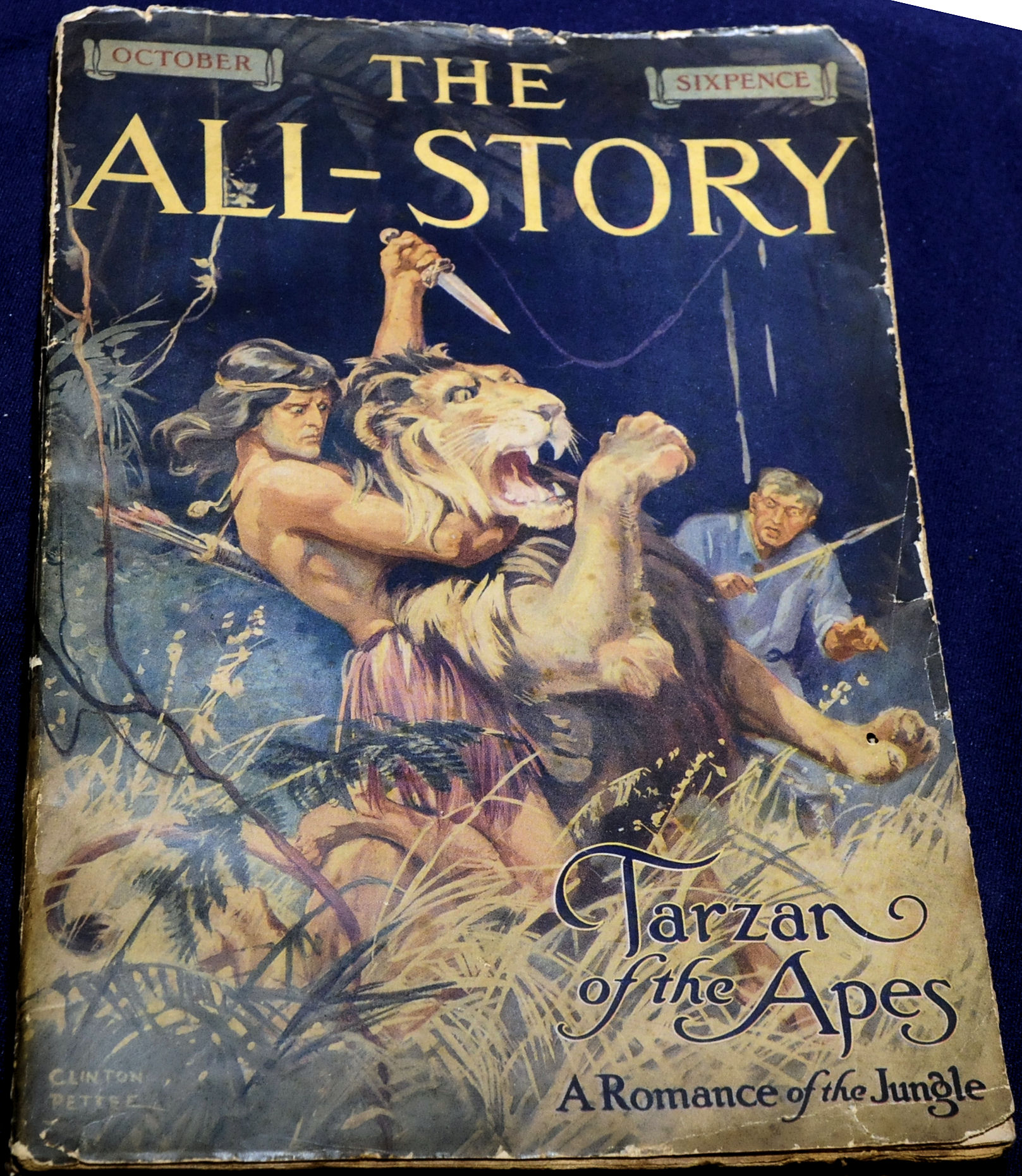
savage-pellucidar-canaveral-press-edition-coverHave we already arrived at the end of Pellucidar? It feels like I started examining this Edgar Rice Burroughs series only a few months ago — but it’s been almost a year since I drilled down to visit At the Earth’s Core. A year may have passed for me, but thirty has passed for Burroughs, and counting the time until the last unpublished novella was collected in Savage Pellucidar, the gap widens to fifty years. If you read At the Earth’s Core in the pulps as an enthusiastic thirteen-year-old, you’d be close to retirement age by the time you could buy the last book and have a complete Pellucidar set.

Wait, what am I talking about? This is Pellucidar. Time is meaningless here! I started writing this article series yesterday — or maybe a century ago, and the books were all published either over a span of one year or five hundred years. It’s all the same under the perpetual noonday sun.

Our Saga: Beneath our feet lies a realm beyond the most vivid daydreams of the fantastic … Pellucidar. A subterranean world formed along the concave curve inside the earth’s crust, surrounding an eternally stationary sun that eliminates the concept of time. A land of savage humanoids, fierce beasts, and reptilian overlords, Pellucidar is the weird stage for adventurers from the topside layer — including a certain Lord Greystoke. The series consists of six novels, one which crosses over with the Tarzan series, plus a volume of linked novellas, published between 1914 and 1963.

Today’s Installment: Savage Pellucidar (1963)

Previous Installments: At the Earth’s Core (1914), Pellucidar (1915), Tanar of Pellucidar (1929), Tarzan at the Earth’s Core (1929–30), Back to the Stone Age (1937), Land of Terror (1944)

The Backstory

I’ve told this tale before with Escape on Venus and Llana of Gathol, the sister works of Savage Pellucidar, but once more won’t hurt. At the start of the 1940s, Edgar Rice Burroughs experimented writing novels in three of his settings — Mars, Venus, and Pellucidar — as sets of four linked novellas. Each novella was capable of standing on its own but could later fit together with the other three for book publication. The idea may have been the suggestion of Cyril Ralph Rothmund, business manager for ERB Inc., who first wrote a letter to the editor of Ziff-Davis Magazines with the format proposal. It was an experiment of necessity, since the pulps were turning away from serializations as more of the weekly magazines dropped to monthly publication. Burroughs approached the three books as a round-robin, changing from one setting to the next to finish all the novellas.

Read More Read More

Star Kings, Virtual Reality, and Genetic Monsters: Rich Horton on Crown of Infinity by John M. Faucette/ The Prism by Emil Petaja

Star Kings, Virtual Reality, and Genetic Monsters: Rich Horton on Crown of Infinity by John M. Faucette/ The Prism by Emil Petaja

Crown of Infinity James M Faucette-small The Prism Emil Petaja-small

Over at his website Strange at Ecbatan, Rich Horton takes a look at a long forgotten Ace Double from 1968. So forgotten, in fact, that I’ve never even heard of it. I dug through the dusty pile of Ace Doubles by my bed but, nope, it ain’t in there.

Assuming Rich didn’t just make this book up, it looks like a fascinating artifact, although maybe not for the usual reasons. Here’s Rich on the first half:

The lure for me in this Ace Double is the first novel by John M. Faucette, a fairly little known writer these days, but one of a very small set of African American SF writers before, really, the 1980s, which is amazing and a bit embarrassing for the field… I approached Crown of Infinity, Faucette’s first published novel, with interest and a real desire to like it. The publisher’s copy compares it to Doc Smith and Olaf Stapledon, and, oddly enough, that comparison makes a lot of sense. Unfortunately, the comparison ultimately is utterly to the disadvantage of Crown of Infinity. Indeed, I’d say this book reads as if written by a teenager completely in love with Doc Smith’s work … and with enough talent to imitate aspects of it effectively, but with no ability to structure a novel, nor enough originality to really make the novel “new.”

Here’s the inside cover, with the full description.

Read More Read More

Galaxy Science Fiction, December 1953: A Retro-Review

Galaxy Science Fiction, December 1953: A Retro-Review

Galaxy Science Fiction December 1953-small Galaxy Science Fiction December 1953-back-small

Featuring festive, seasonal artwork from Ed Emshwiller, the December 1953 issue of Galaxy Science Fiction includes fiction from both Theodore Sturgeon and Isaac Asimov.

“The Dark Door” by Alan E. Nourse — Harry Scott hides in an apartment, waiting for them to find him. Who they are, he doesn’t know. But they aren’t men. He tried to learn about them only to become their target. He can’t go to the police. But if he can get back to the center where he works, he might find help. Unless the mysterious not-men get to him first.

I like the feel of this story. It’s not clear what’s happening, and as a reader, you aren’t certain if you can trust the main character’s point of view because it’s clear he’s unstable.

I’ve mentioned this in a past article, but Nourse wrote a novel titled The Bladerunner in 1974. And Ridley Scott bought the rights to the title “Blade Runner” for his 1982 film (which was based on Philip K. Dick’s novel Do Androids Dream of Electric Sheep?). I mention this again because of the recent release of Blade Runner 2049. And if you haven’t seen that movie yet, what are you waiting for?

Read More Read More