Browsed by
Category: Editor’s Blog

The blog posts of Black Gate Managing Editor Howard Andrew Jones and Editor John O’Neill

C.S.E. Cooney’s The Sea King’s Second Bride wins the Rhysling Award

C.S.E. Cooney’s The Sea King’s Second Bride wins the Rhysling Award

C.S.E. Cooney
C.S.E. Cooney

Woo-hoo!  Break out the bubbly!

Black Gate Website Editor C.S.E. Cooney has won the Rhysling Award, Long-Form category, for her poem “The Sea King’s Second Bride.” The Rhysling Awards are given each year by the Science Fiction Poetry Association to the best science fiction, fantasy, or horror poem of the year.

The Rhyslings are named for the blind poet Rhysling in Robert A. Heinlein’s “The Green Hills of Earth.” The categories are “Best Long Poem” (50 or more lines), and “Best Short Poem” (49 or fewer lines).

About her winning poem, Claire tells us:

It’s all due Nicole Kornher-Stace. And Amal El-Mohtar. And Jessica Wick. Who conspired to buy me that print of John Bauer’s Agneta and the Sea King. Which made me FINALLY buy that book of Swedish Folk Tales.

“The Sea King’s Second Bride” was originally published in Goblin Fruit, edited by Amal El-Mohtar and Jessica P. Wick . You can read the complete poem here.

The winners are announced at Readercon, held this year from 14-17 July at the Burlingon Marriott, outside of Boston, Massachusetts. The nominated works are traditionally compiled into an anthology called The Rhysling Anthology. This year, there were 37 nominees in the long poem category, and 56 in the short poem category. The complete list of nominees is here.

Congratulations to C.S.E!  In honor of her win, Black Gate would like to buy all our readers a bottle of bubbly1. Raise a toast with us in honor of our favorite poet — and now the world’s favorite, too.


1. Must be of legal drinking age. Must realize we’re joking. Offer not valid outside the continental U.S.A. Or anywhere that sells bubbly.

UFO TV Presents: Pulp Fiction – The Golden Age of Sci Fi, Fantasy

UFO TV Presents: Pulp Fiction – The Golden Age of Sci Fi, Fantasy

So I recently stumbled upon this terrific, hour-long documentary on the Golden Age of Science Fiction and Fantasy pulps, produced by UFO TV.

I admit I’ve never heard of UFO TV before (um, is it a cable station I don’t know about?), but this is a fun offering. Some of the folks interviewed include Ray Bradbury and Kevin J. Anderson (with a large variety of L. Ron Hubbard paperbacks prominently displayed over his shoulder, from every angle), and the mix of old movies clips and spot animation is top-notch.

Plus they pack in what must be a record number of SF pulp covers for a documentary. Seriously.

YouTube offers the entire video for free, although it’s interrupted occasionally by (skipable) commercials.  It’s just like TV used to be!

Solaris Rising, Women Falling?

Solaris Rising, Women Falling?

solaris_rising2I was consistently impressed with The Solaris Book Of New Science Fiction, edited by George Mann, which published three annual volumes between 2007 and 2009. Solaris Books is relaunching the series as Solaris Rising (shipping in October) under new editor Ian Whates, and I’ve been looking forward to it.

A while back Kev McVeigh at Performative Utterance noted the following rather dismaying statistic:

The Solaris Book of New Science Fiction by Boys volume one has Mary A Turzillo as token feminine contributor. One woman from eighteen listed authors. Volume Two is obviously the feminist volume with a remarkable three women out of fourteen involved…. It’s back to normal for Volume Three as fifteen stories allow room for just one woman…

It might be tempting to just blame editor George Mann for this. Perhaps it really is just his personal taste. After all Ian Whates is now on board, and he published an excellent all female anthology for Newcon Press, Myth-Undertakings. His Solaris Rising might reflect that? No, nineteen stories, 21 contributing authors, just three women.

What I’ve chiefly been dismayed about is the  reaction from some of the SF old guard, which quickly attacked Kev and his arguments in various newsgroups. This was an irrelevant stat (they said), and the percentage of women contributors had no bearing at all on quality. After all, if If Solaris was against women writers, why were they bothering to include any at all?

To put it bluntly, old guard, you’re missing the point. Wake up.

About five years ago I experienced exactly the same criticism as Ian and George. Someone (I honestly forget who) did the math on the first six issues of Black Gate and figured out that I’d published only 15 stories by women, out of a total of 51 – roughly 29%. Right about this time Rich Horton started reporting on the percentage of fiction by women in his yearly short fiction summations. At first I had exactly the same reaction as the old guard – this is a load of crap. I pick the very best stories sent to me; case closed. I deeply resented any implication otherwise, and considered the entire argument a waste of time.

I was, in short, a complete idiot.

Read More Read More

SF Site reviews Black Gate 15

SF Site reviews Black Gate 15

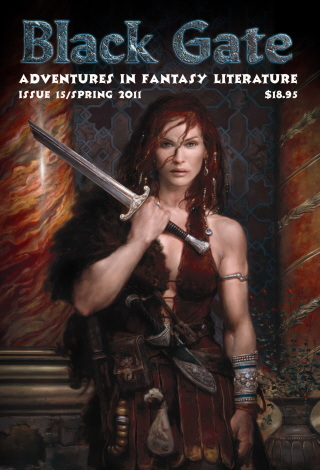
bg-15-cover2Sherwood Smith continues her uninterrupted run of Black Gate reviews with a lengthy look at our latest issue at SF Site:

The previous issue, at nearly 400 pages, was so successful that the decision was made to stay at that length. For the amount, the price is quite reasonable, and the online subscription is half that. There are plans for issues compatible with Kindle and other e-readers. Judging by Black Gate‘s consistent quality, moving away from the pressure of seasonal publication has been a good one… here we’ve got a broad range of fantasy adventure fiction, from horror to comedy, at a variety of lengths. This spectrum, along with the regular columns, is another of Black Gate‘s strengths.

Sherwood seemed particularly taken with “A River Through Darkness and Light” by John C Hocking:

Lucella, a tough warrior woman, and the first-person narrator Archivist, have history together, as they travel in search of a hidden stash of ancient scrolls, accompanied by a scholar and an old soldier. Unfortunately, they are chased by bandits bent on vengeance… and then there’s the demon…

I think of Hocking’s stories as characteristic of Black Gate: a strong blend of the old sword and sorcery action and mood, but with modern attention to character development, especially of the women. Lucella, like Asdis in Hocking’s Norse tales, can hold her own in a world of heroes and demons. Dark and vivid, shot through with moments of humor, this story is a promising opening to the issue.

As well as “Into the Gathering Dark” by Darrell Schweitzer:

At first, when I saw that this was another tale of True Thomas, I settled in for a familiar ride. The story of Thomas has seen many versions, especially in the last thirty years. But Schweitzer does not inject this last tale of True Thomas with modern sensibilities. Exquisitely poignant, it is one of the best stories in the issue, beautifully rendering all that was best in the tales of Elfland, “neither of Heaven or of Hell,” of a century ago.

And “Dellith’s Child” by Nye Joell Hardy:

In this world, ship-owning families never set foot on land, and the female captains inherit the ability to see ley-lines, crucial on the vast oceans. The first person narrator, Grady, is visiting his sister Dellith on her ship. At first he’s delighted to learn that she has a son… until he sees the sea monster she calls by her son’s name. Then the whole world goes askew. Grady is a sympathetic hero in a fascinating world, the tension never flags, and the ending is unpredictable. This was one of my favorites.

The complete review is here. Sherwood’s previous review, of Black Gate 14, is here.

Martin Harry Greenberg (March 1, 1941 – June 25, 2011)

Martin Harry Greenberg (March 1, 1941 – June 25, 2011)

great-sf-17Martin H. Greenberg, one of the most prolific creators in the history of the genre, died last week.

Dr. Martin H. Greenberg received a doctorate in Political Science from the University of Connecticut in 1969, and taught at the University of Wisconsin, Green Bay, from 1975 until 1996. In 1974 he edited his first anthology (with Patricia Warrick): Political Science Fiction, intended as a teaching guide.

It was to be the first of literally thousands of books he published over the next 36 years, the vast majority of them science fiction and fantasy anthologies.

Greenberg’s specialty was copyright searches and handling author royalties, and he was famously adept at both. He founded book packager Tekno Books, which typically produced 150 titles per year, totaling over 2,300 books.

Shortly after he entered the field Greenberg discovered he shared a name with another famed SF anthologist: Martin Greenberg, publisher of Gnome Press, who edited some of the most influential science fiction anthologies of the 1950s, including Travelers of Space and Journey to Infinity (both 1951). In his autobiography Isaac Asimov, who worked extensively with both men, said he suggested that he call himself “Martin H. Greenberg” or “Martin Harry Greenberg,” which he did.

Greenberg frequently partnered with other editors such as Joseph D. Olander, Andre Norton, Robert Silverberg, and especially Asimov, with whom he co-edited a total 127 anthologies, including the 25-volume Isaac Asimov Presents the Great SF Stories.

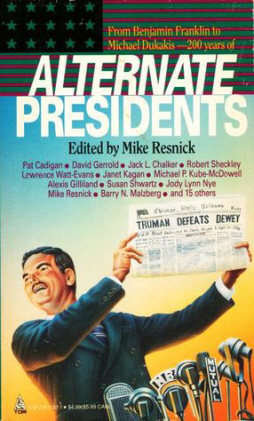
alt-prezs1In recent years Greenberg, working chiefly with editors Jean Rabe, John Helfers, Kerrie Hughes and others at Tekno Books, produced 10 original anthologies per year for DAW books, often referred to as “the DAW magazine.”

Black Gate contributor Mike Resnick,  who edited 19 anthologies for or with Greenberg and sold him a total of 61 stories, shared this story of how their partnership started:

We’re eating lunch at the 1989 Boston worldcon, he asks what I’m working on, I say a Teddy Roosevelt alternate history novella, and as we’re getting up he says he’s off to sell our anthology. I say what anthology? He says Alternate Presidents, with Teddy Roosevelt in 1912 and a bunch of others. I say I didn’t know we were talking about one, and besides, this one’s unsaleable.

Three hours later he hunts me up: “We’ve sold it to Tor for a 5-figure advance, and you’re editing it.” I never doubted him again.

In 2009 Greenberg was the recipient of one of the first Solstice Awards presented by the Science Fiction and Fantasy Writers of America (SFWA) in recognition of his contributions to the field.

For a complete list of his titles (caution: it’s a big list), see his entry at the SF Encyclopedia.

The 2011 Locus Award Winners

The 2011 Locus Award Winners

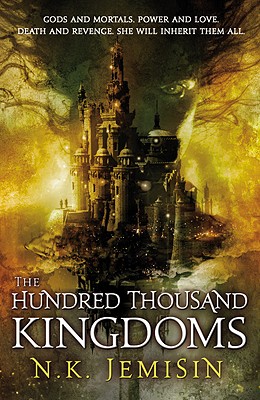
hundred-thousandThe 2011 Locus Awards were announced last weekend. The winners are:

Best Science Fiction Novel: Blackout/All Clear, Connie Willis (Spectra)
Best Fantasy Novel: Kraken, China Miéville (Macmillan UK; Del Rey)
Best First Novel: The Hundred Thousand Kingdoms, N.K. Jemisin (Orbit UK; Orbit US)
Best Young Adult Book: Ship Breaker, Paolo Bacigalupi (Little, Brown)
Best Novella: The Lifecycle of Software Objects, Ted Chiang (Subterranean)
Best Novelette: “The Truth Is a Cave in the Black Mountains”, Neil Gaiman (Stories)
Best Short Story: “The Thing About Cassandra”, Neil Gaiman (Songs of Love and Death)
Best Magazine: Asimov’s SF
Best Book Publisher: Tor
Best Anthology: Warriors, George R.R. Martin & Gardner Dozois, eds. (Tor)
Best Collection: Fritz Leiber: Selected Stories, Fritz Leiber (Night Shade)

You can find the complete list of winners and nominees at Locus Online.

The Locus Awards are presented to winners of Locus Magazine’s annual readers’ poll. The award was first given in 1971, for works published in 1970. According to Locus, the awards frequently draw more voters than the Hugo and Nebula Awards combined.

July/August Fantasy & Science Fiction Magazine Now on Sale

July/August Fantasy & Science Fiction Magazine Now on Sale

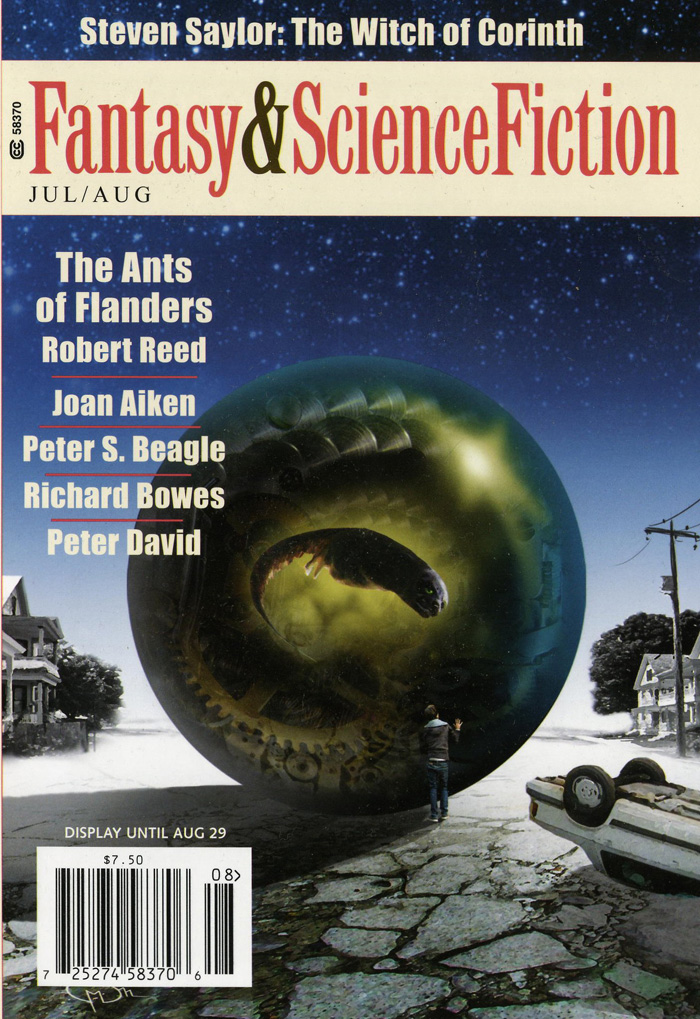
fsf-july-aug11The May/June double issue of Fantasy & Science Fiction went on sale June 28.

Robert Reed, one of the most prolific and impressive contributors to F&SF over the past decade, has the cover story this issue: a big new novella titled “The Ants of Flanders.” Novelets are Peter David’s “Bronsky’s Dates with Death,” Steven Saylor’s “The Witch of Corinth,” and KJ Kabza’s “The Ramshead Algorithm.”

Short stories this issues are “The Way it Works Out and All,” by Peter S. Beagle, “Less Stately Mansions,” by Rob Chilson, “Hair” by Joan Aiken, “Sir Morgravain Speaks of Night Dragons and Other Things,” by Richard Bowes, and “Someone Like You,” by Michael Alexander.

Plus the regular departments, including Charles de Lint’s column “Books to Look For,” book reviews by Elizabeth Hand, “Plumage From Pegasus: A Short History of the ETEWAF Revolution,” by Paul Di Filippo, “Films: Free Will Hunting,” by Lucius Shepard, and “Science: Pattern Recognition, Randomness, and Roshambo,” by Paul Doherty & Pat Murphy.

F&SF is published six times a year; issues are 258 pages.  It is the longest-running professional fantasy magazine in the country, and has been published continuously since 1949.

The cover price is $7.50. The magazine’s website, where you can order subscriptions and browse their blog, is at www.sfsite.com/fsf/.

F&SF is edited by Gordon van Gelder. The cover this issue is by Maurizio Manzieri. We covered the May/June issue here.

The Year’s Best SF & Fantasy 2011, edited by Rich Horton

The Year’s Best SF & Fantasy 2011, edited by Rich Horton

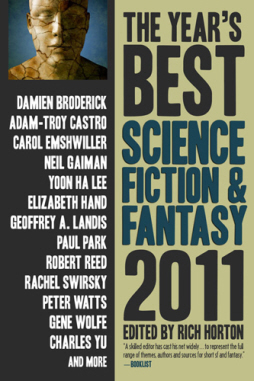
yearsbest2011The third volume of Rich Horton’s Year’s Best Science Fiction and Fantasy (Prime Books), my favorite annual Year’s Best collection, shipped in early June, and my copy finally arrived last week. Imagine my surprise to find this on the dedication page:

For two editors who got me started on the route to putting together these books: Dave Truesdale and John O’Neill.

You don’t have to imagine how honored I feel, because I can tell you that right now: pretty damn honored. I’ve been publishing Rich’s excellent articles and reviews since the early days of the SF Site, shortly after he was introduced to me by, yes, Dave Truesdale, who was publishing his short fiction reviews at Tangent. Thanks, Rich. And thanks, Dave.  Owe you one.

As for the book, it’s excellent as always. This year it features thirty stories that showcase the very best in contemporary SF and fantasy, from the finest writers in the field: Gene Wolfe, Robert Reed, Paul Park, Carol Emshwiller, and many others. In fact, this year’s volume is even more awesome than usual, as it features “The Word of Azrael” from BG 14, by our very own Matthew David Surridge, as well as “Braiding the Ghosts” (from Clockwork Phoenix 3) by our website editor C.S.E. Cooney.

C.S.E. had a particularly good year last year, in fact: two additional tales made Rich’s Recommended Reading list, including “Household Spirits” (from Strange Horizons; read the complete story here) and her novella The Big Bah-Ha (from Drollerie Press), alongside Robert J. Howe’s novella from BG 14, “The Natural History of Calamity.” We covered the 2009 edition of Year’s Best SF & Fantasy here.

Congratulations to all the contributors, and to Rich on another superb volume. If you’re looking for one book this year to point you to the cream of the crop in modern SF & fantasy, this is the one.

2010 Bram Stoker Award Winners

2010 Bram Stoker Award Winners

straub-a-dark-matter2Yes, these awards were actually given out last week, so technically this isn’t news. But I’m just getting around to it now, and you probably forgot who won already, so I’m sure this is still useful. Glad we could be of service.

The winners of the 2010 Bram Stoker Awards for Superior Achievement in the horror field are:

Novel: A Dark Matter, Peter Straub (DoubleDay)
First Novel (tie): Black and Orange, Benjamin Kane Ethridge (Bad Moon Books) & Castle of Los Angeles, Lisa Morton (Gray Friar)
Long Fiction: “Invisible Fences,” Norman Prentiss (Cemetery Dance)
Short Fiction: “The Folding Man,” Joe R. Lansdale (Haunted Legends)
Anthology: Haunted Legends, Ellen Datlow & Nick Mamatas, eds. (Tor)
Collection: Full Dark, No Stars, Stephen King (Simon & Schuster)
Non-Fiction: To Each Their Darkness, Gary A. Braunbeck (Apex)
Poetry Collection: Dark Matters, Bruce Boston (Bad Moon Books)

The Bram Stoker Awards have been presented annually by the Horror Writers Association since 1987. Winners are selected by ballot among active members of the HWA. In 2011 three new Categories will be added: Superior Achievement in a Screenplay; Superior Achievement in a Graphic Novel; and Superior Achievement in a Young Adult Novel.

What about Superior Achievement in a video game? Any year that doesn’t include an award for Dead Rising is missing the boat, in my opinion.

The complete list of nominess for 2010 is here.

Matthew Wuertz reviews Black Gate 15

Matthew Wuertz reviews Black Gate 15

bg-15-cover2Long time reader Matthew Wuertz contributes one of the first reviews of our latest issue on his blog, Adventures of a Fantasy Writer:

The immense tome is now the standard size, much to the chagrin of mail carriers everywhere. For those who love adventure fantasy, however, it is a welcome change for the bi-annual publication.

This is one of the best issues I’ve read. There is a mix of old and new writers, and there is even a theme around strong female protagonists (or “Warrior Women” as John puts it). If you’ve read Black Gate in the past but have fallen away from it in recent times, this is an excellent issue to jump back in with. If you’ve never read Black Gate, check them out.

Matthew has particular praise for “World’s End” by Frederic S. Durbin, “Groob’s Stupid Grubs” by Jeremiah Tolbert, “The Lions of Karthagar” by Chris Willrich, and stories by John R. Fultz and Maria V. Snyder. But he reserves his highest praise for “The Oracle of Gog,” the first story in an ambitious new S&S sequence by Vaughn Heppner:

Lod has survived as hunters’ bait and seeks to end his slavery. Meanwhile, the Nephilim, Kron, comes to his master – the terrible Firstborn named Gog – who has peered into the future and sees a threat. Kron’s mission is to eliminate that threat, while Lod’s mission is to simply survive in his newfound freedom. This was my favorite tale within the issue. Heppner’s narrative style wrapped me into each scene and into the characters’ minds. I hope to see more stories of Lod in future issues.

Read Matthew’s complete review here.

You can get more details on Black Gate 15 here, and purchase copies for just $18.95 (shipping included) at our online store.