Browsed by
Category: Books

Edgar Rice Burroughs’s Venus, Part 1: Pirates of Venus

Edgar Rice Burroughs’s Venus, Part 1: Pirates of Venus

pirates-of-venus-first-edition-coverNext year brings the hundredth anniversary of Edgar Rice Burroughs’s first two published novels: A Princess of Mars and Tarzan of the Apes, as well as a big-budget film version of A Princess of Mars from Disney. (The film is saddled with the unfortunately bland title of John Carter. Fear of a Red Planet?) The effect these novels had on popular cultural was immense: they created a whole medium, they altered the nature of reading for pleasure. Pulp magazines existed before Edgar Rice Burroughs had the idea he could write better than the tripe found in the publications where he was working to place ads; but it was the success of first Under the Moons of Mars (the serial title for A Princess of Mars) and then Tarzan of the Apes in 1912 that made the pulps into the artillery of the Reader Revolution. The pulps turned the U.S. into a nation of readers, and ERB fired the first two shots in the revolution.

Then, twenty years into the revolution, he fired off the few rounds of his “Venus” series.

I have planned some festivities for the upcoming centenary of the Burroughs Upheaval. One is an ambitious project I have wanted to try on Black Gate for the last two years. But as a prologue to my 2012 ERB projects here in 2011, I’ve chosen to present a look at Burroughs’s least popular series, the last one he started before his death.

These posts will have a different structure from my usual free-form analysis style. Inspired by columns I’ve seen on the movie review sites I frequent (particularly “Franchise Me” on CHUD.com), I’ve laid out a template for tackling each of the five installments of the Edgar Rice Burroughs “Venus Saga.” An experiment? Or an admission that trying to go academic on this series feels like the wrong approach? I’m not sure myself, but here it goes….

Read More Read More

Fictional Frontiers Interviews Howard Andrew Jones

Fictional Frontiers Interviews Howard Andrew Jones

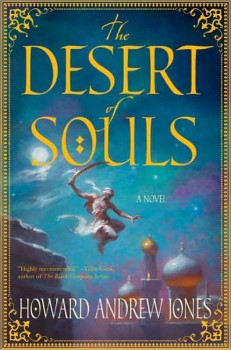
the-desert-of-soulsSohaib Awan at Fictional Frontiers interviews Black Gate Managing Editor Howard Andrew Jones on his first novel The Desert of Souls, non-Western fantasy, juggling modern expectations in historical fiction, and much more:

Fictional Frontiers: I’m spouting hyperbole here, but I think it’s so well earned…. give us an overview of The Desert of Souls.

Howard: Like a lot of adventure fiction, it starts with the discovery of a body. Of course, it’s the body of a dead parrot. The parrot’s beloved by Jaffar — I guess it’s a little Disney joke, because you know, Jaffar and the parrot. But of course Jaffar was a real character… arguably the most famous vizier in Arabian history. Anyway… his guard captain Asim suggests an adventure into the market. So he and Jaffar and the scholar Dabir go out into the city in disguise, and a dying man presents them with a strange and beautiful artifact, a golden door pull, and he asks them to keep it safe.  And that’s where things really take off. Dabir and Asim are tasked by Jaffar with learning the pull’s origin and purpose. Naturally they’re not the only ones after the thing, and they soon learn it may open a gateway to an unearthly realm, accessed in the ruins of the lost city of Ubar, which is sort of like an Atlantis of the sands.

The complete podcast runs 22 minutes, and is available here.

Goth Chick News: Cool Stuff from the Chicago Comic-Con

Goth Chick News: Cool Stuff from the Chicago Comic-Con

image004Ah, August in Chicago.

Bicyclists along the lake front, street festivals, the Navy Pier Ferris Wheel… and so many guys dressed like storm troopers you can’t spit a piece of gum without hitting one.

It’s once again Comic-Con time in the city.

Each year, following the bacchanalia in San Diego in July, the less manic, more edgy and far more spandex-laden version makes its way to my favorite city and thanks to my Black Gate creds, I get VIP access every August. The big Hollywood bunny-huggers in California can keep their con. Give me the artsier, indy-er and far more laid back Midwest version where you can still hobnob with the entertainment industry; but instead of seeing them from behind black draped partitions, you walk right up, shake hands and have a chat.

Amazing cartoonists, emerging authors, small-movie moguls and performance artists all mix with Iron Man-costumed day traders and slightly overweight Batmen.

A better afternoon you couldn’t hope to spend.

In the coming weeks it will be my distinct pleasure to bring you in-depth looks at some of my absolute favorite finds from the 2011 show. But being one of those “open at least one present on Christmas Eve” kind of girls, I couldn’t wait for the interviews to start taking shape.

So, here are a few of the most unique sights that caught my attention, in a good way. Believe me, there were a lot of sights that caught my attention in an entirely different way altogether, but I’ll stow my snark and stick to the cool stuff, listed in no particular order.

Read More Read More

Dorgo the Dowser and Me

Dorgo the Dowser and Me

mad_shadowsWhen John O’Neill invited me to write article about my collection of sword and sorcery stories, Mad Shadows: The Weird Tales of Dorgo the Dowser, for the Black Gate blog, I was naturally thrilled and honored. I was also somewhat uncertain.

Where do I begin? What should I say?

So I asked myself… why not first tell readers something about your book — the world of Tanyime, the kingdom of Rojahndria, the city of Valdar, and its main character — and then talk a little bit about how it all came to be? Well, here goes.

Mad Shadows is a picaresque novel — six interconnected sword and sorcery tales featuring Dorgo the Dowser, a sort of private eye set in the 14thcentury of my alternate world. It is pulp-fiction, old-school sword and sorcery with a film noir twist. That’s one of the reasons for the subtitle, The Weird Tales of Dorgo the Dowser, and the retro look of the cover.

One reason of the reasons Dorgo is known as the Dowser is because he’s a sort of private investigator, searching for clues and answers like someone searching for water with a dowsing rod. The other reason for his epithet is that he actually uses a special kind of dowsing rod in his line of work. There are all kinds of dowsing tools, and each has its own special use or “power.” I even think that dowsing rods may be the inspiration for what we call “magic wands.”

Read More Read More

Breathing Life Into Dead Gods: The Allegory of Love by C.S. Lewis

Breathing Life Into Dead Gods: The Allegory of Love by C.S. Lewis

allegory-of-love-cover

The old gods, when they ceased to be taken as gods, might so easily have been suppressed as devils: that, we know, is what happened to our incalculable loss in the history of Anglo-Saxon poetry. Only their allegorical use, prepared by slow developments within paganism itself, saved them, as in a temporary tomb, for the day when they could wake again in the beauty of acknowledged myth and thus provide modern Europe with its “third world” of romantic imagining.

–C.S. Lewis, The Allegory of Love


Tracing the roots of fantasy is a fascinating exercise. From whence did works of pure fancy spring? How far back do we go to find their source? Are its origins to be found in works like The Epic of Gilgamesh, or The Iliad and The Odyssey (for a great series of posts on the subject, look no further than Matthew David Surridge’s four part series Worlds Within Worlds ).

In his landmark study The Allegory of Love (1936), C.S. Lewis implies that fantasy’s roots lie not in the classical period, but the Medieval Age. Medieval poets infused “extinct” pagan gods with new life by employing them as allegory. Venus and Mars, Minerva and Jupiter, died and awoke again as concepts, sewing seeds that would eventually give rise to works like Phantastes or The Well at the World’s End.

Go back to the beginnings of any literature and you will not find works of myth and fancy, Lewis claims. Ancient writers wrote stories based on the probable, or events that they believed actually happened. Or they took the marvellous as fact, writing without irony about hippogriffs and sea-monsters. Purely fantastic fiction was unknown (classical poets employed allegory, but not in this manner). Pagan gods as allegory, and the acknowledgement of myth by medieval poets, marked a cosmic shift in artistic technique, paving the paths for writers like Spenser and Shakespeare and Milton and transitioning us to works of pure fantasy. “It is difficult for the modern man of letters to value this quiet revolution as it deserves,” writes Lewis. “Allegory may seem, at first, to have killed them; but it killed only as the sower kills, for gods, like other creatures, must die to live.”

Revelations and gorgeously turned bits of wisdom like these are only a few of the treasures to be found in The Allegory of Love.

Read More Read More

Goth Chick News: The Last Four Things

Goth Chick News: The Last Four Things

image012The options for your summer reading list are as copious as the Speedo bathing suits which have suddenly appeared on the rooftop sun deck of the Black Gate offices, but not nearly as difficult to speak about.

A couple weeks back I told you about Robert Browne’s The Paradise Prophesy, which hit store shelves on July 21st. This week British author Paul Hoffman brings us the second in The Left Hand of God trilogy, entitled The Last Four Things.

Hoffman’s first book set off a worldwide bidding frenzy among US publishers in 2008. The Left Hand of God (aka The Angel of Death) follows the story of Thomas Cale, a teenager imprisoned in The Sanctuary, a brutal institution that trains boys to become warriors, known as “Redeemers” in an imminent holy war.

Though the trilogy is set in an intriguingly ambiguous medieval realm with modern overtones, this isn’t entirely a fantasy world; much of it is based on Hoffman’s own experiences growing up in an extremist Catholic boarding school.

Read More Read More

Broadly Speaking Interviews C.S.E. Cooney

Broadly Speaking Interviews C.S.E. Cooney

cseBroadly Speaking, the podcast about the adventures of women writing science fiction, fantasy, horror, has interviewed Black Gate website editor C.S.E. Cooney.

For their July episode Broadly Speaking host Julia Rios interviewed C.S.E. Cooney, Gwynne Garfinkle, and Mary Robinette Kowal (sort of) on the ins and outs of writing humor.

Here’s C.S.E. on Pride and Prejudice and Zombies:

The thing is, I love Jane Austen… I found it delightful to have Elizabeth Bennet wanting to cut off people’s heads when they threatened her honor. I liked the whole thing between samurais and ninjas. I liked that the Bennet sisters fought back-to-back at the Netherfield ball… I do think that there is something exquisitely funny in having girls in dresses with swords. It speaks to my inner She-ra, Princess of Power.

C.S.E. Cooney is the author of Jack o’ the Hills and The Big Bah-Ha. Her poem “The Sea King’s Second Bride” won the Rhysling award for long form poetry. Gwynne Garfinkle’s short stories and poems have appeared in The Wiscon Chronicles, Volume 4, Chicken Soup for the Soul: Teens Talk Growing Up, and No Body’s Perfect. Mary Robinette Kowal won the Campbell Award for Best New Writer in 2008, her latest fantasy novel is Shades of Milk and Honey.

The complete podcast is roughly 39 minutes; you can find it here. And you can find C.S.E. Cooney’s behind-the-scenes article on the interview (including how she managed to channel Mary Robinette Kowal) right here at Black Gate.

A Beautiful Trilogy – Uglies Film Announced

A Beautiful Trilogy – Uglies Film Announced

ugliesScott Westerfeld has posted on his blog a press release announcing upcoming film adaptations of his popular Uglies trilogy, set in a post-apocalyptic future where everyone, at age 16, is made “pretty” through an intense surgical procedure. When everyone is Pretty, the idea is, everyone is equal and happy, so there’s no reason for discord.

Why the Books Rock

Uglies is a powerful book which features some of the best of science fiction. It has action, but also deep thematic elements. It has social context, without being preachy. It has deeply realized characters and very human conflicts between them. It is a rich world that grows more complex with each book.

And, of course, being a modern young adult series, it also features a love triangle. (A couple of them, actually.)

The story of the first book, Uglies, starts with the main character, Tally Youngblood, who is nearing 16 (and her surgery) with anxious anticipation. One great thing about this book is Tally, because she’s not your typical hero. She’s fairly selfish and certainly short-sighted. It often doesn’t occur to her, especially in the first book, that she should take into account much beyond her own immediate wants and desires … which makes her a perfect teenage protagonist.

Read More Read More

Win a Limited Edition Copy of Rage of the Behemoth from Rogue Blades Entertainment

Win a Limited Edition Copy of Rage of the Behemoth from Rogue Blades Entertainment

rotbJason M Waltz, publisher of Rogue Blades Entertainment, is giving away a free copy of the limited edition of Rage of the Behemoth to one lucky winner this week.

Described as “Almost 150,000 words of monstrous mayhem recording the ferocious battles that rage between gargantuan creatures of myth and legend, and the warriors and wizards who wage war against, beside, and astride them,” Rage of the Behemoth gathers 21 splendid tales of pure adventure fantasy under one cover, including contributions from Bill Ward, Andrew Offutt & Richard K. Lyon, Lois Tilton, Mary Rosenblum, Sean T. M. Stiennon, Brian Ruckley, Bruce Durham, Jason Thummel, C.L. Werner, and many more.

How do you win? Easy!

Just comment on any of the three posts this week at Rogue Blades Entertainment’s Home of Heroics , and you’ll be entered into a drawing to win a copy. The Home of Heroics is the Grand Central Station for heroic fiction on the Web, and previous writers have included Martha Wells, E.E. Knight, David C. Smith, Charles Saunders, Bill Ward, and many others.

Comments must be made between Monday, July 25, and Friday July 29. Complete details on the contest are here.

Learn more about Rage of the Behemoth here.

You won’t find many contests this easy — or this much fun. Check out Home of Heroics today. You can thank us later.

Mark Lawrence on Prince of Thorns

Mark Lawrence on Prince of Thorns

prince-of-thornsThat fantasy story you love, the one where the farm boy gets the sword and kills that monster so the bad overlord is cast down and the princess is freed… I didn’t write that one. Those stories, wrapped up in more sophisticated prose with a twist and turn and an OMG, are great. They’re the strength and the curse of the genre. I didn’t write one. I wrote an ugly awkward thing that has seriously made someone blog ‘I got that horrible feeling in my tummy and could not read any more.’ Prince of Thorns is an ungentle book.

In 2004 I got my first ever check for writing fiction, a princely $31 for ‘Song of the Mind-born,’ a story that Black Gate had turned down. Between 2003 and 2006 Black Gate turned down about five of my short stories. John O’Neill writes the best rejections of any magazine editor I’ve ever encountered, and believe me if we lived pre-email I would have enough rejections to reconstitute a sizeable tree.

Reading an O’Neill rejection you know that the man has read your submission from top to bottom and put some thought into letting you know why he’s not going to pay you for it. He lets you walk away with dignity and hope.

This was the last O’Neill rejection I got:

It is with great pain that I am forced to reject you yet again. I really liked this story and read to the end, even though I was sure after the first few paragraphs that it wouldn’t be a fit for Black Gate. It was very nicely done, and hit me on an emotional level. It works at all levels, I think — except it’s not a fit for Black Gate. Please put some of your excellent talent to use on an adventure story with some unique world building, and ship it my way.

I took John’s advice and the next three submissions were all accepted. ‘Bulletproof,’ accepted in 2006, will appear in Black Gate 16, perhaps Spring 2012? And that’s another thing I love about Black Gate (apart from the fact you can actually buy it off the shelves of real shops) – the optimism, the way they put the season on each issue as if the year wasn’t enough to uniquely identify it!

Read More Read More