David Soyka Reviews Is Anybody Out There
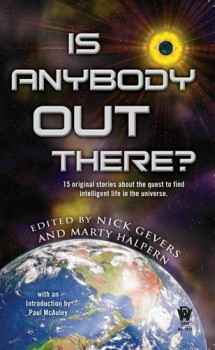 Is Anybody Out There?
Nick Gevers and Marty Halpern, eds.
DAW (312 pp, $7.99, June 2010)
Reviewed by David Soyka
The $64 question of the modern era is not whether God exists. How you answer that depends on intangibles and inferences based more on faith than the scientific method. What is nearly as imponderable is the empirical evidence of a vast universe (and possibly co-existent multi-verses) within which conditions exist (or once existed) that may give rise to life as we know it (putting aside consideration of life as we don’t know it and are incapable of comprehending). Moreover, given the age of the universe, it is further conceivable that there is, somewhere in some galaxy, more advanced civilizations capable of interstellar travel that, by now, should be aware of our existence. Even if we are in an Einsteinean universe in which speed of light travel cannot be exceeded, seeing as how that we are already capable of mapping distant universes, presumably a more advanced civilization would have the technology to find us and make radio contact, just as we have been launching Elvis recordings out beyond the solar system in hopes of doing the same. With no results.
So, where are they? This is the crux of the famous Fermi Paradox, posed by the Nobel physicist who reasoned that given the mathematical probabilities of the existence of alien civilizations, why hasn’t anyone phoned home? Is it truly possible that we are the only intelligent beings in the universe? Or, more depressing, are “intelligent” beings fated to self-destruct, allowing technology to harness their fate instead of the other way around, before becoming capable of interstellar travel?
 Nihilism got you down? Can’t stomach yet another scene of rape and torture? Need a break from learning your eleventeenth language and living abroad? If so,

 I’ve been in unwilling low-content mode for the past couple of weeks (question: what’s worse than getting the flu at Christmas? Answer: getting the flu along with a sinus infection). That’s meant I’ve had some time to read, which is good for a number of reasons. As it happens, though, one of the things I picked up to read left me wondering something I’ve wondered several times before: why do certain books pull me along, and compel me to read them, even when I think they’re not particularly good?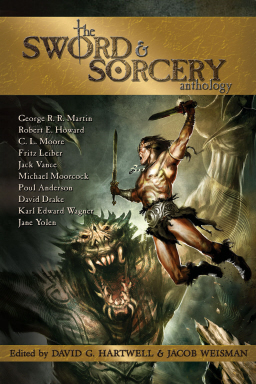
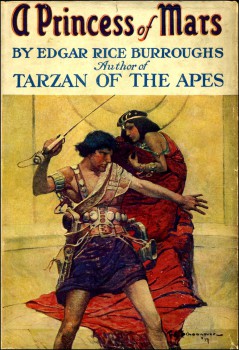 The year 2012 C.E. is the centenary of the Reader Revolution. Two novels published in pulp magazines that year, A Princess of Mars and Tarzan of the Apes, re-shaped popular fiction, helped change the United States into a nation of readers, and created the professional fiction writer. One man wrote both books: Edgar Rice Burroughs.
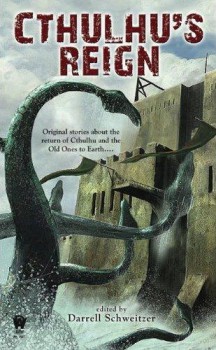 Cthulhu’s Reign