The Dungeons (and Dragons) of My Life, Part Two
The Dungeons (and Dragons) of My Life, Part Two

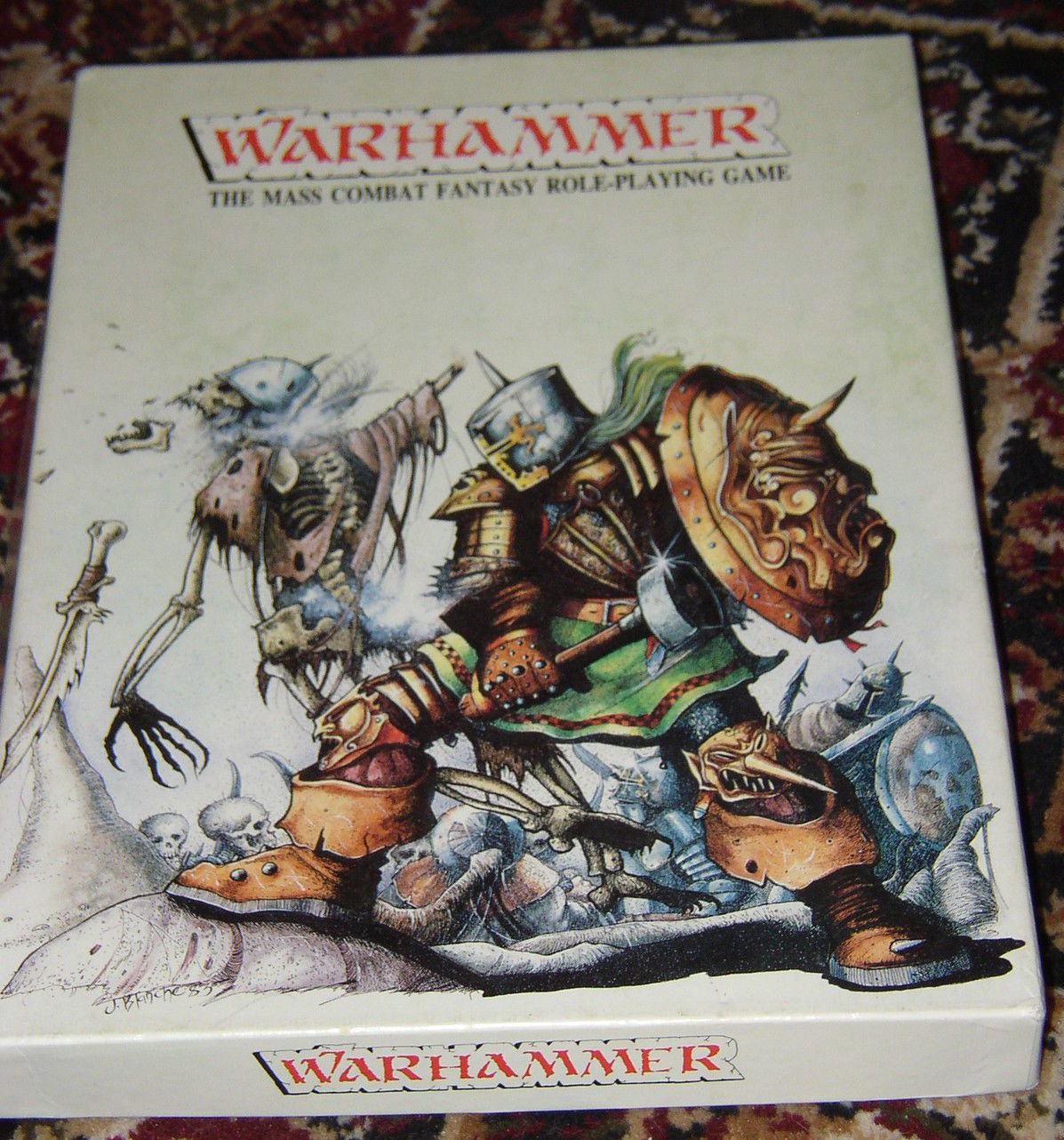
Warhammer First Edition box set-smallHey, folks. Last month I posted the first part of this blog about the Dungeons & Dragons campaigns I’ve run. Now I’m back with the second half.

Before I get back into my tale, I need to make a correction. The last section of my first-half blog was subtitled 1989-2002. I need to amend that to 1989-1992, since it only encompassed my college years. Let’s call it a senior moment and move on. Alrighty then.

1993-2002

So, after college I found a group of players back in my hometown. A couple were old friends from my high school days, and some were new friends. At the time, I was getting into the Warhammer Roleplaying Game as well, so I tried to infuse my D&D campaign with some of those dark, gritty elements. As a result of a growing love of fiction writing (I was still years away from being published at this time), I was also developing more of my own adventure material.

The first campaign out of the gate began with the adventurers waking up after a battle with collective amnesia. They followed a trail of clues to find out who they were and why they had been attacked. Sadly, this campaign only last about half a dozen sessions because I played a rather nasty trick. I allowed my brother to play a double agent inside the group with instructions to betray them when he saw an opportunity.

Read More Read More

Vintage Treasures: Weird Tales #1, edited by Lin Carter

Vintage Treasures: Weird Tales #1, edited by Lin Carter

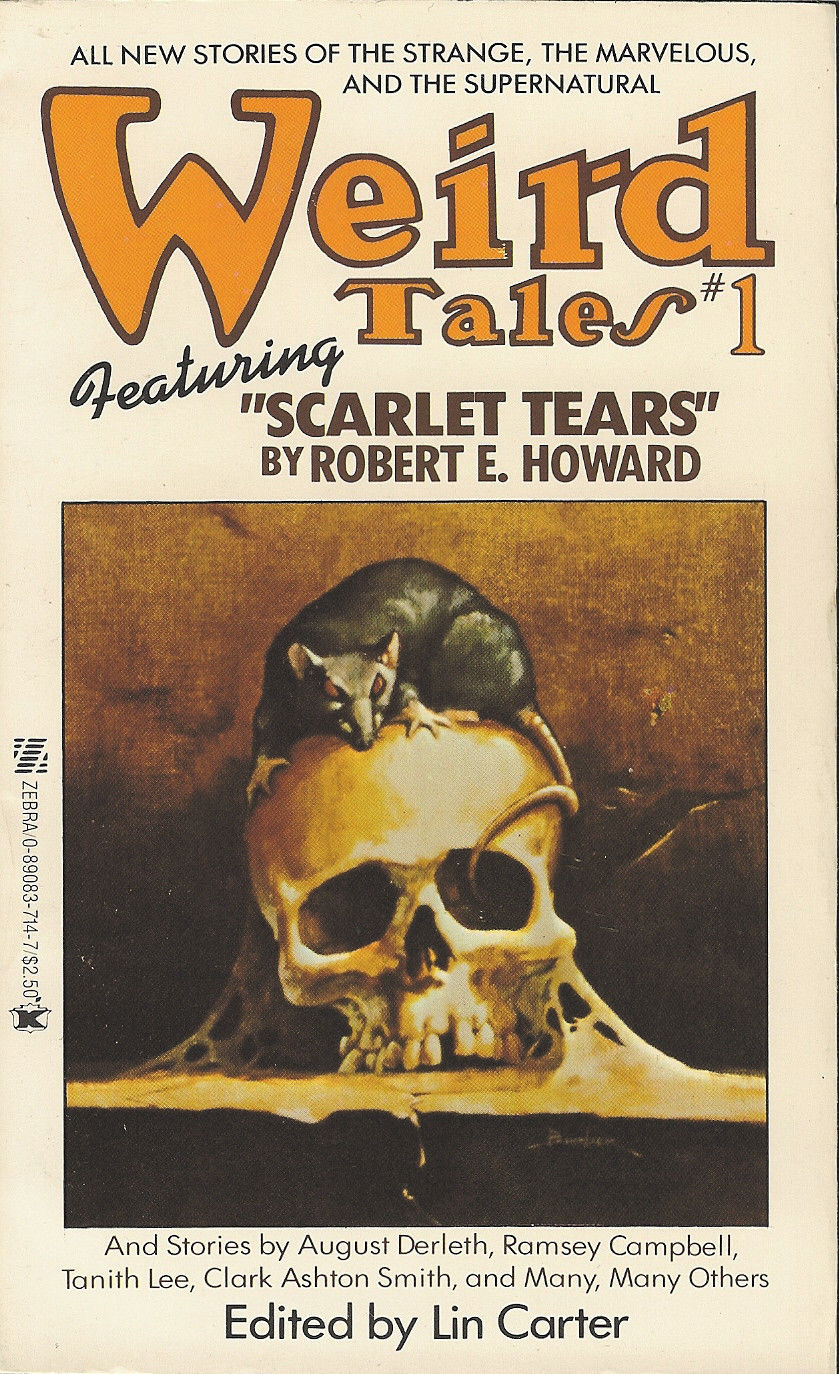
Weird Tales 1 paperback-smallIf you’ve hung around Black Gate for any length of time, you’ve heard us talk about Weird Tales, the greatest and most influential pulp fantasy magazine every published.

Weird Tales has died many times, and crawled out of the grave and shambled back to life just as often (if you’re a Weird Tales fan, you’ve heard countless zombie metaphors about your favorite magazine). When the pulp version of the magazine died in September 1954 after 279 issues, many believed it was for the final time. But it returned to life in the early 1970s, edited by Sam Moskowitz and published by Leo Margulies, and then perished again after four issues.

Bob Weinberg and Victor Dricks purchased the rights to the name from Margulies some time after that, and in December 1980 a brand new version appeared: Weird Tales #1, an original paperback anthology of horror and weird fantasy edited by none other than Lin Carter. On the inside front cover (under the heading The Eyrie, the name of the old editorial column in the pulp magazine) Carter introduced his anthology to a new generation of fantasy readers:

WEIRD TALES was the first and most famous of all the fantasy-fiction pulp magazines. It featured tales of the strange, the marvelous, and the supernatural by the finest authors of the macabre and the fantastic, old and new, from its first issue in 1923 until its 279th and last consecutive issue in 1954.

Now it is back, with all new stories — and even such an exciting find as “Scarlet Tears,” a recently discovered and never before published novelette by Robert E. Howard.

Over the years many great writers were published in the pages of WEIRD TALES, and now a great tradition is being continued into its second half-century.

“Scarlet Tears,” a Robert E. Howard story featuring his private detective Brent Kirby, never sold in his lifetime, and it’s not hard to see why (Kirby, a brawler who leads with his fists, doesn’t actually do much “detecting.”) Nonetheless, this kind of star billing for a Robert E. Howard trunk story gives you some indication just how much his reputation had grown since his death 44 years earlier.

Read More Read More

Somalia’s Forgotten Past: The Prehistoric Painted Caves of Somaliland

Somalia’s Forgotten Past: The Prehistoric Painted Caves of Somaliland

DSC_1188

When we think of Somalia, we usually think of the endless civil war and the rise of the militant Islamist group Al-Shabab. That’s all that gets in the news, after all. But Somalia has a rich past that’s been all but forgotten thanks to its sad present. Back in 2012, I went in search of it.

I visited Somaliland, an independent state that makes up the northern third of the former Somalia. While it remains unrecognized by any other nation, it has established a viable government with free and fair elections, a growing economy, and the rule of law. Visiting Somaliland gives outsiders a chance to get to know Somali culture and see some of the best prehistoric painted caves in Africa.

Read More Read More

The Ballantine Adult Fantasy Series: The Spawn of Cthulhu edited by Lin Carter

The Ballantine Adult Fantasy Series: The Spawn of Cthulhu edited by Lin Carter

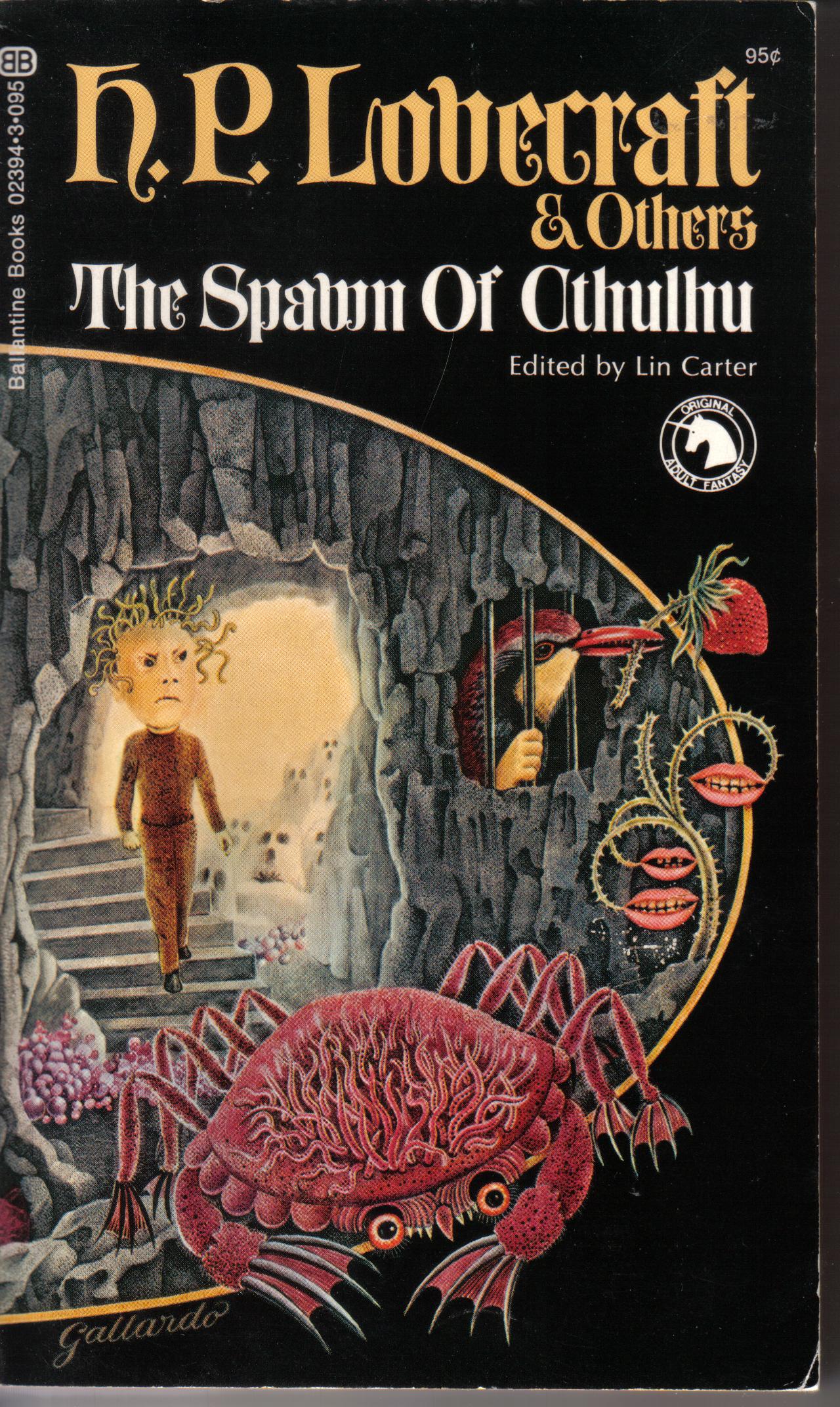
The Spawn of Cthulhu edited by Lin Carter-smallThe Spawn of Cthulhu
H. P. Lovecraft and Others
Lin Carter, ed.
Ballantine Books (274 pages, October 1971, $0.95)
Cover by Gervasio Gallardo

Lin Carter edited more than one anthology for the Ballantine Adult Fantasy series. Up until now, I’ve not discussed any of them. One reason is that where I am sequentially, there have only been two. The other reason is it’s easier to discuss a single novel than the contents of an anthology.

I’m going to break with that practice for this particular entry in the series. Carter has built a thematic Mythos anthology with The Spawn of Cthulhu. Taking references to the work of other writers referenced in Lovecraft’s short novel “The Whisperer in Darkness,” Carter then proceeds to include either the story referenced or other stories written about the Old Ones mentioned.

I’m going to include some mild spoilers in this post. If that is of concern to you, then let this paragraph serve as your warning. The discussion will start after on the other side of the Read More link just below.

Let’s start with “The Whisperer in Darkness,” shall we? It’s 85 pages long, by far the lengthiest story in the book. The story concerns a folklorist at Arkham University named Wilmarth who is writing a series of newspaper articles debunking sightings of strange bodies seen in swollen rivers and creeks after a particularly bad storm in Vermont. The articles generate some lively discussion in the paper, and are eventually reprinted in Vermont papers.

Read More Read More

National Just Write Something Month

National Just Write Something Month

120px-Girl_with_stylus_and_tablets.Fresco_found_in_PompeiI hope you’ll forgive me for stepping off topic this week. We’ll return to Gilgamesh soon, but today, I wanted to talk to you about something different.

Writing. The process, not the product, which is what I usually blog about here at Black Gate. I’m surrounded by true professionals and artists here, so it feels like hubris to presume upon the subject. But as that has rarely stopped me before, I shall forge ahead.

Many of you reading this have heard of NaNoWriMo, or National Novel Writing Month. For those who haven’t, the idea is that if you write 1,666 words a day for every day of November, you’ll end up with fifty thousand words, or, in some genres, a novel. The idea is that everybody does it in one giant nationwide frenzy, cheering each other on, swapping tips, hosting write-a-thons in which people chug coffee and type like the wind. Winning means getting fifty thousand words. They don’t have to be great. They don’t have to be good. They just have to be on the page.

Read More Read More

Those Thrilling Days of Yesteryear

Those Thrilling Days of Yesteryear

boothillAs my children will tell you, a frequent refrain around my house is “I’m so glad I was a kid in the 1970s.” I say it often enough that my teenage daughter – Lord, help her – is starting to wish she’d grown up during the “Me” Decade as well. I could probably write several posts about why I say this and why I say it with conviction, but I’ll spare my readers such blather at this time. However, I will explain how it’s pertinent to the present post.

Television during the 1970s was a funny thing. Outside of “prime time,” first-run programming was broadly limited to game shows, soap operas, news broadcasts, and, of course, Saturday morning cartoons. That left a lot of air time to be filled, which, coupled with new rules passed by the Federal Communications Commission intended to foster the creation of local content (but generally didn’t, at least in my neck of the woods), meant that I saw reruns of many, many old TV shows and almost as many old movies.

Even though I started watching most of this stuff because there was nothing else on, in retrospect, I’m glad that I did so. Not only did it expose me to content, genres, and actors with which I might otherwise have never become familiar, it also provided me with pop cultural connections to my parents, grandparents, and even just the older guys I’d later encounter in the hobby shops. That’s why, to this day, I’m very much a man out of time, with the tastes and interests of the generation before mine, such as my abiding interest in the Second World War. I suspect many of my age peers are similar in this respect.

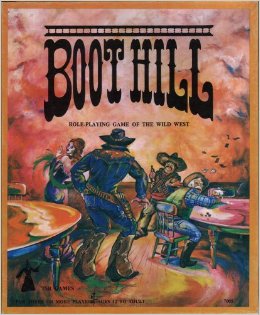
One of those pop cultural connections to earlier generations was the Western, a genre that had peaked during the 1960s and was well on its way out the door by the time I was born. Yet, thanks to syndication, I got to see plenty of Westerns (as well as shows, like Gunsmoke and Bonanza, which were still being produced in my early childhood). It’s no surprise, then, that, once I discovered roleplaying games, I’d seek out any that recalled the Western TV shows and movies I’d enjoyed. The first – and, as it turned out, only – one I ever played was TSR’s Boot Hill, co-authored by Brian Blume and Gary Gygax.

Read More Read More

Uncanny Magazine Issue 1 Now on Sale

Uncanny Magazine Issue 1 Now on Sale

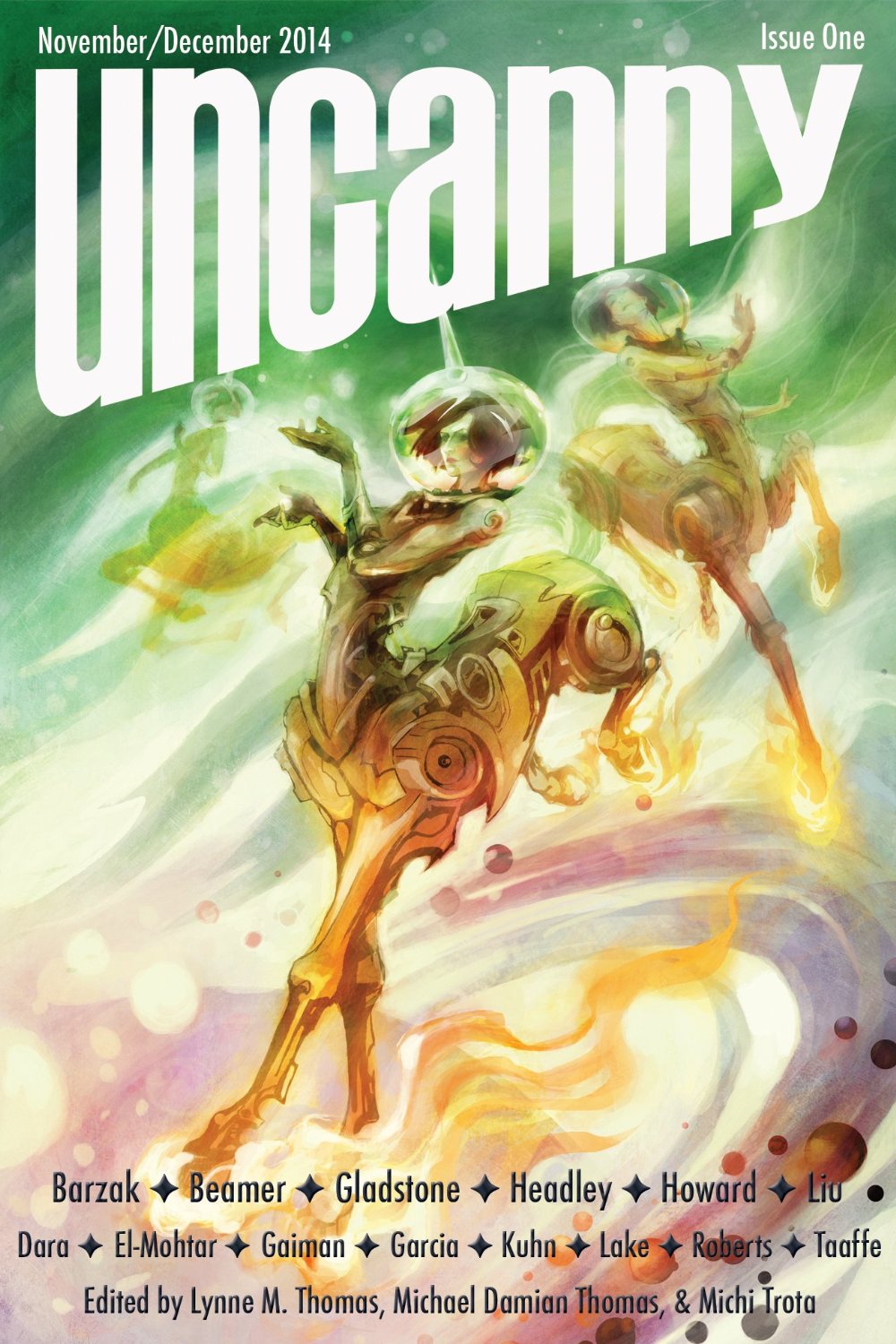
Uncanny Magazine Issue 1-smallWith all the bad news swirling around genre magazines over the past few years, I can’t tell you how uplifting it is to celebrate the arrival of a brand new magazine — especially one as promising as this.

Uncanny is a bimonthly magazine of science fiction and fantasy, showcasing original fiction from some of the brightest stars in the genre, as well as reprints, poetry, articles, and interviews. The first issue, cover-dated November/December 2014, is on sale today. It contains new fiction by Maria Dahvana Headley, Kat Howard, Max Gladstone, Amelia Beamer, Ken Liu, and Christopher Barzak, plus a reprint from Jay Lake. There’s also articles by Sarah Kuhn, Tansy Rayner Roberts, and Christopher J Garcia, and a special Worldcon Roundtable featuring Emma England, Michael Lee, Helen Montgomery, Steven H Silver, and Pablo Vazquez. The issue also contains poetry by Neil Gaiman, Amal El-Mohtar, and Sonya Taaffe, and interviews with Maria Dahvana Headley, Deborah Stanish, Beth Meacham on Jay Lake, and Christopher Barzak.

If that’s not enough, the magazine’s staff has also produced two stellar podcasts. Episode 1, released today, features the Editors’ Introduction, Maria Dahvana Headley’s “If You Were a Tiger, I’d Have to Wear White” and Amal El-Mohtar’s poem “The New Ways” (both read by Amal), as well as an interview with Maria conducted by Deborah Stanish. Episode 2 (coming December 2) will contain an Editors’ Introduction, Amelia Beamer reading her story “Celia and the Conservation of Entropy,” Sonya Taaffe’s poem “The Whalemaid, Singing” (as read by Amal El-Mohtar), and an interview with Amelia conducted by Deborah Stanish.

Uncanny was funded by a successful Kickstarter campaign that had over 1,000 backers and raised over $36,000 (surpassing its goal by over $10,000.) The magazine is available for purchase as an eBook in PDF, EPUB, and MOBI formats. If you’re the type of buyer who needs to sample things first, the website features free content that will be released in two stages — half on November 4 and half on December 2.

Uncanny is published and edited by Lynne M. Thomas and Michael Damian Thomas. The first issue is priced at $3.99; order directly from the website. The cover is by Galen Dara.

New Treasures: Premonitions by Jamie Schultz

New Treasures: Premonitions by Jamie Schultz

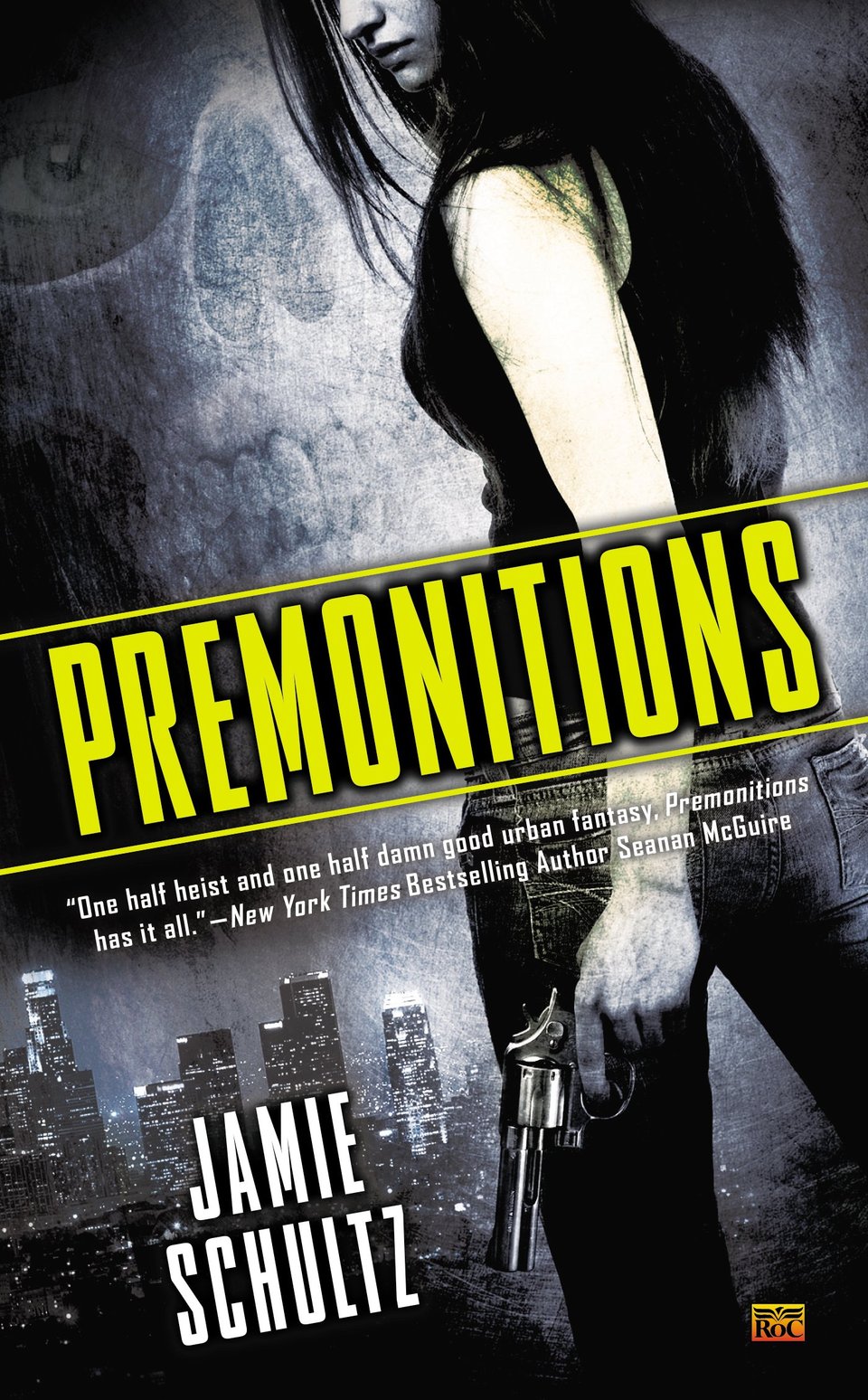
Premonitions Jamie Schultz-smallThe trick with the plethora of urban fantasy on the shelves these days is sorting through it all to find the really promising stuff. Buried between all that werewolf romance and those countless vampire sex novels are some undiscovered gems. It takes a little patience to find them, but they’re often worth the effort.

Last weekend, I stumbled on a promising supernatural noir offering from first-time novelist Jamie Schultz. It was easy to miss, crammed into the crowded shelves next to John Scalzi, James H. Schmitz, and Charles Stross, but I found a single copy of Premonitions, and was sold immediately by the cover art and the back cover copy. See what you think.

TWO MILLION DOLLARS…

It’s the kind of score Karyn Ames has always dreamed of — enough to set her crew up pretty well and, more important, enough to keep her safely stocked on a very rare, very expensive black market drug. Without it, Karyn hallucinates slices of the future until they totally overwhelm her, leaving her unable to distinguish the present from the mess of certainties and possibilities yet to come.

The client behind the heist is Enoch Sobell, a notorious crime lord with a reputation for being ruthless and exacting — and a purported practitioner of dark magic. Sobell is almost certainly condemned to Hell for a magically extended lifetime full of shady dealings. Once you’re in business with him, there’s no backing out.

Karyn and her associates are used to the supernatural and the occult, but their target is more than just the usual family heirloom or cursed necklace. It’s a piece of something larger. Something sinister.

Karyn’s crew and even Sobell himself are about to find out just how powerful it is… and how powerful it may yet become.

Premonitions was published on July 1, 2014 by Roc. It is 384 pages, priced at $7.99 in paperback and $6.99 for the digital version.

The End of the Story: Sorceress of the Witch World by Andre Norton

The End of the Story: Sorceress of the Witch World by Andre Norton

oie_324651kfYzNZDkAndre Norton’s Sorceress of the Witch World (1968) completes the trilogy begun with Three Against the Witch World and continued in Warlock of the Witch World. (Follow the links to read my reviews here on Black Gate). The trilogy itself is a continuation of Norton’s Witch World saga begun in Witch World and followed with Web of the Witch World.

The heroes of the first two novels, Simon Tregarth and his wife Jaelithe, mysteriously disappear at the beginning of the trilogy. Their triplets, born between Web of the Witch World and this trilogy, are searching for them. Each volume tells the adventures of one of the siblings, Kyllan, Kemoc, and Kaththea.

In Three, brothers Kyllan and Kemoc rescue their sister Kaththea from her forced induction into the ranks of the Witches and escape into the magically hidden eastern land, Escore. In addition, the warrior Kyllan’s talents are put to the test against a growing horde of vile enemies. In Warlock, the scholarly Kemoc travels across dimensions to rescue his sister from her evil suitor.

You can probably tell from the title that Kaththea herself takes center stage in Sorceress of the Witch World. For reasons related to her situation in the previous book, Kaththea is spiritually damaged. Sadly, for the reader that damage seems to have rendered her a little boring also. She narrates the entire story in a dull voice that distances the reader from the action.

At the end of Warlock, Kaththea lost most of her magical abilities. Now, fearing that stripped of her defenses she is vulnerable to control by the powers of Shadow, she decides she must return to the West and seek guidance from the very same Witches from whom she once fled.

While trying to cross the mountains back into the West Kaththea’s party is caught in an avalanche. She is taken prisoner by a hunter from the Inuit-like nomads, the Vupsall. She manages to escape from the tribe during a bloody attack on their camp by raiders. Armed with magical knowledge gleaned from the possessions of the tribe’s wise woman, she makes for a great ruined city nearby. Hoping to escape the forces of Shadow she still fears, she enters an old dimensional gate. She doesn’t know what lay on the other side, only hoping it will be some sort of sanctuary. What she encounters are tremendous dangers in an utterly alien world.

Read More Read More

Hallowe’en 2014 Post Mortem (Hallowe’en Post #2)

Hallowe’en 2014 Post Mortem (Hallowe’en Post #2)

In the strange retail "nightmare before Christmas" time, Hallowe'en and XMas displays intermix
In the strange retail “nightmare before Christmas” time, Hallowe’en and XMas displays intermix

On Friday night, as the light waned and the sky turned the color of mildewed pumpkins, that familiar holy chant began resounding up and down the streets: “Trick or Treat!”

Wee supplicants bedecked in strange garb began their door-to-door pilgrimages to receive the benediction of sugared confections by the handfuls.

Hallowe’en partly descends from All Hallows’ Eve (on its good Catholic mother side — the one who married some pagan dude and their offspring got really weird and started bobbing for apples and wearing William Shatner masks). All Hallows’ Eve was once a prologue to All Saints’ Day. Not many recall that that one nowadays. By dint of Hallowe’en falling on Friday this year, many bars, restaurants, and homes expanded their Hallowe’en celebrations to encompass Saturday, creating the irony of All Hallows’ Eve not only overshadowing, but completely usurping the day of the saints.

The time of feasts and holy days is nigh upon us. Now our most cherished holidays both secular and religious come in quick succession: after Hallowe’en, Thanksgiving and Christmas before the lull of the long, gray winter.

After a couple dull months, a certain bow-wielding matchmaker sneaks in to liven things up a little. He is soon followed by those green-bedecked, Guinness-swigging leprechauns who are ambassadors of a saint who drove snakes out of a place that never had any snakes.

Valentine and Patrick won’t miss losing All Saints’ Day since they each have their own, but they — one a third-century Roman martyr and the other a fifth-century Romano-British missionary — might well wonder how they became the de facto saints of heart-shaped candy and risqué greeting cards on the one hand and green beer on the other. Along with a certain fourth-century Greek bishop named Nikolaos, they could form a support group for saints whose legends bear little resemblance to their actual lives, while also making their names among the most well-known on the planet.

Not that it matters to most of us. The holy days and the names attached to them were always more-or-less excuses to do what humans have been doing (or wanting to do and feeling really guilty about it) throughout history: looking for reasons to get together and celebrate and dress in silly clothes. If there is a benevolent God, that Prime Mover may well wonder why we feel such a strong need to have an excuse.

Read More Read More