Forgotten Authors: F. Anstey
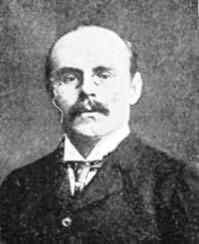
Thomas Anstey Guthrie was born in London on August 8, 1856. He attended King’s College School and studied at Trinity Hall in Cambridge. Over the course of his career, he used multiple pseudonyms, including Hope Bandoff, William Monarch Jones, and the one most associated with his genre work, F. Anstey. He had meant to publish under his first initial and middle name, but a typo rendered the initial F and he elected to keep it.
Anstey studied law and briefly practiced beginning in 1880, but gave it up to write, with numerous short humorous pieces appearing in Punch. He was also known for writing humorous novels, the most famous of which, Vice Versa, originally published in 1882, was adapted into a play by Anstey in 1883. He similarly adapted several other of his novels and short stories into plays, as well as adapting multiple of Molière’s works into English.
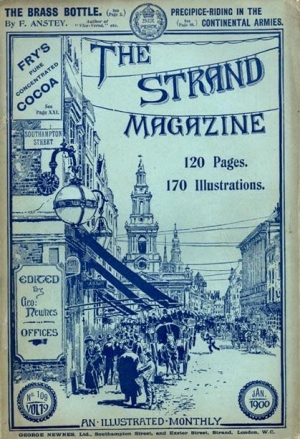
His novels and short stories are explorations of normal, bourgeois English life when they are touch by elements of the fantastic and magic. Many of his stories show the influence of William S. Gilbert, not only his plays like The Sorcerer, but also his short stories and The Bab Ballads.
Anstey anonymously published the story “The Wraith of Barnjum” in the March 1879 issue of Temple Bar, reprinting it under his byline in his 1884 collection of short fiction, The Black Poodle and Other Tales. His stories not only appeared in Punch, but in other Victorian magazines, and as Anstey built a reputation for incorporating magic into his stories, he would sometimes use that reputation to subvert the readers’ expectations by hinting at the possibility of magic, but writing a story without any fantastic elements.
His novels The Brass Bottle, The Tinted Venus. The Man from Blankley’s, and Vice Versa have been filmed multiple times, with two versions of The Brass Bottle filmed during Anstey’s lifetime (1914 and 1923) and The Man from Blankley’s released in 1930 and 1934. The earliest version of Vice Versa filmed in 1916 and The Tinted Venus in 1921. Vice Versa was also filmed in 1948 featuring a sixteen year old Petula Clark, and in 1988, starring Judge Reinhold and Fred Savage. It was also adapted for television at least four times.
Popular throughout the Victorian period, writing for adults and children, his style of writing influenced authors who would follow him, and his style became known as Ansteyan fantasy. However, the Edwardian era was not as enamored in his style of Victorian writing or morality and, while his writing remained influential on other humorists who followed, such as P.G. Wodehouse, his general popularity waned.
Guthrie died on March 10, 1934. He is buried in St Peter Churchyard in East Blatchington in East Sussex.
 Steven H Silver is a twenty-one-time Hugo Award nominee and was the publisher of the Hugo-nominated fanzine Argentus as well as the editor and publisher of ISFiC Press for eight years. He has also edited books for DAW, NESFA Press, and ZNB. His most recent anthology is Alternate Peace and his novel After Hastings was published in 2020. Steven has chaired the first Midwest Construction, Windycon three times, and the SFWA Nebula Conference numerous times. He was programming chair for Chicon 2000 and Vice Chair of Chicon 7.
I’ve read Vice Versa a couple of times, and he second time I produced a short write-up for my column for the New York C. S. Lewis Society. One comment there was this:
—–Vice Versa (1882) was one of 15 books discussed by Henry. It belongs to a mini-canon of English creative work that evokes the unhappiness of school days. Other entries are Charles Lamb’s “Christ’s Hospital Five-and-Thirty Years Ago” (in Essays of Elia, 1823 – boys served “gags” of beef fat), Charles Dickens’s Nicholas Nickleby (1839 — Dotheboys Hall) and later novels, Charlotte Brontë ‘s Jane Eyre (1847 – the tuberculous Lowood Institution for girls), George Orwell’s “‘Such, Such Were the Joys’” (published 1952 — “boyhood is the age of disgust”), and Lewis’s Surprised by Joy (“Belsen”).——
I noted that Vice Versa is rather less of a farce than one might have expected. Mr. Bultitude, at his son’s school and looking like his son, really experiences an ordeal:
—-He is hungry because he finds the food unpalatable. His isolation and his fear of beatings from the boys and corporal punishment from the headmaster, and even of lifelong entrapment in a boy’s body, intensify. —–
For much of the time, things are not really that funny. The boy’s liberties back in London, looking like an adult and commanding his father’s privileges, are not much dwelled upon. The novel, then, is less funny and perhaps more thought-provoking than if it were the farce we might have anticipated.
Anstey wrote some non-fantastic novels, too. I’ve read The Giant’s Robe and Lyre and Lancet, but this was about 30 years ago. I remember thinking they were pretty good, but I don’t really remember them.
I read Vice Versa as a teenager and can agree with Dale Nelson that Mr Bultitude’s ordeal as a school boy is, frankly, awful. School was written up by many contemporaries as being jolly, ripping fun. The works of Talbot Baines Reed established a genre in which school was seen as creating fit models of manliness that would serve the needs of the British Empire. This tradition was satirised by Kipling in his Stalky stories which showed that to be a good imperialist you had to have thuggish tendencies. The problem with Kipling’s stories are that he approved of the thuggish ethos. At least Anstey was honest and showed that the English public school (which are private establishments geared towards the sons and daughters of the gentry and charge enormous fees) are dreadful institutions which foster bullying and promote dubious ideals. Two other things. Nobody has pointed out that the premise of Vice Versa was stolen by Disney for the Freaky Friday films. The other is that I have also read The Brass Bottle. The story of a young man who acquired the brass bottle which turns out to have a genie inside it. The genie grants his wishes which all go spectacularly wrong. Its a fun book as long as you can tolerate the racist bias.
To be fair, the Mary Rodgers stole the idea for Freaky Friday from Anstey for her 1972 novel. Disney just adapted Rodgers’s novel.
And Rodgers said she stole the…er…”borrowed” the idea from Thorne Smith’s later novel “Turnabout.” The Smith book was probably inspired by Anstey’s “Vice Versa.”
As an American who went to British public school, I can attest that not all of them are “dreadful institutions which […] promote dubious ideals.” Nor are they all “geared toward the sons and daughters of the gentry.” If you want the ethos you’re talking about, you’re really thinking more of the boarding schools and private schools.
That British public school fosters bullying, I cannot argue against. That’s an unfortunate side effect of putting kids in uniforms and having them compete in “houses” for “house points.” If you try to equalize kids by making them all wear the same thing, that’s going to make it a point of rebellion for kids to separate themselves into hierarchical groups by savaging their uniforms and developing antisocial group behaviors. If you try to foster competition between “house” groups of kids whose individuality you’ve taken away by forcing them to all wear the same thing, they’re going to latch onto “house” identity and beat each other over it. That whole system is as idiotic as the American school tendency to put kids into music classes and force them to compete against each other for “chairs” as a requirement for their grades.
Thanks so much for this! I stumbled across Anstey in High School looking up “The Brass Bottle,” the Sixties movie they used to show on network TV in prime time or late at night. In the decades since I’ve read some of his short stories and at least one more novel. He was probably an influence on Thorne Smith years later. And I believe his novel “The Time Bargain” would make a hilarious movie if done right. They’d have to do something about the it-was-all-a-dream ending.