An Obscure 70s Fantasy: The Vanishing Tower, by Michael Moorcock
 |
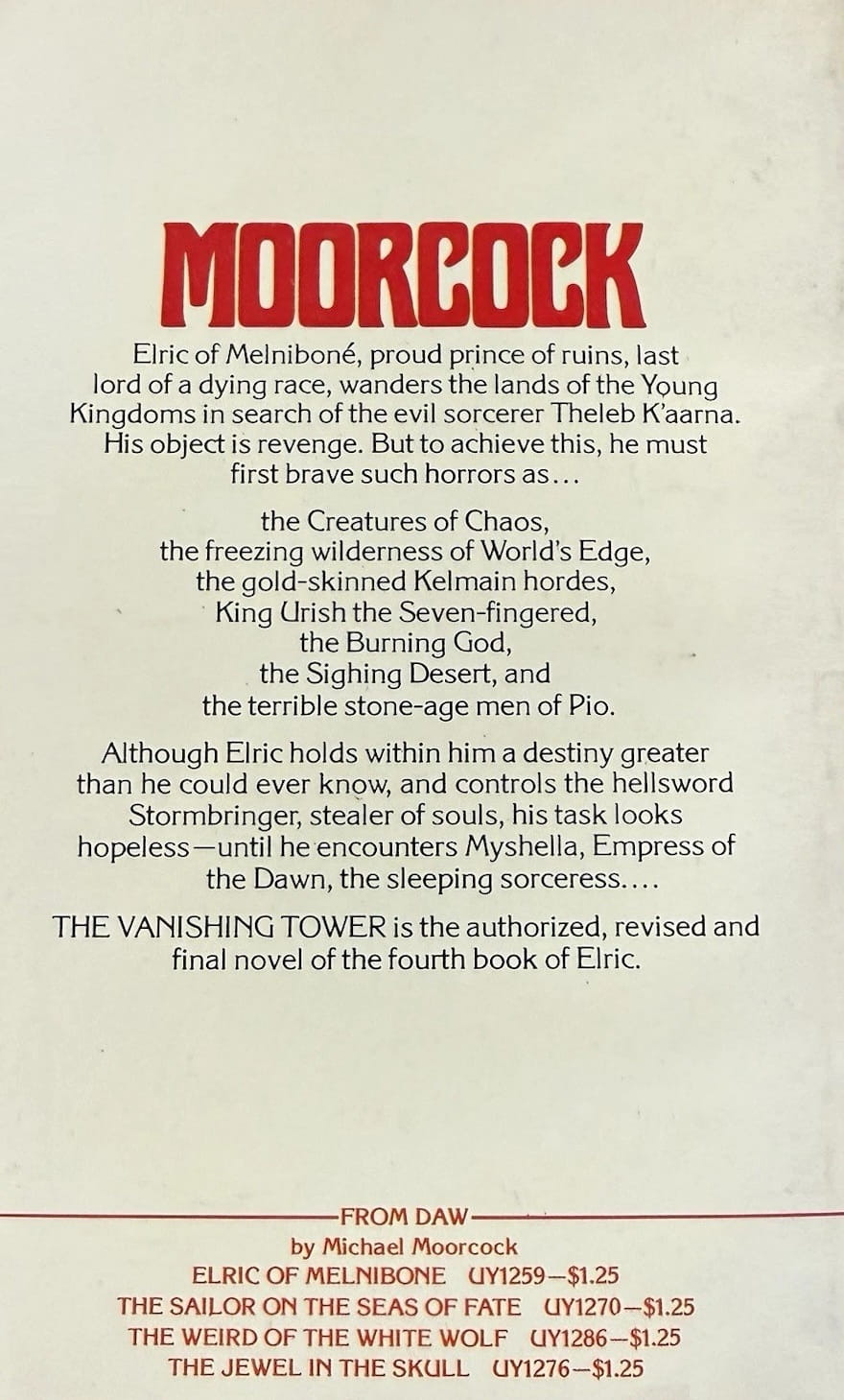 |
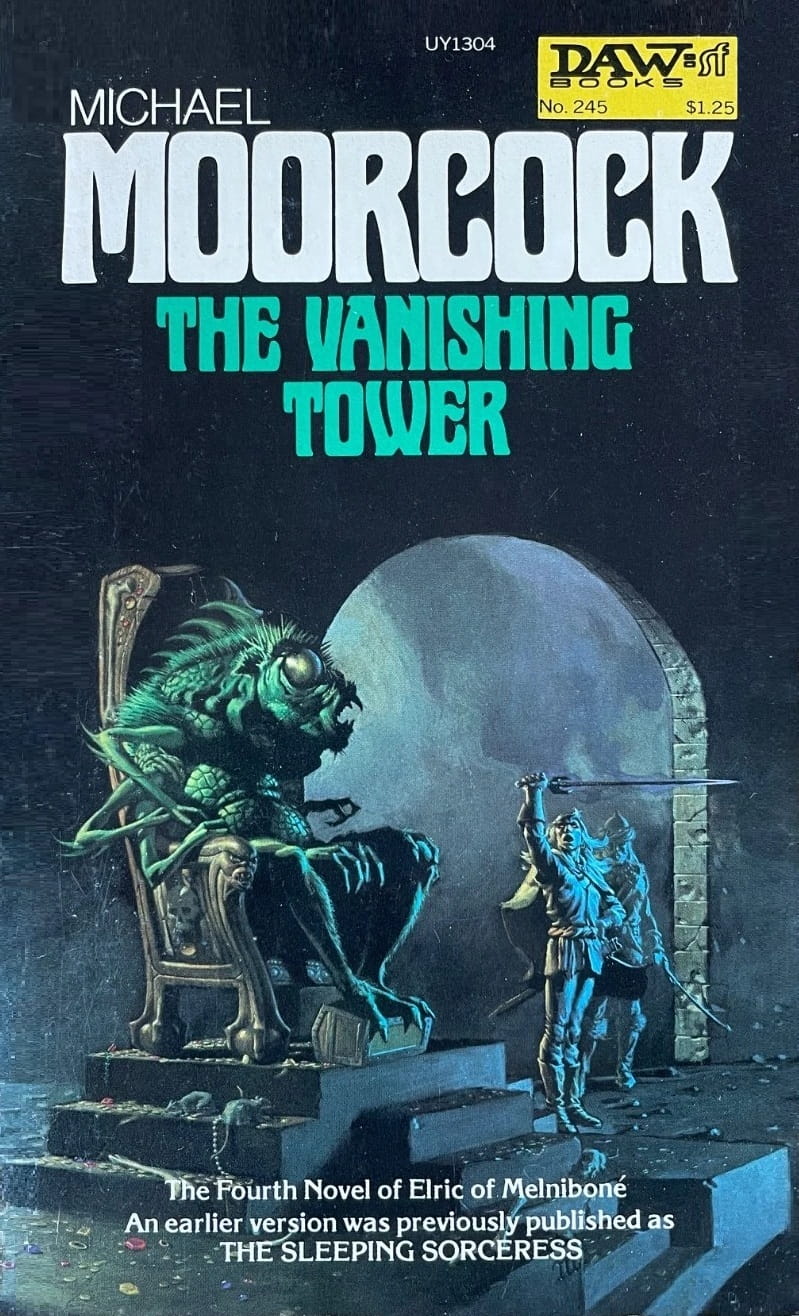
The Vanishing Tower (DAW Books, June 1977). Cover by Michael Whelan
Here’s another in my series of reviews of “mostly obscure” 1970s/1980s books — the last one was of Evangeline Walton’s The Children of Llyr. That book was published in 1971, and so was the original edition of The Vanishing Tower (first titled The Sleeping Sorceress.)
And already I can hear people asking “Obscure? Obscure?! Evangeline Walton’s Mabinogion retellings were not really obscure, and Michael Moorcock’s Elric novels are not remotely obscure!”
And I apologize — because you’re right. This novel in particular is part of one of the major sword and sorcery series of all time. Yet — as with the The Children of Llyr — it’s a book I myself didn’t read until just now, over 50 years after it first appeared.
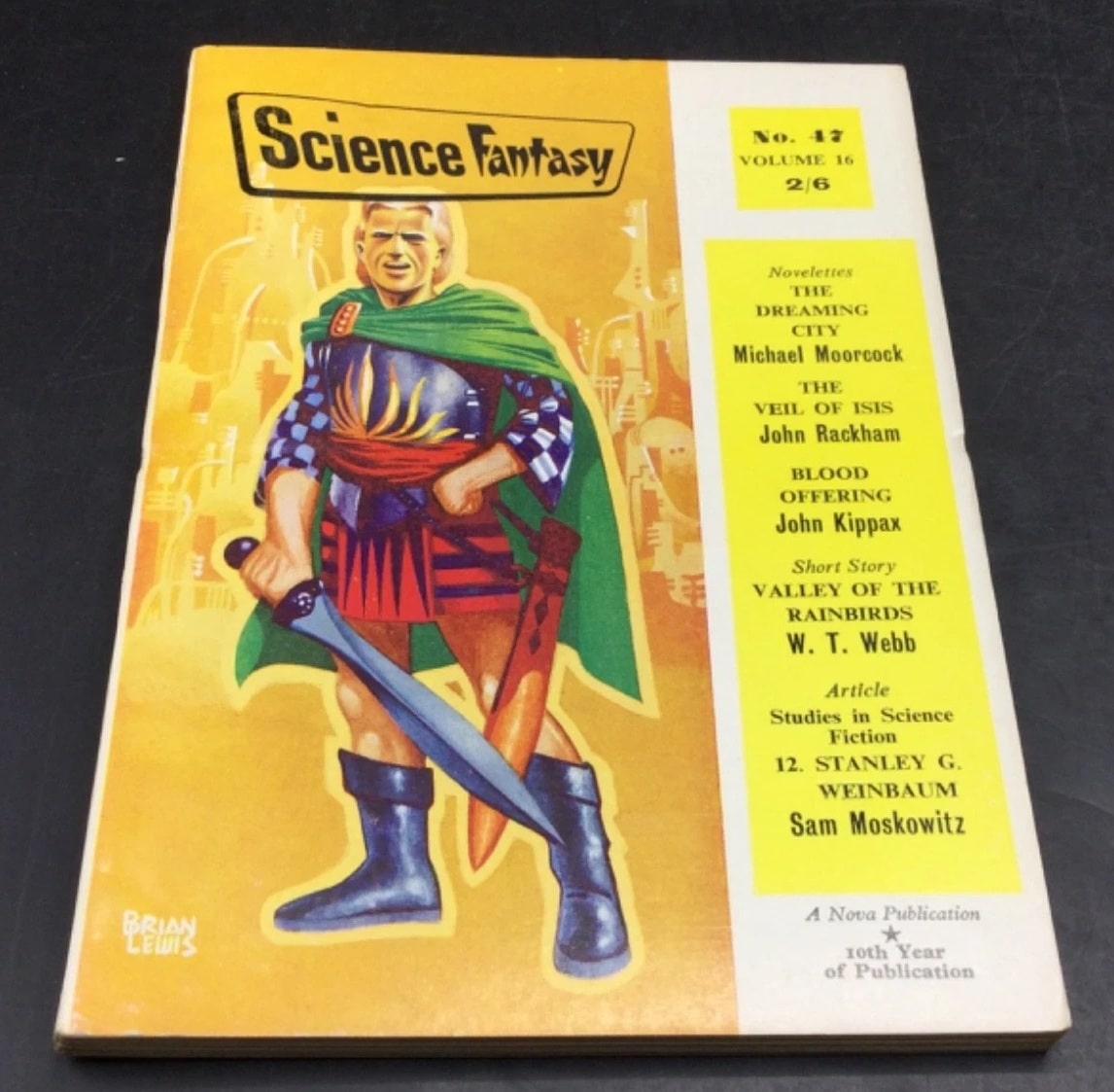
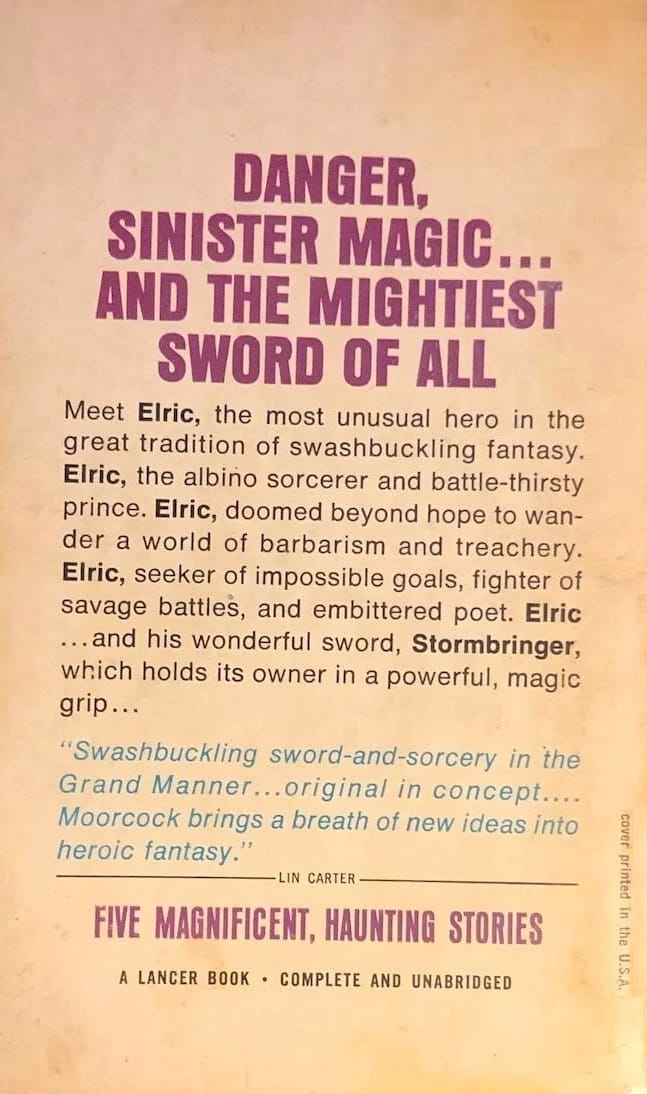
I’m going to delve into the publishing history not just of this book but of all the Elric books, because it gets a bit complicated. The first Elric story, “The Dreaming City,” appeared in the classic British magazine Science Fantasy in June 1961 (shown above). Over the next few years, several more stories appeared there and in Fantastic Stories.
Some of these stories formed a fairly coherent narrative that fundamentally ended with the 1964 story “Doomed Lord’s Passing,” though the publication order of the stories and the internal chronology don’t match at all. The first Elric book, The Stealer of Souls (1963), included mostly stories set somewhat early in the internal chronology, while the second, Stormbringer (1965), included four of the latest stories in internal chronology.
 |
 |
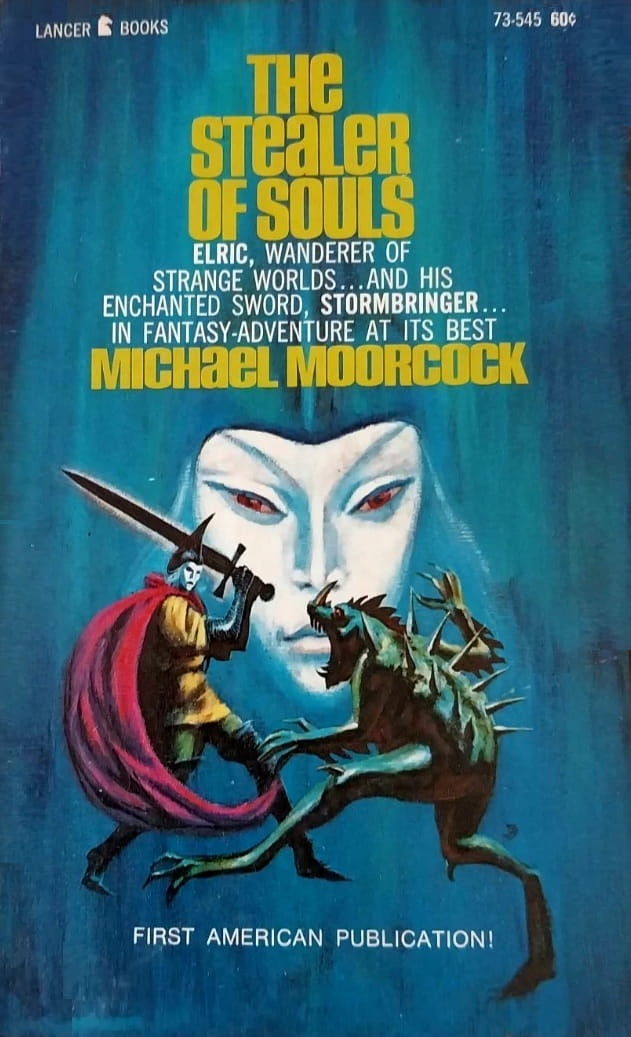
The Stealer of Souls (Lancer Books, 1967). Cover by Jack Gaughan
Beginning in 1970 Moorcock began to expand and reorganize his Elric sequence — first with a collection, The Singing Citadel, that included four of his earlier stories, and then in 1971 with some new work, that eventually included stories set before any of the earlier pieces, as well as stories set at various times in between the already published works.
Later books would include new stories and also stories from the first and third collections reshuffled — though Stormbringer remains the capstone of the whole series. (This chaotic chronology is actually quite appropriate for the themes of the whole series.)
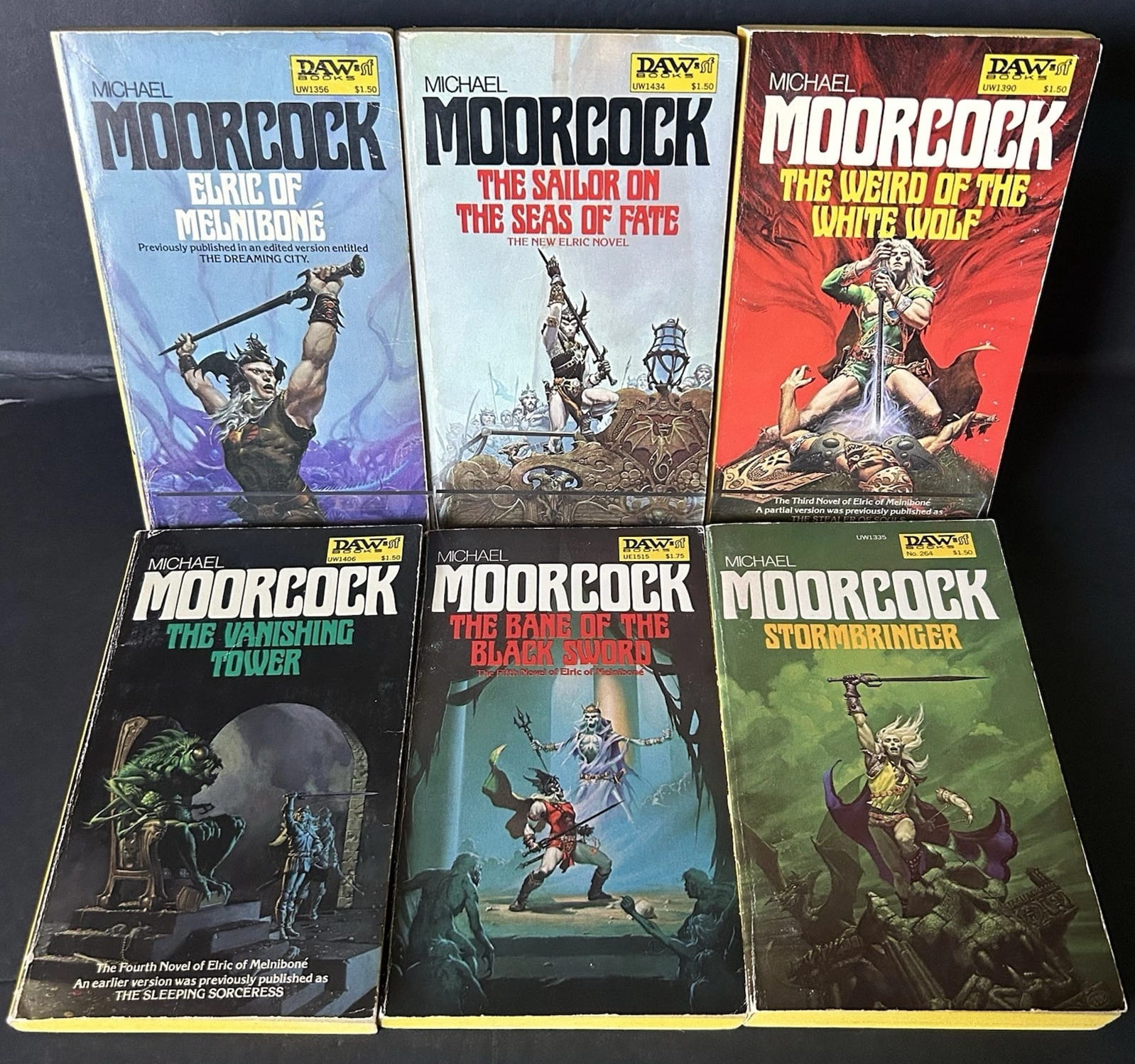
In 1976 and 1977 DAW published a set of six volumes, in internal chronological order, serving at that time as more or less the complete official Elric series, with restored texts and titles preferred by Moorcock. Three more books have been added in the subsequent decades, most recently The Citadel of Forgotten Myths in 2022.
The Vanishing Tower was fourth in the DAW set, and is sixth in the current chronology. It was first published by the New English Library in the UK as The Sleeping Sorceress in 1971, and by Lancer Books in the US in 1972. The DAW edition, from 1977, was the first to use The Vanishing Tower as the title.
 |
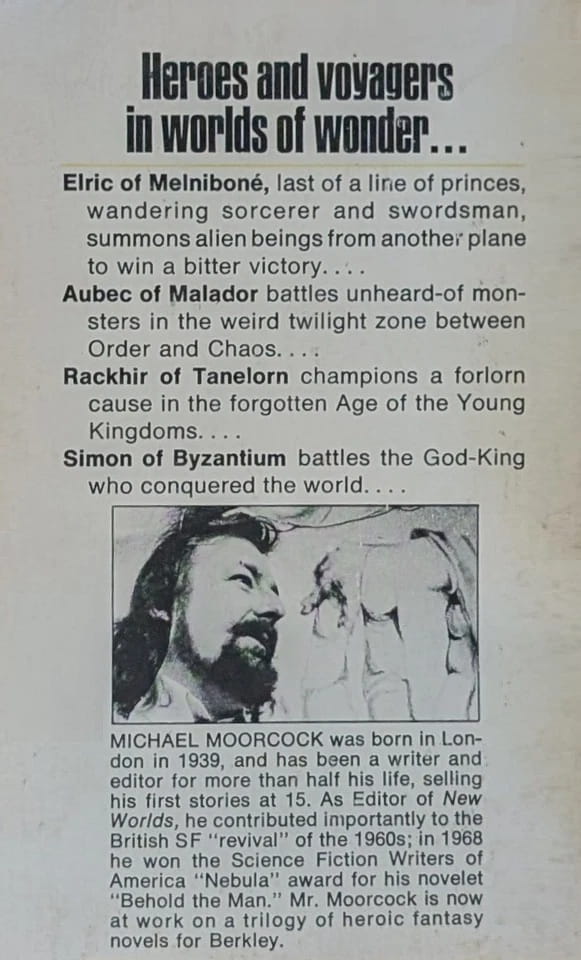 |
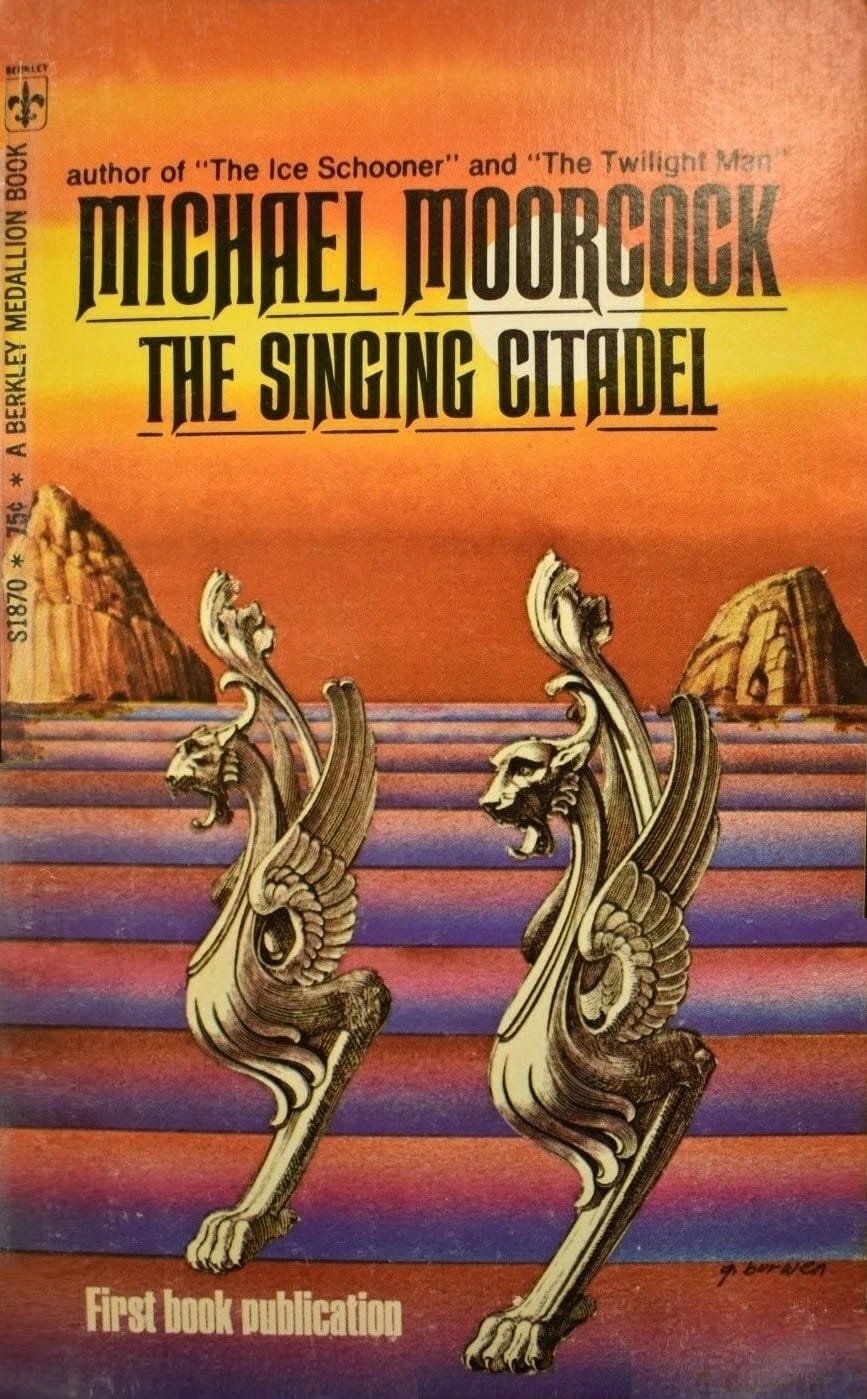
The early collection The Singing Citadel, containing the Elric tales
“The Singing Citadel” and “Master of Chaos,” and the Eternal Champion tale
“To Rescue Tanelorn” (Berkley Medallion, August 1970). Cover by Gail Burwen
The novel comprises three closely linked “books,” all concerning Elric attempting to find and kill the evil sorcerer Theleb K’aarna. The first “book,” here called “The Torment of the Last Lord,” was published separately as “The Sleeping Sorceress” in the UK anthology Warlocks and Warriors, also in 1971, and reprinted in the February 1972 issue of Fantastic Stories in the US.
Elric, the tall, gaunt, albino warrior, long since exiled from his home Melniboné, and his sidekick Moonglum, come to the kingdom Lormyr, near the World’s Edge, where they believe they can find Theleb K’aarna.
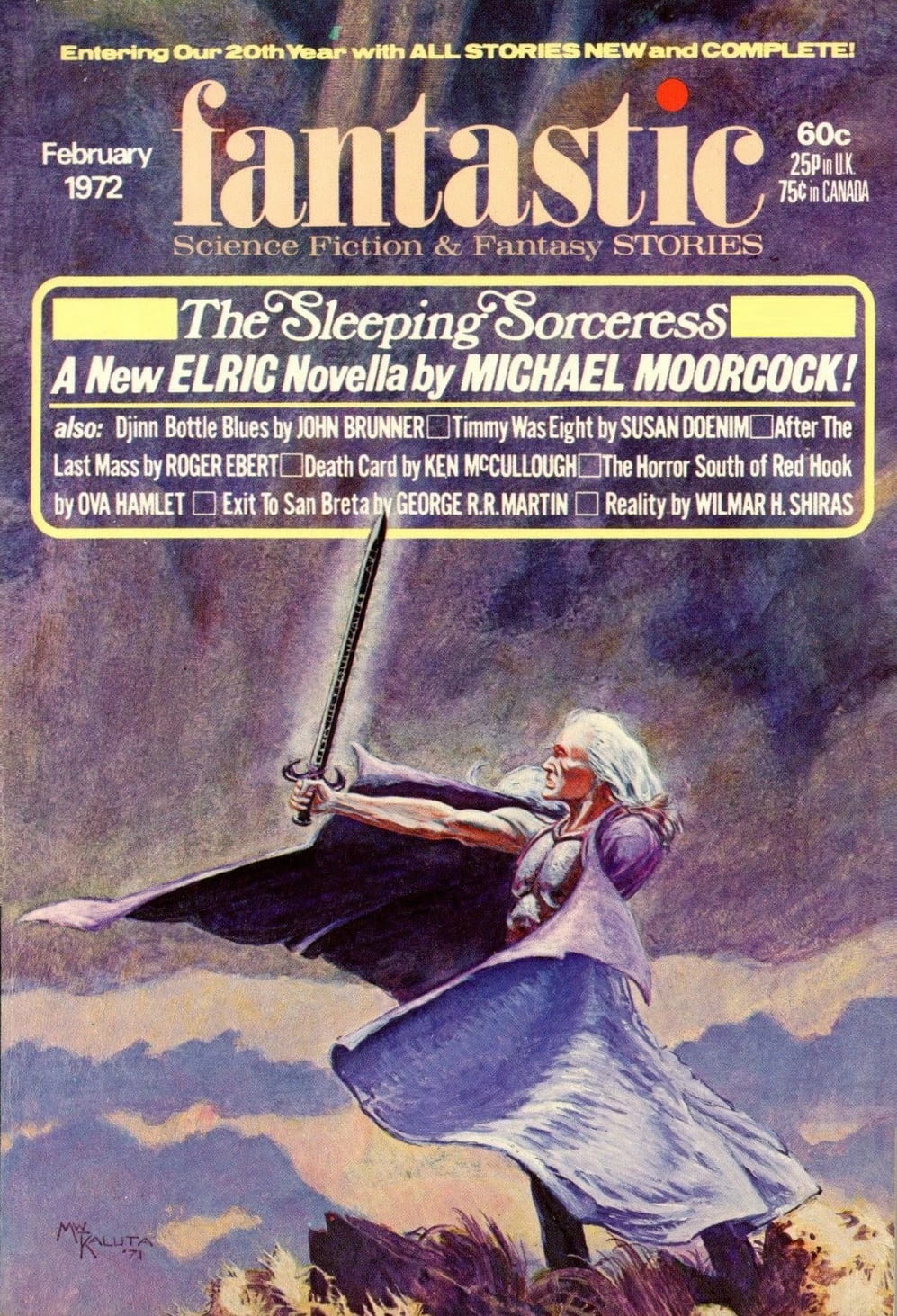
After some travails they happen on an isolated castle — and in it they find a beautiful woman in an enchanted sleep. This is Myshella, and she is another enemy of K’aarna. She, even as she is enchanted, reveals to Elric that Theleb K’aarna has allied with a certain Prince Umbda to attack her castle. If Elric can find a certain pouch Myshella may be able to wake and help Elric and Moonglum in a battle against Prince Umbda and the sorcerer.
Of course they succeed, but only partly, and in the second episode Theleb K’aarna, having miraculously escaped certain death, has come to Nadsokor, the City of Beggars. He has a proposition for the Beggar King, Urish, about the destruction of Elric, for Elric had previously stolen (or reclaimed) something from Urish.
 |
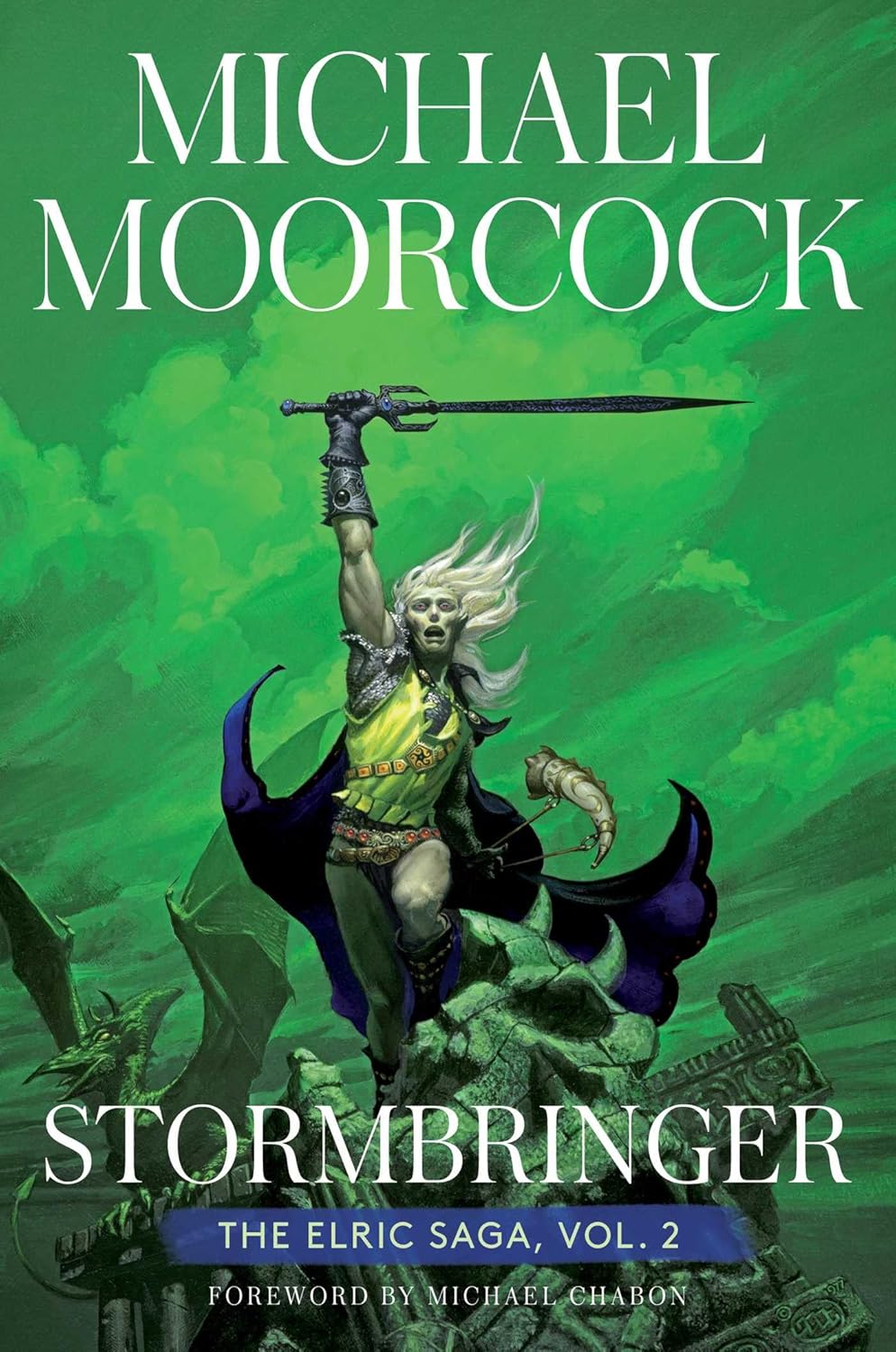 |
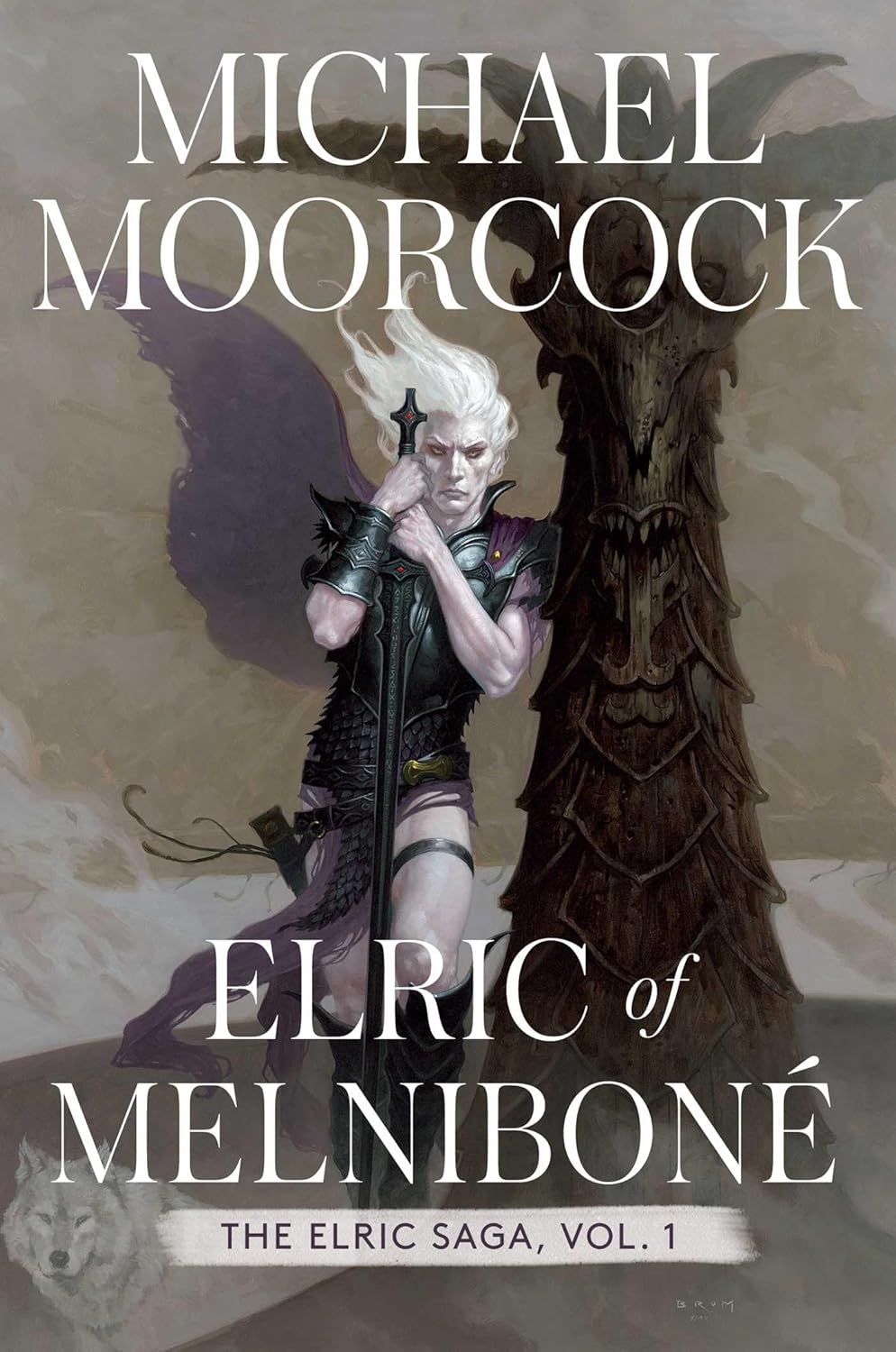
The first two volumes of The Elric Saga omnibus editions from Saga Press: Elric of Melniboné
(February 15, 2022, cover by Brom) and Stormbringer (April 12, 2022, cover by Michael Whelan)
Meanwhile Elric and Moonglum, believing Theleb K’aarna to be dead, plan to go to the eternal city Tanelorn for some rest. But on the way, Elric loses the Ring of Kings to a thief — and soon realizes that the ring is on the way to Nadsokor. And — you guessed it — after some more adventures and perils, Elric and Moonglum are successful — except that Theleb K’aarna escapes again.
The final episode involves another encounter with Theleb K’aarna, who now threatens Tanelorn (and thus many of Elric’s friends.) This is in some ways one of the most interesting parts of the book, for Elric meets some avatars of — himself; which explicitly links this series to Moorcock’s overarching Eternal Champion series, and his “multiverse,” along with characters with the initials JC (and with the Three Who Are One!) There are journeys to other Planes, and a battle alongside Corum and Erekosë, and a bitter reunion with Myshella.
 |
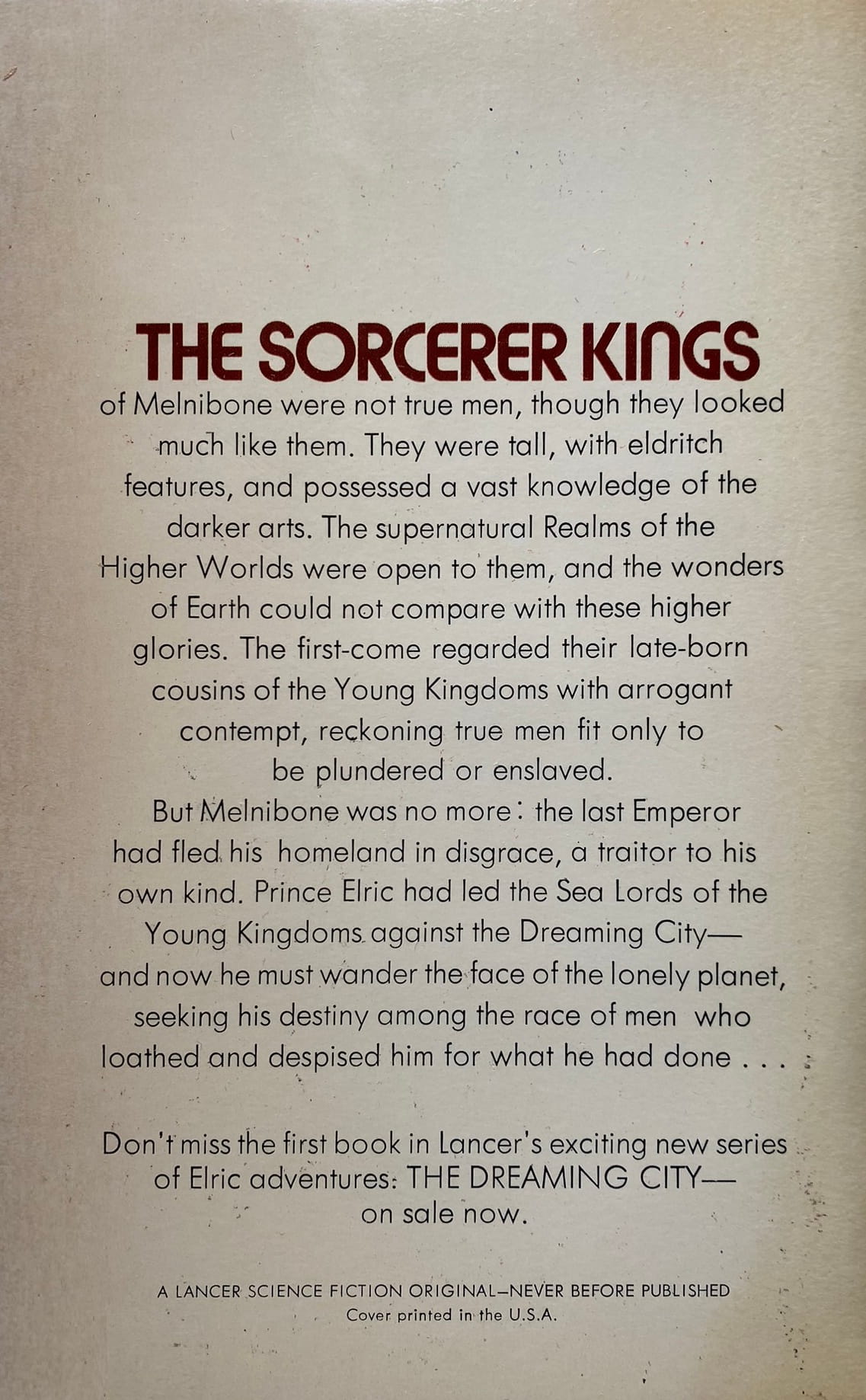 |
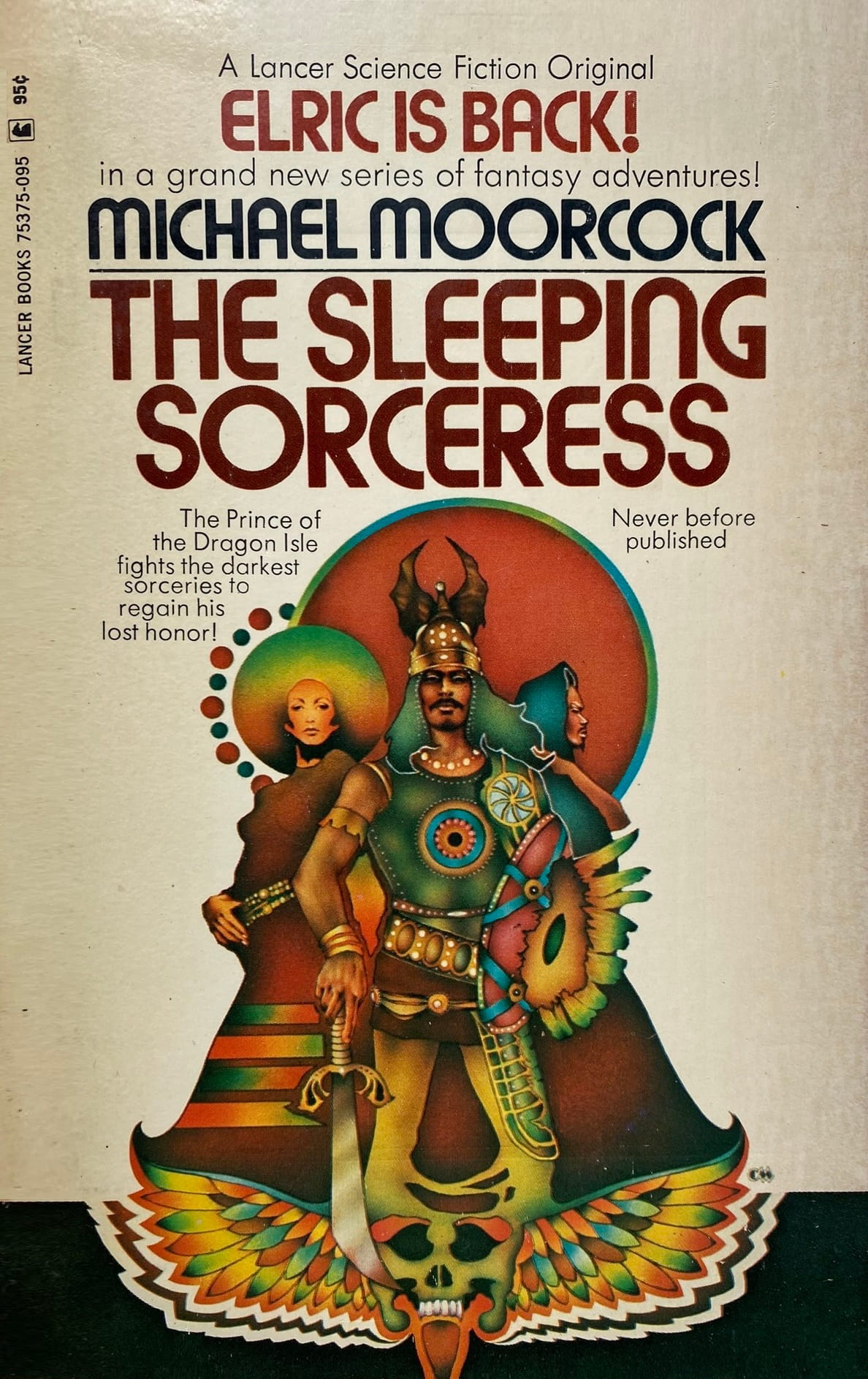
The first US release of The Vanishing Tower, first published as The Sleeping Sorceress
(Lancer Books, September 1972). Cover by Charles Moll
So, what did I think?
I don’t really think this is likely the best place to start with Elric. There are good points — Moorcock’s imagination is fecund, and the character of Elric is a worthwhile counter to traditional Sword and Sorcery heroes like Conan. But on the whole the novel doesn’t do a whole lot. The writing seems hurried — the prose isn’t terrible but it’s a bit slapdash. The action scenes seem run of the mill S&S — there isn’t a lot of suspense, just superhuman swordplay.
It’s not bad stuff, but it’s not special. I can see via the outlines of the entire series why this is a key part of fantasy history. But for me, the Moorcock I want to stick with is stuff like The Dancers at the End of Time — or like the novel up next, Mother London.
Rich Horton’s last article for us was a review of The Children of Llyr by Evangeline Walton. His website is Strange at Ecbatan. Rich has written over 200 articles for Black Gate, see them all here.
For my money his best fantasies are Gloriana and the underrated The War Hound and the World’s Pain. All the Eternal Champion books, (when viewed from my now-advanced age, anyway) while fun, are very heavy doses of black-light poster adolescent angst. Elric especially.
I hope to get to The War Hound and the World’s Pain soon — it looks very intriguing.
I started Elric with the Lancer Books edition The Dreaming City. I think that there are 2 more Elrics in the Lancer line (The Sleeping Sorceress and The Stealer of Souls and Other Stories). Things yet to find! Along with ‘The Greater Conqueror’, that Simon of Byzantium vs. Alexander the Great story that the back cover of the Berkley The Singing Citadel edition obliquely mentions.
The Dancers at the End of Time series? Is that the one with the Latvians??
Fine, I josh. But before you end your Elric dive, Mr. Horton, do endeavor to find ‘Elric at the End of Time’ for a double-dip treat. I have one friend who is a stone Elric fan, another who loves The Dancers. Neither has read the other series, nor ‘Elric at the End of Time’, and neither one would fully enjoy it if they did, alas.
Thanks for the explanation of the Elric publishing chronology, Rich. I had read the Daw books and then came across “The Sleeping Sorceresss” with the “Elric is Back!” exclamation at a used book store. So I bought it. Didn’t have the internet back in the 80’s to check things out before I bought. Loved the Daw books when I read them (in the early 80s) but couldn’t make it through the series during a second read about 10 years ago. Maybe it’s because I knew the doomed ending was coming. Love the Whelan “Stormbringer” cover but a couple of the other Daw covers didn’t capture Elric’s body type as I imagined it, much too muscular. Thanks again for the article
I complete agree about the representations of Elric’s appearance, especially the body type. (The original Science Fantasy cover is especially egregious.) Whelan did a great job.
Honestly? I think I enjoy Elric more in the graphic novel adaptations than innMoorcock’s actual prose.
The recent Blondel adaptations of the Elric books, translated from the French, are amazing.
I had the opportunity to talk to Michael Moorcock a few days ago — our book club was discussing his novel Mother London, and Mike was able to call in on Zoom. It was a fascinating and wide-ranging discussion. He acknowledged that some of the Elric books — including The Vanishing Tower — were written very quickly (three days was a number he suggested.)
He also talked about his goals with New Worlds magazine. His focus was not (as I had always assumed) to influence the field of science fiction — to make it better and more interesting. (Though I think that was a welcome side effect.) Instead he wanted to influence literary writers! He (and Ballard) thought English (and probably American) literary fiction was getting dull, and they wanted to goad literary writers to do more experimentation.