Future Treasures: Courtney Crumrin Volume 7: Tales of a Warlock by Ted Naifeh
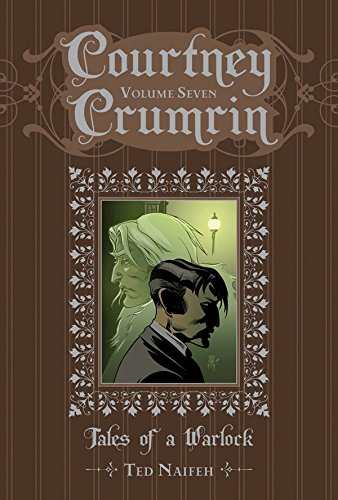
Future Treasures: Courtney Crumrin Volume 7: Tales of a Warlock by Ted Naifeh

Courtney Crumrin Volume 7 Tales of a Warlock-smallNearly three years ago, I reviewed the first volume of the new hardcover editions of Courtney Crumrin, concluding that “Courtney Crumrin is one of the finest comics produced in the 21st Century.”

In his Black Gate blog post on Courtney Crumrin and the Night Things, renamed Courtney Crumrin Volume One: The Night Things in its expanded hardcover edition, Michael Penkas did a far better job than I of describing the appeal of this brilliant comic:

Be honest. If you had magical powers when you were a teenager, what would you have done? How long would you have walked the path of righteousness before cursing the school bullies? Before casting a spell to make yourself popular? Before just flat-out killing bad people? Would you have made friends with elves… or goblins?

Ted Naifeh’s series of fantasy comics… introduces us to Courtney Crumrin on the day her vapid parents move in with her grand-uncle, Aloysius… Going through his collection of grimoires, she begins her own self-guided education in the magical arts. In the first volume, she traps a child-eating goblin, enchants herself to become the most popular girl in school, travels to the faerie kingdom to swap out a changeling for a human infant, and gets replaced by a doppelganger who turns out to be nicer than her.

Like Michael, I was thrilled to find the early black & white issues of Courtney Crumrin gradually being collected in handsome and affordable hardcover editions — and in color! I was purchasing them steadily, until I kinda lost track of them. (Cut me some slack… I collect a lot of stuff.) Shortly after Christmas, when I noticed that it was now 2015, I did a quick check to see how many volumes were out. I was startled to see that no less than six had already been released, and a seventh, Tales of a Warlock, was on its way.

Read More Read More

December Short Story Roundup

December Short Story Roundup

Magazine of Fantasy and Science Fiction Jan-Feb 2015-smallNot every month brings me a great big stack of stories to review. Which is fine. I mean, it’s not like we all don’t have a ton of things to do during December. Still, I did find three stories to tell you about, one them quite good.

Let’s start with the highlight of the December stories, “Prisoner of Pandarius,” by Matthew Hughes in The Magazine of Fantasy & Science Fiction (January/February 2015). It’s a tale of revenge, thievery, and guild politics starring Raffalon, a thief with a ready wit, an overriding sense of self-preservation, and a name more than a little reminiscent of E A Hornung’s famous gentleman thief, Raffles.

Hughes makes no bones about being a fan of, and inspired by, Jack Vance’s Dying Earth. On his site he refers to Raffalon as “my archetypal Dying-Earthish thief.” There’s certainly a Vancian sensibility to the story’s trappings, e.g. a spell with the name “Izzizitz’s Matchless Latch” and the thieves’ organization’s official name of “The Ancient and Honorable Guild of Purloiners and Purveyors.” I’m a sucker for Jack Vance-inspired stories, provided they’re done well. I’m quite happy to write that “Prisoner of Pandarius” is one of those.

My first encounter with Hughes’s fiction was just this past September, also on the pages of F&SF (Sept/Oct 2014). “Avianca’s Bezel,” which I like very much, also features Raffalon. Therein, he learns the hard way the problems attendant with working for wizards.

In the new story, his decision to never again work for a wizard is put to the test when he is defrauded by the Purveyors — i.e. fences — of his guild. An old associate, the sorcerer Cascor, approaches him with a job offer and he reconsiders the hard line he’d previously taken.

Read More Read More

The Barbarism of Bullfighting and Archaic Diction in L. Sprague de Camp’s “The Rug and the Bull”

The Barbarism of Bullfighting and Archaic Diction in L. Sprague de Camp’s “The Rug and the Bull”

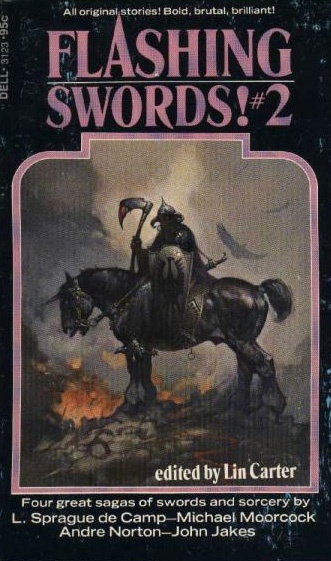
1974 Paperback edition. Cover art by Frank Frazetta.

One of the many freedoms of Sword and Sorcery, it seems to me, is that it enables the adoption of a world that allows the writer to comment on just about anything on which one would want. One of Robert E. Howard’s purposes in the construction of his own Hyboria was to create a conglomerate of cultures, no matter how anachronistic their juxtapositions, so that his hero Conan might have any kind of adventure that Howard might think up. Whereas for previous tales, Howard perhaps had to construct different heroes for different historical epochs (Bran Mak Morn for the Celtic Picts, Solomon Kane for the sixteenth century, Kull for Atlantis), in the Hyborian Age Conan might be a thief, a soldier, a pirate, and ultimately a king, his adventures all the while providing Howard with powerful commentary on “civilization.”

So, too, writers after Howard have utilized this purpose. Dave Sim, through his creation of Cerebus the Aardvark, begins by commenting on the Sword and Sorcery genre itself (as well as the mainstream comic books of Sim’s time) and then goes on to explore High Society, Church & State, marriage – and this last, in Jaka’s Story, is as far as my reading has taken me, but I understand that Sim is so far reaching in his exploration of topics that in a much later volume he even explores the life and works of Ernest Hemingway through Cerebus taking on the position of Hemingway’s personal secretary!

Terry Pratchett uses the Sword and Sorcery milieu to ingenious satirical effect, cribbing directly (I believe) from Fritz Leiber in order to forecast to his readers, in the very first pages of the very first Discworld novel, just what tone and material his readers may expect. Pratchett’s initial perspective characters, soon abandoned, are Bravd and the Weasel (Fafhrd and the Gray Mouser, obviously). I quote the following description in order to give an example of Pratchett’s satirical treatment of Sword and Sorcery and to underscore, specifically, Pratchett’s debt to Leiber. For more humor, one might want to pick up this book and enjoy the way that these characters talk to each other – it’s impressively Leiberesque.

Read More Read More

A Blast From the Past: John Christopher’s The Tripods Trilogy

A Blast From the Past: John Christopher’s The Tripods Trilogy

white1Long before YA fiction conquered the universe and millennia before the trilogy became the gold standard by which the world judges any given author, there lived Sam Youd, a British writer who worked under the pseudonym of John Christopher. Youd published The White Mountains in 1967, at a time when the United Kingdom was lurching away from the tight-laced, survivalist mode inherited from and necessitated by back-to-back world wars. Cue mods and rockers, Pink Floyd, the Swinging Sixties. Twiggy. Bowie. Cue a mind-set ready to dismiss the bleak past in favor of (in Christopher’s eye) an equally bleak future.

I first encountered The Tripods trilogy in the late seventies, and both my sister and I devoured the series more than once. In the first book, Will Parker, his loutish cousin Henry, and a whipsmart French lad, Beanpole, embark on a post-apocalyptic journey to the only haven they’ve ever heard of where humankind isn’t ruled by the fearsome Tripods, massive metal beings reminiscent of The War Of the Worlds. But in The White Mountains, the tripods have won: humanity has been enslaved through the use of “caps,” metal headgear installed without fail on a child’s fourteenth birthday. Will, Henry, and Beanpole are about to turn fourteen, and they are all too aware that after capping, their peers are never the same.

So book one is the journey. Book two, The City Of Gold and Lead, pits the boys, along with a stoic German, Fritz, against the creatures that operate the tripods, the Masters. Will and Fritz pose as slaves and infiltrate one of the three cities inhabited by the Masters.

Read More Read More

New Treasures: The King’s Deryni by Katherine Kurtz

New Treasures: The King’s Deryni by Katherine Kurtz

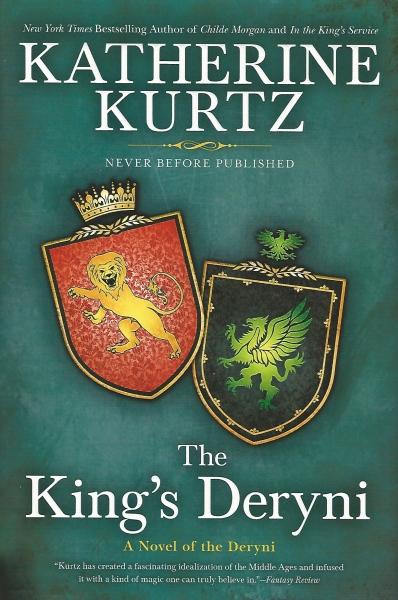
The King's Deryni-smallThe very first Deryni novel — and Katherine Kurtz’s first published novel — was Deryni Rising, which appeared as part of Lin Carter’s prestigious Ballantine Adult Fantasy line in 1970. Keith West has been gradually working his way through the entire BAF line, and I found what he said about Deryni Rising very compelling.

When Lin Carter started the Ballantine Adult Fantasy line, he began by reprinting works that were obscure and/or considered classic in the field at that time, but as he wrote in the introduction to Deryni Rising, he had hoped from the very beginning to be able to publish high quality new works as well. The first original fiction he published was Deryni Rising, the first novel by Katherine Kurtz.

I think he hit the ball out of the park when he selected this one.

Read Keith’s complete comments here.

Katherine Kurtz’s Deryni novels were some of the most popular fantasy novels of the 20th Century. Deryni Rising has been reprinted over 10 times, and more recent volumes in the series have hit the New York Times bestseller list. The series is still being published and now consists of five trilogies, a stand-alone novel, two collections of short stories, and a pair of reference books.

Read More Read More

The Public Life of Sherlock Holmes: Hard Boiled Holmes

The Public Life of Sherlock Holmes: Hard Boiled Holmes

HBH_MurderBy now, readers of this column (all three of you) know that I’m ‘all-in’ on Sherlock Holmes and Solar Pons. But I am also a long-time hard boiled fiction afficionado. I’ve got a section of the bookshelves well-stocked with private eye/police novels and short stories, from Hammett and Daly to Stone and Burke.

Now, I wouldn’t bet my house on the premise of the following essay, which first appeared in Sherlock Magazine back when I was a columnist for that fine, now defunct periodical. But I believe that I make a more compelling argument than you thought possible at first glance. The roots of the American hard boiled school can be seen in Sherlock Holmes and the Victorian Era. Yes, really.

And if any of the hard boiled heroes mentioned catch your fancy, leave a comment. I’ll be glad to tell you more about them. Without further ado, I bring you “Hard Boiled Holmes.”

“But down these mean streets a man must go who is not himself mean, who is neither tarnished nor afraid.”

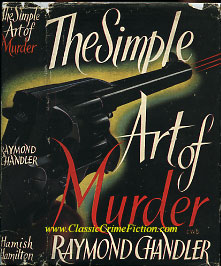
Raymond Chandler wrote these words in his essay, ‘The Simple Art of Murder.’ Ever since, the term ‘mean streets’ has been associated with the hard-boiled genre. One thinks of tough private eyes with guns, bottles, and beautiful dames. But was it really Chandler who created those words to describe the environment that the classic Philip Marlowe operated in?

Is it possible that it was Victorian London that gave birth to the mean streets, which would later become famous as the settings in the pages of Black Mask? Could it be that Sam Spade and Philip Marlowe were followers in the footsteps of Sherlock Holmes?

Read More Read More

Vintage Treasures: The Second Ghost Book, edited by Lady Cynthia Asquith

Vintage Treasures: The Second Ghost Book, edited by Lady Cynthia Asquith

Great Pan Second Ghost Book-smallI’ve done a fair job of collecting American horror and dark fantasy paperback anthologies over the years. I have by no means a complete collection (or anything close to a complete collection), but after nearly four decades of collecting I’ve seen almost all the really desirable stuff, and I’m intimately familiar with the market.

That’s not remotely true of British paperbacks. Take for example the highly regarded Pan Ghost Books. They were published between 1952 and 1980, and there are a lot of them. How many? I have no idea. A lot.

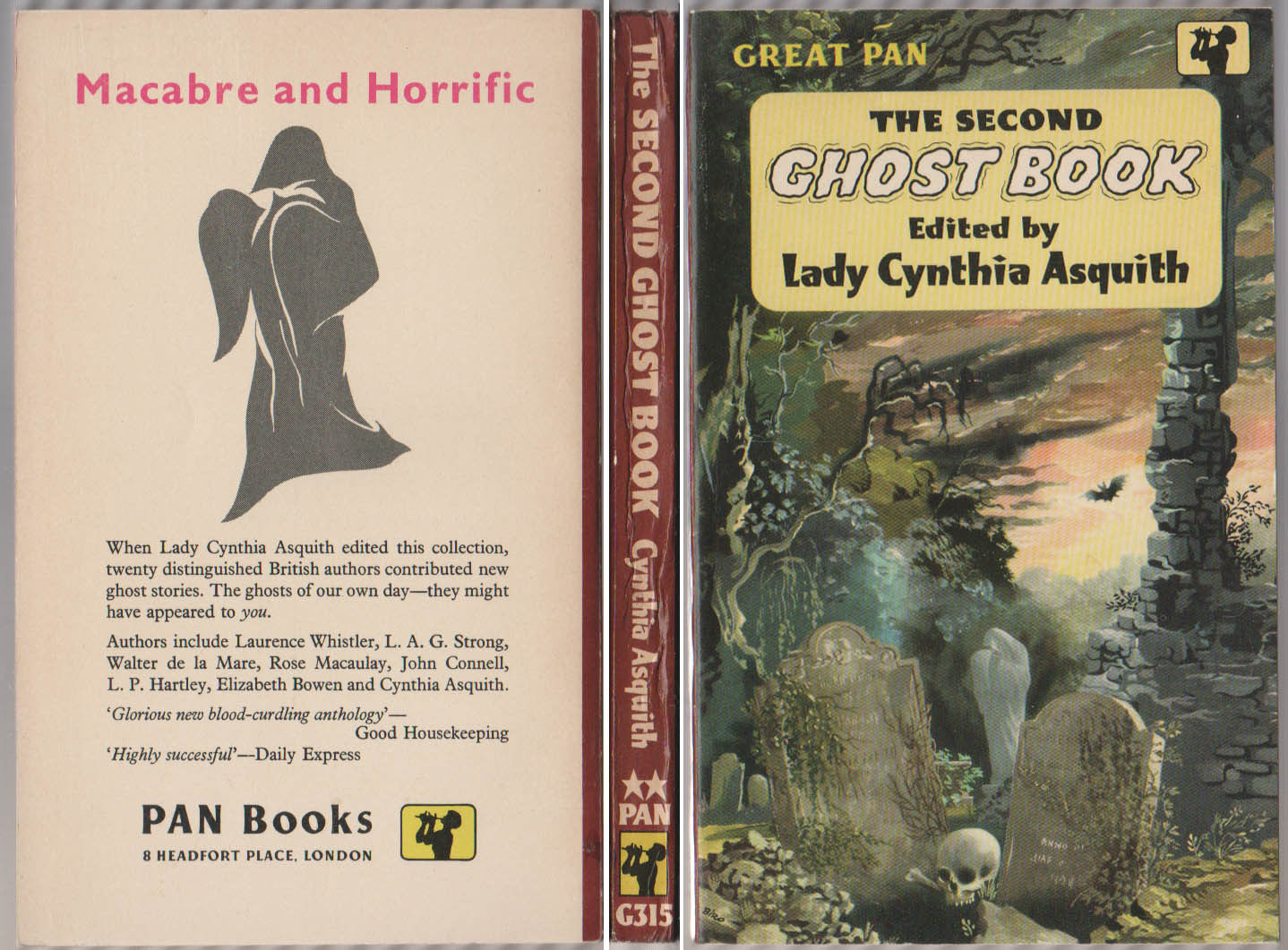
The first, originally titled The Ghost Book, was published in hardcover from Hutchinson in 1926, and didn’t appear in paperback until 1945. The Second Ghost Book had a hardcover edition in 1952 from James Barrie, and was reprinted in paperback by Pan (under the imprint Great Pan) in 1956. If things had continued at that pace, we wouldn’t have much of a series to talk about, but fortunately they picked up a bit, with the third appearing in hardcover in 1955.

The books were a mix of original fiction and reprints. All three of the first Pan Book of Ghost Stories were edited by Lady Cynthia Asquith, who was also a contributor (under the name Cynthia Asquith.) The fourth volume was edited by James Turner; altogether the series had half a dozen editors by the time it petered out in 1980.

My first encounter with the series was with The Bumper Book of Ghost Stories, a fat omnibus of two later volumes, which I found at the Windy City Pulp & Paper show last year. That was enough to set me on the trail of the earlier volumes. I recently stumbled across a copy of the The Second Ghost Book, and it’s got a stellar list of contributors, including V. S. Pritchett, Lord Dunsany, Elizabeth Bowen, L. P. Hartley, and many others. It’s also got a fabulous cover.

Read More Read More

The Tragic and Poignant Tales of R. Murray Gilchrist: A Night on the Moor & Other Tales of Dread

The Tragic and Poignant Tales of R. Murray Gilchrist: A Night on the Moor & Other Tales of Dread

A Night on the Moor-smallIt’s probably no surprise that I got a new volume in the Wordsworth’s Tales of Mystery And The Supernatural series for Christmas.

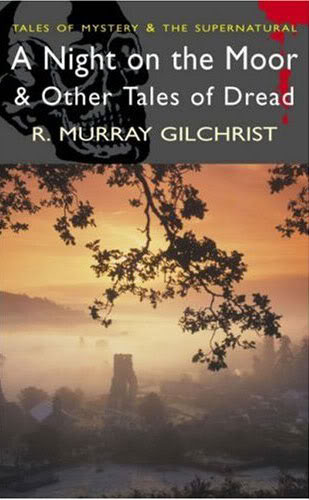
I’m not familiar with R. Murray Gilchrist, but that’s the beauty of this series — it’s introduced me to a wide range of excellent ghost story writers. Gilchrist wrote chiefly in the late 1800s and he produced a fine range of supernatural ghost stories, including horror, humor, mystery, and even tragic romance. A Night on the Moor is a slender volume (at just 190 pages, it’s considerably shorter than most of the recent Wordsworth edition we’ve covered), but I’m enjoying it so far.

Robert Murray Gilchrist (1868-1917) is perhaps best known for his interest in topography, and for his stories set in Derbyshire’s Peak District. But he was also a master of mystery and horror, as this richly varied collection shows.

If you are looking for a conventional horror story, in which the supernatural element is paramount, try “The Crimson Weaver,” “Dame Inowslad,” “Witch In-Grain,” or “A Night on the Moor.” If you are more taken with the psychology of the participants, often allied to a fascination with the killing of friends or lovers, then “Francis Shackerley,” “The Noble Courtesan,” “Althea Swathmore,” and “My Friend” will be right up your street. For humor we are offered the Peakland comedy of “The Panicle” or “A Witch in the Peak.” And when it comes to love, there are the tragic and poignant tales we might expect (“The Return,” “The Lost Mistress,” “The Madness of Betty Hooton”), but also the engaging and unusual “Bubble Magic” — a story of romantic betrayal which hints at a happy ending.

Read More Read More

James Bond is in the Public Domain in Canada

James Bond is in the Public Domain in Canada

James Bond 007-smallNews that the character of James Bond entered the public domain in several countries around the world, including Canada, on January 1st 2015, has stirred considerable excitement among small press publishers.

As io9 reported on Thursday, for many countries who signed the international Berne Convention governing copyright, an author’s works are protected until 50 years after her death. Ian Fleming died in 1964, which means his work entered the public domain this year. Fleming’s original novels can now be published by anyone in Canada, and new film adaptions of those works are fair game.

Canadian publishers such as Neil Baker’s April Moon Books, who recently produced the popular anthologies The Dark Rites of Cthulhu and Amok!, are exploring what this means to those interested in producing new Bond-related books and anthologies. Here’s Neil:

Here is what I know so far. The name James Bond is currently not trademarked, and it wouldn’t be an issue if it was. However, James Bond OO7 is trademarked, and would cause a kerfuffle. The movies are off-limits, so no fluffy white cats or Q. Movie versions of James are off-limits, as is SPECTRE and, to some extent, villains using nuclear threats. It’s all a bit murky, but I’m still digging.

I’m trying to clarify the position of writers outside of Canada, bear with me on this.

Keep up with developments on the April Moon Facebook page.

The 2014 Philip K. Dick Award Nominees

The 2014 Philip K. Dick Award Nominees

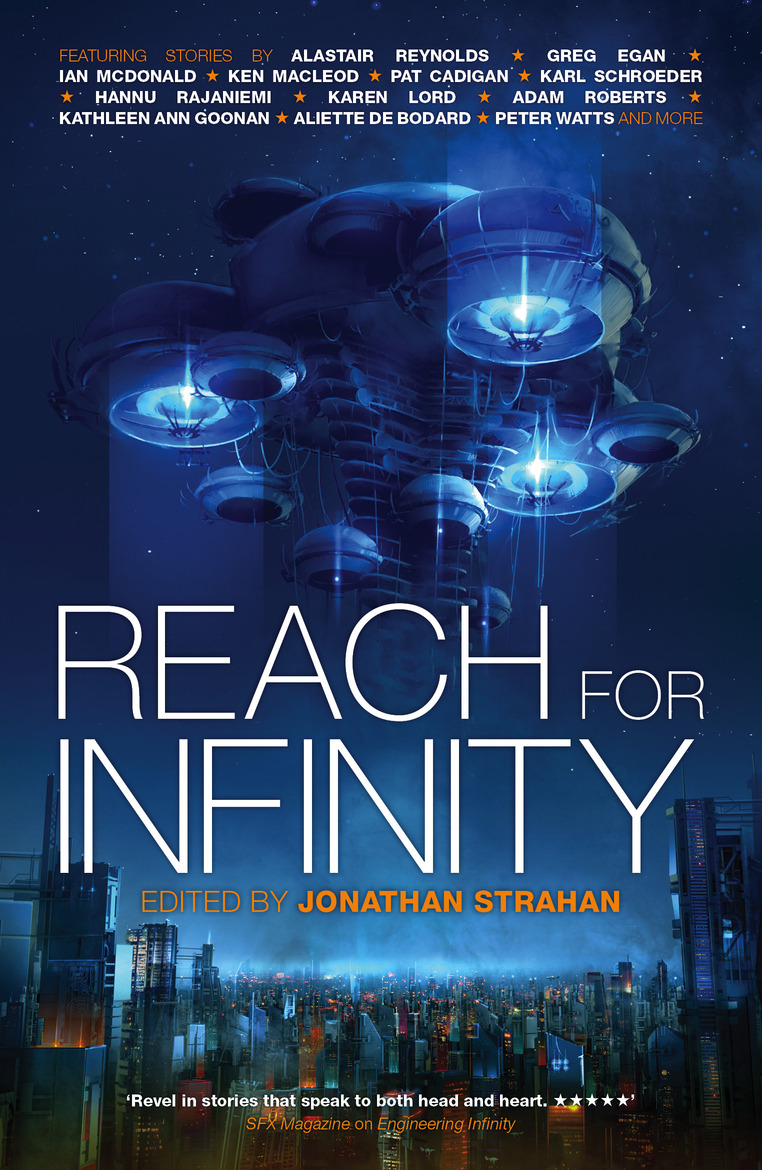
Reach For Infinity Solaris-smallThe Philip K. Dick Award is presented annually for distinguished science fiction originally published in paperback in the United States. The award is sponsored by the Philadelphia Science Fiction Society.

The six finalists this year are (with links to earlier Black Gate coverage, where appropriate):

Elysium by Jennifer Marie Brissett (Aqueduct Press)
The Bullet-Catcher’s Daughter by Rod Duncan (Angry Robot)
The Book of the Unnamed Midwife by Meg Elison (Sybaritic Press)
Memory Of Water by Emmi Itäranta (Harper Voyager)
Maplecroft: The Borden Dispatches by Cherie Priest (Roc)
Reach For Infinity edited by Jonathan Strahan (Solaris)

I wasn’t aware that anthologies are eligible for the Dick Award, but I’m very pleased to see Jonathan Strahan’s Reach for Infinity on the list this year.

Last year’s winner was Countdown City by Ben H. Winters, author of The Last Policeman, with a special citation going to Toh EnJoe’s Self-Reference Engine.

This year’s winner will be announced on Friday, April 3, 2015 at Norwescon 38 in SeaTac, Washington. The 2014 judges are Jon Armstrong, Ritchie Calvin, Ellen Klages, Laura J. Mixon (chair), and Michaela Roessner. See more details at the Official Philip K. Dick Awards Home Page.

See all of our recent News articles here.