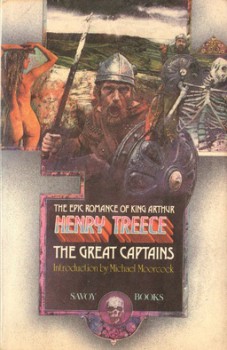
They were great men, yet to see them only as men, stripped of their doom-driven greatness, is to represent them on too trivial a scale. To draw them as massive heroes only would be to recreate them as inhuman cyphers.
from the preface to The Great Captains
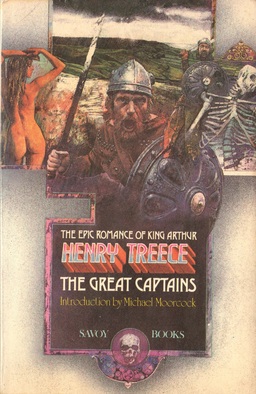
The Great Captains (1956) is Henry Treece’s brutal and gripping version of the King Arthur story. Treece has pruned away the romantic embellishments that have obscured the old legend and returned it to the historic time and place in which it might really have happened. Excalibur isn’t buried in an anvil, but a tree stump, and Camelot isn’t a fairy tale castle, but a restored Roman town. Instead of an anachronistic quasi-medieval setting, the story unfolds during the bloody chaos of the waning days of Roman Britain decades after the last legionaries sailed for Gaul.
Britain’s darkest hours came in the Fifth Century AD, when waves of Germanic invaders swept across the English Channel. Stripped of all Roman soldiers in 407 AD, the people of Britain were forced to fend for themselves. In the end, they failed. None of the 1,000 or more prosperous Roman-style villas survived the Saxon onslaught. London, once rich and home to 60,000 people, was abandoned. Starvation and violence covered the land. Yet there were moments of hope.
In the middle of the Fifth Century AD, Ambrosius Aurelianus, a soldier of noble Roman ancestry, rallied the people and raised an army. For years, he fought off the invaders. His success spurred on the British and a generation after his death, the Saxons were routed at the Battle of Badon, securing another generation of peace for the land. According to the Historia Brittonum, written around 828 AD,
The twelfth battle was on Mount Badon in which there fell in one day 960 men from one charge by Arthur; and no one struck them down except Arthur himself.
This is the first historical mention of Arthur. The Historia goes on to document twelve great battles waged by Arthur, dux bellorum (war leader), against the Saxons and their allies. From this, all the great legends of Arthur Pendragon, Once and Future King, arise. And though many historians today have come to doubt he existed, Arthur lives on as the chivalric hero who leads the righteous against a seemingly overwhelming enemy.
…
Read More Read More
 From all of us in the underground offices of Black Gate, wishing you a wonderful “holiday” season and thank you for continuing to follow us into the dark.
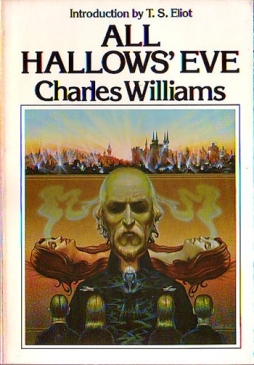 I observed the other day that the end of October’s a good time for reading classic weird fiction. This morning, as young ghosts and goblins of all sorts are preparing their evening’s depredations, I’m writing about a subject I’ve wanted to deal with for a while: the novels of Charles Williams. Williams was born in 1886, and died in 1945; a scholar, poet, editor, and theologian as well as a novelist, he’s probably the third-best-known of the informal group of Oxford Christians called the Inklings, behind C.S. Lewis and J.R.R. Tolkien. A Christian fascinated with the occult, his novels are tales of the supernatural and the numinous at play in the ‘real’ world. He wrote of ghosts, magi, and the Holy Grail, among other things, and his stories, laboured and profound, are some of the strangest fantasies I know.