“This Ghostly Little Book”
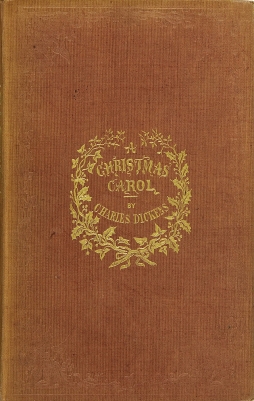 It’s one of the most famous stories in the English-speaking world, and it is a fantasy. A Gothic fantasy of Christmas, and the meaning thereof: the story of the miser and the three spirits. It’s been retold any number of times, parodied, set in America, updated to the modern day, acted out with mice and ducks, with frogs and pigs. It’s easy to overlook how powerful the original work really is.
For myself, I cannot remember how old I was when I first encountered some version of A Christmas Carol. Very young, and possibly pre-literate. The story’s often presented, I think, as a children’s story; but as I read it now, it seems far from that. Indeed it seems like a story that can only be understood with age. When I was a child I didn’t believe in Scrooge’s conversion, and didn’t see how simply revisiting his past could start such a change in his personality. Now that I’ve lived long enough to have distant memories of my own, I understand it. And rereading the story now, I see that while it’s true Dickens was unashamed of being sentimental and broad, he was also in many ways very subtle in the way he described Scrooge. To me, now, Scrooge and the change in his character seem only one reflection of the book’s central theme and of its vision: a vision of the human soul, both alone and as part of society.
Charles Dickens wrote A Christmas Carol in 1843. He was thirty-one, and already famous. Made to work as a child in a blacking-warehouse while his father was imprisoned for debt, the adult Dickens had a fierce drive to succeed, and a horror of the developing industrial capitalism around him; he worked as a journalist and editor, then had a massive popular success with the serially-published The Pickwick Papers. Oliver Twist followed, then Nicholas Nickleby, The Old Curiosity Shop, Barnaby Rudge, and A Christmas Carol. On the one hand, that’s already an incredible body of work. On the other, Dickens was a very young man to so powerfully capture the elderly Scrooge. But capture Scrooge he did; if A Christmas Carol works — and given that it hasn’t been out of print in a hundred and seventy years, we can say it does — it’s because Dickens gets at something in memory, and in how people age.
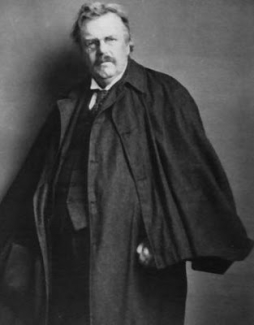 Last week, in a post about Neil Gaiman’s Sandman, I said that certain habits of Gaiman’s plotting reminded me of G.K. Chesterton. It seemed to me that I’d referred to Chesterton fairly often in my posts here, so I did a search of the Black Gate archive. I found that I had in fact mentioned Chesterton a number of times, but that neither I nor anyone else had yet written a post for Black Gate specifically about him or any of his works. I’ve therefore put together this piece to give an overview of the man and his writing. It’s insufficient; Chesterton’s difficult to describe, more so than most writers. But one has to begin somewhere. He’s an important early fantasist, admired by figures as diverse as Gaiman, Borges,