Browsed by
Category: Vintage Treasures

Singularity & Co. use Successful Kickstarter to Rescue Out-of-Print SF & Fantasy

Singularity & Co. use Successful Kickstarter to Rescue Out-of-Print SF & Fantasy

the-torch-jack-bechdoltThe ever-vigilant Jason Waltz has called our attention to this article on Singularity & Co., who are rescuing extremely rare SF and fantasy titles and bringing them back into print as e-books.

It began with a Kickstarter campaign by Ash Kalb, Cici James, Jamil V Moen, and Kaila Hale-Stern, which raised $52,276 (350 percent of their $15,000 goal). The campaign ended on April 2 and the team wasted no time setting their dream in motion. Each month they have carefully selected one out-of-print science fiction novel, tracked down the copyright holders, and re-packaged it in DRM-free PDF, Epub, and Mobi format for subscribers.

So far they have reprinted A Plunge Into Space by Robert Cromie (first published in 1890) and Jack Bechdolt’s 1948 novel The Torch. They have also opened a Brooklyn bookshop where vintage science fiction and fantasy paperbacks are filed chronologically by publication date, which I find weirdly compelling.

Tracking down old books — both rights and physical copies to scan — has proven more challenging than they expected. Their planned third book is Mr. Stranger’s Sealed Packet by Hugh MacColl, first published in 1889. But according to a Wired article about the group, locating a copy took some effort:

The team tracked down the lone copy [of Mr. Stranger’s Sealed Packet] out of university archives, and went on a thousand-mile drive just to scan it. Despite being out of copyright, none of the universities who owned a copy of [the book] permitted scanning.

Singularity & Co. currently don’t offer individual e-books for sale; titles are available only to subscribers. Subscription plans start at $29.99 for a year, or $129.99 for a lifetime subscription. Learn more at their website, savethescifi.com.

You’ll Never See it in Galaxy

You’ll Never See it in Galaxy

youll-never-see-it-in-galaxyIn my last post, Discovering Galaxy Science Fiction, I shared my excitement in discovering Galaxy magazine and getting my hands on some issues. While I was still admiring my recent collection, my wife surprised me with the first twelve issues of Galaxy Science Fiction!

Galaxy’s first issue was October, 1950. Upon the back cover are the words, “You’ll Never See it in Galaxy.” Below that header, two short narratives appear about Bat Durston – one set in space, one set in the old west. Other than the setting and descriptions, the paragraphs are nearly identical. Following that is this great statement: “If this is your idea of science fiction, you’re welcome to it!” [Click on the image at right for the complete text].

Editor H.L. Gold writes in the opening letter that science fiction is finally coming of age and that media sources are treating science fiction intelligently. Gold writes that Galaxy “proposes to carry the maturity of this type of literature into the science fiction magazine field, where it is now, unfortunately, somewhat hard to find.” With stories akin to Bat Durston in heavy supply, that’s no surprise.

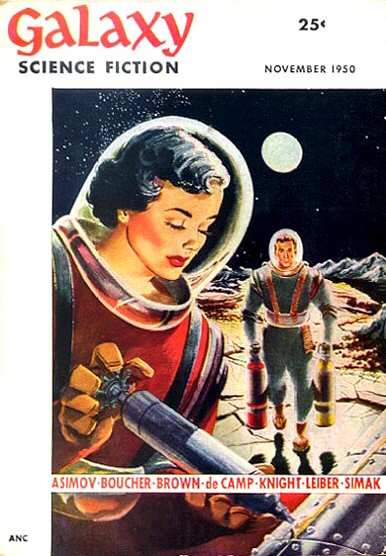
In addition to Galaxy’s content, Gold writes that even their cover art

is proof of [Galaxy’s] break with the amateur and/or shoddy tradition… We never were convinced, in any case, of the actual commercial appeal of naked maidens, prognathous youths in winter underwear… and monsters that can exist only on the nutrients found in India ink and Bristol board.

He describes cover artist David Stone as “weary of tearing covers off magazines to avoid embarrassment.”

Clearly, Galaxy’s founders found a dearth in excellent science fiction, presented in a professional format. I admire them for their boldness, to proclaim what’s needed and to publish it. I look back on the golden age of science fiction with renewed interest; editors like Gold forged that age through their publishing and promotional endeavors.

As to what lies within the pages of these magazines, I can only grin, for I’ve just finished reading one of the issues. In a future article, I’ll reveal what I’ve read and perhaps entice some of you to join me. Here’s a spoiler: you won’t find any tales about Bat Durston.

Vintage Treasures: A Box of 1950s SF and Fantasy Magazines, and the End of the First Era of Space Exploration

Vintage Treasures: A Box of 1950s SF and Fantasy Magazines, and the End of the First Era of Space Exploration

july-ebay-lot2

I bought a box of 1950s SF and fantasy digests in an online auction at the end of July, an assortment of chiefly lesser-known magazines such as Imagination, Worlds of Tomorrow, Fantastic Universe, and Imaginative Tales. The box has been sitting in my library for three weeks while I puttered around it, like an unopened Christmas present. I finally unpacked it this morning. Just as I’d hoped, it was filled with wonders.

Holding these the day after the death of Neil Armstrong gives me the powerful sense of the passage of history. Every one of these magazines was published before Armstrong walked on the moon — in most cases at least a decade before. The era of space exploration, with all its incredible promise and danger, was firmly in mankind’s future. Looking at them now, as the first era of space exploration draws to a close with the death of its most famous hero at age 82, I feel like I’m looking back through not one but two eras, to a time when landing on the moon was something that many still scoffed at. When the future was a place where robots carried guns, aliens were green-skinned and wore khakis, and housewives walked alien dogs who didn’t know what to do with a fire hydrant.

Even setting aside all the musings on history, there’s still a lot of wonder packed into these yellowing pages. Marvelous artwork, and even more marvelous stories, from some of the brightest lights in the genre. This box of 20 magazines, which I purchased for 48 bucks, is a splendid sampling of some of the best work of the decade.

Read More Read More

New Treasures: Kim Newman’s Anno Dracula: The Bloody Red Baron

New Treasures: Kim Newman’s Anno Dracula: The Bloody Red Baron

anno-dracula-bloody-red-baronOkay, technically, this is both a Vintage Treasure and a New Treasure. It’s a brand spanking new edition of a novel that came out nearly two decades ago, in 1995.

But what a novel. The sequel to Anno Dracula, one of the most acclaimed vampire novels of the 90s — an alternate history in which Count Dracula has killed Van Helsing, married Queen Victoria, imposed a police state and launched a terrifying new era of British vampire domination — The Bloody Red Baron picks up the story a few years later, at the dawn of World War I:

It is 1918 and Graf von Dracula is commander-in-chief of the armies of Germany and Austria-Hungary. The war of the great powers in Europe is also a war between the living and the undead. Caught up in the conflict, Charles Beauregard, an old enemy of Dracula, his protégé Edwin Winthrop, and intrepid vampire reporter Kate Reed go head-to-head with the lethal vampire flying machine that is the Bloody Red Baron…

One of the most fascinating aspects of Anno Dracula was the adroit manner in which Newman drew from real and fictional historical characters for virtually his entire cast — including Jack the Ripper, Sherlock Holmes, Inspector Lestrade, Allan Quatermain, Billy the Kid, Orson Welles, Oscar Wilde, Fu Manchu, The Invisible Man, Dr Jekyll and Mr Hyde, Carmilla, Doctor Moreau, Kurt Barlow (Salem’s Lot), Carnacki, Barnabas Collins (Dark Shadows), Daniel Dravot (The Man Who Would Be King), Count Orlok (Nosferatu) and even Carl Kolchak (The Night Stalker).

Read More Read More

Vintage Treasures: The Startling Worlds of Henry Kuttner

Vintage Treasures: The Startling Worlds of Henry Kuttner

the-startling-worlds-of-henry-kuttner2I have fun with these Vintage Treasure pieces. For one thing, they’re a great excuse to shine some light on interesting items that cross my path.

Take Henry Kuttner’s paperback collection, The Startling Worlds of Henry Kuttner. Published in 1987, nearly 20 years after his death, it’s unusual in several respects. For one thing, it includes only novellas. And all originated from a single source: the long-dead pulp magazine Startling Stories.

I think this is a neat idea. The best writers of the pulp era — and Kuttner certainly qualifies — have seen most of their short fiction studiously reprinted. In fact, we’ve covered four generous collections of Kuttner’s pulp fiction just in the last few years: the weird-menace collection Terror in the House, the first volume in The Early Kuttner series; Thunder in the Void, gathering his early space operas; Detour to Otherness, the massive retrospective of his collaborative work with C.L. Moore; and none other than the distinguished James Enge reviewed his Gallagher stories for us, collected in Robots Have No Tails.

But short novels, 40,000-word epics printed in a single pulp issue, rarely (if ever) get reprinted. They’re too long for most collections, and generally too short for a standalone novel, so most of them have slipped through the pages of history. The Startling Worlds of Henry Kuttner rescues three such wonders and puts them under one cover.

But that’s not even the most interesting thing about The Startling Worlds of Henry Kuttner. Since all three novels appeared in a single source, this isn’t just a collection of Kuttner’s work. It’s an anthology that celebrates Startling Stories. Just as most collections give us insight into the recurring themes in an author’s work, this book offers us a  generous sampling of the kind of fiction that appeared in that grand old pulp.

The Startling Worlds of Henry Kuttner collects The Portal in the Picture (originally published in 1949), Valley of the Flame (1946), and The Dark World (1946). It’s one of the most intriguing collections I’ve come across in the past year. At press time, there are 23 used copies available on Amazon.com, ranging in price from $2.25 to $9.99.

Discovering Galaxy Science Fiction

Discovering Galaxy Science Fiction

galaxy-may-1952I’ve known about older speculative magazines for a few years – the pulp fiction magazines from decades ago. I listened to people talk about stories they read from those magazines, and it seemed like I was missing out on something.

I’m Matthew Wuertz, a fiction reader and writer. I’ve been a Black Gate reader since issue 7. I’ve met most of the Black Gate team over the years, and even took part in the 2010 Sword & Sorcery Panel Podcast with them at the World Fantasy Convention in Columbus. I also have my own blog.

My wife’s van had Sirius Satellite Radio for a year, and I liked listening to the station that played old radio shows — including “X Minus One,” which had episodes of science fiction. One of the episodes was “Surface Tension” by James Blish, originally published in Galaxy Science Fiction. When I heard of the episode’s origin, my curiosity in pulp magazines increased. And now I had a title in mind. I recall thinking, “Would it be possible to actually get one of these Galaxy magazines in my hands?”

A short time later, John O’Neill posted the article “How Galaxy Magazine Saved Robert Silverberg from a Life of Smoking,” so I asked how one might acquire an issue. One of the answers was eBay, and John posted several links to active auctions.

At this point, my wife, whose eBay prowess amazes me, became involved. In mere moments, she was saving search results and tracking a number of options. After considering several choices, I chose an auction for 22 issues of Galaxy. So we made a bid. It was a long week until the auction ended, but we won.

When the magazines finally arrived, I was so excited. These were pocketbook-sized magazines with incredible art on the covers, like astronauts mining asteroids with jackhammers while their cylindrical rocket ship floats overhead. This was on the cover of my oldest issue – May, 1952. I was holding a 60-year-old magazine in my hands! I could hardly wait to open the musty, faded pages and read stories written long before I’d been born. See the complete lot here.

What lies within those pages will be revealed another time. I need to stop here. Those astronaut miners are waiting for me.

Vintage Treasures: Eleanor Arnason’s The Sword Smith

Vintage Treasures: Eleanor Arnason’s The Sword Smith

the-sword-smith2I first became acquainted with Eleanor Arnason through her powerful science fiction novels, including To the Resurrection Station (1986), Ring of Swords (1993), and especially A Woman of the Iron People (1991), the novel which won both the first Tiptree Award and the Mythopoeic Award in 1992.

But Arnason has a fine rep as a fantasy author as well. Her Daughter of the Bear King (1987) — the tale of a Minneapolis housewife who finds herself in a strange world where she’s hailed as a long-awaited hero, a true bear and shape-changer called to fight a creeping evil — was her second fantasy novel. Her first, and her first published novel, was The Sword Smith (1978).

The Sword Smith is an odd book in many ways. In begins in media res, with our heroes Limper, a lame smith, and his companion, the young dragon Nargri, in full flight from the King of Eshgorin, who has put a price on their heads. The reasons for all this are gradually revealed in a book that’s more travelogue than tightly-plotted heroic fantasy, with the two companions having a variety of adventures, meeting new companions, getting captured (more than once), and getting in and out of sticky situations. That’s our two heroes on the cover, making a sword (click for bigger version).

The Sword Smith is sometimes described as “low fantasy” (as opposed to high fantasy), chiefly because of the lack of plot. But it’s also praised for its originality; world building; and themes of individual freedom in the face of tyranny, the value of artistic aspirations, and prejudice.

It took me a while to track down a copy, but I finally found one last week. I think this has more to do with the publisher — a tiny outfit called Condor Publishing, who as far as I know published virtually no other fantasy novels — than any lack of quality. For whatever reason, copies are scare, and the book has never been reprinted.

The Sword Smith is 208 pages in paperback. It was published in 1978 by Condor Publishing, with a wraparound cover by A. Echevarria, and had an original cover price of $1.95.

Enjoying Vintage Comics with The Toon Treasury of Classic Children’s Comics

Enjoying Vintage Comics with The Toon Treasury of Classic Children’s Comics

toon-treasure-of-classic-childrens-comics2One of the great things about the 21st Century? Cheap comic reprints (I know, that’s top of your list too, right?)

Seriously. When I was growing up, if you wanted to know what happened in Amazing Spider-Man #65, you had to find someone five years older than you and pester the hell outta them until they told you. As comic archival systems went, it was crude and had little to recommend it.

Not today. Now you have an embarrassment of choices. Want the color reprints of Amazing Spider-Man? The cheap black-and-white? Hardcover or paperback? Digital or paper? Paper or plastic? Bah. All these choices make me grumpy. I miss nagging all the teenagers in my neighborhood. Yelling at them to get off my lawn isn’t the same.

And here’s the other thing. If you want to read premium reprints of superhero, sci-fi, or horror comics from the 50s through the 90s, life is grand. Just browse the graphic novel section at Barnes & Noble or Amazon and you’ll see what I mean — the choices are staggering. Marvel, DC, Gold Key, Charlton, EC… they’re all there, and in quantity.

But if you’re interested in children’s comics from the same era? Good luck.

There are a few intrepid publishers bucking the trend. Fantagraphics has one of the most ambitious publishing ventures in the history of comics with The Complete Peanuts, collecting all 17,897 daily and Sunday strips by Charles M. Schulz (18 hardcover volumes, so far). And let’s not forget Pogo: The Complete Daily & Sunday Comic Strips by Walt Kelly, or the extensive Disney comics of Carl Barks — especially his Donald Duck and Uncle Scrooge — published by Gladstone and Boom! Studios over the years.

But these publishing projects assume you’re already a dedicated fan, and willing to shell out $30 (or more) per book for archival quality hardcovers. What if you just want to sample some of the best from the golden age of kid’s comics? For that, I heartily recommend Art Spiegelman and Francoise Mouly’s wonderful volume, The Toon Treasury of Classic Children’s Comics.

Read More Read More

The Golden Age of Science Fiction is Twelve

The Golden Age of Science Fiction is Twelve

universe-3I continue to find marvelous treasures in the four boxes I purchased from the Martin H. Greenberg collection.

Take, for example, Universe 3, the 1973 original anthology edited by Terry Carr. I haggled with Doug Ellis until he sold me both Universe 3 and 4 for 51 cents (all the change I had left in my pocket), mostly because of the mysterious and cool notes I found scrawled on the Table of Contents, presumably by Martin H. Greenberg himself.

But it was in Carr’s introduction that I found the real treasure this time, a quote I’ve heard time and time again since I started reading science fiction and fantasy in my early teens:

When aficionados of this field get together, that’s a standard topic of discussion. When was science fiction’s golden age? Some say the early forties, when John W. Campbell and a host of new writers like Heinlein, Sturgeon and van Vogt were transforming the entire field; others point to the early fifties, to [editors] H.L. Gold and Anthony Boucher and to such writers as Damon Knight, Alfred Bester and Ray Bradbury. Some will lay claims for the late sixties, when the new wave passed and names like Ballard, Disch and Aldiss came forward.

There are still people around, too, who’ll tell you about 1929 and David H. Keller, E.E. Smith and Ray Cummings.

The clue in most cases is when the person talking first began to read science fiction. When it was all new, all of it was exciting. Years ago a friend of mine, Pete Graham, tersely answered the question “When was the golden age of science fiction?” by saying “Twelve.” He didn’t have to explain further; we knew what he meant.

I was surprised and pleased to discover the origins of that famous phrase (although, by the time it reached me, it had morphed into “The golden age of science fiction is fourteen.”)

Either way, there’s fundamental truth in Pete Graham’s observation. Between the ages of 12 and 14 I devoured countless volumes of fantasy and science fiction, including a great many reprints from the pulp era. For me, the Golden Age of Science Fiction lies between 1932 and 1942, when everything was new in the genre, and authors sought, above all, to deliver a sense of wonder to their readers.

There’s a great deal more to recommend Universe 3 besides Carr’s famous introduction, by the way. It contains fiction by Edward Bryant, George Alec Effinger, Edgar Pangborn, Robert Silverberg, Gordon Eklund, pulp writer Ross Rocklynne — and Gene Wolfe’s famous tale “The Death of Doctor Island.” If you can find a copy, I highly recommend it.

Just don’t expect to pay 51 cents for it. Leave that to the experts.

Vintage Treasures: The Prince of Morning Bells by Nancy Kress

Vintage Treasures: The Prince of Morning Bells by Nancy Kress

prince-of-morning-bellsI first discovered Nancy Kress through her brilliant SF short stories, like the Hugo- and Nebula-Award winning  “Beggars in Spain.” But she has an impressive fantasy resume as well, including her early novels, The Golden Grove (1984) and The White Pipes (1985) — which we cover here.

The Prince of Morning Bells (1981) was her first novel, and I’m embarrassed to say I’d never heard of it. Until I found a copy in Martin Harry Greenberg’s vast paperback collection.

Only yesterday, when marvels and mystery blessed the Universe…

Lovely Princess Kirila rejected royal traditions to seek wisdom and truth at the Tents of Omnium at the Heart of the World. With her protector and savior, the enchanted purple dog, Chessie, she reaches the kingdom of the Quirks — but their rational society cannot help in her hazardous quest. Nor can the people of Ruor, whose mystic religion threatens to enslave her. It is only at the Castle of Reyndak that a handsome young prince succeeds in interrupting her journey…

But years later, Kirila will again take up her quest with faithful Chessie, to reach the fabled tents, and discover the amazing secret at the heart of every woman’s world.

You’ve got to hand it to any book summary that includes the words “enchanted purple dog.” That’s some serious book blurbing chutzpah right there.

The original Timescape paperback is pretty hard to find (and no, you can’t have mine.) But we live in the era of digital books, and if you’ve got an e-reader, then The Prince of Morning Bells can be all yours for just $5.99 in a revised edition with a new afterword by the author.

The Prince of Morning Bells is 236 pages. It was originally published by Pocket Books, as part of their Timescape line, and released in a revised edition in trade paperback by FoxAcre Press in 2000 (still in print). It is currently available in digital format for the Nook and Kindle.