Browsed by
Category: Vintage Treasures

Vintage Treasures: The Barbarians Anthology Series

Vintage Treasures: The Barbarians Anthology Series

barbariansThere’s been some good discussion of Sword & Sorcery on the BG blog of late, from Brian Murphy’s excellent list of “A Half-Dozen Swords And Sorcery Short Stories Worth Your Summer Reading Time, and Howard Andrew Jones’s skillful examination of the writing technique of the genre’s patriarch, “Under the Hood with Robert E. Howard,” to Joe Bonadonna’s warm reminiscence of the very best S&S of his youth, “How I Met Your Cimmerian (and other Barbarian Swordsmen).”

I thought I was pretty well educated in Sword & Sorcery; but it’s the sign of a rich and vibrant genre that it can still surprise you after decades of collecting.

That’s exactly what happened when I found the artifact at left, buried deep in a paperback science fiction collection I recently purchased.

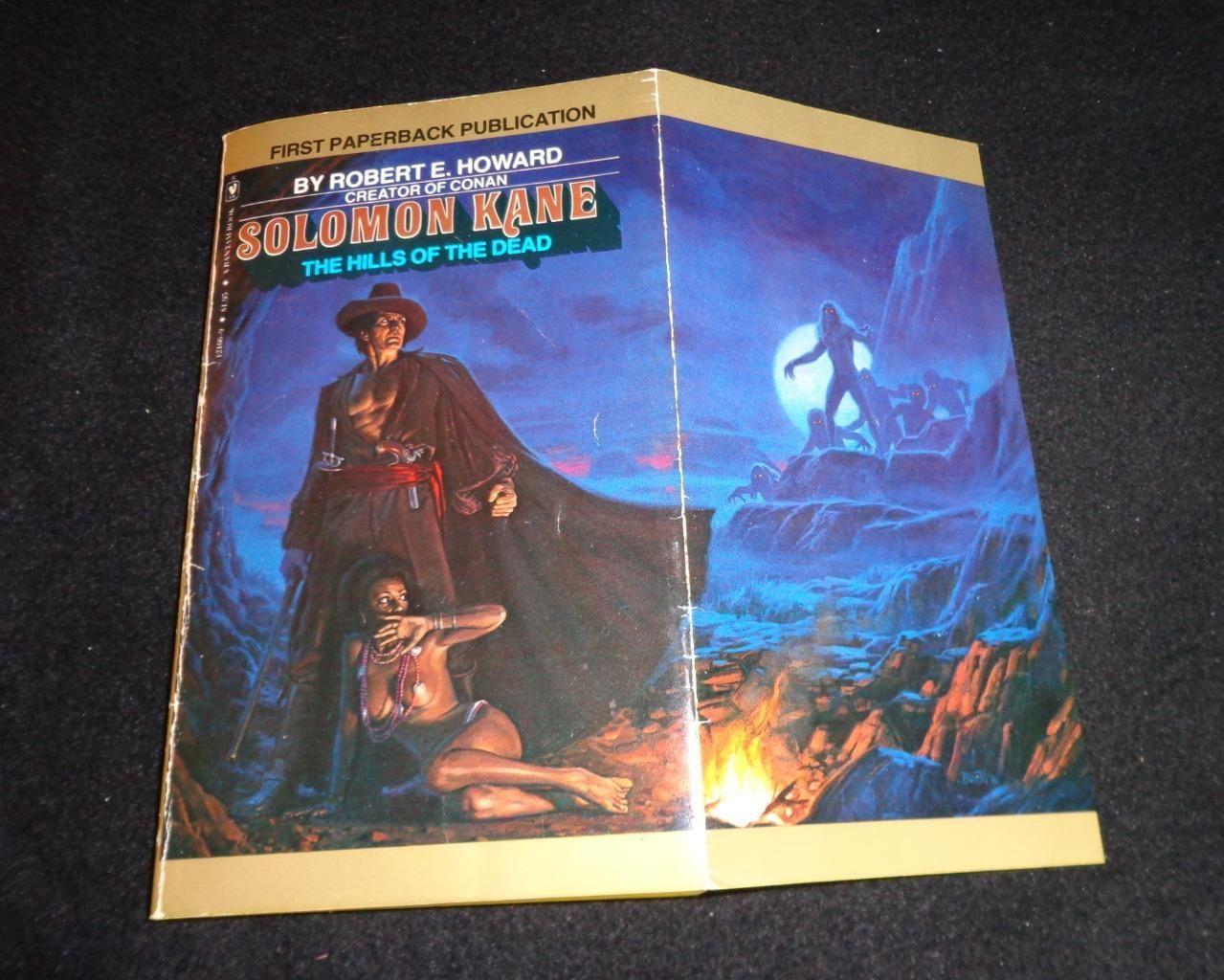
Barbarians was a major S&S retrospective anthology published by Signet in 1986. It was edited by Robert Adams, Martin H. Greenberg, and Charles Waugh, and contained stories by Fritz Leiber, Fred Saberhagen, Andre Norton, Karl Edward Wagner, and many more. It’s a thick paperback original with 13 short stories.

And no, I’d never seen a copy before — or its sequel. Here’s the back cover copy:

From a beautiful huntress with glittering eyes and a killing kiss to mighty Conan’s struggle in a deadly place beyond magic… from a distant planet fated to do battle with the forgotten past to primeval swordsmen pledged to protect a besieged land — here are tales of titanic strength and unearthly courage, of savage warriors facing incredible challenges in the far-flung realms of the imagination.

Sounds pretty good. Not entirely sure how this one escaped me for all these years, but I’m glad I’ve stumbled across it now.

Read More Read More

The Return of Brak the Barbarian

The Return of Brak the Barbarian

witch-of-the-four-winds2E-book publisher Open Road Media has announced the publication of two omnibus editions of John Jakes’ fondly-remembered Sword & Sorcery hero Brak the Barbarian.

Witch of the Four Winds and Brak the Barbarian will be available in digital format at Barnes & Noble and Amazon.com on July 31 for $4.99 each (before discounting).

Brak the Barbarian first appeared in Fantastic magazine in the short story “The Devils in the Walls” (1963). Over the next few years, Jakes produced over a dozen short stories and novellas featuring Brak, that he gradually collected and expanded into five books, published between 1968 and 1980.

Brak the Barbarian contains the 1968 short story collection Brak the Barbarian and the novel Mark of the Demons (1969), plus additional Brak stories and an illustrated biography of Jakes with rare images from the author’s personal collection.

Witch of the Four Winds contains two more early novels: Witch of the Four Winds — originally published under that title in Fantastic magazine in 1963, and then revised and expanded in novel format as Brak the Barbarian Versus the Sorceress (1969) — and When the Idols Walked (Fantastic 1964, expanded and released under the same title in 1978), plus more bonus stories and an illustrated biography.

Jakes’ Brak the Barbarian stories were strongly influenced by Robert E. Howard’s Conan. In the YouTube video Open Road created to promote the launch of the digital editions, Jakes says:

I was directly influenced by Robert Howard, by the fact that there weren’t enough Conan stories to go around… I wanted to create a character much like Conan, put him in similar circumstances, and have a good time writing them.

For science fiction fans, Open Road has also collected two early SF novels by Jakes in a third omnibus collection: On Wheels (1973) and Six-Gun Planet (1970). It’s also available July 31.

Vintage Treasures: Chelsea Quinn Yarbro’s To the High Redoubt

Vintage Treasures: Chelsea Quinn Yarbro’s To the High Redoubt

to-the-high-redoubt2When I think of Chelsea Quinn Yarbro, it’s usually in the context of her hugely successful Count Saint-Germain novels, the tales of gentleman vampire Saint-Germain and his adventures down through the centuries, beginning with Hôtel Transylvania (1978).  Yarbro’s 26 novels featuring Saint-Germain have covered a lot of historical ground, from the reign of emperor Heliogabalus in 3rd century Rome (Roman Dusk) to his escape from Genghis Khan in Tibet and India (Path of the Eclipse), 6th Century China (Dark of the Sun), and the rise of the Nazi party in Germany (Tempting Fate). The most recent, Commedia della Morte (March 2012), finds our dark protagonist in France during the Reign of Terror of the French Revolution.

But Yarbro has had a very successful career as a noted fantasist quite apart from her Saint-Germain books, with some 65 novels to her credit, including Time of the Fourth Horseman (1977) and A Baroque Fable (1986). Two of her earliest novels, The Palace (1979) and Ariosto (1980), were nominated for the World Fantasy Award, and in 2003 she was named a Grand Master at the World Horror Convention. In 2005 the International Horror Guild named her a “Living Legend,” and in 2009 she was presented with a Bram Stoker Lifetime Achievement Award by the Horror Writers’ Association.

Truthfully, I wouldn’t know any of this if I hadn’t stumbled on some of her paperbacks among a few of the collections I recently purchased, and become intrigued enough to give Yarbro another look. Perhaps the most promising is To the High Redoubt, a 1985 paperback that has received little attention (it’s not even listed on her otherwise comprehensive Wikipedia page) but immediately caught my eye. Here’s the typically dramatic 80s back cover copy:

The Bundhi — Lord of Darkness, stealer of souls. This master of evil had destroyed all who fought against him, all but the beautiful Surata, last surviving adept in tantric alchemy. From Surata he had taken family, vision, and freedom, selling her into slavery in a distant land. But even the Bundhi could not comprehend how deep Surata’s power flowed, even he could not foresee that destiny would bring Surata her champion, Arkady, soldier of fortune.

United by a growing trust, and their astral crusade against the deadly forces of the Bundhi, Surata and Arkady rode forth to challenge their enemy in the very heart of his empire, racing against both time and terror.

To the High Redoubt was published by Questar in 1985, with a cover by the fabulous Rowena Morill. It is 370 pages of promising 80s fantasy. I’ll let you know if it’s any good.

Read More Read More

How Galaxy Magazine Saved Robert Silverberg from a Life of Smoking

How Galaxy Magazine Saved Robert Silverberg from a Life of Smoking

galaxy-issue-1-smallI’ve been neglecting Galaxy magazine in my recent Vintage Treasures articles. I’ve covered some of the great fiction in Analog, Asimov’s Science Fiction, and Worlds of If, but the truth is that Galaxy was on its last legs by the time I started reading science fiction and fantasy in 1976, and it folded in 1979.

But I’m not wholly ignorant of the contribution Galaxy made to the field, especially under the editorship of H.L. Gold (1950 – 1961) and Frederik Pohl (1961 – 1969). Until 1950 the field was almost entirely dominated by John W. Campbell, editor of Astounding, who was legendary in his ability to spot talent, but also held a fairly narrow view of what kinds of SF and fantasy would sell. Gold was interested in tales of social and psychological upheaval, not just the hard science puzzle fiction in Astounding, and quickly proved that readers would buy stories with that bent — as well as satire, humor, and tales where mankind didn’t always triumph in its march to the stars and inevitable conflict with alien races.

Mike Ashley, one of our field’s finest historians, credits the success of Galaxy for the huge boom in science fiction and fantasy in the fifties, when the field grew from a handful of magazines to over two dozen, saying Galaxy “revolutionized the field overnight.”

Author Robert Silverberg, however, has a more personal tale of how Galaxy changed his life. He writes:

It was the founding of Galaxy that saved me from a life of smoking. It was September, 1950, and I was a teenager with about forty cents in my pocket. A pack of cigarettes cost about a quarter then. So did the first issue of Galaxy, which had just come out. I went into a newsstand thinking I might buy some cigarettes (I had been smoking a few, not with any pleasure, but simply to make myself look older) and there was the shiny Vol One Number One Galaxy. I could afford one or the other, not both. I made my choice and lived happily ever after.

While I was too late to buy more than a handful of issues of Galaxy on the newsstand, I rectified that later in life, amassing a fair collection going back to that famous first issue in 1950. I’ve been enjoying them over the last few years, and will report in here with the very best stories I find.

Vintage Treasures: The Giant Anthology of Science Fiction, edited by Margulies and Friend

Vintage Treasures: The Giant Anthology of Science Fiction, edited by Margulies and Friend

the-giant-anthology-of-science-fiction2Those four boxes of books I purchased from the Martin H. Greenberg collection have been the gift that keeps on giving. In the third box I found about 30 hardcover anthologies, dating from the 40s to the 70s, including The Giant Anthology of Science Fiction: 10 Complete Short Novels, edited by Leo Margulies and Oscar J. Friend.

This book is a treasure trove of vintage novellas from the Golden Age of SF and fantasy. Despite the “Science Fiction” in the title, a great many of the delights on offer are fantasy, as the term was used pretty much interchangeably with science fiction at the time. Just check out this table of contents, with original dates of publication:

  • “Enchantress of Venus,” Leigh Brackett (1949)
  • “Gateway to Darkness,” Fredric Brown (1949)
  • “The Girl in the Golden Atom,” Ray Cummings (1919)
  • “Forgotten World,” Edmond Hamilton (1946)
  • “By His Bootstraps,” Robert A. Heinlein (1941)
  • “Sword of Tomorrow,” Henry Kuttner (1945)
  • “Things Pass By,” Murray Leinster (1945)
  • “Rogue Ship,” A. E. van Vogt (1950)
  • “Island in the Sky,” Manly Wade Wellman (1941)
  • “The Sun Maker,” Jack Williamson (1940)

Read More Read More

Vintage Treasures: The Pan Book of Horror Stories

Vintage Treasures: The Pan Book of Horror Stories

the-third-pan-book-of-horror-storiesI talk a lot about book collecting here on the blog. People sometimes tell me, “It’s interesting to hear about all the books you’ve been able to find… sort of. But you know what would really be interesting? To hear about the books you haven’t been able to find.”

Okay, but this is a painful subject. Just ask any serious book collector to tell you about the titles that have eluded them for decades. It’s like asking a guy to enumerate all the women who’ve turned him down. We carry those memories for a long time, but that don’t mean we wanna talk about ’em.

“Oh come on,” people say. “Like you’ve ever turned down a chance to talk about books. Give it up.” Well, since you put it that way.

Let’s talk about The Pan Book of Horror Stories.

The Pan Book of Horror Stories was a British paperback series of horror anthologies. Published by Pan Books, it lasted for an amazing thirty volumes, from 1959 to 1989. The series creator — and editor for the first 25 volumes — was the renowned editor Herbert van Thal (Told in the Dark, Tales to Make the Flesh Creep, Lie Ten Nights Awake, and many others classic horror anthologies). Clarence Paget took over in 1985 after Van Thal’s death and edited the last five volumes, until the series came to an end with number thirty in 1989.

The Pan Book of Horror Stories has a legendary reputation. Van Thal is a highly regarded editor, and with these books his vision was nothing less than to create a complete library of the finest short horror stories ever written. With the early volumes he relied heavily on classic tales from Bram Stoker, C. S. Forester, Ray Bradbury, Lord Dunsany, Edgar Allan Poe, William Hope Hodgson, William Faulkner, Frank Belknap Long, and many others, but with later installments he branched out to include newer authors (such as Stephen King), which helped launch a lot of new talent.

After several decades of collecting I have managed to lay my hands on exactly one volume: The Third Pan Book of Horror Stories, published in 1962 (shown above).

That probably overemphasizes the rarity of these books — they’re not that hard to find. But they are expensive, especially in the original British editions (the US editions were dramatically pared down, including fewer stories), and the older volumes in particular are difficult to find in good condition. I’ve been trying to locate a reasonably-priced collection of Pan Book of Horror Stories for years, with absolutely no success.

But that’s okay. As most collectors know, the real joy is in the search. I’m looking forward to a lot of joy in the next few years, as I gradually accumulate the other 29 volumes. Wish me luck.

Howard Waldrop’s “The Ugly Chickens”

Howard Waldrop’s “The Ugly Chickens”

universe-10I’ve been reading a lot of short fiction recently. It started as I was putting away a collection of Worlds of IF magazines and dawdled over the April 1970 issue, with Ron Goulart’s tale of casual wife-swapping, “Swap,” which I talked about here. The same thing happened with Octavia E. Butler’s “Bloodchild” (in the June 1984 issue of Isaac Asimov’s Science Fiction Magazine), and then George R.R. Martin’s “Nightflyers” (Analog, April 1980). And my wife wonders why it takes me two hours to put away a dozen magazines.

It happened again today, this time with Howard Waldrop’s “The Ugly Chickens,” which also originally appeared in 1980, in the tenth volume of Terry Carr’s long-running Universe anthology series. I read it in Donald A. Wollheim’s The 1981 Annual World’s Best SF, where it had this introduction:

Science Fiction is subject to many definitions and there are some that are so specific that they might exclude this unusual story. But if science fiction deals with the probable that is just beyond the newspapers or with things that might have happened — even though they did not shake the world — then this is truly science fiction.

“The Ugly Chickens” won the Nebula Award for best novelette, and the World Fantasy Award for Short Fiction. There are times when I look around at my collection of science fiction and fantasy, and wonder if I’ve wasted my time gathering such a concentration of work in relatively few genres. Then I read something like Howard Waldrop’s “The Ugly Chickens.” If even a fraction of the unread books in my collection have the charm and wonder of this story, then I’m certain I’ll never grow tired of it.

Read More Read More

Vintage Treasures: Bug-Eyed Monsters, edited by Bill Pronzini and Barry N. Malzberg

Vintage Treasures: Bug-Eyed Monsters, edited by Bill Pronzini and Barry N. Malzberg

bug-eyed-monsters2Last week I posted a brief article on Damon Knight’s landmark SF anthology, A Science Fiction Argosy (and I mean that in the literal sense — it’s so large that for years I used it as a visual landmark when scanning my bookshelves.) The first response in the Comments Section was from the esteemed John C. Hocking, who wrote:

Some years back I read the anthology Bug-Eyed Monsters, edited by Bill Pronzini and Barry Malzberg, which leads off with Knight’s story “Stranger Station.”

This story knocked me out of my chair.

It is not a clever punch-line kind of tale, it’s a bravura piece of serious space operatic sf with strong characters, a vivid setting, genuinely alien horror, and a plot that manages to make the outcome of a single character’s dire situation a crux of cosmic importance without pushing the whole tale into wide-eyed melodrama.

The other stories in the collection were worth reading, but Knight’s tale put them deep in the shade.

So naturally I had to dig up my copy of Bug-Eyed Monsters, a 1980 Harcourt Brace Jovanovich trade paperback, to see what all the fuss was about. First thing I noticed was the Ruby Mazur cover. Mazur, who created over 3,000 album covers, was one of the most famous rock ‘n’ roll cover artists of the 70s and 80s. His work here is serviceable but not particularly attractive, with a rather drooly BEM lording it all over a pulpy alien landscape.

But we’re here to talk about “Stranger Station,” not 70s cover art, and Mr. Hocking is right that Damon Knight’s story, which first appeared in 1956 in F&SF, is a fine piece. The editors give it pride of place as first in the anthology, calling it “a virtuoso performance — arguably, one of the two finest BEM stories ever written (the other being, of course, H.G. Wells’s The War of the Worlds.)”

Read More Read More

Vintage Treasures: A Science Fiction Argosy, edited by Damon Knight

Vintage Treasures: A Science Fiction Argosy, edited by Damon Knight

a-science-fiction-argosy2Damon Knight’s massive anthology A Science Fiction Argosy was published in 1972, when I was eight years old. It’s over 800 pages, packed with 24 novellas and short stories plus two complete novels, Theodore Sturgeon’s More Than Human and The Demolished Man by Alfred Bester. It’s one of those big, heavy books I’d often glance at on my bookshelf, thinking “I should really read that. As soon as I finish this game of Solitaire.”

I know Damon Knight mostly as an editor — of the highly acclaimed Orbit series, and dozens of other SF anthologies — but he was also a novelist and short story writer. Late in his career he wrote some exceedingly weird SF novels. Check out the article I published at SF Site in 1997, Jim Seidman’s review of his last novel Humpty Dumpty: An Oval, which centers on a lingerie salesman whose skull is fractured by a stray bullet, and who abruptly finds himself dodging both deadly meteorite storms and the society of dentists that secretly rules the world. Glad Jim read it, as I’m sure he made more sense out of it than I would have.

Damon Knight was also a highly respected critic, famous for his dislike of popular pulp writer A. E. van Vogt (“A pygmy who has learned to operate an overgrown typewriter”), for founding the Science Fiction and Fantasy Writers of America, and co-founding both the Milford Writer’s Workshop and the Clarion Writers Workshop. He was a busy guy.

I finally started reading A Science Fiction Argosy this morning (after blowing nearly four decades of dust off it). And you know what? It’s pretty good. I was particularly charmed by Knight’s introduction, which can be nicely encapsulated with its first and last sentences:

Some few years ago, when I was only teen-aged science fiction addict in Hood River, Oregon, I prowled the stacks of the local library… like a pornographer looking for pornography, I ferreted out science fiction… but I never got enough…

This is the kind of big meaty selection I wish someone had given me when I was a teen-aged science fiction addict in Hood River, Oregon.

That may be the most honest intro I’ve ever read, and it explains a good deal about what Knight was trying to accomplish with A Science Fiction Argosy — and indeed, perhaps, his entire life as a critic and highly vocal advocate for science fiction. The first story, John Collier’s “Green Thoughts,” is from 1931, but the anthology quickly leaps forward (skipping nearly the entire pulp era) to 1949 for the second, Isaac Asimov’s talky SF puzzler, “The Red Queen’s Race.” Henry Kuttner and C.L. Moore’s “The Cure” is even better, a dark and twisted fantasy of a New York lawyer trying to understand an oddly recurring hallucination of suffocation.

That puts me barely 50 pages in. I’m tempted to stop here and write a review, but Knight the critic would not be impressed. So I’ll reserve final judgment until I turn a lot more pages. In the meantime, consider this un-critical word of advice: find your own copy, and don’t wait as long as I did to crack it open.

Vintage Treasures: George R.R. Martin’s “Nightflyers”

Vintage Treasures: George R.R. Martin’s “Nightflyers”

analog-april-1980-smallOver the weekend I put away a collection of 80s magazines I purchased a few months ago. In the process I discovered the April 1980 issue of Analog, which I read as a junior in high school in Ottawa, Canada.

There’s a lot to like about this issue, from the gorgeous cover by Paul Lehr — perhaps my favorite SF artist — to a famous short story by one of my all-time favorite SF writers: “Grotto of the Dancing Deer,” by Clifford D. Simak, which won both the 1980 Nebula Award and 1981 Hugo Award for Best Short Story. Even the ads reflect those things I personally found most exciting and fresh about SF and fantasy at the time: a full page ad from TSR for D&D, “The Ultimate in Adventure Games;” an ad for six microgames from Metagaming (the company that introduced me to role playing games), including the classic Ogre; and a subscription form for Ares, the short-lived SF gaming magazine from SPI.

This issue is an intriguing cultural artifact for other reasons. There’s an editorial from Stanley Schmidt in response to the recent kidnapping of 50 Americans at the US embassy in Iran, both a fascinating snapshot of a critical moment in American history, and a typical science fiction response:

What the Iranian crisis really demonstrates, at least as dramatically as any incident so far, is that if we want real freedom, we must produce our own energy… Technologies which can do this are possible, and we should not willingly settle for less. Readers of this magazine are well acquainted with the role space can play, but many people are not — and we need to get the action under way now.

If you read Analog in the 20th Century, you got used to this. Exploring space was pretty much the answer to everything — the energy crisis, the hole in the ozone, foreign policy crises, and crappy network television programming — and the magazine’s self-congratulatory tone clearly told its readership (including 15-year-old readers in Ottawa) that they were smarter and more informed than everyone else, especially on science and technology, topics far more important than cars, sports, and other things kids our age obsessed about. Analog told its readers they were destined for success. The future was ours.

But the real reason this issue is remembered is its cover story, George R.R. Martin’s novella of horror in deep space, the chilling classic “Nightflyers.”

Read More Read More