Browsed by
Category: Vintage Treasures

Vintage Treasures: The Great Steamboat Race by John Brunner

Vintage Treasures: The Great Steamboat Race by John Brunner

The Great Steamboat Race John Brunner-smallJohn Brunner is one of my favorite writers. He wrote one of the finest SF novels I’ve ever read, the Hugo Award-winning Stand on Zannibar, and over a career that spanned 40+ years he produced nearly 60 SF novels  and 15 short story collections.

I have virtually all of his SF output, but a few months ago I stumbled on a Brunner novel unknown to me: The Great Steamboat Race, published in a premium trade paperback edition by Ballantine in 1983. Based upon the true story of an epic race between the steamboats Natchez and Robert E. Lee down the hazardous Mississippi River on the July 4th 1870 weekend, The Great Steamboat Race is a massive historical saga and a significant departure for Brunner. It’s the only book like it in his catalog and Ballantine obviously sunk some money into the production — it’s packaged very much like a historical bestseller.

A decade before it appeared, a virtually unknown sword & sorcery writer named John Jakes escaped midlist obscurity by turning from SF and Fantasy to historical fiction with his novel The Bastard. That single novel made Jakes one of the most popular writers in America and the series that grew from it, the Kent Family Chronicles, eventually sold 55 million copies (to put that in perspective, that’s roughly twice George R.R. Martin’s sales for all the volumes of A Song of Ice and Fire.) Jakes’s success inspired many of his fellow SF writers to experiment with straight historical fiction, including Robert Silverberg (with Lord of Darkness, 1983) and a handful of others.

Although The Great Steamboat Race was well-reviewed, it was not a success. It was never reprinted in mass market paperback (although copies of the trade paperback edition are easy to find, even today) and John Brunner returned to writing SF and fantasy. He never wrote another historical novel.

The Great Steamboat Race was published by Ballantine Books in February, 1983. It is 568 pages, originally priced at $7.95. New copies are available on eBay for roughly the same price today.

A Bomb on a Plane: The Adventures of Captain Marvel, Chapter Four: Death Takes the Wheel

A Bomb on a Plane: The Adventures of Captain Marvel, Chapter Four: Death Takes the Wheel

Adventures of Captain Marvel Part 4-smallAll right, you kids — put those squirt guns away and stop throwing that popcorn; it’s time for this week’s exciting chapter of The Adventures of Captain Marvel. Today’s thrilling episode: “Death Takes the Wheel.”

Three title cards should bring any late arrivals up to speed. “The Scorpion – Sends his men to Oak Mountain Lodge for Carlyle’s lens.” “Billy Batson – Tries to beat them to the Lodge in his plane.” “Whitey – Fails to warn Billy that his plane will blow up at one minute past eight.” Now, speak the magic word and gain the wisdom of Solomon, the strength of Hercules, the stamina of… whew! I’m bushed. Never mind the rest; let’s get started!

In a flashback to the end of last week’s segment, a grinning Billy wings his way to Oak Mountain Lodge to retrieve the lens from Carlyle’s safe, blissfully unaware that an “atmospheric exploder” has been planted in his plane, while an agitated Whitey (there were a lot of them around in the 40’s) desperately tries to radio a warning to his friend. Neither he nor Billy knows that the plane’s radio wires have been cut.

As the time for detonation approaches, Billy glances down and sees the dangling wires; he reaches down and twists them together, restoring the connection just in time to hear Whitey say, “There’s a bomb wired to explode in your plane at one minute past eight! Bail out!”

On hearing this, Billy wastes no time in saying “Shazam!” Now transformed into Captain Marvel, he immediately opens the door and leaps from the plane, showing solidarity with all those who have ever been presented with a warmed-over airline turkey meal or an in-flight movie starring Rob Schneider. The airplane explodes (hope your insurance was paid up, Billy) and Captain Marvel flies away unhurt.

Read More Read More

Collector the Barbarian’s Corner: Hunting the 1978 TRASH COMPACTOR MONSTER

Collector the Barbarian’s Corner: Hunting the 1978 TRASH COMPACTOR MONSTER

trash eyeOf course you’ll recall the Death Star scene in Star Wars when our stalwart heroes escape the Storm Troopers by blasting open a panel, jumping down a chute, and landing in a trash compactor.

Han Solo declares:

“The garbage chute was a really wonderful idea. What an incredible smell you’ve discovered!”

And then the walls start closing in. But not before our heroes discover that there’s something else in that there garbage, leading Luke Skywalker to observe:

“There’s something alive in here!”

…That is, another life form besides a princess, a farm boy, a space pirate, and his wookiee sidekick. Something that is only glimpsed — specifically, a tentacle and a single eye stalk.

God, I loved that scene.

What was that thing? It is usually simply referred to as the trash compactor monster, but seeing as how virtually every aspect of the Star Wars universe has been fleshed out via franchise tie-ins, it turns out it’s a “dianoga.” According to Wookieepedia, the Star Wars Wiki, it is not unique: dianogas “could be commonly found in trash compactors, garbage pits and sewers” and are “sometimes referred to as a garbage squids, sewer squids, or trash monsters.”

I had the original 1978 trash compactor set. Essentially a plastic box, it had a knob that rotated a screw to make one wall close in. In lieu of garbage, it was loaded with colorful bits of foam. When the foam, along with a couple of your favorite action figures, was sufficiently compacted, the door would pop open, spelling freedom for whomever you’d tossed in there.

It also came with the monster.

Read More Read More

Vintage Treasures: Weird Tales #290

Vintage Treasures: Weird Tales #290

Weird Tales 290-smallI’m still unpacking all the treasures I brought home from the 2014 Windy City Pulp & Paper show in April. Although, as my wife Alice points out, things would go a little faster if I didn’t fondle everything for 20 minutes.

I found the artifact at right buried in a box of magazines and fanzines from the 70s and 80s I acquired at the show. It’s the 290th issue of Weird Tales, covered dated Spring 1988 — the Sixty-Fifth Anniversary issue, a landmark, and one of my favorite issues of perhaps the most famous fantasy magazine of all time.

Issue 290 was the first issue of Weird Tales from Terminus Publishing, under editors George H. Scithers, John Gregory Betancourt, and Darrell Schweitzer. It’s special to me because the Terminus era was my favorite incarnation of Weird Tales.

I suppose some folks will find that odd. Certainly the early pulp era of the Grand Old Lady of fantasy was its most fertile and famous period — the late 20s to mid-thirties, when it routinely published groundbreaking work by Robert E, Howard, H.P. Lovecraft, Clark Ashton Smith, Edmond Hamilton, and many, many others. Those issue are highly prized by collectors and key copies in good condition from that era routinely command hundreds of dollars.

But the Terminus years, which began in my mid-20s, marked the resurgence of Weird Tales as a vibrant, important and thoroughly modern fantasy magazine, publishing short fiction by the top fantasy writers of the time. It was also the first time I was able to enjoy it as a contemporary publication, rather than a highly collectible relic of a distant era, and I appreciated that very much. I had a subscription, and looked forward to each issue eagerly.

Read More Read More

Blogging Sapper’s Bulldog Drummond, Part Two

Blogging Sapper’s Bulldog Drummond, Part Two

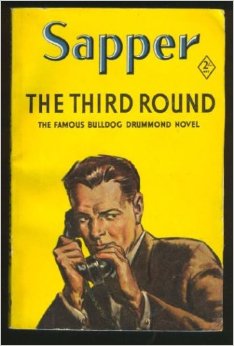
4b19b9961e944_71847n861809-superdicklib_3The strongest scenes in Bulldog Drummond (1920) are the ones that show off Sapper’s strengths as a humorist. While it has since become commonplace to see Bondian heroes tossing off quips while being menaced by an unfailingly polite villain, it hardly compares to the way Hugh Drummond handled himself in similar scenarios. Drummond regularly displays a self-deprecating humor when it comes to his features and his intellect, yet his ability to needle villains by refusing to treat them as a serious threat displays an intelligence and understanding of the criminal mind that provides a constant source of amusement to the reader.

Drummond may start off as an independently wealthy and very bored veteran of the First World War seeking adventure, but the character soon transforms into the head of a gang of vigilantes determined to right wrongs as they see fit. He and his gang view meting out justice without resorting to the law as their right as recently demobilized soldiers. The wartime ability to kill without fear of criminal punishment continues into their clandestine civilian activities, although they take the precaution of hiding behind masks and hoods to protect their identities when doing so.

Drummond’s gang includes his fellow World War I veterans Algy Longworth, Peter Darrell, Ted Jerningham, Toby Sinclair, and Jerry Seymour, as well as New York police detective Jerome Green. Later dubbed The Black Gang, the vigilante squad was clearly inspired by Edgar Wallace’s bestselling Four Just Men series. The secret war they wage is aimed squarely against the forces of socialism and communism to an extent that was matched only by Harold Gray’s original version of Little Orphan Annie. The anti-foreign sentiments in the first book are rooted in the perceived threat of foreigners altering the course of England’s political identity and economic status.

Read More Read More

Kidnapping, Murder, and Disrupting Traffic on Public Roadways: The Adventures of Captain Marvel, Chapter Three: Time Bomb

Kidnapping, Murder, and Disrupting Traffic on Public Roadways: The Adventures of Captain Marvel, Chapter Three: Time Bomb

Adventures of Captain Marvel Part 3-smallToday, before the lights go down and our show begins, we have a brief public sevice message. No, it’s not about the YMCA car wash or the Friends of the Library book sale. It’s about where you can find The Adventures of Captain Marvel for your own viewing.

The serial was last released on DVD in 2003, but is now only available used — the Amazon marketplace has several copies available. They can be a bit pricey, however; the serial was ten dollars ten years ago, when I bought mine new, but now the cheapest copies on Amazon are twice that.

A true hero never despairs, though, and there’s good news for those who want to experience serial thrills first hand, instead of just hacking their way through my breathless prose descriptions. The Adventures of Captain Marvel is available to watch on YouTube, along with many other classic (and not so classic) serials. It’s a great place to get acquainted — or reacquainted — with this kind of storytelling.

If online serial watching whets your appetite for more Saturday matinee thrills, I enthusiastically direct you to the Serial Squadron, a great group of people who seek out and restore serials — many of them rare or even thought to be lost. You can visit them at www.serialsquadron.com. They make remastered copies (often with plenty of great extras) for sale on DVD and also make them available for free viewing on their own YouTube channel, www.youtube.com/user/serialsquadron.

Now, sit back and let the wizard Shazam transport you to a world of action and excitement where evil keeps things interesting but justice is bound to prevail!

Read More Read More

Doctor Strange Gets a Director

Doctor Strange Gets a Director

Strange Tales 110 Doctor Strange-smallI’ve been getting cranky waiting for progress on Marvel’s Doctor Strange movie, and as the wait has stretched out, I’ve been getting progressively more pessimistic (see my March post, Hurry Up With That Doctor Strange Movie, Marvel.)

The property has enormous potential to be something completely original in the superhero genre — namely a faithful rendition of Steve Ditko’s playful (and totally bonkers) inter-dimensional setting, which is what first blew away so many readers of Doctor Strange in the 1960s. A hero whose adventures routinely took him to gorgeous, bizarre, imaginative, and frequently monster-filled realms where normal concepts of space and distance were useless was something totally new, and readers thrilled to it — and it took Ditko’s unique genius to really make it work.

However, Marvel Studios took a huge step forward this week, announcing that they had selected a director for the film: Scott Derrickson, writer/director of the terrific little horror film Sinister, perhaps the best horror flick of 2012. Derrickson has an impressive resume as a writer/director, including The Exorcism of Emily Rose (2005) and the upcoming Deliver Us from Evil (July 2014). He was also the director of the 2008 remake of The Day the Earth Stood Still.

If you’re getting a strong horror vibe off  Derrickson’s resume, you’re not alone. Matt D. Wilson at Comics Alliance did a fine job of articulating my own feelings on the announcement yesterday:

Seriously, though, that’s pretty interesting, considering that Doctor Strange has never been what I’d call a horror character, despite his many dealings with supernatural forces, demons, dark magic, and so forth. But his stories have always tended to be more fantastical, while other Marvel characters, such as Son of Satan, Werewolf By Night, and, you know, Dracula, have tended to be more horror-focused. The decision perhaps suggests a tone that won’t necessarily please Doctor Strange fans, but may be very palatable to general movie audiences, who made the low-budget Sinister a surprise hit back in 2012.

Read More Read More

To The Dark Tower He Came: Warlock of the Witch World by Andre Norton

To The Dark Tower He Came: Warlock of the Witch World by Andre Norton

oie_305718ZdC2d7IWIn my previous reviews of Andre Norton’s Year of the Unicorn and Three Against the Witch World, I wrote how exciting it was to discover that a series I had long overlooked was so much fun. I am happy to report that with Warlock of the Witch World (1967), things get even better.

In Science Fiction and Fantasy, edited by Reginald, Menville, and Burgess, Andre Norton wrote that “the background of most of [Witch World] is based on Celtic and early English folklore. Warlock of the Witch World is a retelling of “Childe Roland.” In the original Scottish ballad, the children of the queen are playing ball. When the daughter, Burd Ellen, dances widershins around the church, she vanishes. Her four brothers learn she has been taken prisoner by the King of Elfland. One by one, her brothers set off to save her, each disappearing in turn until only the youngest brother remains. Armed with a magic sword, he undertakes the quest — his siblings’ last hope.

In Three Against the Witch World, the three children of the dimensionally transported American, Simon Tregarth, and a Witch of Estcarp, Jaelithe, have escaped their homeland to the hidden land of Escore. There, the arrival of the triplets — warrior Kyllan, scholar Kemoc, and witch Kaththea — reawakened dark forces long asleep and reignited a war between the forces of Shadow and Light. By the end of the book, the stage for a final confrontation was being set. Allies for the armies of Light were being sought and marshaled in the magically protected Valley of Green Silences.

Read More Read More

What Might Have Been: Steven Bauer’s Satyrday

What Might Have Been: Steven Bauer’s Satyrday

SatyrdayOne of the interesting things about going back to the beginning of any tradition is seeing how things might have gone. Seeing, that is, possibilities unexplored and roads not taken. Sometimes you catch a glimpse of what, in retrospect, is an earlier stage of evolution. Sometimes there’s a sense of a missed chance. And then sometimes you can see why things went the way they did.

I’ve written here before about my fascination with underexplored elements in 80s fantasy. In this context I have an elastic definition for ‘80s,’ beginning in 1977 — arguably when the modern mass-market fantasy genre was born, with the publication of Brooks’s Sword of Shannara and Donaldson’s Illearth War — and ending whenever seems rhetorically convenient (I go back and forth, and any ideas in comments about when 80s fantasy ended will be read with interest). Particularly earlier on, there’s an odd mix in these years of idiosyncratic, individual tales alongside a developing commercial genre; in all, a lot of stories trying out techniques and approaches, a lot of writers finding out what works and what doesn’t. We remember, on the whole and more or less, the stuff that works. But sometimes it’s interesting to see the stuff that misfires and see other possibilities for the genre.

Steven Bauer’s Satyrday is mentioned in Clute and Grant’s Encyclopedia of Fantasy, where they call it a satire. I will say up front that I didn’t get that sense from the book and have no idea what it’s supposed to be satirising. It’s a book that mixes animal fable, Greek myth, and the then-emerging fantasy staple of a young boy coming to adulthood by engaging in a quest to defeat a dark lord. A great owl has captured the moon and holds it captive as part of a plot to gain ultimate power. But not far away, a satyr named Matthew has brought up a human boy named Derin, and at the urging of a raven named Deirdre they set out to free the moon and thwart the owl’s schemes. The adventure’s less than compelling, but there are nice passages and if the book doesn’t entirely come together, there’s still an engaging weirdness to the ingredients.

Read More Read More

Vintage Treasures: Eyes of Amber by John D. Vinge

Vintage Treasures: Eyes of Amber by John D. Vinge

Eyes of Amber John D Vinge-smallI’m still exploring the box of SF and fantasy paperbacks I inherited from my sister-in-law Mary Dechene after her death last month.

Mary enjoyed bestselling fantasy and she had a fabulous collection. But her library also had many surprises, including some from an age when it wasn’t unusual for a midlist author to have a mass market collection. In 1979 Joan D. Vinge had only two other books to her name, The Outcasts of Heaven Belt (1978) and Fireship (1978), when Signet published her short story collection Eyes of Amber, featuring the Hugo Award-winning title story. Among Mary’s collection was the 1983 Signet reprint, with a fabulous new cover by artist Tom Kidd (at right).

The Universe of the Imagination Awaits You in…

Eyes of Amber — The Hugo Award-winning story of one Earthman trying to play a symphony of civilization to a distant, barbaric world.

To Bell the Cat — What happens to humans facing a true alien encounter when they have already become alienated from each other?

View from a Height — What do you do with the rest of your life when you’re alone on a one-way journey to meet the universe?

Media Man — In the precarious society of Heaven Belt, he sold dreams to a dying people. And he knew his career would be over the day he told them the truth…

The Crystal Ship — The Star Well: Was it two races’ chance for the future or a bottomless pit in which all hope must die?

Tin Soldier — Can love really survive across the spaceways and down through time?

Read More Read More