Browsed by
Category: Vintage Treasures

New Treasures: Planets of Adventure by Murray Leinster

New Treasures: Planets of Adventure by Murray Leinster

Planets of Adventure-smallThere’s lot of great new arrivals to tell you about this week. I’ve got them all stacked up beside my green chair, unread. Because the book I’m really excited about is Planets of Adventure by Murray Leinster, published by Baen Books over a decade ago.

That’s when I first bought it, too — over a decade ago. I went hunting for a copy as a birthday gift for my son last week, and was thrilled to find it was still in print. A fat omnibus of pulp science fiction from one of my favorite science fiction writers, still in print in mass market after nearly eleven years!

Just like that, my faith in humanity is restored. Here’s the back cover blurb, ’cause it’s awesome.

Breathtaking space adventure by a master of interplanetary science fiction. Including two complete novels, one of them a Hugo Award-winner.

The Planet Explorer: As humans spread throughout the galaxy, thousands of planets have been colonized. Often, the colonists discover too late that an apparently hospitable planet conceals a danger to their survival. The fate of these colonies scattered across the galaxy rests with one man, whose own fate is to race forever against looming interstellar disaster.

The Forgotten Planet: A ship is marooned on a planet whose existence has been mislaid by the galactic bureaucracy. And the planet’s ecology has gone wild, breeding deadly giant insects. The ship’s crew and passengers have no hope of rescue. Can they and their descendants survive? Tune in next millennium.

Plus more exciting adventures of men and women against the hostile stars.

Read More Read More

Vintage Treasures: The Stars Are the Styx by Theodore Sturgeon

Vintage Treasures: The Stars Are the Styx by Theodore Sturgeon

The Stars Are the Styx-smallWe’re living in a truly splendid era for fantasy fans. Fantasy films and TV shows routinely top box office charts and Nielsen ratings, fantasy novels crowd bestseller lists, and Gandalf, Harry Potter, and Tyrion Lannister are all household names. Believe it or not, there was a time when girls did not find you cool for talking about Wolverine or Captain America, or for being able to rattle off the names all 13 dwarves who accompanied Bilbo into the Misty Mountains. Hard to comprehend, I know.

Even those of us who cherish the history of the genre have a lot to celebrate. Many of the great fantasy books of the 20th Century are still in print, or at least available inexpensively online. Let’s face it — if you’re a fantasy fan, the world is your oyster.

Unless you’re a fan of short story collections, of course. In which case, you’re out of luck.

For most 20th Century fantasy writers, this has been a regrettable literary development, but not catastrophic. Most didn’t have short story collections anyway. But for some — like the great Theodore Sturgeon, who produced much of his best work at short length — it means that the 21st Century is rapidly forgetting them.

And that’s a tragedy. Yes, Sturgeon did leave behind a handful of novels, some of which — like More Than Human, The Dreaming Jewels, and Venus Plus X — are still in print today (in attractive trade paperback editions from Vintage Books actually; check ’em out.) But for decades before his death in 1985, he was justly renowned as one of the finest short story writers the field had ever seen.

Read More Read More

Backed into a Corner by Smoking Lava: The Adventures of Captain Marvel, Chapter Five: The Scorpion Strikes

Backed into a Corner by Smoking Lava: The Adventures of Captain Marvel, Chapter Five: The Scorpion Strikes

Adventures of Captain Marvel Scorpion Strikes lobby card-smallNow that the ushers have gathered all of the popcorn boxes left from the last show and have safely withdrawn, settle back in your seats. Let the lights go dim and the fun begin; it’s time for this week’s edge-of-your seat episode in The Adventures of Captain Marvel. Today’s chapter: “The Scorpion Strikes.”

Four title cards will enlighten those who were napping last week. “The Scorpion — Traps Billy Batson in Chan Lal’s curio shop.” “Betty — Is held prisoner at the N Street Garage by the Scorpion’s men.” “Barnett — Is forced to tell Captain Marvel where Betty is being held.” “Captain Marvel — Races to her rescue.”

Now, let the arcane arts of the Wizard Shazam transport you to realms of action and adventure undreamed of by those who chose to stay home and play stickball or have a tea party in the backyard with their dolls. Say the name!

A flashback to last week’s nail-biting conclusion shows Betty, unconscious in her car, hurtling down the garage ramps as Captain Marvel speeds to the scene. The life-size flying model is used to show his approach, its cape rippling in the wind as it moves diagonally downward across the front of the garage building. The landing is very nicely done, with stuntman Davy Sharpe alighting on the ground after a drop of at least ten feet; the film is slowed very slightly as is usual in these shots, and the result is quite effective — we’re convinced that Captain Marvel has just flown in. As with all of the flying effects in the serial, this sequence is a top-notch combination of stunts and model work.

Read More Read More

Thanks, Dad

Thanks, Dad

HolmesboxI’ve mentioned before – probably too often – that the first copy of Dungeons & Dragons I ever owned was the 1977 Basic Set edited by J. Eric Holmes, featuring a cover illustration by the late, great David C. Sutherland III. The contents of that boxed set are pictured to the right, though the particular version I owned did not come with the dice shown there, but rather laminated cardboard chits. I had to purchase those dice separately through a local toy store.

I loved that Basic Set to bits – literally. I carried it with me everywhere: to school, to the library, to my grandparents’ place, but most often to my friends’ homes, where we’d gather round a table to play this incredible new game we discovered over Christmas break. Consequently, the box eventually fell apart, just as the rulebook and adventure module started losing pages. Before too long, all that remained were the chits, which I still own to this day. I still own the dice, too, but they’re so battered and beaten that the twenty-sider is barely recognizable, never mind usable.

I think about that Basic Set often, because it was my introduction to a hobby I still enjoy to this day, but I found myself thinking about it this past Sunday – Father’s Day – for another reason. By the time I first encountered D&D in 1979, it was well on its way to becoming a genuine fad, helped in no small part by the notoriety it achieved due to its supposed connection to the disappearance of a Michigan State University student earlier that year. The Basic Set I first owned was originally purchased for my father. My mother bought it in the belief that he’d want to see what this game was all about, since he’d been reading all the newspaper and magazine articles he could find about the Michigan State disappearance.

As it turned out, Dad had no interest in learning to play Dungeons & Dragons whatsoever, which is why he readily turned it over to me when I expressed an interest in learning more. It’s for that reason that I’ve always considered him to be the person who first introduced me to roleplaying, even though he was not (and never would be) a roleplayer himself.

Read More Read More

Galaxy Science Fiction, December 1951: A Retro-Review

Galaxy Science Fiction, December 1951: A Retro-Review

Galaxy Science Fiction December 1951-smallGalaxy’s December issue hit newsstands with a holiday cover: Santa Claus smoking a pipe on an alien world in a restaurant patronized by humans and aliens. This was a very strong issue and I loved it.

There are other Galaxy stories I would place above those in this issue, such as Bradbury’s “The Fireman” or anything by Poul Anderson, but the contents of December 1951 are amazing. I couldn’t even pick a favorite story. Authors include Damon Knight, Fritz Leiber, and Jack Vance, so that might be part of the reason for its greatness.

“World Without Children” by Damon Knight — George is the last recorded birth for humanity, and even though that was 200 years ago, people still refer to him as The Child. The birth prohibition is firmly in place to prevent overpopulation — a reasonable precaution since scientists have figured out a way to extend a human lifespan by fifty times.

But even if it were repealed, very few of the populace would have the ability to procreate. George is part of a small group of individuals who realize that the trade-off for longevity was sterility, and since they cannot convince the government to take action, they plan to start an underground birthing organization.

The story seemed to start out a bit slow, but it soon moved into a cloak-and-dagger, resist-the-all-powerful-government thriller. I’m not sure if I liked the ending, though. It seemed too upbeat after everything else that took place.

“A Pail of Air” by Fritz Leiber — The earth has been ripped free from its orbit around the sun by the gravitational pull of a dark star. One family works together to survive in the frozen world.

Read More Read More

Were These the 10 Best Ghost Stories as of 1927?

Were These the 10 Best Ghost Stories as of 1927?

photo 1In 1927, Funk & Wagnalls Company published a 10-volume set titled The World’s One Hundred Best Short Stories. Edited by Grant Overton, each small (about 4” by 6.5”), red, hardbound book had a distinct sub-heading: V1. Adventure, V2. Romance, V3. Mystery, V4. Love, V5. Drama, V6. Courage, V7. Women, V8. Men, V9. Ghosts, V10. Humor.

Before I get to the meat-and-potatoes of this post (and if you think that would be volume 9, you would be eerily correct), a couple random observations about the series overall…

First: what an idiosyncratic parsing of genres! Four or five of them would be recognizable genres today, but I’ve yet to see a “courage” section in any bookstore.

Second: I wonder what distinguishes stories of “love” from stories of “romance”? My first thought was that maybe “romance” was being used in an earlier sense — as describing literature like the tales of King Arthur and stories that we would today classify as “fantasy.” Nope. A brief perusal was enough to see they’re romance stories in the modern sense.

Third: “Drama” here is meant to denote what we’d probably just deem mainstream or literary fiction. That volume includes stories by Kathleen Norris, Stephen Crane, and Guy de Maupassant (“The Necklace”, one of my first introductions to “literary fiction” in school — a story that fostered the oft-reinforced impression that “literary” fiction has to be depressing). “Drama” as it is used today — and back then too, for that matter — denotes stage scripts, at least in literary studies. Come to think of it, “drama” as Overton applied it to short stories back in 1927 is how it is now used in classifying films.

Okay, enough of the general observations. What really piqued my curiosity, when I came across these little volumes in a box dropped off at the bookstore where I work, was that ninth volume. Ghosts.

Read More Read More

New Treasures: Adventure Tales #7

New Treasures: Adventure Tales #7

Adventure Tales 7-smallHurrah! Hurrah! The latest issue of Adventure Tales has arrived! And a spectacular issue it is.

It starts with the cover, a reprint of my all-time favorite Planet Stories cover. I’ve always wanted to know who painted it — and I still don’t know, as the cover artist remains uncredited. (Maybe nobody knows? Sadly, that’s entirely possible.)

It’s been a long, long time since we’ve seen an issue of Adventure Tales, Wildside Press’s flagship magazine of pulp reprints. And speaking as a magazine publisher who thought he was doing well putting out one issue a year, that means something. Here’s an explanatory snippet from John Betancourt’s (anonymous) editorial:

We are, as usual, managing to keep to our “irregular” schedule with an issue that’s “only” 4 years in following the last one. Hopefully that won’t happen again. (Blame the economy… we’ve had to focus on things that actually make money, rather than the publisher’s time-consuming pulp-magazine hobby!)

I’m hugely appreciative of Wildside’s tireless efforts to keep countless genre authors — many of whom have no other outlet — constantly in print. But having said that. I still vote for more issues of Adventure Tales. Let’s hear it for time-consuming pulp-magazine hobbies! They make the world go round.

Read More Read More

Doug Draa on Weird Tales and Keeping the Brand Alive: The Paperback Years

Doug Draa on Weird Tales and Keeping the Brand Alive: The Paperback Years

Creeps by Night-smallLong before Doug Draa became an occasional blogger for Black Gate, I was a reader of his blog, Uncle Doug’s Bunker of Horror, which we’ve celebrated before. I especially enjoyed his habit of using any excuse whatsoever — and I do mean any excuse — to post luscious high-res images of countless beautiful old paperbacks. Reading Uncle Doug’s Bunker was like browsing a superb used bookstore (without any money).

As Doug has become busier with other projects, including becoming an Online Editor for Weird Tales, he’s been less and less able to keep up his blog. So I was delighted to see that he’s now started to post at the Weird Tales site. His recent articles include “The 15 most entertaining Horror Films from the 1980s,” “Four Decades of the Lovecraftian Aesthetic in Paperback,” “Lin Carter’s Weird Tales” and more fun stuff like that (see a complete archive here.)

On May 25, Doug posted one of his best recent articles, continuing his series on 90 Years of Weird: Keeping the Brand Alive: The Paperback Years. Doug surveys three decades of paperback anthologies reprinting WT fiction, from the death of the pulp magazine in September 1954 through its rebirth in 1988, generously illustrated with nearly three-dozen high-res scans. Here’s a quick snippet:

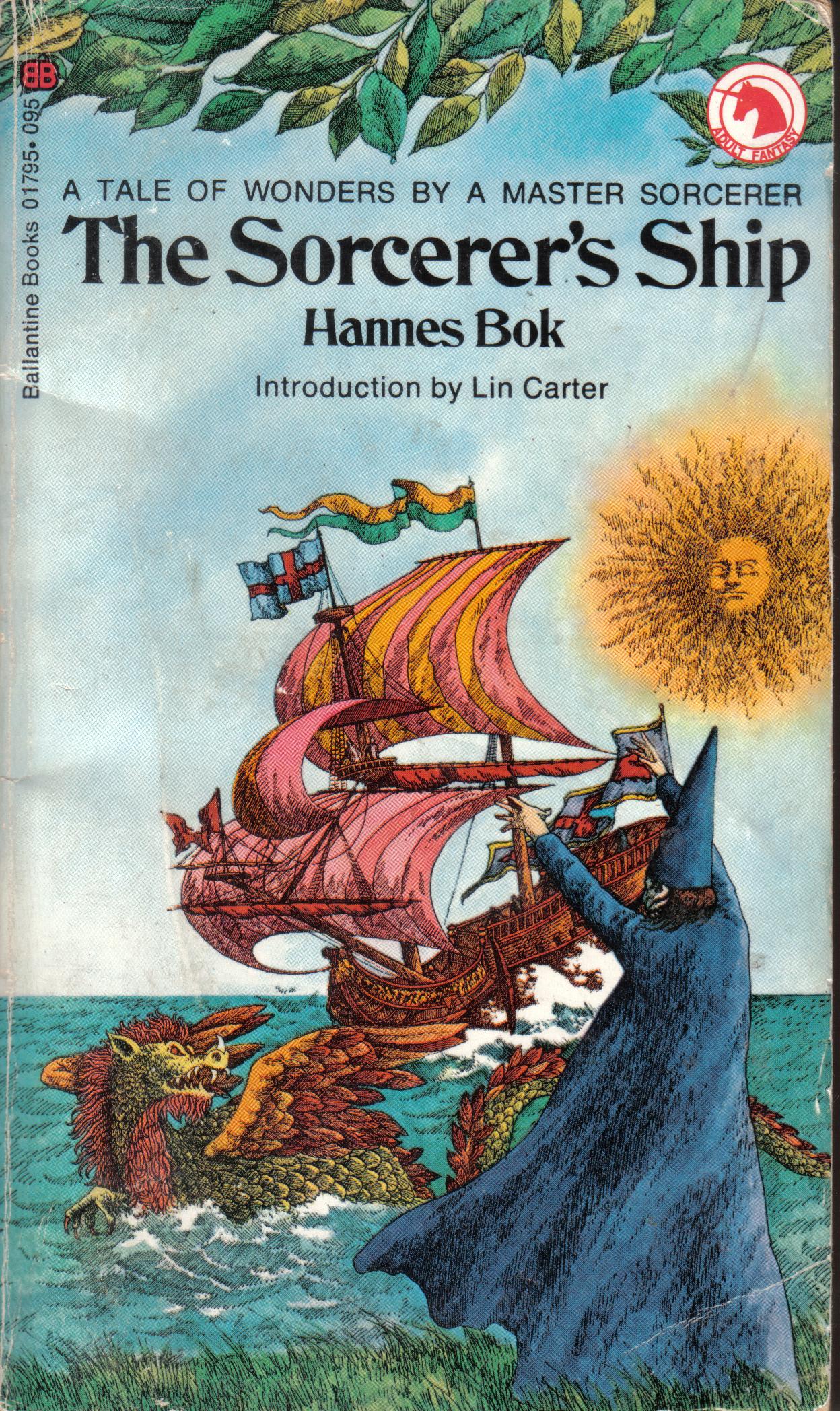
Lin Carter has a special place among the ranks of Weird Tales preservationists and revivalists. During the late 1960s and early 70s he edited and reprinted many H. P. Lovecraft and Clark Ashton Smith collections as part of his Adult Fantasy Series published by Ballantine. Mr. Carter never failed to sing praises to Weird Tales from the roof tops in his numerous introductions to the collections in this series. At the beginning of the 1980s Mr. Carter even went as far as to revive Weird Tales in paperback format for four issues. This incarnation wasn’t a darling of the critics, but I found it to be enjoyable and true to the original vision of the magazine… Thank you Mr. Carter, I drink to your Shade!

See the complete article here.

Kirkus Looks at Andre Norton’s Young Adult Novels

Kirkus Looks at Andre Norton’s Young Adult Novels

Star Born Andre Norton-smallAndrew Liptak has written a fine series of pulp and classic SF retrospectives SF at Kirkus Reviews over the last few months. In his latest, which he introduces at his website, he looks at the often-neglected YA novels of the great Andre Norton:

Norton wrote largely for what we now call the YA audience: teenagers, with fantastical adventures throughout numerous worlds and times. She was also largely ignored or dismissed for writing ‘children’s literature’, which is a shame, because it’s likely that she had as great an influence on the shape of the modern genre as Robert Heinlein, [whose] Juvenile novels attracted millions of fans to new worlds. Norton was the same, and influenced countless readers and writers for decades. It’s fitting that the major SF award for YA fiction is titled The Andre Norton Award for Young Adult Science Fiction and Fantasy.

Go read the entire article here. Or have a look at some of Andrew’s previous articles, including:

Astounding Science Fiction
Galaxy Science Fiction
Donald A. Wollheim and the Ace Double
The Meteoric Rise and Fall of Gnome Press

Digging further, I note that Andrew has also published blog posts on Leigh BrackettHeinlein and Asimov, Philip K. Dick, Francis Stevens, C.L. Moore, Judith Merril, Margaret St. Clair, Katherine MacLean, and Anne McCaffrey, all at the Kirkus site. How did I miss all that? Clearly, I have some catching up to do!

In Praise of Paperbacks

In Praise of Paperbacks

The Chessmen of Mars-smallFirst, a disclaimer. The Luddite rant that follows is my personal view only. I acknowledge the many benefits and advantages of electronic reading devices and to all of the people (many of them dear friends of mine) who would never think of parting with their Kindle, iPad, Nook, or whatever, this is in no way a judgment or condemnation of you or your reading preferences. It is simply about me and my preferences. Now, let the rant begin.

I teach elementary school, and when I began that job, ten years ago, I was faced with the “problem” of what to do with my summers. Yardwork? Get the garage in order? Any of the thousand other home projects that clamor for attention during the working week and never get done for lack of time or energy? Attractive as these options are, I quickly hit upon the happy idea of passing my summers in the same way I did as an adolescent, in reading through as many SF/fantasy paperbacks as I possibly could in the allotted time. Though age does take its toll, and gone are the days when I had the stamina to read The Chessmen of Mars or Have Spacesuit, Will Travel through in a single sitting, as I did when I was thirteen, I still manage to do all right. The choice to spend my extended vacations reliving those great days of blissful, carefree reading is one of best I’ve ever made.

A couple of summers ago, having just finished one book (I think it was one of E.C. Tubb’s Dumarest of Terra novels), I looked around for my next read. There on the shelf was a paperback copy of The Stars Are Ours by Andre Norton. My copy is a 40 cent paperback, published by Ace in 1954. The book is great fun and I quickly zipped through it.

Read More Read More