Browsed by
Category: Pulp

New Treasures: The Big Book of Adventure Stories, edited by Otto Penzler

New Treasures: The Big Book of Adventure Stories, edited by Otto Penzler

The Big Book of Adventure Stories-smallIt shouldn’t be a surprise that I love these big omnibus collections, and The Big Book of Adventure Stories is much bigger and omnibus-er than most. Weighing in at a generous 896 pages, it’s Penzler’s generous gift to those of us who love fast-paced pulp adventure… or just need a door stop (for a bank vault).

The massive volume is divided in 11 intriguing sections, including Sword & Sorcery, Man Vs. Nature, Island Paradise, Go West, Young Man (pulp westerns), Future Shock (science fiction), Yellow Peril (sinister Asian villains), and by far the largest, In Darkest Africa.

You can pack a lot of great authors into nearly 900 pages, and Penzer doesn’t disappoint, including Robert E. Howard, Fritz Leiber, Philip Jose Farmer, Harold Lamb, Rudyard Kipling, Ray Cummings, Rafael Sabatini, Sax Rohmer, Cornell Wollrich, Louis L’Amour, and many others. Among other fascinating tales are the one that introduced The Cisco Kid, O. Henry’s 1907 “The Caballero’s Way,” and Edgar Rice Burrough’s complete novel Tarzan the Terrible.

Everyone loves adventure, and Otto Penzler has collected the best adventure stories of all time into one mammoth volume. With stories by Jack London, O. Henry, H. Rider Haggard, Alastair MacLean, Talbot Mundy, Cornell Woolrich, and many others, this wide-reaching and fascinating volume contains some of the best characters from the most thrilling adventure tales, including The Cisco Kid; Sheena, Queen of the Jungle; Bulldog Drummond; Tarzan; The Scarlet Pimpernel; Conan the Barbarian; Hopalong Cassidy; King Kong; Zorro; and The Spider. Divided into sections that embody the greatest themes of the genre — Sword & Sorcery, Megalomania Rules, Man vs. Nature, Island Paradise, Sand and Sun, Something Feels Funny, Go West Young Man, Future Shock, I Spy, Yellow Peril, In Darkest Africa — it is destined to be the greatest collection of adventure stories ever compiled.

Featuring: Lawless open seas, ferocious army ants, deadeyed gunmen, exotic desert islands, feverish jungle adventures.

Read More Read More

Life Underground

Life Underground

manfrommarsI suppose it’s only natural that I’d consider the decade of my formative years – the 1970s – to have been the “perfect” one in which to grow up. I have little doubt that those whose childhoods encompassed the ’80s or even (Merritt forfend!) the ’90s may feel the same way. They’re wrong, of course, at least if you were the kind of kid who enjoyed hearing tales of the weird, the strange, and the occult. The 1970s were alive with such nonsense, from Bigfoot to ancient astronauts to the Loch Ness Monster, not to mention The Exorcist, In Search Of, and The Night Stalker. And let us not forget that the decade also saw the popularization, through books and movies and television, of the watered-down Theosophy of the New Age movement. In retrospect, it all makes sense if you look at the ’70s as a ten-year hangover in the aftermath of the various counterculture movements that spread like wildfire during the 1960s.

For a lot of adults living at the time, it probably wasn’t pretty, but, for me, as a child with a sense that there was more to the universe than what we saw everyday, it sure was fun. Though far more skeptical today, I still retain a keen interest in such oddities, as well as the sense – or is it merely the hope? – that I was not wrong in my youthful intuition that there are more things in heaven and earth than are dreamt of in our philosophy. Like Fox Mulder, “I want to believe,” even if I find it increasingly hard to summon up the credulity necessary to do so. Perhaps that’s why, even as I scoff, I nevertheless retain a more-than-grudging admiration for men and women who do believe, often in the face not merely of seemingly contradictory facts, but also of social ridicule, ostracism, and abuse.

That probably explains why I’ve long been intrigued by “the Shaver Mystery,” which first burst upon the world in the form of the story “I Remember Lemuria,” published in the March 1945 issue of Amazing Stories. The story purports to be an ancient, first-person account (preserved in “thought records”) of an advanced subterranean civilization that once existed on Earth and whose remnants continue to have intermittent – and often unpleasant – contact with the surface.

Read More Read More

Terror in the Heroic Age: Lovecraft and Culbard’s At the Mountains of Madness: A Graphic Novel

Terror in the Heroic Age: Lovecraft and Culbard’s At the Mountains of Madness: A Graphic Novel

At the Mountains of Madness Culbard-small“At the Mountains of Madness” is one of my favorite Lovecraft tales. It was originally serialized in the February, March, and April 1936 issues of Astounding Stories; I was first exposed to it through the brilliant audio adaption from Dark Adventure Radio Theatre, which I listened to during a snowy commute through lonely back highways in Illinois in the winter of 2010. Marvelous stuff.

So in November, I was very intrigued to read James Maliszewski’s review of a recent comic adaptation by I.N.J. Culbard. Here’s James:

In 124 pages, Culbard succeeds in re-telling one of Lovecraft’s best tales in a fashion that’s both engaging and true to its source. That’s harder than it sounds…

Culbard deftly pares the story down to its essentials, in terms of action, dialog, and exposition. The story thus moves along at a fairly brisk pace, something that cannot be said of the novella, love it though I do. Second, the artwork, which, to my mind, recalls Hergé’s Tintin series, contributes greatly to a sense of narrative motion, which is vitally important in an adaptation of a long and complex story like this one. Furthermore, the artwork suits the subject matter perfectly, recalling as it does (at least to me) stories of late 19th and early 20th century exploration in the still-dark corners of the globe… Even though I already knew the plot intimately, I found Culbard’s strong, clear, almost innocent, illustration style gave it new life, something I didn’t think possible.

Sold! I especially enjoyed James’s description of artwork that recalled “stories of late 19th and early 20th century exploration in the still-dark corners of the globe.” I asked for the Culbard’s graphic novel version for Christmas and my lovely bride was kind enough to deliver.

Read More Read More

New Treasures: Old Mars, Edited by George R.R. Martin and Gardner Dozois

New Treasures: Old Mars, Edited by George R.R. Martin and Gardner Dozois

Old Mars-smallI heard George R.R. Martin and Gardner Dozois were doing a new science fiction anthology about Mars and I thought, “Eh, Mars. It’s just no fun anymore. Too bad they don’t write stories about Mars the way they used to — like Clark Ashton Smith’s brilliant “The Vaults of Yoh-Vombis,” or Leigh Brackett and C.L. Moore’s fabulous tales of decadent civilizations and inscrutable alien mysteries. No one has that much imagination any more. Bah! I think I’ll go yell at the kids to get off the lawn.”

Then Old Mars finally arrived and it thawed my mean old heart. Martin and Dozois have rallied some of the finest writers in the industry — like Michael Moorcock, Joe R. Lansdale, Ian Mcdonald, Howard Waldrop, Matthew Hughes, Phyllis Eisenstein, and many others — to write brand new tales of Mars in the classic pulp tradition. Here’s the marvelous book description:

Burroughs’s A Princess of Mars. Bradbury’s The Martian Chronicles. Heinlein’s Red Planet. These and so many more inspired generations of readers with a sense that science fiction’s greatest wonders did not necessarily lie far in the future or light-years across the galaxy but were to be found right now on a nearby world tantalizingly similar to our own — a red planet that burned like an ember in our night sky… and in our imaginations.

This new anthology of fifteen all-original science fiction stories, edited by George R. R. Martin and Gardner Dozois, celebrates the Golden Age of Science Fiction, an era filled with tales of interplanetary colonization and derring-do. Before the advent of powerful telescopes and space probes, our solar system could be imagined as teeming with strange life-forms and ancient civilizations — by no means always friendly to the dominant species of Earth. And of all the planets orbiting that G-class star we call the Sun, none was so steeped in an aura of romantic decadence, thrilling mystery, and gung-ho adventure as Mars.

Join such seminal contributors as Michael Moorcock, Mike Resnick, Joe R. Lansdale, S. M. Stirling, Mary Rosenblum, Ian McDonald, Liz Williams, James S. A. Corey, and others in this brilliant retro anthology that turns its back on the cold, all-but-airless Mars of the Mariner probes and instead embraces an older, more welcoming, more exotic Mars: a planet of ancient canals cutting through red deserts studded with the ruined cities of dying races.

Martin and Dozois may well have produced my dream anthology. You don’t know how thrilled I am to see this kind of open-hearted embrace of the genre’s pulp roots from a major publisher.

Read More Read More

Lord Dunsany, Philip José Farmer, and Appendix N: Advanced Readings in D&D

Lord Dunsany, Philip José Farmer, and Appendix N: Advanced Readings in D&D

Over the Hills and Far Away-smallI’m still enjoying the Appendix N surveys by Tim Callahan and Mordicai Knode at Tor.com, as they read through every author Gary Gygax cited as an influence on Dungeons and Dragons, even though I’ve found lots to disagree with in their recent columns.

So I’m happy to continue with these re-caps here. Especially since I don’t have a lot emotionally invested in their next two subjects: Lord Dunsany and Philip José Farmer.

I have a lot of respect for Lord Dunsany, but that chiefly stems from the many fine writers who have cited him as an influence. I’ve read only a handful of his shorter works and, while I’ve enjoyed what I’ve read, he’s mostly an untapped natural resource for me.

It’s much the opposite with Philip José Farmer. I was a huge fan of his Riverworld books when I first read them decades ago. But they didn’t really hold up on re-reading 15 years later, for me.

So Farmer is a writer I largely lost interest in years ago, although I have to admit I haven’t really given fair attention to his many fantasy novels. I know his work is highly regarded, and in fact both Cynthia Ward and Christopher Paul Carey made excellent cases here for why I should pay a lot more attention to his Gods of Opar and Tales of the Wold Newton Universe series, for example.

So let’s say I have more of an open mind with both Lord Dunsany and Philip José Farmer, and I’m willing to be influenced.

With that out of the way, let’s see what Tim and Mordicai have to say.

Read More Read More

Galaxy Science Fiction, July 1951: A Retro-Review

Galaxy Science Fiction, July 1951: A Retro-Review

galaxy science fiction July 1951-smallWith a colorful, 4th of July holiday-appropriate cover, the July issue of Galaxy hit newsstands (or arrived in your mailbox if you were a subscriber), much to the delight of its readers (or so I imagine). The issue felt very full — as though H. L. Gold used some undetectable device to cram extra fiction into the folds. Or perhaps it was the anticipated conclusion of “Mars Child” and the absence of any science article. At any rate, I think this was one of the better issues.

“Venus is a Man’s World” by William Tenn — Ferdinand is the only boy on a rocket filled mostly with young women on a journey to Venus. That world offers a better opportunity of finding a suitable husband than Earth, where the population is mostly made up of women. Not that Ferdinand cares about any of that. He just wants something to do, so he explores the ship, including restricted areas, like one of the lifeboats. Except that someone’s already in the lifeboat — a stowaway who calls himself Butt. And Butt knows all kinds of things that Ferdinand’s sister never talks about. If only he’d let Ferdinand hold his gun…

I absolutely loved this story, and it was easily my favorite of the issue. The narration is told in first-person from Ferdinand’s point of view, and it is hilarious and engaging. Butt’s character is outstanding. This is also a piece that stands the test of time. It was eventually collected in William Tenn’s third collection, The Square Root of Man (1968).

“Common Denominator” by John D. MacDonald — As humanity begins to study another advanced race in the galaxy, they discover that the aliens have a crime rate and insanity rate of nearly zero. Charting the past millennia reveal that it all improved eight thousand years in the past. Lambert, Chief of the Bureaus of Racial Maturity, has the chance to speak with one of them and to try to understand how such a change was possible.

While the story itself is written well, I found the premises simplistic and absurd. But I’m not going to reveal the reason for the alien race’s rise in peace and safety because that is part of the bite of the story. I’m starting to see more of this trend in some of Galaxy’s fiction, though, where an author will envision what humanity (or a variety of humanity) might look like if X or Y was subtracted or added. And that utopia is but one tweak away.

Read More Read More

Robert E. Howard and the Yellow Peril

Robert E. Howard and the Yellow Peril

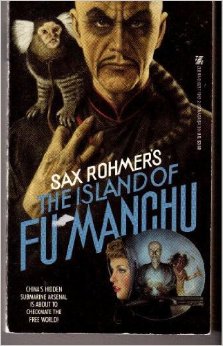
MenaceSteve-Harrisons-Casebook1Many pulp writers were influenced by the success of Sax Rohmer’s Yellow Peril criminal mastermind, Dr. Fu Manchu. The best of the early imitators was Achmed Abdullah’s The Blue-Eyed Manchu while the pulp era brought Robert J. Hogan’s The Mysterious Wu-Fang and Donald Keyhoe’s Dr. Yen-Sin to give the Devil Doctor a run for his money.Today, the best remembered Fu Manchu clone is undoubtedly Ian Fleming’s Dr. No. Marvel Comics’ The Mandarin and The Yellow Claw are the other two characters who have burrowed the furthest into popular culture’s collective memory of the past century.

Having to choose the one of the scores of imitations that came closest to matching Rohmer for style and yet was distinct enough to avoid being nothing more than a shameless copy, I would have to single out Robert E. Howard’s Skull-Face and Erlik Khan, the Lord of the Dead. Howard’s reputation as a story-teller has grown over the past few decades to allow him to escape the looming shadow of his immensely popular sword and sorcery hero, Conan the Barbarian and be recognized as a singular talent who mastered many genres during his all too brief life. Sadly, his Yellow Peril thrillers are still largely unknown outside the circle of Howard completists.

Read More Read More

Prologomenon to Fantasy

Prologomenon to Fantasy

bullfinchOne of the things that I frequently blather about is that, when I was growing up in the 1970s, “fantasy,” as it’s understood today didn’t really exist, at least not as a mainstream, popular genre.

Don’t get me wrong: the ’70s were a decade of fantasy par excellence, especially literary fantasy, from reprintings of earlier works, such as the Lancer Books Conan series (begun in 1966) and the Ballantine Adult Fantasy series (begun in 1969), to the Tolkien imitators, like Terry Brooks’s The Sword of Shannara (1977) and Stephen R. Donaldson’s Lord Foul’s Bane (1977) – not to mention Tolkien’s own The Silmarillion (1977 once again!) – to modern classics like Fritz Leiber’s Our Lady of Darkness (guess what year?). The ’70s also saw fantasy rise to prominence in other media, like comic books, where Roy Thomas’s Savage Sword of Conan cultivated an entire generation of artists, and movies, where special effects artists continued to acquire the skills and technology to bring fantasy to life on the silver screen. And, of course, the decade also saw the appearance and flourishing of fantasy roleplaying games, beginning with Dungeons & Dragons in 1974.

Despite these strides, spearheaded by the faddish popularity of D&D and its imitators, I’d argue that fantasy didn’t really come into its own as a pop cultural phenomenon until much later. Consequently, when I first encountered Dungeons & Dragons very late in 1979, I had almost no direct experience of what we’d nowadays call fantasy. Indeed, I wouldn’t read a word of The Lord of the Rings or the tales of Conan until after I’d begun rolling polyhedral dice. For that matter, I don’t think I’d even heard of J.R.R. Tolkien or Robert E. Howard until I encountered both their names in the pages of the J. Eric Holmes-edited D&D rulebook that was my introduction to the game. The same goes for Lovecraft, come to think of it, and most of the other authors whom we typically regard as the “founders” of fantasy. In that respect, my youth is very different than that of 21st century fantasy aficionados, almost all of whom I’d bet didn’t make it to the age of 10 without at least being familiar with the characters and ideas these authors birthed.

However, this isn’t to say I had no experience with fantasy before I discovered Dungeons & Dragons, only that my introduction to it was of a different sort, one I expect I shared with many kids of my generation.

Read More Read More

New Treasures: The House of R’lyeh: Five Scenarios Based on Tales by H.P. Lovecraft

New Treasures: The House of R’lyeh: Five Scenarios Based on Tales by H.P. Lovecraft

The House of R'lyeh-smallI feel like I’m in the middle of H.P. Lovecraft week.

On Sunday I talked extensively about Lovecraft, a propos of his inclusion in the latest round of Advanced Readings in D&D. This morning I invoked his name while discussing Robert Bloch’s Nightmares collection. Now here we are again, with the latest collection on adventures for one of my favorite role-playing games, Call of Cthulhu, based on the work of H.P. Lovecraft.

I bought my first CoC adventure — the classic Shadows of Yog-Sothoth — over 30 years ago (yes, I’m aware that’s longer than most of you have been alive. Shut up), and the most recent, Cthulhu By Gaslight, last April. I haven’t played CoC in years (decades, probably), but the adventures are marvelously inventive and always a pleasure to read for a veteran game master like me. But The House of R’lyeh has extra appeal for Lovecraft fans of all kinds, not just CoC players, I think: it draws directly from five of the Master’s short stories. I’m looking forward to digging in and seeing how successful it is.

The House of R’lyeh contains five Call of Cthulhu scenarios that follow or expand upon events in five of H.P. Lovecraft’s stories: “Pickman’s Model,” “The Haunter of the Dark,” “The Hound,” “Arthur Jermyn,” and “The Nameless City.” Set in Boston, Providence, the British Isles, continental Europe, and the Middle East, none of the scenarios need be played at set dates or in a set order, but they could be run in the order presented to form a loose campaign using optional link between scenarios to draw investigators from one to the other.

Alternatively, the scenarios may be used to supplement classic Call of Cthulhu campaigns such as The Shadows of Yog-Sothoth which suggests that its component scenarios should be interspersed with others.

Read More Read More

Vintage Treasures: Nightmares by Robert Bloch

Vintage Treasures: Nightmares by Robert Bloch

Nightmares Robert Bloch-smallI’ve been on something of a Robert Bloch kick recently.

It started with the Vintage Treasures article on The Best of Robert Bloch I wrote back in July, the second in my series on Lester Del Rey’s Classics of Science Fiction. That lead me to his Lovecraftian novel Strange Eons, first published in 1979, which I wrote about in October.

Strange Eons was fun, but honestly I think I prefer Bloch’s short stories. And he certainly has a lot of them, gathered in dozens of collections starting with The Opener of the Way, published in 1945 by Arkham House when he was just 28 years old, and ending the year he died with his final collection The Early Fears (1994, Fedogan & Bremer) — which won the Bram Stoker Award for Superior Achievement in a Fiction Collection.

As usual, I tend to gravitate towards the paperbacks. Last week I bought a copy of Nightmares, a slender 1961 paperback from Belmont which contains 10 short stories originally published in Weird Tales, Fantastic, The Magazine of Fantasy and Science Fiction, and other fine publications.

Nightmare is a selection of tales from Pleasant Dreams — Nightmares (1960), an Arkham House hardcover which contained 16 short stories and novelettes (and cost, according to a note on the copyright page, an outrageous $4). The paperback is dedicated to August Derleth, Fritz Lieber (sic), and Star Trek writer Samuel A. Peeples, author of “”Where No Man Has Gone Before” (one of my favorite episodes, incidentally, although doubtless he’s listed here for his horror work).

And yes, Fritz’s Leiber’s name was misspelled. Clearly the paperback editions were not edited as tightly as they could have been, or Fritz Leiber wasn’t yet a big name. Probably both.

Read More Read More