Browsed by
Category: Pulp

Vintage Treasures: The Man Who Awoke by Laurence Manning

Vintage Treasures: The Man Who Awoke by Laurence Manning

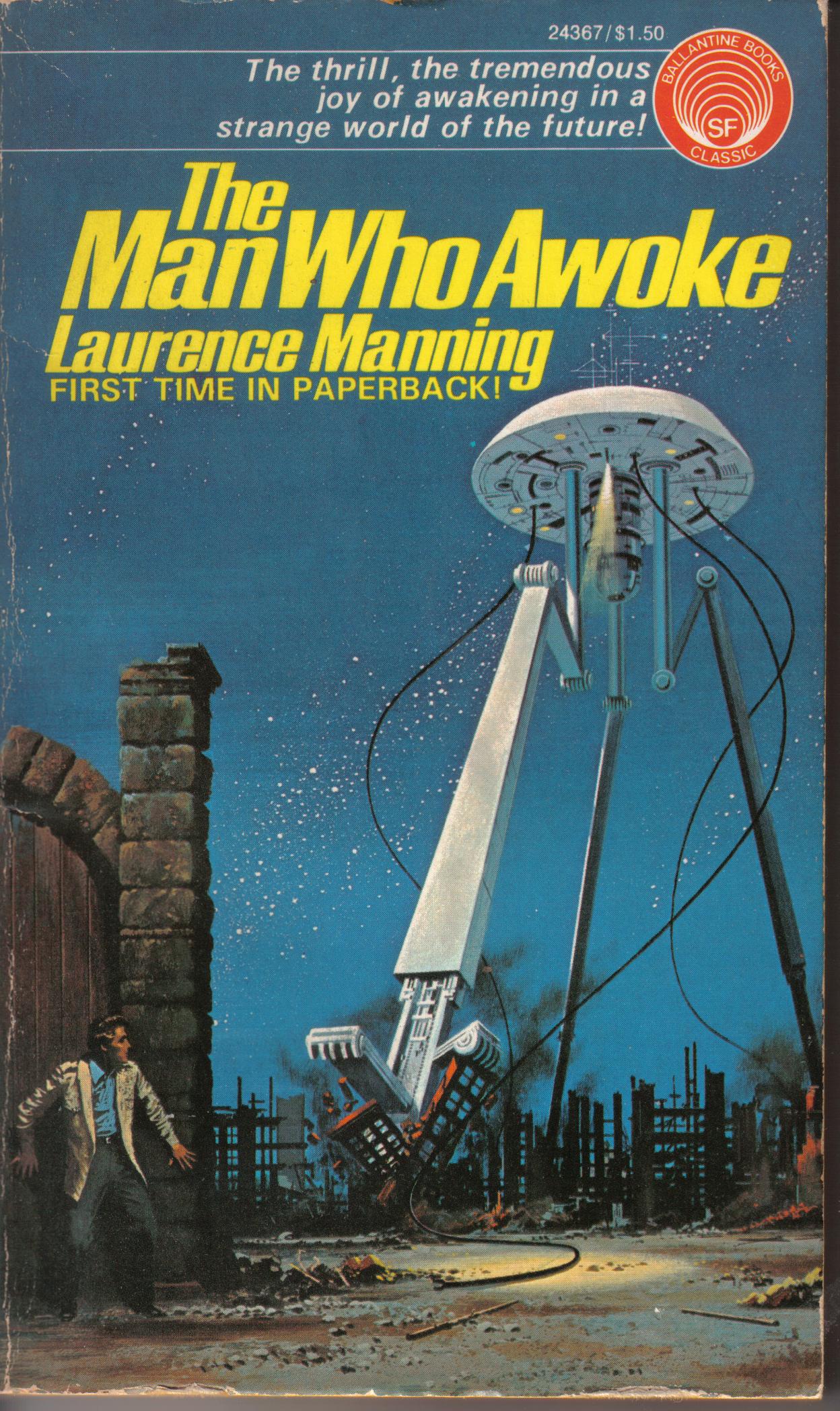
The Man Who Awoke-smallI love dollar bins. If you’ve ever been in the Dealer’s Room at a convention, or any decent bookstore, you know what I’m talking about. The jumbled box at the foot of the booth, virtually ignored, with a hand-scrawled note on the lid: “All books — $1.”

I was at Capricon 34 this weekend here in Chicago and dropped by Greg Ketter’s booth in the Dealer’s Room. Greg is a great guy, owner of DreamHaven Books in Minneapolis, one of the last great science fiction bookstores. I’m pretty sure I was in the middle of a conversation with someone when I saw three boxes peeking under from under his booth with a hand-written “$1” sign. Next thing I know, I’m sitting on the floor, surrounded by neat little stacks of books on the carpet.

There’s nothing like finding a book you’ve always wanted in a dollar bin. Except maybe finding a treasure you didn’t even know existed. And that’s what happened when I pulled out a pristine copy of Laurence Manning’s 1975 paperback The Man Who Awoke from the bottom of the box.

The Man Who Awoke is a collection of five novelettes originally published in Wonder Stories in 1933. It follows the adventures of Norman Winters, a scientist who finds a way to put himself into suspended animation and wake up every 5,000 years. He encounters vastly changed human civilizations at every stop, until he awakens one last time in the year 25,000 A.D.

I read the first story in the pages of that pinnacle of Western Modern Literature, Isaac Asimov’s pulp anthology Before the Golden Age, and really enjoyed it. Winters awakens in 5,000 A.D. to find the city of New York gone, and in its place a thick forest — and humanity struggling to survive.

It was a rip-snortin’ slice of pulp escapism… or was it?

Read More Read More

As Tartary Burns

As Tartary Burns

As-Tartary-Burns-smalltumblr_makahwr3RL1rs6hqwo1_500-smallAs Tartary Burns is the debut novel by Riley Hogan and is newly published by Airship 27. Calling the novel pulp fiction isn’t completely accurate. Hogan finds himself in the same position as the standout talents of the pulp world of the 1920s and 1930s who were published in the pulps, but whose prose was more polished and literate than most of their peers to the degree that it seems an oversight they were passed up by the slicks. Many of those talents today are recognized as having lasting literary value. So it is with As Tartary Burns, an ambitious fast-paced historical adventure that presents an alternate history of the Cossacks, Ottomans, and Crimeans.

Hogan’s book has been likened to Robert E. Howard and Harold Lamb. One reviewer suggests comparison to the film Braveheart. I felt it read like a stream-lined Game of Thrones with the explicit sex and language excised. Hogan is possessed not only of an obvious passion for history, but a pride in the culture, folklore, and religion of these people to the degree that one wonders if it is his own heritage. His reshaping of world events makes one curious if he plans not so much a conventional follow-up, but rather an expanding alternate history of the world set in different epochs.

Read More Read More

Vintage Treasures: The Legion of Space by Jack Williamson

Vintage Treasures: The Legion of Space by Jack Williamson

The Legion of Space-smallA few months ago I wrote about The Best of Jack Williamson, a fun refresher course for me in one of the great science fiction writers of the pulp era. It also reminded me that I wanted to read his Legion of Space novels, one of the most popular pre-Campbell space operas.

Time is running out, too. Isaac Asimov, a huge fan of The Legion of Space when he first read it in Astounding Stories in 1934, sadly found it virtually unreadable when he returned to it as an adult. It’s not unusual for these early pulp novels to be a tough read as you get a little older — if you want to really enjoy them, you pretty much have to experience them first in your youth. And since I turn 50 this year, I figured I better get cracking.

The story goes that Jack Williamson was in a Great Books course when he heard that Henryk Sienkiewicz, the Nobel Prize-winning writer of Quo Vadis, had written at least one of his novels by mashing The Three Musketeers with Shakespeare’s John Falstaff. Recognizing a brilliant idea when he heard it, the young Williamson took Falstaff and the Musketeers and shot them into space, and went looking for a market for his new masterpiece.

Williamson’s Legion, the military and police arm of the newly-liberated Solar System, was led by Jay Kalam and the brilliant warrior Hal Samdu. The part of Falstaff is played by Giles Habibula (frequently described on the jacket copy as “the incomparable Giles Habibula!”, with an exclamation mark). The setting is the 30th Century, where the solar system is colonized but mankind dares venture no further, since the first team of interstellar explorers to Barnard’s Star returned as barely-alive madmen, babbling about a massive planet filled with deadly aliens — and a city inhabited by evil “Medusae,” floating jellyfish with terrible powers.

Astounding turned out to be the right market at the right time. Editor F. Orlin Tremaine published The Legion of Space as a five-part serial, beginning in April 1934. It was a success and Williamson followed with The Cometeers, a four-part serial in Astounding starting  in May 1936, and then One Against the Legion, a three-parter starting in April 1939. All three were collected in 1980 as Three from the Legion; one of the first books I ever purchased from the Science Fiction Book Club. Williamson re-visited the Legion a final time, nearly 50 years after he penned their first adventure, with The Queen of the Legion, an epic set after the disbanding of the Legion. It was published in 1983.

I’ve been reading a lot of pulp fiction recently, and mostly enjoying it — especially the short work of Clark Ashton Smith (“The Vaults of Yoh-Vombis“), Murray Leinster (“Proxima Centauri“), and the fanzines that cover the pulps, like Fantasy Review. I have high hopes that The Legion of Space will add to that list.

Galaxy Science Fiction, August 1951: A Retro-Review

Galaxy Science Fiction, August 1951: A Retro-Review

Galaxy Science Fiction August 1951-smallSometimes when I look at the table of contents for Galaxy, I can almost hear Horace Gold chuckling. In the August, 1951 issue, for example, there are stories from both Lester del Rey and Ray Bradbury. But every issue is full of talented authors, though some became more famous with the passage of time. I think it would be a struggle to compete against such a formidable magazine.

“Beyond Bedlam” by Wyman Guin — Everyone in society has Multiple Personality Disorder with two strong personalities. The treatment is to allow each personality to live on its own for five days at a time, and the rules of society forbid interacting with the worlds of one’s own alternate personality. Each personality has its own name, its own job, its own spouse. Yet in the case of Bill and Conrad, who share a single body, their wives are within the same physical body. Bill’s curiosity leads him into an interaction with Conrad’s wife, and over time, it develops into an affair — something that the Medicorps would deal with severely if they found out.

Guin mistakenly uses the term schizophrenia throughout the piece, but there has been confusion between that and Multiple Personality Disorder for decades, so it’s easily ignored. This is really an amazing story — highly imaginative and suspenseful. It pulled me along quickly and I couldn’t tell where it would go; I just knew I wanted to find out. This was my favorite piece in the issue.

“Operation Distress” by Lester del Rey — During his return trip from Mars, Bill Adams notices a rash on his hands. It quickly spreads, and he’s denied clearance to land on Earth. Instead, he’s ordered to land on the moon, where a dedicated, risk-taking physician will assess his health. If Bill’s carrying a new disease, it will likely kill both men.

One curiosity beyond the story: the byline had a typo of Lester del Ray. Oops. The logistics within the story felt very realistic. It’s well-written with a nice pace. And it’s interesting that a story with such a dire plot can have a genuine, light-hearted ending.

Read More Read More

Sgt. Janus Returns

Sgt. Janus Returns

Sgt._Janus_ReturnssgtjanusJim Beard made quite a splash in the New Pulp community when he introduced an original occult detective character in Sgt. Janus, Spirit-Breaker in 2012. There has been a rich history of Holmesian occult detectives, but Beard appeared to have been the first to hit upon the brilliant concept of having each short story in the volume narrated by a different client of the detective. It was a simple, but highly effective means of giving eight different perspectives on the character.

Beard also took the unexpected decision to kill off his character at the end of the last story in the collection. Imagine if A Study in Scarlet had concluded with Holmes plunging to his death at the Reichenbach Falls and you have a clear notion of what a bold and unexpected move it was to make for an author who had already managed to raise the bar in a genre that many believed had been exhausted of fresh ideas.

Read More Read More

A Contemporary Eye on the Pulps: Fantasy Review, April-May 1949

A Contemporary Eye on the Pulps: Fantasy Review, April-May 1949

Fantasy Review April-May 1949-smallRecently I’ve found myself thoroughly captivated by early fanzines. I’m not doing a study by any means… I’m just surfing eBay, picking up bargains here and there. And I have to say I’ve been lucky enough to stumble on some marvelous finds.

Each of the fanzines I’ve found has its own unique identity, but there are things they all seem to have in common. For one thing, they are suffused with a marvelous optimism. Science fiction of the 1930s and 40s wasn’t dominated by grim dystopias like The Hunger Games and The Matrix; often it idealized the future, as in Things To Come (1936), or gave us heroes like Buck Rogers. It’s hard to be gloomy when the future is whispering promises of ray guns and a personal jet pack.

But it was more than just that. Immerse yourself in early fandom long enough, and you’ll come to see that interest in science fiction was viewed unquestionably as a virtue, like temperance and personal hygiene. Never mind that society viewed SF as perhaps the lowest form of literature, low-grade children’s entertainment at best; early fans were convinced otherwise, and by the late 40s there was actually evidence to support that line of thinking. SF prepared you for the future, and in a world still startled and horrified by the rapid advances of World War II — and thrown headlong into the Atomic Age by the bombing of Hiroshima and Nagasaki — preparation of any kind offered a psychological edge, even if just an illusory one, and fans relished the vindication.

Now, I have no doubt that readers of the day were drawn to the pulp magazines by the same things that drew me, decades later: bright covers featuring monsters, dinosaurs, space ships and beautiful women. But the pages of early fanzines are filled with earnest young fans patting each other on the back for their enlightened choice in literature, as if reading science fiction was the vocation of a select elite who took on the task as a social imperative, like early socialists. All while simultaneously expressing giddy excitement at the latest installment of their favorite space opera. It’s funny, and oddly charming, and it doesn’t hurt that many of the fans filling the pages of these slender proto-magazines are fine writers in their own right — and many of them are insightful critics, as well.

Read More Read More

New Treasures: The Vampire Archives, edited by Otto Penzler

New Treasures: The Vampire Archives, edited by Otto Penzler

The Vampire Archive-smallLast week I wrote a brief piece on Otto Penzler’s marvelous The Big Book of Adventure Stories, and I’ve been having so much fun with it that I decided to look at some of his other door-stopper genre anthologies. So here we are this week with The Vampire Archives, one of the best collections of vampire stories I’ve ever encountered.

What makes it so great? It’s over 1,000 pages of the finest vampire fiction ever written, old and new, in a beautiful and inexpensive package. This is the only volume you need to bring yourself up to speed on vampire lit of the 18th, 19th, 20th and 21st centuries — no small claim.

It includes the classics you’d expect, like John Keats’ 1820 poem “La Belle Dame sans Merci,” Guy de Maupassant’s “The Horla,” and “The Girl with the Hungry Eyes” by Fritz Leiber — as well as many that you might not, like Ambrose Bierce’s 1891 tale “The Death of Halpin Frayser,” an excerpt from Lord Byron’s poem “The Giaour,” “Ligeia” by Edgar Allan Poe, “The Lovely Lady” by D. H. Lawrence, and even a Sherlock Holmes tale, “The Adventure of the Sussex Vampire” by Arthur Conan Doyle.

There’s a generous selection of fiction from the pulps, including “Stragella” by Hugh B. Cave, “Revelations in Black” by Carl Jacobi, “When It Was Moonlight” by Manly Wade Wellman, and Clark Ashton Smith’s Averoigne tale “The End of the Story.”

Read More Read More

At the Intersection of Merritt and Howard

At the Intersection of Merritt and Howard

merrittI’m a big proponent of taking note of literary anniversaries, particularly of the birthdays of authors of whom I am fond. January is chock full of such birthdays – J.R.R. Tolkien on January 3; Clark Ashton Smith on January 13; Edgar Allan Poe on January 19. Had my weekly blog slot fallen on one of those dates, I almost certainly would have taken the time to commemorate their births, since they’ve all exercised an unshakeable influence over my imagination.

As it happened, though, my slot this week didn’t fall on the birthdays of any writer of my acquaintance. Instead, it fell between the birthdays of two scribes whose memories I hold dear. Yesterday was the birthday of Abraham Merritt and tomorrow is that of Robert E. Howard. Over the years, I’ve written multiple celebrations of these men and their contributions, both to the world of letters and to my own life. I think this only just, given how much enjoyment Merritt and Howard have offered to me, despite being decades in the grave before my own birth (indeed, both died before the births of my parents). And so I shall continue my practice this year.

The difficulty, though, is in finding something new to say about these men that I have not said before. That’s a tall order and, whenever this time of year rolls around, I worry that I’ll simply repeat things I’ve said many times before. Perhaps that’s not an unworthy anxiety, especially since truths does not become less true if they are repeated often.  The truth is that Merritt and Howard have each, in their way, made me the man I am today and it’s difficult to conceive of a version of myself that had not discovered and devoured their works.

Just as true, though, is the fact that I first made their acquaintance thanks to Dungeons & Dragons – and it’s on this foundation that I shall build this year’s commemoration of these two titans of fantasy.

Read More Read More

Gifts From the Godfather of Space Opera: The Collected Edmond Hamilton, Volume Four

Gifts From the Godfather of Space Opera: The Collected Edmond Hamilton, Volume Four

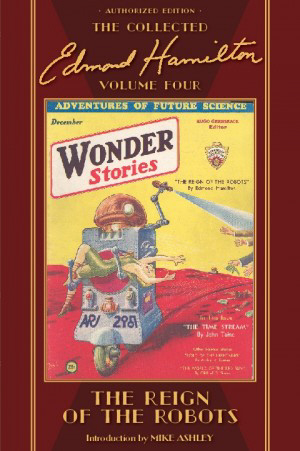
The Collected Edmond Hamilton Volume Four-smallCancel all my appointments! My copy of The Reign of the Robots, The Collected Edmond Hamilton, Volume Four arrived today.

Edmond Hamilton is my favorite pulp writer, and has been ever since I encountered his work in Isaac Asimov’s seminal anthology Before the Golden Age. I talked about my early affection for Hamilton — and my frustration at being unable to find some of his most acclaimed early space opera — in my Vintage Treasures piece on The Best of Edmond Hamilton last fall.

At the time I wrote:

While some of Hamilton’s shorter fiction was reprinted over the years, both Cities in the Air and The Universe Wreckers, and much of the longer work which made him famous, was available only in the early pulps in which they first appeared.

Stephen Haffner finally rectified this in 2011 with his The Collected Edmond Hamilton volumes, which gathered at last all of Hamilton’s early pulp work in archival quality hardcovers (thanks Stephen! I owe you one).

When I wrote that, only three volumes of The Collected Edmond Hamilton were available, covering Hamilton’s work from his very first story “The Monster-God of Mamurth” (from Weird Tales, Aug 1926, gathered in The Metal Giants and Others), through “World Atavism” (from Amazing Stories, Aug 1930, collected in The Universe Wreckers.)

Read More Read More

Vintage Treasures: Br-r-r-! edited by Groff Conklin

Vintage Treasures: Br-r-r-! edited by Groff Conklin

Br-r-r Groff Conklin-smallYou’ve got to admire an editor who titles his anthology Br-r-r-! You just know it caused fits with distributors, book sellers, librarians and other folks who alphabetize books for a living.

Mind you, Br-r-r-! was Conklin’s 21st science fiction anthology, and I figure by that point you’ll do anything to break up the tedium a bit. It was released in 1959; by 1964 he was so desperate for new topics he was putting out books like Great Detective Stories About Doctors (um, what?). He eventually produced 44 anthologies, before (presumably) going crazy and locking himself in a lighthouse.

In any event, Br-r-r-! looks like a terrific collection, starting with that striking and original Richard Powers cover. Put that cover on a phone book, and I still might choose to read that over a lot of other stuff on the shelves in 1959. Just sayin’.

Here’s the back-cover text. If this doesn’t bring you back to the classic era of 1950s monster movies, then your education is seriously lacking.

B R R R R ! — you’ll shudder when you meet:

THE MONSTER WORM that took 200 years to come up from the depths of the damned — it hated mankind!
THE BEETLE FROM HELL whose stinger brought slow, excruciating death — its evil eyes held the promise of something even worse!
THE LIVING CORPSE that commanded a graveyard. It sentenced a mortician to the bubbling bowels of hell!

And in “Legal Rites,” Isaac Asimov relates the fascinating — and gory — story of a blood-dripping specter fighting for its right to haunt a house. Asimov flavors pure horror with a unique brand of fantastic humor.

These are some of the blood-curdling, heart-pounding messengers of horror to be found in these bloodstained pages of evil!

Just for the record, the pages in my copy are not actually bloodstained. Or evil.

Read More Read More