A New Beginning: Bowling With Corpses by Mike Mignola & Dave Stewart
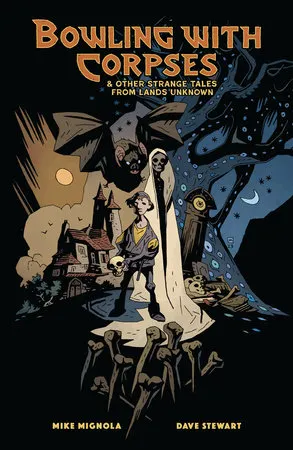
It all started because I wanted to draw a kid bowling with corpses
Mike Mignola
Maybe it was John Fultz who mentioned them on Facebook. He’s always mentioning things that lead me to acquiring more books. Maybe it came to me in a dream. I’m not really sure. Either way, I discovered that Mike Mignola, creator of Hellboy, the World’s Greatest Paranormal Investigator ®, had drawn and written (colored exquisitely by Dave Stewart) two collections of dark fantasy stories; Bowling With Corpses (2025), and Uri Tupka and the Gods (2026). I bought them almost at once.
Bowling With Corpses is a collection of stories, some fairytale-inspired and some detailing the setting’s complex cosmogony, opens with the following dedication:
For all those who transported me to lands unknown way back when — Howard, Smith, Lovecraft, Dunsany, Leiber, Moorcock, Lee and Kirby. And so many others. I realized now this book was inevitable.
From the first page all those influences are apparent, though I think Dunsany’s dreamlike stories such as those I reviewed from At the Edge of the World. Some follow fairytale logic, and others, dream logic. Mignola’s dark and shadow-filled art brings them to life, or death, as the case might be. In the later years of Hellboy, Mignola’s art took on a very stylized look. His work here has stepped back from that towards the more detailed style of his older work. In the afterword, Mignola describes himself as semi-retired until he realized:
“The hell with this. I love drawing comics so I’ll just keep drawing comics.”
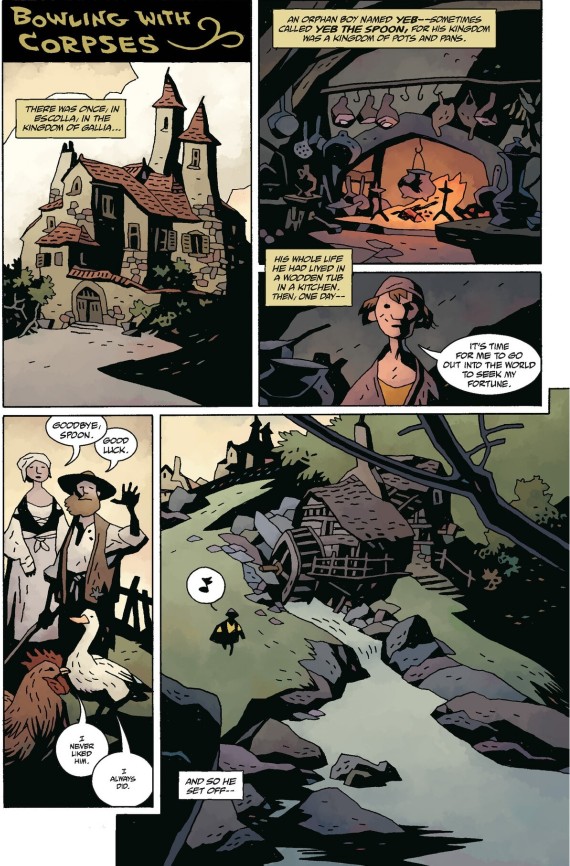 The book opens with the title story, itself derived from an Italian fairy tale. A version of the original tale is included in Italo Calvino’s leviathanic Italian Folk Tales as “The Dead Man’s Arm.” He’d wanted to adapt the story for years, but “play fast and loose with it.” To allow that, he decided he needed to create a whole fantasy setting, and against his own usual method of starting with characters, he gave birth to a new world. Before he knew it, plenty of other characters, gods, countries, and even a map, sprung into being.
In both Mignola’s and the original version of “Bowling with Corpses,” a young boy sets out to seek his fortune. His very first night on the road, he meets a trio of corpses who challenge him to a bowling match with a skull for the ball and bones for the pins. Should he win, they’ll reward him with a magical talisman, the arm of a dead man. Should he lose, well, it won’t be good.
The boy proves to be innately gifted as a bowler and wins the dead man’s arm. Equipped with the arm, he travels on, only to find himself pitted against a band of evil sorcerers. Unlike the original, which ends with an appropriately upbeat fairytale ending, Mignola’s is bit darker. I love this story, and not just because it’s narrated by a duck. My favorite Hellboy stories were those clearly inspired by folktales. Mignola’s writing and art in those sorts of stories seem to come straight out of the deep well of myth and legends that lies under the gentler tales that have survived the ages, pointing back to the more dangerous currents that run beneath them.
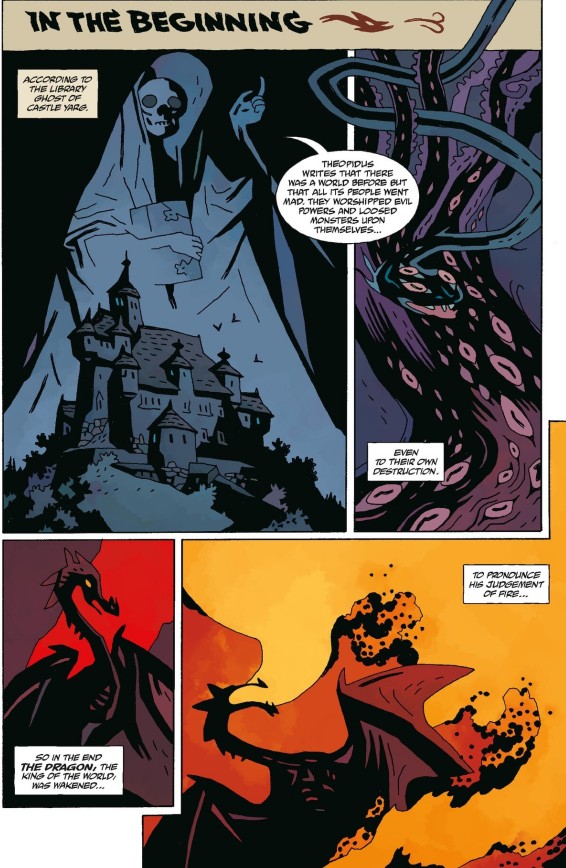 The tone immediately shifts with the next two stories, “In the Beginning” and “The Making of the World.” Narrated by the ghost of the library of Castle Yarg, these aren’t stories, but cosmological narratives, that provide some of the background for the Lands Unknown’s creation. In the first, the reader learns an earlier world fell prey to a terrible evil and was wiped out by a great dragon. From the dragon’s own blood, a new world, new gods, and humanity was created. The second tells how the gods have gone missing, perhaps are even dead. These few pages of pseudo-myth feel more real than the vast encyclopedias worth of similar material larded over many fantasy novels. Mignola’s art is like Clark Ashton Smith’s prose, creating something steeped in dreams and nightmare and far more memorable than run of the mill fantasy storytelling.
The beginning of the next story, “Justice Denied,” based on a Japanese vampire story, is only the setup for a longer story of a haunted house. The main tale is about a young woman seeking help in uncovering why the house she inherited from her uncle is infested with ghosts. Needless to say, the answer is not one she is hoping to hear. As with most of these stories, there isn’t any real action. Instead, the focus is on a narrative and illustrations that build a dark and chilling atmosphere. This story also contains an element that exists in much of Mignola’s stories. Justice is inexorable. Even if it must be meted out beyond the grave, it will be meted out.
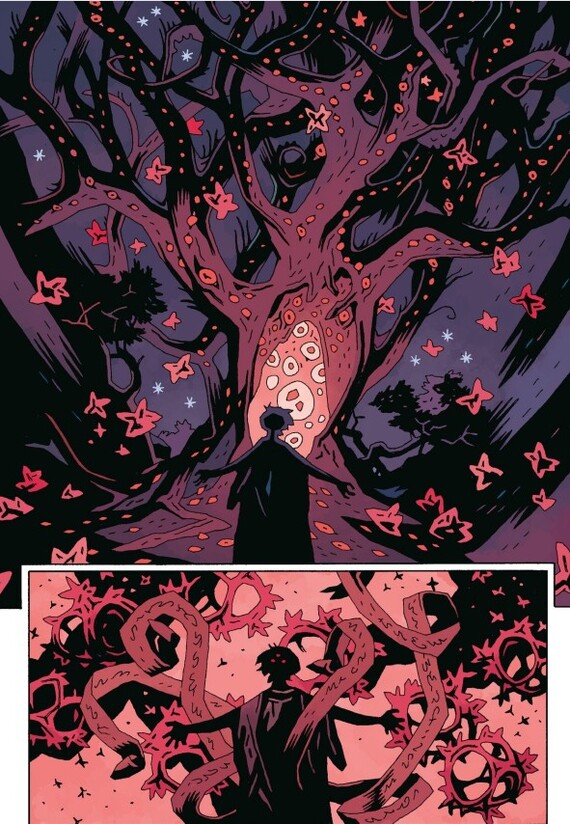
“Immortality Dust” is phantasmagorical with some wild imagery that will reappear in the second book, Uri Tupka and the Gods. Unsurprisingly, immortality appears attainable only by unsavory means. When Hizen Gozig, who rejects the notion of evil, tries to uncover how Olgar Rooski achieved immortality four centuries earlier, it goes poorly.
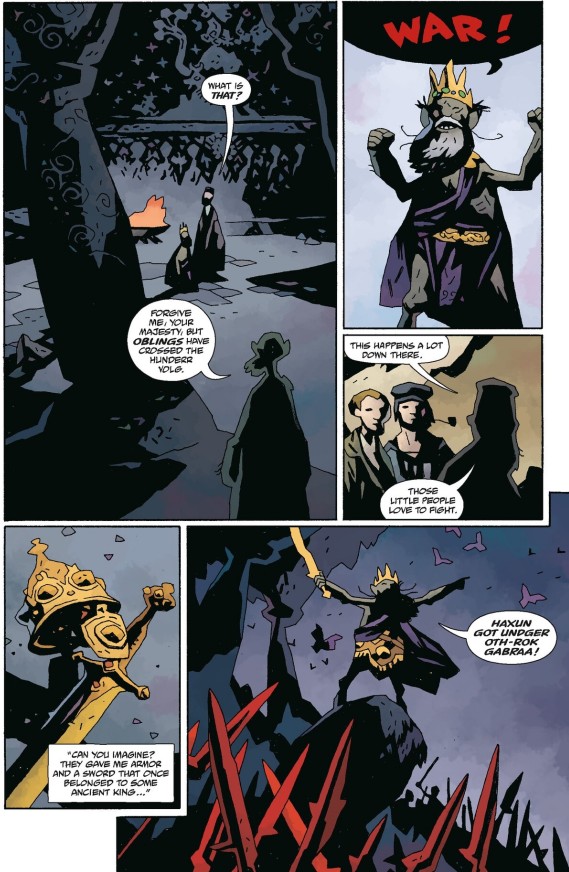
“The Soldier and the King” is a moment of delight in the middle of the otherwise disturbing events. Its theme is lifted from Herminie Templeton Kavanagh’s Darby O’Gill stories. A pair of men in a tavern discussing what to call the little people, that is the faerie folk, meet an old man who claims to have personal knowledge of them and their ways.
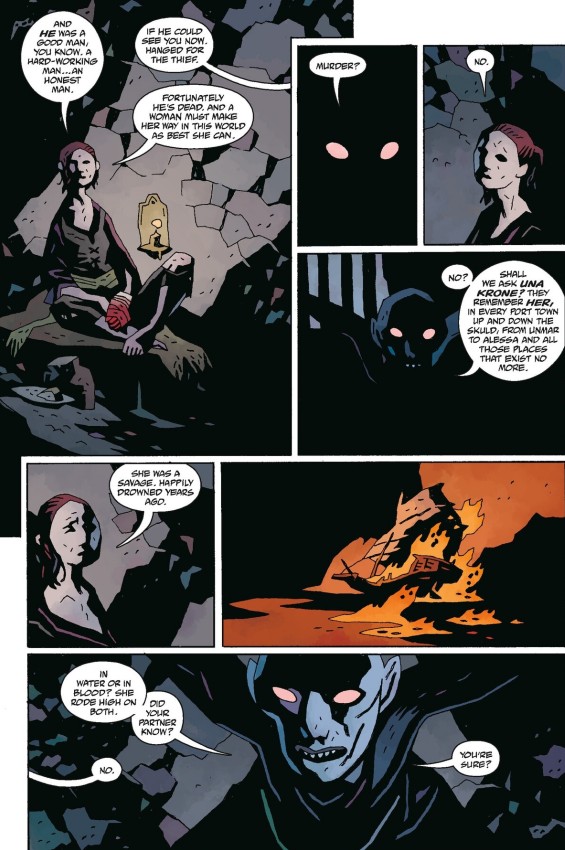
“Una Krone and the Devil” and “Una Krone” tell the tragic rise, fall, and potential damnation of Una Krone. Once just a girl named Iggrid, she wanted to see the world, but instead found herself transformed into a mighty and terrible pirate queen. Despite leaving that life behind, she was never able to become Iggrid again and soon found herself facing execution for burglary. When the Devil intervenes offering his usual way out from her impending doom, he takes it.
As with any deal with the Devil, there are conditions and she finds herself sent to kill one of his earthly enemies. It doesn’t go well for her, but it goes in an unexpected direction as well. There are stories are suffused with melancholy and loss, themes, like justice, that run through much of Mignola’s work.
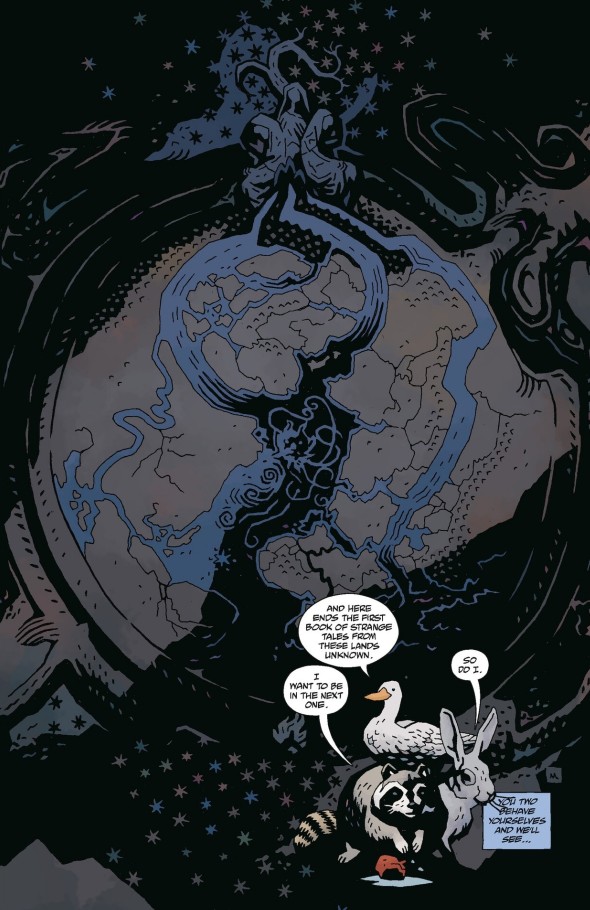
The book closes with “Lands Unknown,” where the ghostly narrator of “In the Beginning” and “The Making of the World” is taken on a tour of the world by a raven. It’s no more than an excuse to show off lands and creatures of Mignola’s new world. It’s clear he’s relishing the chance to give birth to a whole new setting after spending the greater portion of his career to date on Hellboy and related books. Many of the things illustrated or mentioned here make fuller appearances in the following book, Uri Tupka. There’s also a map, something Mignola claims he swore he would never include in the book.
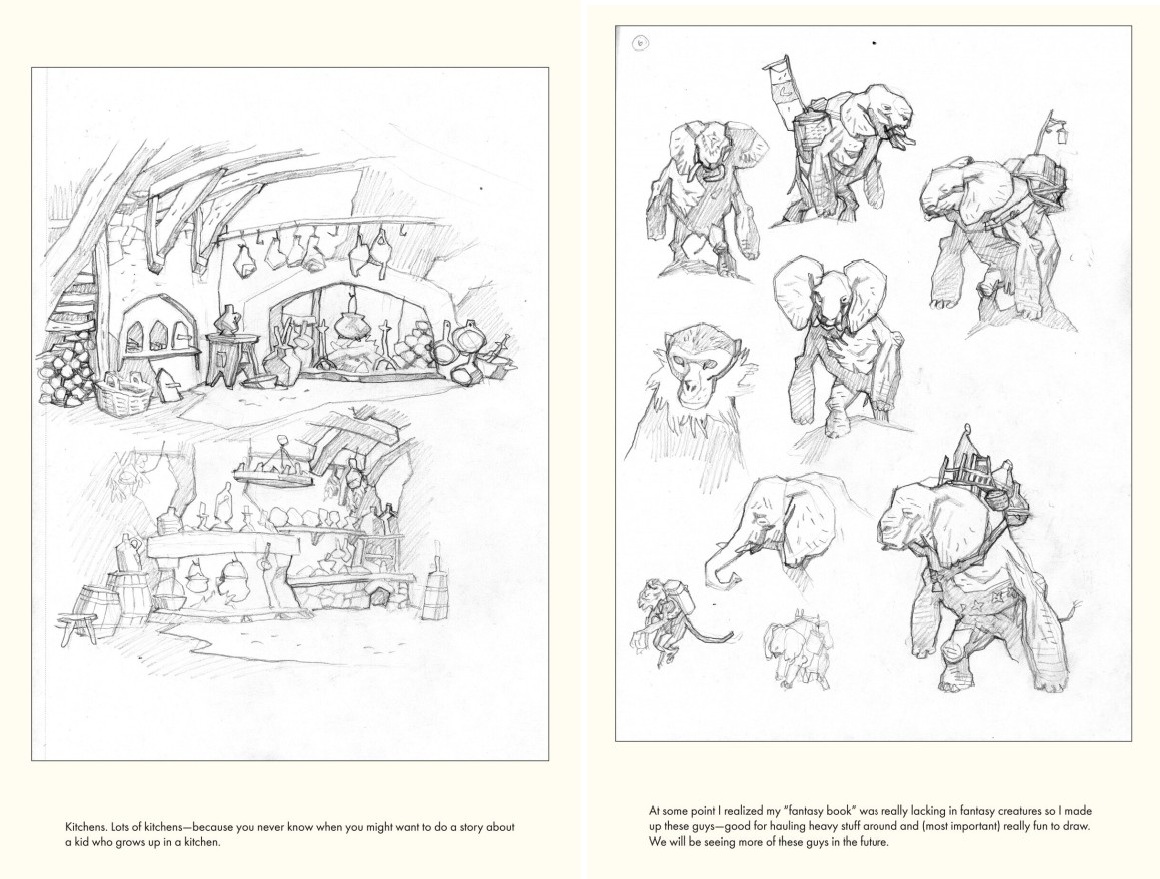
Bowling With Corpses doesn’t actually end there. Aside from the afterword, as with most Mignola collections, there’s an extensive series of sketches and notes. There are reference sketches and preliminary designs of his world’s inhabitants. There’s also an uninked and unlettered version of “In the Beginning.”
I love Mike Mignola, as a writer and an artist. I grew up reading DC’s war and horror comics, and went through a short X-Men and Daredevil phase in the early eighties, but for the most part I was never a huge comic book reader, especially as an adult. At some point, though, I realized I really like Jack Kirby, particularly his lunatic Fourth World books. I like the writing and I love his blocky, thick-lined and detail-filled style and bought collections of all of them.
Mignola’s clearly Kirby-influenced art attracted me from the first time I saw it on the White Wolf covers for their editions of the Fafhrd and the Gray Mouser books as well as some Moorcock books. I was later excited to find he’d done a whole collection of Fafhrd and the Gray Mouser stories with Howard Chaykin. By the time I was hipped to Hellboy by a friend of mine, I had a strong sense of him as an artist, but not as a writer. That ended when I dove into the world of Hellboy and B.P.R.D.
While I enthusiastically recommend his past work to anybody and everybody, Bowling With Corpses is a great introduction to Mignola and his work. I think he’s one of the major fantasists in recent decades. This book, and what I hope will be many more, continue to impress that notion on me. He draws inspiration from the greater body of myths, and fantastic and weird storytelling — unlike so many contemporary artists.
So, I had planned to write about Uri Tupka, the heretical theologian, as well, but I’m not going to. First, he deserves as much space as Bowling With Corpses has, and second, the concluding volume, Uri Tupka and the Devils is coming out in the fall. Once it does, I’ll tell about both of them.
NOTE:
I’ve written about Mike Mignola twice before, once here and once at my own site. Check both out and enjoy.
The World’s Greatest Paranormal Investigator: Hellboy by Mike Mignola and Sundry Hands
Fritz Leiber’s Fafhrd and the Gray Mouser” by Howard Chaykin, Mike Mignola and Al Williamson
Fletcher Vredenburgh writes a column each first Sunday of the month at Black Gate, mostly about older books he hasn’t read before. He also posts at his own site, Stuff I Like when his muse hits him
MMY extra issues podcast just started a full Hellboy reading club. I read the first two trades last weekend .
Way more episodic and pulpy than I expected.
It’s so pulpy in the beginning, but gradually turns into something phantasmagorical.
I was the first kid on my block to discover Hellboy, but my favorite Mignola will always be the Amazing Screw-On Head.
Well, it is a hoot.