Browsed by
Category: Pulp

Experience the Joy of the Pulps With The Incredible Pulps

Experience the Joy of the Pulps With The Incredible Pulps

The Incredible Pulps-smallWe’ve been chatting a lot about pulp fantasy recently — for example, in our recent explorations of Appendix N, Unknown magazine, escaping our genre’s pulp roots, forgotten pulp villains, Clark Ashton Smith’s Martian pulp fiction, and much more.

I occasionally get asked what I mean by “pulp.” It’s not the most intuitive term, I’ll grant you that, especially for younger readers. For them, if it means anything it usually conjures up images of Tarantino’s Pulp Fiction, and perhaps vague echoes of noir detective stories.

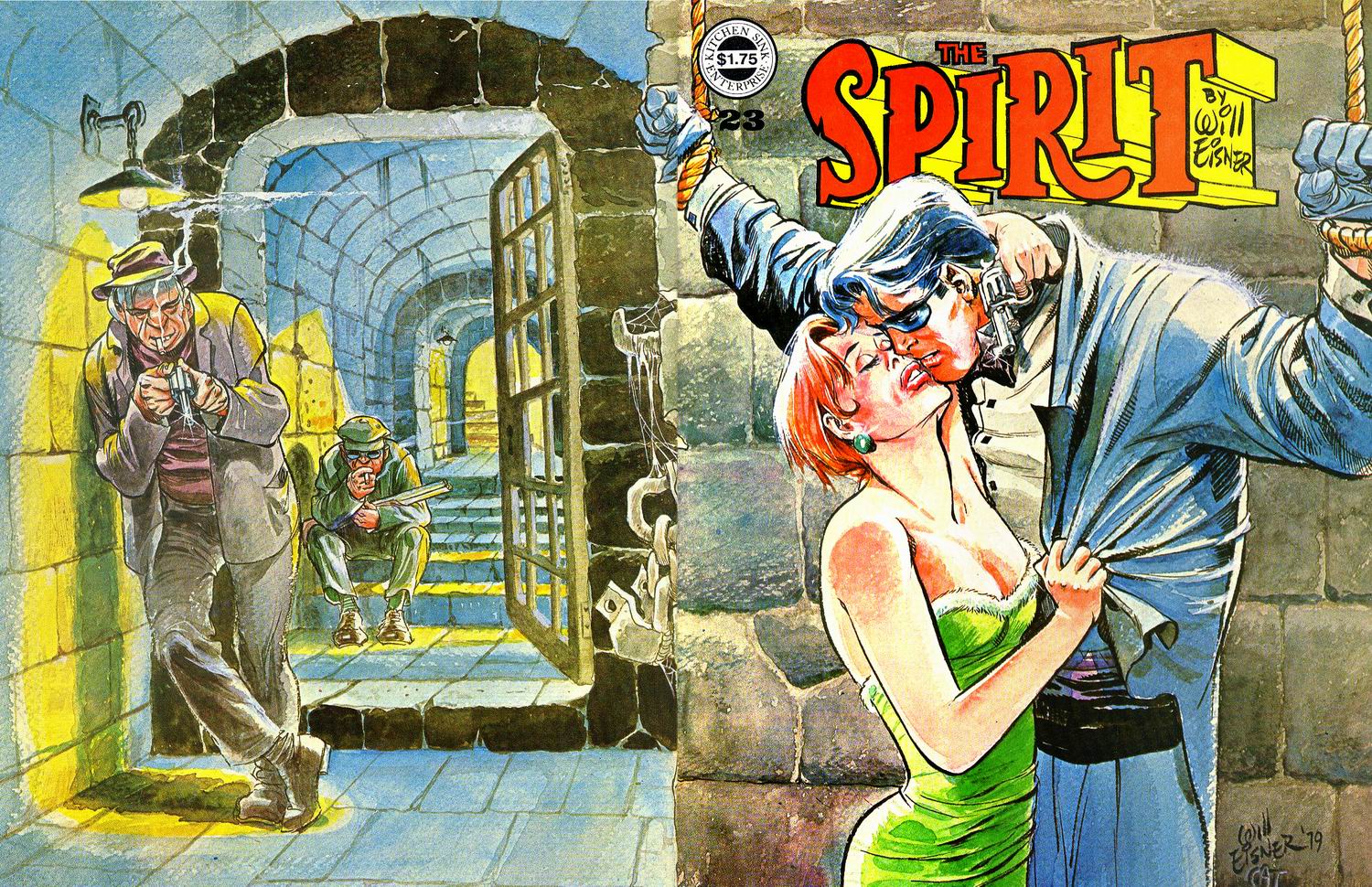
“Pulp fiction” means the fast-paced genre stories written for the popular magazines of the 1920s, ’30s and ’40s, and modern fiction written in conscious emulation of that style. The most popular of the pulp magazines, including Argosy, Adventure, All-Story Weekly, and Detective Story, had reliable circulations in the hundreds of thousands. They cost a quarter or less, and were printed on cheap (pulp) paper, frequently with ragged, untrimmed edges.

The pulps are still discussed and collected today for a number of reasons. Several of the most important writers of the 20th century — including Edgar Rice Burroughs, Sax Rohmer, H.P. Lovecraft, Ralph Milne Farley, Raymond Chandler, Agatha Christie, Louis L’Amour, and Harold Lamb — got their start in the pulps. They featured some of the most famous heroes of the early 20th Century, including Doc Savage, The Shadow, Conan, Buck Rogers, Tarzan, Zorro, and many others.

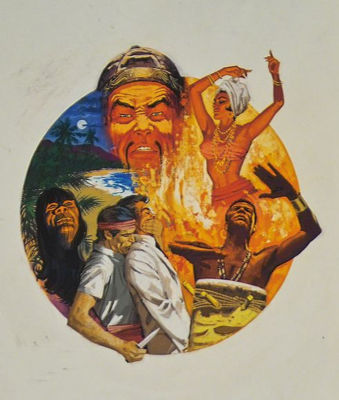
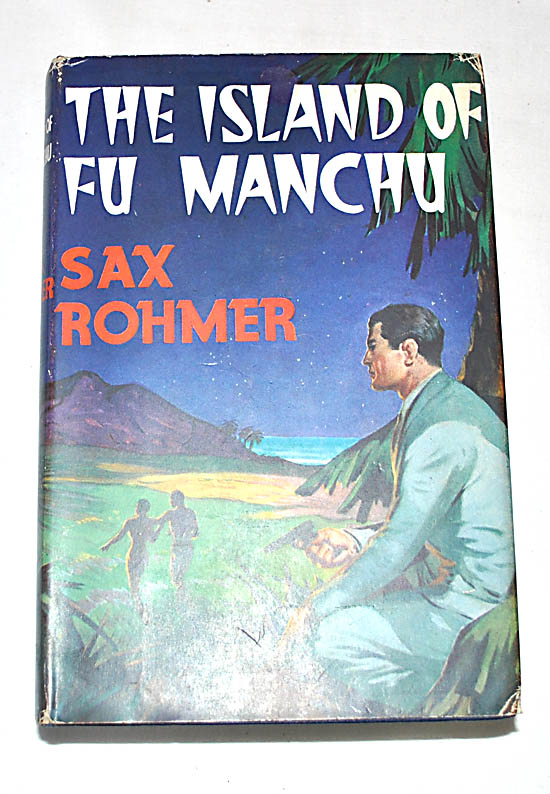
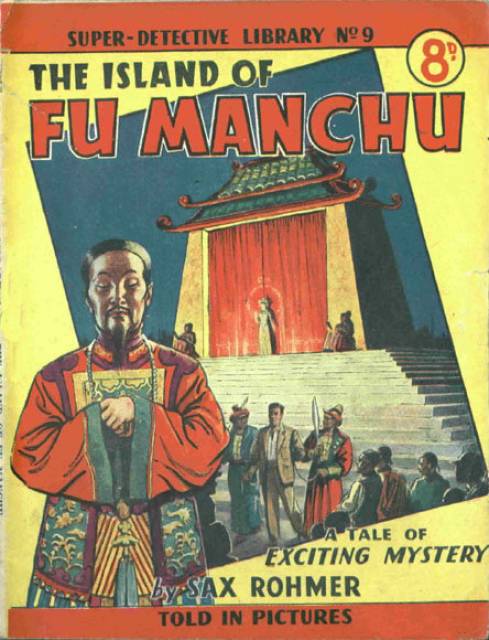
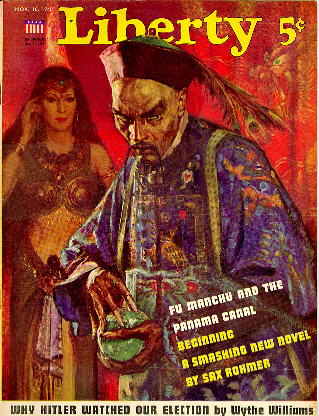
But the best fiction from the pulps has been reprinted many times and — unless you’re Howard Andrew Jones, Stephen Haffner, or John C. Hocking, on the trail of an obscure or neglected author — you rarely dig through pulps for the fiction any more. No, there’s really only one reason most of us still collect pulps. And that’s the fabulous covers and artwork.

Read More Read More

H.P. Lovecraft, A. Merritt, and Appendix N: Advanced Readings in D&D

H.P. Lovecraft, A. Merritt, and Appendix N: Advanced Readings in D&D

The Lurking Fear HP Lovecraft-smallWe’re drawing closer to the end of Gygax’s famous Appendix N, the list of influences and recommended reading he included at the back of the D&D Dungeon Masters Guide.

Over at Tor.com, Tim Callahan and Mordicai Knode continue their tireless trek through the entire list, sampling a little bit of each writer and generously sharing their impressions with us, while here at Black Gate we continue to appreciate and critique their columns. Since that’s a heck of a lot easier than actually trying to read along with such a massive project. Makes me tired just to think about it. Seriously, I need a bit of a lie down.

In the last few weeks they covered one of the most popular fantasy writers of the 20th Century — indeed, one of the most popular writers to pick up a pen, period — and a relatively obscure short story writer who was ignored for virtually his entire life, until a tiny press in Sauk City, Wisconsin, decided to make it their mission to return all of his works to print shortly after his death. Yes, we’re here today to discuss A. Merritt and H.P. Lovecraft, respectively.

Let’s start with Lovecraft. Mordicai kicks things off in fine fashion:

The guy basically invented contemporary horror — besides splatter and slasher, I suppose — and you can’t really talk about him without a sort of gleeful enthusiasm. Or at least, I can’t.

Uncaring alien godthings and cults of fishpeople get all the attention, but the stories that stick with me are the ones that get a little more surreal. Don’t get me wrong: At the Mountains of MadnessCall of CthulhuThe Dunwich HorrorThe Shadow Over Innsmouth… there are a reason that these stories are at the forefront, as the juxtaposition of modern man with truly unknowable forces is a ripe category…the ensuing cosmic creepfest and insanity in response to a nihilistic and uncaring universe might be seen as Lovecraft’s thesis.

That said, for me it is the odder tales, like The Dream-Quest of Unknown Kadath, that kick it up a notch. Hordes of cats, friendly conversations with cannibal ghouls, trips to the moon, evil ticklers, and terrifying plateaus that only exist in dreams? Yes please! I’m going to go on a limb and say that I see a little Randolph Carter in some of my favorite protagonists. Dale Cooper from Twin Peaks, I’m looking at you…

While I’m a devoted fan of Lovecraft’s longer and most famous works — I consider “The Shadow out of Time” to be one of the finest pieces of fantastic fiction ever written — there’s no question that his Dream-Quest tales are equally worthy of attention. A tip of the hat to Mordicai for not taking the easy route.

Read More Read More

Forgotten Heroes of Pulp Fiction: Jim Maitland

Forgotten Heroes of Pulp Fiction: Jim Maitland

JimMaitlandisland of terror hcWorld War I veteran, H. C. McNeile (better known by his nom de plume of “Sapper”) was a bestselling author of the last century whose works are quickly fading into obscurity.

His most famous creation, Bulldog Drummond is best remembered for the old-time movie and radio series rather than the nearly twenty novels where the character first appeared. “Sapper” also wrote numerous stories and books about a Holmes-like consulting detective, Ronald Standish as well as two books about Jim Maitland, the monocle-wearing two-fisted defender of honor who personified the ideals of the British Empire while traveling abroad.

Read More Read More

Vintage Treasures: The Unknown, edited by D.R. Bensen

Vintage Treasures: The Unknown, edited by D.R. Bensen

The Unknown edited by D R Bensen-smallIn all of our recent discussions of pulps, we have sorely neglected one of the greatest pulp fantasy magazines of all time: John W. Campbell’s magnificent Unknown. It wasn’t deliberate; we’ve just been focusing on Amazing Stories, Galaxy, and the pulp roots of Dungeons and Dragons of late.

So to do a little catch-up, I thought I’d talk about a splendid anthology I’ve been reading this weekend: The Unknown, a collection of ten short stories and one novelette from the pages of Unknown. If you’ll allow me, I’d like to quote from the Wikipedia entry on Unknown, since I think it does a fine job of summarizing the genesis and impact of Campbell’s great experiment in fantasy:

Unknown (also known as Unknown Worlds) was an American pulp fantasy fiction magazine, published from 1939 to 1943 by Street & Smith, and edited by John W. Campbell. Unknown was a companion to Street & Smith’s science fiction pulp, Astounding Science Fiction, which was also edited by Campbell at the time; many authors and illustrators contributed to both magazines. The leading fantasy magazine in the 1930s was Weird Tales, which focused on shock and horror. Campbell wanted to publish a fantasy magazine with more finesse and humor than Weird Tales, and put his plans into action when Eric Frank Russell sent him the manuscript of his novel Sinister Barrier, about aliens who own the human race… The magazine is generally regarded as the finest fantasy fiction magazine ever published, despite the fact that it was not commercially successful, and in the opinion of science fiction historian Mike Ashley it was responsible for the creation of the modern fantasy publishing genre.

The Unknown contains an excellent survey of Unknown magazine, with entertaining editorial comments and fiction contributions from Henry Kuttner, Nelson S. Bond, Theodore Sturgeon, L. Sprague de Camp, H. L. Gold, Manly Wade Wellman, Fredric Brown, and Anthony Boucher — plus a Fafhrd and the Gray Mouser tale from Fritz Leiber, and more.

It also reprints interior art from the magazine by the great Edd Cartier (see a sample here), who painted the covers for many Unknown issues. I wish more paperbacks from the era did this, as I found the artwork delightful.

Read More Read More

Rejecting the Golden Age: Gareth L. Powell on Escaping Science Fiction’s Pulp Roots

Rejecting the Golden Age: Gareth L. Powell on Escaping Science Fiction’s Pulp Roots

The Recollection Garath Powell-smallOver at SF Signal, author Gareth L. Powell has issued a call to stop recommending classic SF and fantasy, and start putting newer works in the hands of readers curious about our genres. His comments apparently arise from his experiences talking to a reading group who hadn’t read any SF written in the last 50 years.

The only way we’ll escape the legacy of our pulp roots is to promote the innovation, literary merit, and relevance of the best modern genre writing. Some fans will always cling to the ‘golden age’ works of the 1950s, 1960s and 1970s, and I can understand why. They provide a magic door back to the simple pleasures of a simpler world – a world before global warming, oil shortages, terrorism, and economic uncertainty; relics of a world where the future was easily understood, and (largely) American, middle class and white in outlook, origin and ethnicity.

Part of me understands and sympathizes with that need for security. I still draw comfort and enjoyment from those old books. Arthur C. Clarke, Larry Niven, Philip K. Dick… These writers are the elder gods in my personal pantheon; but they are neither the beginning nor the end… being a fan’s a bit like being in a marriage. You have to accept that the person you’re with will mature and change, and you have to embrace that, and change with them in order to keep things fresh…

So, the next time a non-SF reader asks you what they should read, resist the temptation to throw them a copy of Foundation or Slan, and point them instead at something published in the last five years… Give them something modern, and they’re more likely to find characters, ideas and attitudes with which they can relate.

Powell is the author of Silversands, The Recollection, Ack-Ack Macaque and its new sequel, Hive Monkey — which he freely notes employs “the furniture of 1930s pulp literature – Zeppelins, Spitfires, cigar-smoking monkey pilots, evil android armies.”

Read the complete article at SF Signal here.

New Treasures: Dark Melody of Madness by Cornell Woolrich

New Treasures: Dark Melody of Madness by Cornell Woolrich

Dark Melody of Madness-smallI wish a knew more about Cornell Woolrich.

From what I understand, this is a common state of affairs, even for some of his most devoted fans. Woolrich was something of a recluse, especially in the last few years of his life, and there are only a handful of people alive today who had any real dealings with him. Barry N. Malzberg, Woolrich’s agent for much of the 1960s, is one of the few, and he’s provided a fascinating reminisce in his introduction to Phantom Lady, one of the handsome new Woolrich editions from Centipede Press.

Woolrich is revered by mystery and noir fans — and rightly so. Some three dozen films have been made of his taut thrillers, including Rear Window, Night Has a Thousand Eyes, The Bride Wore Black, and many others. But on occasion, he also wrote supernatural fiction and Dark Melody of Madness, one of the new Centipede Press volumes, collects four of his novellas for the first time: “Graves For The Living,” “Jane Brown’s Body,” “Dark Melody of Madness,” and “I’m Dangerous Tonight,” all originally published between 1935 and 1938.

Holding on to a loved one can be difficult, but certainly not as weird and treacherous as in this quartet of Cornell Woolrich novellas set in the mid-1930s. It’s a time of great incongruities — physical anguish of the Great Depression, lighthearted dancing to the rhythms of swing; near-legendary bank robbers, daredevil long-distance airplane pilots; head bashing of union members, air-conditioned comfort for movie goers.

Woolrich takes this milieu, adds an overlay of the supernatural, and places his protagonists in grotesque, untenable situations involving their lives and souls. Here is the eerie world of voodoo, Frankenstein-style reincarnation, live burial, and macabre garments — a mixture of cold sweat-producing dilemmas, where the characters find it near-impossible to separate the real from the unreal.

Dark Melody of Madness was published by Centipede Press on August 6, 2013. The introduction is by Bill Pronzini, and the cover and color interiors are by Matt Mahurin. The trade paperback is 296 pages, priced at $18; there’s also a limited edition, out-of-print hardcover. The hardcover edition lists an additional novella, “Mannequin,” on the TOC. For mystery and noir fans, Centipede Press offers three additional volumes in the series: Deadline at Dawn, I Married a Dead Man, and Speak to Me of Death (see the complete set here.)

The Shadow of Fu Manchu Falls Upon Me

The Shadow of Fu Manchu Falls Upon Me

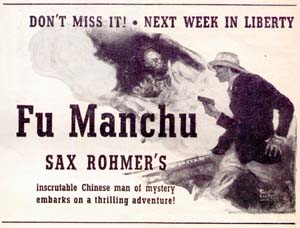
MaskMoviePortraitMovieMirrorMaskofFuManchuWithout Fu Manchu in my life, I would never have started down the path of penning these articles. One thing I was certain of was that there were no more surprises. I had found every official appearance of Sax Rohmer’s master villain and would, in due course, cover all of them in this blog eventually. So it seems appropriate that in this the year that marks the centennial of the first Fu Manchu novel, my 200th article covers a hitherto unknown official piece of Fu Manchu history.

A few weeks ago, I attended Classicon in Michigan and convention organizer, Ray Walsh handed me the January 1933 issue of Movie Mirror with Joan Bennet on the cover. The second feature was The Mask of Fu Manchu by Sax Rohmer. I suspected it was an excerpt from or serialization of the book I was unaware of and found it intriguing that it had eluded both Bob Briney and Larry Knapp, the two foremost Rohmer scholars who have done a phenomenal job of compiling bibliographical information on the author.What the issue actually contained was something far more valuable: an 11-page “fictionization” of the 1932 MGM film starring Boris Karloff and Myrna Loy, fully illustrated with stills from the movie, some of which were quite rare. The adaptation was credited to Constance Brighton, an author I have found no other information concerning which made me suspect the name was a pseudonym.

Read More Read More

Manly Wade Wellman, Fletcher Pratt, and Appendix N: Advanced Readings in D&D

Manly Wade Wellman, Fletcher Pratt, and Appendix N: Advanced Readings in D&D

Who Fears the Devil-smallI’ve been waiting for Mordicai Knode and Tim Callahan at Tor.com to get to both Manly Wade Wellman and Fletcher Pratt as part of their ongoing exploration of Gary Gygax’s famous Appendix N — and not very patiently, either.

Manly Wade Wellman is consistently one of the most beloved authors we feature here at Black Gate. Just three days ago Fletcher Vredenburgh reviewed his Battle in the Dawn: The Complete Hok the Mighty, and a while back new Black Gate blogger Alex Bledsoe offered a fine reminiscence of Wellman’s Appalachian fantasy tales in “How I Discovered Silver John.” The most popular contest in our history was our call for The Best One-Sentence Reviews of Manly Wade Wellman, and the winners received a copy of Haffner Press’ gorgeous The Complete John Thunstone.

And Fletcher Pratt? He wrote The Well of the Unicorn, one of the 20th Century’s most acclaimed heroic fantasy novels (none other than Lester del Rey called it “The best piece of epic fantasy ever written.”) With his frequent collaborator L. Sprague de Camp, he was also the author of the very popular Incomplete Enchanter and Gavagan’s Bar series.

So I’ve been looking forward to both authors receiving the Appendix N treatment. And now at last the wait is over.

Sadly, Tim doesn’t seem to fully briefed on the greatness that is Manly Wade Wellman:

I didn’t know anything about Manly Wade Wellman before Mordicai and I embarked on this project. I had never heard of the author, outside of the mention of his name in Appendix N.

Ouch. Well, I’d read almost nothing by Clark Ashton Smith prior to last week (when I read his brilliant pulp horror story “The Vault of Yoh-Vombis“), so I guess we all have our blind spots.

The real question is: What does Tim think of Wellman now?

Read More Read More

Forgotten Pulp Villains: Hanoi Shan and Professor Colonna

Forgotten Pulp Villains: Hanoi Shan and Professor Colonna

The Crimes of Hanoi Shan-smallFor twenty years now, George Vanderburgh’s Battered Silicon Dispatch Box has been publishing quality hardcover and trade paperback reprints of titles one might never otherwise discover. Their books rarely appear on Amazon or eBay, so the devoted bibliophile who ventures to www.batteredbox.com is among the few to find such treasures.

Initially focusing on Sherlockian pastiches and scholarly efforts as well as reprinting long unavailable titles from Arkham House and Mycroft & Moran, BSDB has broadened their catalog to include other more obscure treasures.

Their two most recent titles are The Crimes of Hanoi Shan by H. Ashton-Wolfe and The Last of the Borgias by Fred M. White. Both books were edited by acclaimed pulp historian Rick Lai whose own works were spotlighted in last week’s column.

Hanoi Shan first came to my attention roughly 15 years ago when I stumbled across Win Scott Eckert’s Chronology of Fu Manchu online. There I found references to two early Fu Manchu appearances prior to Rohmer’s first novel that were written by someone called H. Ashton-Wolfe. The library proved of no assistance in tracking these stories down and the only antique booksellers who listed Ashton-Wolfe’s works wanted a small fortune for them. I was at a loss as to why Fu Manchu was known as Hanoi Shan, but the key seemed to be held in a fabled publication called The Rohmer Review which I had first found cited in a survey of Rohmer’s work by Will Murray.

There was also reference to some esoteric works by Philip Jose Farmer that I had actually seen alongside used Edgar Rice Burroughs titles at a local bookstore which had subsequently burned down. This Wold Newton business seemed to be the key to much of the fiction I was enamored of, but the trouble was I couldn’t get very far without Farmer’s works to unravel the mystery.

Read More Read More

Battle in the Dawn: The Complete Hok the Mighty by Manly Wade Wellman

Battle in the Dawn: The Complete Hok the Mighty by Manly Wade Wellman

oie_1743857GRCQJimHHistorical adventure fiction is one of the primary roots of swords & sorcery. From it you get the same fast-paced adventure in exotic settings.

Some writers of S&S, Robert E. Howard and Sprague de Camp for example, wrote historical adventure fiction alongside their more fantastic stories. Often the tales involve battling Crusaders and Saracens, high seas Viking adventures, swashbuckling freebooters, or Roman centurions fighting Teutonic hordes. Sometimes, though, they star cavemen.

Manly Wade Wellman spent his childhood in a primitive village in Portuguese West Africa. Till he died Wellman spoke of a young boy forced to kill a leopard in order to protect cattle. Other boys had been less lucky and had fallen prey to leopards. His time and experience in Angola was perhaps the greatest influence on his life, but most certainly on his prehistoric stories.

In 1939, after a decade of writing pulp science fiction with titles like “The Disc-Men of Jupiter” and “Outlaws on Callisto,” Manly Wade Wellman introduced his Cro-Magnon hero, Hok the Mighty, in the novelette “Battle in the Dawn.” Four stories followed before he retired the character. While there’s a strong anthropological component to the Hok stories, with footnotes explaining then-current thoughts on the discoveries made by early man, these five tales get progressively more fantastic.

In 2010 Paizo collected all the Hok stories, along with several fragments and the cavenmen vs. Martians mini-epic “The Day of the Conquerors,” in Battle in the Dawn: The Complete Hok the Mighty for their Planet Stories line.

Read More Read More