Browsed by
Category: Magazines

Try Out Blind Spot, a New Magazine of French Science Fiction

Try Out Blind Spot, a New Magazine of French Science Fiction

Blind Spot 1-smallWhen I was at the Nebula Awards weekend in May, I met a charming young man named Julien Wacquez, the co-editor of the French SF magazine Angle Mort, which publishes English SF in translation for French readers. I learned that he and his co-editor, René-Marc Dolhen, were launching a brand new English magazine to bring the best of French SF to English audiences, Blind Spot. He was kind enough to send me a copy of the first issue last week, and it looks terrific. Here’s René-Marc and Julien, from their introduction.

Angle Mort was founded in France in 2010 to translate innovative science fiction stories written by authors such as Aliette de Bodard, Jeffrey Ford, Kij Johnson, Kelly Link, Ian McDonald, Vandana Singh, and to publish French original narratives written by Stéphane Beauverger, David Calvo, Thomas Day, Jean-Claude Dunyach, Léo Henry, and Laurent Kloetzer among others. Our work has been recognized several times by the Grand Prix de l’Imaginaire and nominated as “best translated work of the year” or “best short story of the year…”

Going forward, we wish to widen our audiences to pursue our two main goals:

1 – Bolster the ties between French and American science fiction, by launching a new magazine, Blind Spot, that translates French stories into English. We think that French science fiction is rich from finding new ways to describe human experiences and contradictions, the weight of structures upon our lives, and the role of collective entities on our destiny.

2 – Bridge art, science, and literature, by supporting people who try to remold original perceptions of the self or the surrounding world, regardless of whether their works are fictional stories, academic papers, or visual arts, as long as they relate to science fiction.

Both French and English online magazines owned by the group are conceived as an endeavor to find new languages, new ways of telling true stories. They will be published at a frequency of two issues per year each. The narratives will be available for free on their dedicated website and exclusive additional content (interviews with contributors) can be accessed by ordering the complete online issue for $3. The proceeds will help us pay our contributors and translators.

Read the first story, Jean-Claude Dunyach’s “Landscape with Intruders,” free online here. And buy the first issue in PDF, epub and mobi formats for just $3 here. Broaden your horizons, and support a new SF magazine!

Thrilling Wonder Stories, April 1951: A Retro-Review

Thrilling Wonder Stories, April 1951: A Retro-Review

Thrilling Wonder Stories April 1951-smallI felt like looking at a classic pulp from the great late stages of the true SF pulps.

A moment of definition is in order here: I consider a true pulp magazine to have been printed on pulp paper, in approximately the traditional pulp size (7″ by 10″), during the heyday of the SF pulps (say, 1926-1955). This is meant to exclude digests (like Astounding after about 1943; and most SF magazines after 1955), and of course slicks. The great pulps (in my opinion) of the early 1950s were the Standard Magazines companion pair, Thrilling Wonder Stories and Startling Stories, and Planet Stories (published by Love Romances).

So this is Thrilling Wonder Stories for April of 1951. Thrilling began publication in 1936, though it was essentially a direct descendant of Wonder Stories, which was founded by Hugo Gernsback after he lost control of Amazing, first as two magazines, Air Wonder Stories and Science Wonder Stories, that soon merged into one. The editor is uncredited but at this time was surely Sam Merwin, Jr., who took over the magazine in 1945, and who left at the end of 1951, Sam Mines taking over. Sam Merwin, little enough celebrated at the time, was actually a quite effective editor, raising the quality of Thrilling Wonder Stories and Startling Stories to at least shooting distance of Astounding – perhaps the quality at the top wasn’t as good, but the vibe was a bit more entertaining, less didactic.

Indeed, I discussed this premise – that Thrilling Wonder and Startling were nearly the equal of Astounding – with a few other folks who know the magazines of that time as well or better than I do, and we came to the conclusion (some holding this view more strongly than others) that in about 1948-1950 that was a very defensible statement, but that by 1951 they were falling behind. And the reason seemed obvious once suggested: the appearance in late 1950 of Galaxy (not to mention the appearance slightly earlier of F&SF) provided a new market that quickly attracted most of the best stories that Campbell didn’t or couldn’t buy.

Read More Read More

Interzone #264 Now on Sale

Interzone #264 Now on Sale

Interzone 264-smallThe May/June issue of Interzone magazine is now on sale, with a cover by 2016 cover artist Vincent Sammy, “My Name To You No More” (click the image at right for a bigger version.)

Interzone #264 contains five stories:

“Breadcrumbs” by Malcolm Devlin
“Starlings” by Tyler Keevil
“Mars, Aphids, and Your Cheating Heart” by James Van Pelt
“Lifeboat” by Rich Larson
“The Tower Princesses” by Gwendolyn Kiste

Non-fiction this issue includes an Editorial by Elaine Gallagher, Future Interrupted by Jonathan McCalmont, Time Pieces by Nina Allan, plus David Langford’s Ansible Link, and the regular columns: book reviews, Nick Lowe’s Mutant Popcorn film reviews, and Tony Lee’s DVD column, Laser Fodder. Issue 264 is nearly 100 pages and packed with fiction, columns, and top-notch art.

Interzone is the sister magazine of Black Static, both are published by TTA Press in the UK. The distinguished Andy Cox is the editor of both.

Read More Read More

The Late June Fantasy Magazine Rack

The Late June Fantasy Magazine Rack

Asimovs-SF-July-2016-big-rack Beneath-Ceaseless-Skies-200-rack Clarkesworld-117-rack Lightspeed-Magazine-June-2016-rack
Uncanny-Magazine-May-June-2016-rack Meeple-Monthly-May-2016-rack The-Digest-Enthusiast-4-rack Freedom-is-Space-for-the-Spirit-rack

The month of June ended with a flurry of new magazine arrivals, more than your humble editors could hope to cover. But we took our best shot.

We added one new title to our coverage: the delightful board game periodical Meeple Monthly (and there’s no truth to the rumor we waited until it did a cover feature on Star Trek first). Fletcher Vredenburgh reported on the latest issue of Swords and Sorcery in his May Short Story Roundup, and the distinguished editor Jonathan Strahan shared his assessment of 2016’s breakout short fiction stars. In other news, we reported that Tor.com is shopping for novellas to feed their fast-growing label, and that the Summer issue of SFX magazine offers a terrific spread on galactic hero Perry Rhodan (including quotes from yours truly.)

We had plenty for vintage magazine fans this month, too — including a review of L. Sprague de Camp’s The Tritonian Ring, which originally appeared in Two Complete Science Adventure Books from 1951, Rich Horton’s Retro Review of the October 1962 Amazing Stories, and a look at Terry Carr’s The Best Science Fiction of the Year #4, from 1974.

Check out all the details on the magazines above by clicking on the each of the images. Our early June Fantasy Magazine Rack is here.

Read More Read More

Vintage Treasures: The Best Science Fiction of the Year #4, edited by Terry Carr

Vintage Treasures: The Best Science Fiction of the Year #4, edited by Terry Carr

The Best Science Fiction of the Year 4 Terry Carr-small The Best Science Fiction of the Year 4 Terry Carr-back-small

With all the Best of the Year volumes arriving over the past few months — from Jonathan Strahan, Rich Horton, Neil Clarke, and David Afsharirad, and more due next month from Gardner Dozois, Paula Guran, and others — it’s hard to remember those dark years in the mid-20th Century when there were only two or three.

Hard, but not impossible. Don Wollheim, Lester del Rey, and the great Terry Carr all had Best of the Year anthologies back in the mid-70s. I know because I bought and cherished them as they showed up in bookstores, starting around 1977 or so. I think my favorite editor of the batch was Terry Carr, who was already famous for his exemplary work at Ace at the time.

How good was Carr at extracting the cream of the crop from the digest magazines in the 70s? Depends who you ask of course, but in general Carr’s reputation was stellar. I’d read plenty of anthologies from the era, but I didn’t remember the magazines I read at the time well enough to say for certain.

However, I recently had the opportunity to do a little primary research of my own. I bought a collection of vintage Analog magazines from the early 70s, back when Ben Bova was editor, and I’ve spent a week of warm evenings on the porch with them, pretending I was Rich Horton.

Read More Read More

May Short Story Roundup

May Short Story Roundup

oie_2824427axWPyjIhWell, sad to say, there are just not that many swords & sorcery stories to round up this month. The big guns, Heroic Fantasy Quarterly and Grimdark Magazine, (the latter delayed while they run the Kickstarter for their anthology, Evil Is A Matter of Perspective) were silent. Beneath Ceaseless Skies’ two May issues didn’t have anything that fit the S&S bill. None of the other magazines yielded stories to review either. Only the stalwart Swords and Sorcery Magazine came through, just like it does every single month for over four years now.

According to the online Merriam-Webster Dictionary, a skimmington is “a boisterous procession intended to ridicule an unfaithful spouse or a shrewish wife often with effigies and a mock serenade” and “The Skimmington” is the title of B.C. Nance’s story in this month’s issue of SSM. No one in town believes wealthy landowner Daegal’s claim that his wife, Esma, ran out on him. Alden, a man who once loved the missing woman, convinces his fellow citizens to conduct a skimmington parade out to Daegal’s estate. His hope is they can shame Daegal into revealing where Esma really is. While there’s a supernatural element to the tale, it could just as easily be set in any small pre-industrial town. In any setting, though, it would remain a well told story with a haunting ending.

“Rivenrock,” by Connor M. Perry (whose previous story in SSM, “Stragglers in the Cold,” I enjoyed very much), tells of Elegia, the reborn Shepherd of Night, and her lover, Darza. Together, they are searching for the Shepherd’s ancestral home, a place called Rivenrock. Their guide is a man named Averon Thorn whom neither fully trusts, even though he claims to be a supporter of their cause. The concluding spasm of violence is brutal and affecting, but it doesn’t really provide a satisfying conclusion to the story.

Behind the events of “Rivenrock” is an ongoing struggle between the Shepherd of Night and the Lord of Morning. Each appears to have been recently reborn after having been gone for sometime. The Lord seems to have come back earlier and wields more temporal and magical power at present. The Shepherd is still finding her way, thus her need to reach Rivenrock. It’s all very vague and makes following the story less than compelling.

So that’s all there is to review this month. As usual, you should go read them and let the authors and editor know what you think.

Read More Read More

June 2016 Lightspeed Magazine, the People of Colo(u)r Destroy Science Fiction Issue, is Now Available

June 2016 Lightspeed Magazine, the People of Colo(u)r Destroy Science Fiction Issue, is Now Available

Lightspeed Magazine June 2016-small Lightspeed Magazine June 2016-back-small

Lightspeed has produced some really exceptional special issues over the last few years, including the groundbreaking Women Destroy Science Fiction and Queers Destroy Science Fiction issues. June sees the People of Colo(u)r Destroy Science Fiction special issue, weighing in at a massive 464 pages. It was funded by a hugely successful Kickstarter campaign that wrapped up on February 20, and is guest-edited by Nalo Hopkinson and Kristine Ong Muslim (original short fiction), Nisi Shawl (reprints), Grace L. Dillon (nonfiction), and Sunil Patel (personal essays).

Even folks who didn’t contribute to the Kickstarter get to share in the benefits, as much of this issue’s massive payload of fiction is already up and freely available at the Lightspeed website — including brand new stories by Sofia Samatar, John Chu, JY Yang, S.B. Divya, and many others. But that’s not all…there’s also a rich assortment of paid content — including original fiction, a novella, flash fiction, reprints, and much more — available to backers, and anyone who purchases the digital edition for just $3.99. This issue is also available in a special trade paperback edition, with all the bonus content, for $17.99.

Here’s the complete Table of Contents.

Read More Read More

July 2016 Asimov’s Science Fiction Now on Sale

July 2016 Asimov’s Science Fiction Now on Sale

Asimovs SF July 2016-smallerOver at Tangent Online, Chuck Rothman finds plenty to like in the latest issue of Asimov’s Science Fiction.

July’s Asimov’s begins with “Ten Poems for the Mossums, One for the Man” by Suzanne Palmer and starts out with a protagonist — a poet — attending what is essentially a writing retreat alone on an alien world with strange life forms, including the Mossums, described as “green fuzzy boulders.” The poet writes a series of poems about his impressions, and slowly begins to discover that the Mossums are more complex than he imagines. The story started a bit slowly, but quickly drew me in, and it was nice to read something that portrayed aliens by hints and without any clear-cut answers…

“Masked” shows a future where the wealthy use both makeup and holographic techniques to make themselves as beautiful as they can. Bess is about to meet again with her friend Vera, who has suffered a computer virus that wreaked havoc with the computer programs she uses to adjust her appearance. Vera is supposedly recovered, but Bess can see that she doesn’t seem right. Rich Larson’s version of the future and the styles are well imagined, and one of the strengths of the story is the way that Bess begins to understand what’s really important…

The set up to Will McIntosh’s “Lost:Mind” is convoluted, but once that’s past it becomes a fine story. Colonel Walter Murphy’s wife Mimi is dying of Alzheimer’s and, desperate, he turns to technology, creating a recording of her mind so she can live on. But such experimentation is illegal in the US, so it has to be smuggled in from India. A full mind would raise alarms, so it’s broken into 32 pieces of a chess set, to be assembled later. And the chess set is stolen. What follows is a race against the clock to find the pieces (from a noted sculptor) before the battery dies, along with Mimi’s mind. There’s a great mixture of action, dead ends, and emotional roller coasters to make the story one of the best of the year.

Read the complete review here.

Read More Read More

Clarkesworld 117 Now Available

Clarkesworld 117 Now Available

Clarkesworld 117-smallIn his editorial this issue, Neil Clarke has some powerful words to say about how all of us can help keep short fiction alive.

If we want short fiction to thrive, we have a responsibility to spread the word and promote the works we’ve enjoyed. There are many ways to do this, but it needs to be focused, respectful, and timely. More specifically, it needs to be done in locations that are relevant to the audience you are trying to attract. Your blog is nice, but adding Twitter or Amazon might have a bigger impact.

Reviewing isn’t for everyone, mind you. I really wanted to do my part and find a way to contribute to a positive conversation about short fiction. I tried writing reviews. The blank screen tormented me and it took a while to realize that I wasn’t following the path that best utilized my skills. Instead, I changed tactics and launched Forever Magazine as a way of bringing back some of the stories I’ve enjoyed. When I go full-time this year, I hope to be able to do a bit more with that project.

Read his complete editorial here.

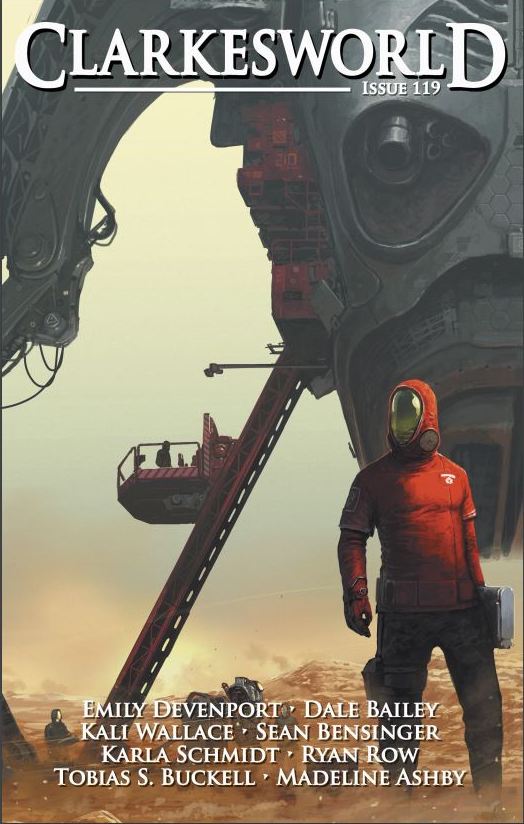
Clarkesworld #117 has four new stories by Margaret Ronald, Sam J. Miller, E. Catherine Tobler, and Zhang Ran, and two reprints by Michael Flynn and Nancy Kress.

Read More Read More

Uncanny Magazine Issue 10 Now on Sale

Uncanny Magazine Issue 10 Now on Sale

Uncanny Magazine May June 2016-smallOver at Tangent Online, reviewer Herbert M. Shaw weighs in on the May/June Uncanny, which features a lot of tales of the undead this issue.

“The Sound of Salt and Sea” by Kat Howard
When the ghost of a brash face from his past returns, it is up to an island’s mortal protector to right a recent wrong. Secluded to a tropical are where the dead rise at low tide, the protagonist describes his struggle as the sole protector with a wide array of metaphors and similes. Howard takes on the undead by fighting fire with fire in a story about friendships, family ties, and skeleton horseback riding.

“You’ll Surely Drown Here If You Stay” by Alyssa Wong
A second-person novella places the reader as the main character to become immersed in the mindset of a person capable of controlling the dead. Some call it witchcraft, some call it a family trait. Through deep understandings of the other character’s perceptions, Wong manages to create a sense of how dangerous and significant your power can be as you lead an expedition to an abandoned mine to rid it of its infestation.

“The Drowning Line” by Haralambi Markov
This issue’s trend of stories involving the undead and death by water culminates in a sort of ‘Freddy meets Jason’ myth held by one person. After a demon killed the father, it is up to the son to prevent it from coming for his newly teenage daughter on the cusp of womanhood. His journey is plagued by a past he cannot let go of for fear that being forgotten will not mean it is gone. As the only male writer in this month’s issue, Markov concludes these stories by unknowingly borrowing aspects of the previous four, those being family values, brash actions, facing the dead, and the ever-present environment of water.

Read Shaw’s complete review here. The magazine also includes fiction by Seanan McGuire, Kameron Hurley, and JY Yang, and non-fiction by Foz Meadows, Sarah Monette, Stephanie Zvan, and Tanya DePass, plus poetry, interview, and an editorial. All of the content became available for purchase as an eBook (PDF, EPUB, MOBI) on May 1, 2016.

Read More Read More