Browsed by
Category: Comics

ARAK Issue 1: The Sword and the Serpent!

ARAK Issue 1: The Sword and the Serpent!

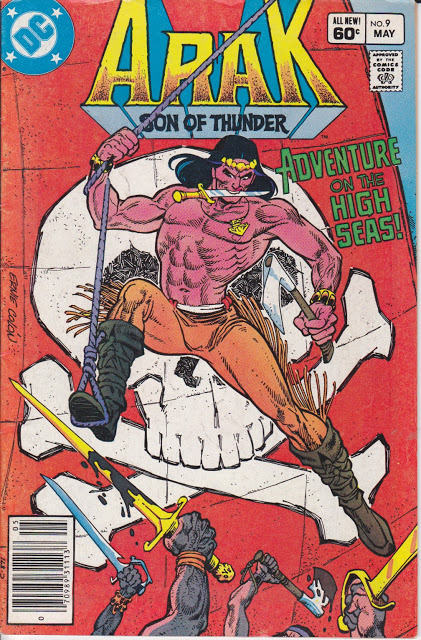
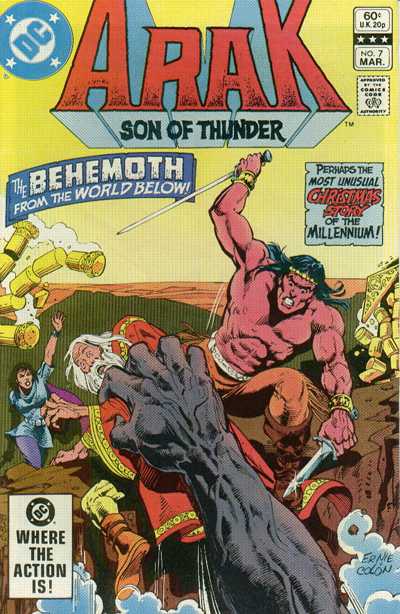
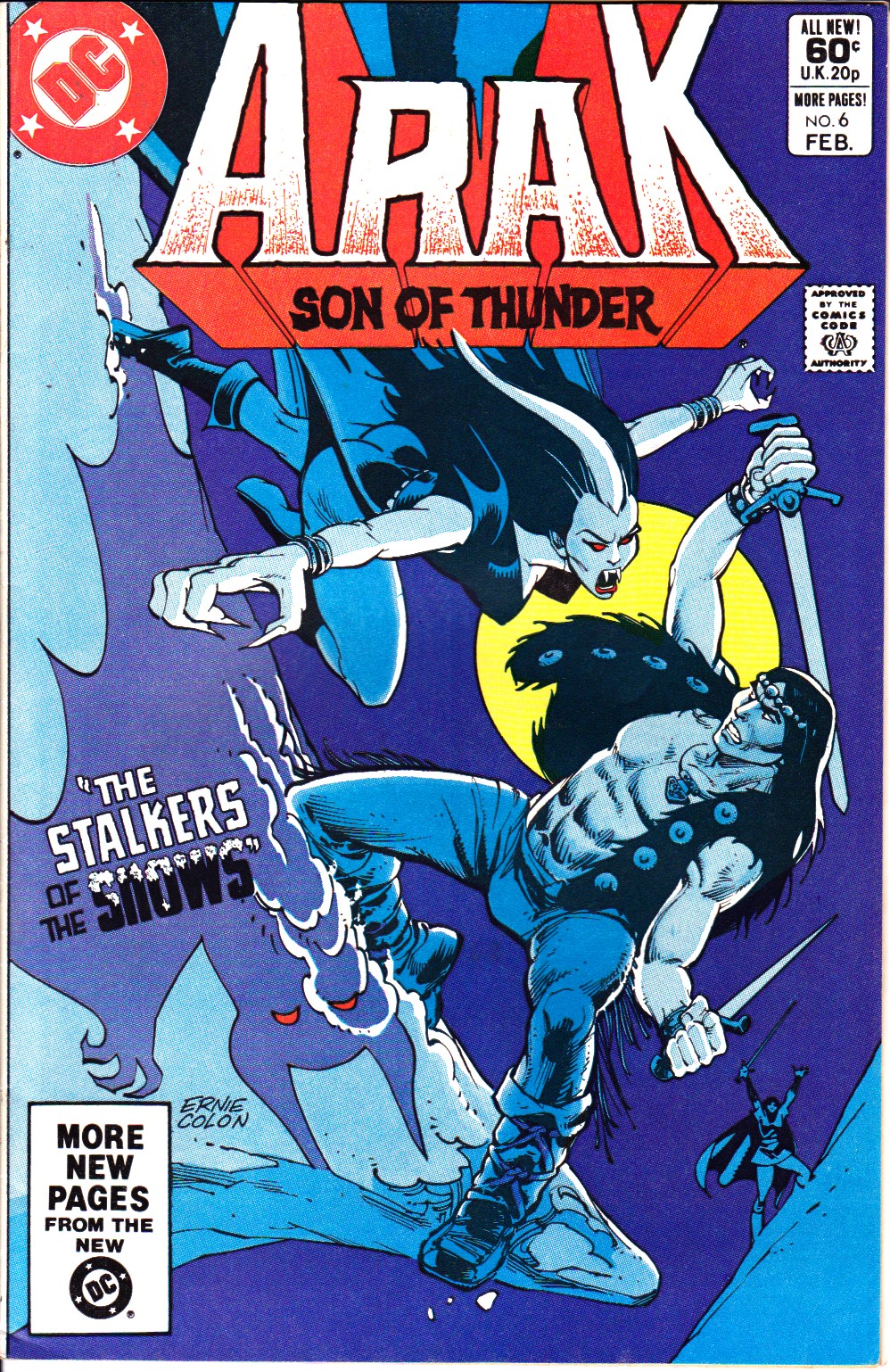
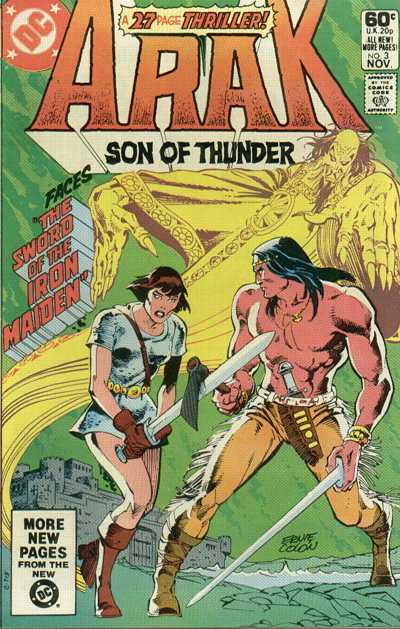
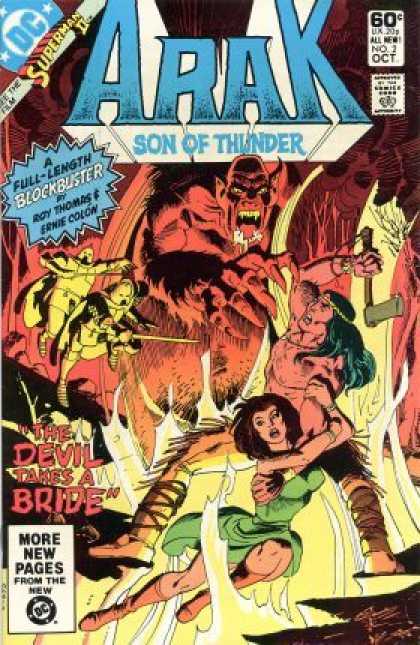
araksonofthunder1In the summer of 1981, DC Comics proudly presented “the coming of a great new hero who stalks the fear-haunted shadows of an age of darkness” — Arak, Son of Thunder!

Arak was brought to life by Roy Thomas, who’d cut his sword-and-sorcery eyeteeth launching the most successful S&S comic-book franchise ever over at Marvel (the line of Conan titles), and penciler Ernie Colon. It had all the earmarks of such titles — swashbuckling action, magic, monsters, and mayhem — but Arak was not just another generic brute barbarian among the sundry pale imitations of Robert E. Howard’s iconic character. No, Thomas seems to have had bigger ambitions for this epic tale, both in its historical moorings and its complexity.

Thomas uses the back page, the one later reserved for a letters column, to explain what he was up to, in an editorial entitled “A SHORT HISTORY OF THE WORLD, DC-STYLE!”

The editorial begins with the observation “They called them the DARK AGES — but we hope to make them blaze with the light of adventure and heroism.”

What follows that intriguing lead line is a brief history lesson of the “latter half of the first millennium A.D.,” during which this series is set. Of course, Howard himself used a quasi-historical background for his famous barbarian, but the “Hyborian Age” was set so far in the shadowy past that he had a good deal of leeway. By conceiving his story as historical fantasy set in a more recent era, Thomas does create more work for himself, although, granted, there probably weren’t too many medieval historians who would be reading the comic and calling him out (I certainly wouldn’t know if he got some minor detail wrong about the court of the king of the Franks).

Where his leeway lies — and where he really gets to have fun and play — is in the fact that he clearly defines this as alternate history, predicated on this premise: “Ah, but what if there were another earth somewhere — a parallel planet, existing but a heartbeat away from our world yet forever separated from it — an earth on which events and names and geography were much like our own, but with one all-important difference: What if, on that world…MAGIC WORKED?”

Read More Read More

Prelude to the Arak and Oz Reunion

Prelude to the Arak and Oz Reunion

ArakAs I embark on a close reading of the complete 50-issue run of ARAK, Son of Thunder, I believe an introductory post is justified, wherein I try to rationalize why I would want to do such a thing. Why Arak? Why now? Why me? (And, for some of you: Who the heck is Arak?)

First, a series of snapshots. These will get at the “Why me?” part, I think:

* I am lying in a hammock outside my grandparents’ cabin, nestled in the ponderosa pine forest on the Mogollon Rim of Arizona…White clouds skim across a blue sky, so close you can almost reach up and touch them… The smell in my nose is pine mixed with the crisp scent of newsprint, courtesy of a Marvel Comics Star Wars and a DC House of Mysteries.

g.i. joe** I am curled up on the top bunk of my bunk bed (bunk beds rocked! — they were like having a tree-house/fort in your own bedroom), home sick from school. My dad (Happy Father’s Day, Dad!) walks in bringing the latest bounty from the mailbox: the new G.I. Joe comic. I eagerly rip off the plastic bag, anxious with bated breath to find out if Snake Eyes escaped the exploding bunker at the end of last month’s issue.

*** I am pedaling my bicycle down to the local gas station, eager to check the revolving display stand to see if the new installment of ROM or Captain Carrot and His Amazing Zoo Crew has hit the stand (and, damn, I was in good shape back then, pedaling hither and yon. It was all downhill once I got my driver’s license).

Read More Read More

New Treasures: The Simon & Kirby Library: Science Fiction

New Treasures: The Simon & Kirby Library: Science Fiction

The-Simon-and-Kirby-Library-Science-FictionJoe Simon and Jack Kirby were perhaps the most important and successful comic team of the 1940s and 50s. Together they created Captain America (among many other popular creations) and produced an incredible body of work spanning numerous genres. Joe Simon was the first editor of Marvel Comics and the legendary Jack Kirby later partnered with Stan Lee to create some of the most enduring characters of the 20th Century, including Iron Man, The Fantastic Four, The Hulk, The Silver Surfer, Daredevil, Thor, the X-Men, and countless others.

The Simon & Kirby Library: Science Fiction is packed with dozens of stories, many of them photographed from the original artwork. This is essential pulp science fiction, with tales of brave spacemen, intrepid jungle explorers encountering lost civilizations, living shadows, crash landings on bizarre alien worlds, sinister robots, giant monsters battling desperate armies, beautiful barbarian princesses, impossible inventions, and much more.

The Simon and Kirby Library: Science Fiction spans more than 20 years, beginning with the first stories Joe Simon and Jack Kirby ever produced together (beginning in June 1940) — their ten-issue run of Blue Bolt adventures. Then the Cold War years will be represented by Race For the Moon, featuring pencils by Kirby and inked artwork by comic book legends Reed Crandall, Angelo Torres, and Al Williamson.

Other rarities from both decades are included, and as a bonus for readers, the volume features stories illustrated by Crandall, Torres, and Williamson — without Kirby.

The book also includes an introduction by Watchmen co-creator Dave Gibbons. This is the fourth volume in The Simon & Kirby Library, following SuperheroesCrime and the best-selling Horror.

The book is in full-color throughout, and most of the art has been restored and vibrantly re-colored by Harry Mendryk. My only complaint about this volume is that only a handful of covers are included, in a sparse 3-page cover gallery in the back.

The Simon & Kirby Library: Science Fiction was published by Titan Books on June 4. It is 352 pages in hardcover, priced at $49.95. There is no digital edition.

Our Comics, Ourselves

Our Comics, Ourselves

OrcaSeveral years ago, I handed my older son my pile of Avengers comics, a sequential trove dating from about 1976 until about 1985.

He read them eagerly, then threw them all over his room. I provided a storage bin and said, “If you want the privilege of reading these, treat them well.”

Message received. The comics, when not in use, lived happily in their bin.

He’s now re-reading them, out of order. He left a couple of them on his bed the other night, and rather than flip out –– “You’re grounded for life, plus I’m confiscating your cell phone! Oh, wait. You don’t have a cell phone. Hmm. Maybe I should confiscate my own cell phone?” –– I elected to simply remind him that my yesteryear treasures need to be treated well.

Then I forgot all about the reminder. I found myself hooked by the back cover of Avengers #164. It was an ad, of course –– what else would grace the back cover of a Marvel Comic? But what an ad, a movie poster extravaganza for (hold me back) Orca (1977).

With Richard Harris and Charlotte Rampling, no less.

Read More Read More

Battlepug by Mike Norton

Battlepug by Mike Norton

BattlepugBattlepug is a weekly web-comic that follows the adventures a big, dumb beast. And his dog. Writer/artist Mike Norton starts off the story as a fairly standard Conan-style barbarian origin piece. You know the spiel … innocent boy orphaned after his village is destroyed, forced into a life of slavery that builds both his muscles and his hunger for revenge. But there are signs along the way that remind us this won’t be the usual dreary rip-off. First of all, the terror that murders our hero’s village is pretty much the cutest thing you’ll see (until the arrival of the titular pug, anyway). Second, the Northern Elves who enslave the boy look all-too-familiar (as does their grim and merciless king). By the time the giant pug on the cover appeared in the story (which is twenty pages, or five months, along), I was already sold on the premise.

Writing a cliffhanger serial is difficult enough. Writing a cliffhanger serial where every single page is a cliffhanger, without ever seeming forced, is the work of a master storyteller. This story never gets tedious, even when it breaks for the narrator offering her own commentary (of course, it helps that the narrator is naked and covered in tattoos, and the audience is a pair of talking puppies). The strip’s been running for over two years and still continues to pull left turns with no end in sight. All the common tropes, the princess in need of rescue, the obligatory big bad, the ruthless warrior woman, are given goofy interpretations, with a few surprise cameos (like an unexpected couple who run a ferry service). As a fan of fantasy (especially sword and sorcery), it was nice to see a story that was paradoxically lampooning, while at the same time honoring, all those standard plot elements. Basically, this story works even as it’s making fun of everything else in the genre.

You can catch a new page of Battlepug every Monday at the website. It’s totally free, which means you’ve got no excuse not to check it out. But if you feel like supporting the artist (bandwidth isn’t free, people), the first bundle of pages have been collected into a traditional print collection (with volume two on its way in August). There’s also a pair of Battlepug t-shirts available (classic style or “Thunderpug”).

And if none of this has convinced you, I’ll just close my post with two words: ghost manatee.

Michael Penkas writes in a variety of genres, is the current website editor for Black Gate, maintains a blog, and has recently published a collection of his early published stories, Dead Boys (available through Amazon and Smashwords).

The Unfulfilled Superhero: Philip Wylie’s Gladiator

The Unfulfilled Superhero: Philip Wylie’s Gladiator

GladiatorGrowing up reading superhero comic books, it was almost inevitable that I’d hear about Philip Wylie’s 1930 novel Gladiator. It was said to be the inspiration behind Superman, the original story about an ultra-powerful strong man who set about trying to right wrongs. Growing older, I heard more: that Jerry Siegel, Superman’s co-creator, had reviewed the book for a fanzine; that he’d swiped dialogue from the book for use in his comics; that Wylie had threatened to sue. These claims were, in fact, not true. It is accurate to say that elements of the novel (now in the public domain and freely available online) can be seen in Superman. It’s also true (as Claude Lalumiére observed to me when he sold me his copy of the book) that the novel seems to have had as much or more inspiration on the character of Spider-Man. But as I see it, the book really stands in opposition to the super-hero genre as it later developed; it’s a kind of deconstructing of the genre before the genre had been really created. Unfortunately, I can’t say I find much else to recommend the novel. Still, it’s worth looking at as a curiosity, to see what survived in later works and what was changed — and how those changes transformed the central idea.

Gladiator opens in rural Colorado, with a man named Abednego Danner, a biology professor at a small college. Danner develops a serum that, administered in utero, can make a living creature tremendously fast, strong, and tough. When his wife falls pregnant, he administers the serum to his unborn child, who turns out to be a son named Hugo. The book follows Hugo though his life, as he develops his tremendous strength, goes to college and becomes a football star, struggles to make money, goes off to fight in the First World War, tries to find his purpose, fails to end political corruption, and finally comes to an odd anticlimactic end struck by lightning on a peak in South America while doubting God.

Read More Read More

Goth Chick News: Hanging with Head Smash Creator Vlad Yudin

Goth Chick News: Hanging with Head Smash Creator Vlad Yudin

image008At this year’s Chicago Comic and Entertainment Expo (“C2E2”), you couldn’t spit a piece of gum without hitting a promotional plug for Head Smash.

To be honest, you couldn’t spit a piece of gum without hitting a lot of unusual things at the May event, but Black Gate photog Chris Z and I couldn’t help but notice that the sheer quantity of Head Smash promotion was on par with the visual assault launched by Marvel for its own upcoming releases.

We had to admit, the curiosity factor was being driven off the scale for a graphic novel that hadn’t yet been released — not to mention an indy film adaptation barely into pre-production.

I had read that Yudin was creating Head Smash (penned by Erik Hendrix and illustrated by Dwayne Harris) for Arcana Comics, as well as writing the film adaptation of the story.  He is also producing and adapting the film’s screenplay with The Twilight Saga producers Mark Morgan and Michael Beckor.

So thanks partially to our nosiness–  but mostly to the tenacity of the PR company handling Head Smash and its creator — Chris and I got an early morning exclusive chat with the Russian-born-US-raised writer, director and producer Vlad Yudin.

And yes, I admit it, there’s no way I’m not going to talk to a guy named “Vlad…”

Read More Read More

Two Sought Adventure

Two Sought Adventure

Don QTwo weeks ago I talked about the city vs. country tension that’s often found in literature, and how it might have contributed to the  rise of the barbarian hero in our own genre. Now I’m wondering whether we haven’t seen a fine-tuning of that same tension in a more familiar guise: the buddy movie, or, more to the point for us genre types, the buddy adventure.

Like some of the other stuff I’ve been talking about, I don’t think this concept is something that’s just shown up recently. In Don Quijote – widely considered to be the first novel, though you won’t get many who’ll agree on what genre it is – we have the titular Don himself, but we also have his travelling companion and side-kick, Sancho Panza.

But, you might argue, Sancho is a side-kick, and not an adventurer in and of himself – though again, you’ll find those who’ll dispute that, and maybe even convince you that, title aside, the book really belongs to Sancho. But let’s think about the implications here for genre heroes. When is a character a side-kick (pray note that I don’t qualify that by saying “just”) and when is the character a co-hero?

Read More Read More

Goth Chick News: Blade Slays Again…

Goth Chick News: Blade Slays Again…

tomb of dracula 10 1976I might be one of the few fans of the Marvel comic Blade to actually admit to liking the screen adaptations staring Wesley Snipes.

New Line Cinema released the trilogy of Blade movies between 1998 and 2004. They were based on the half-breed vampire slayer character created for Marvel Comics by Marv Wolfman and Gene Colan debuting in 1973’s The Tomb of Dracula #10.

Granted, not all three movies were created equal, but I thought the first one was solid and though by the third installment, Blade Trinity, fans of the comic might not have recognized much, the snappy dialog written for Ryan Reynolds and the overall eye-candy made it at least entertaining, if not wildly successful.

In fact, at this year’s C2E2 I overheard an interesting bit of Blade Trinity trivia which maybe helps explain why.

Actor and comedian Patton Oswalt — who played weapons expert Hedges in the third Blade movie — was signing autographs.  He told a fan that all those Ryan Reynolds’ sophomoric one-liners followed by Wesley Snipes’ dead pan stares were largely the result of Snipes not speaking to screenwriter / director David Goyer.

Apparently Snipes would only communicate to Goyer via post-it notes and generally refused to cooperate during the production, causing the rest of the cast to take up the uncomfortable slack in an attempt to save the film. Oswalt explained:

We would all just think of things for him (Reynolds) to say and then cut to Wesley’s face not doing anything because that’s all we could get from him (Snipes).  That was an example of a very troubled shoot that we made fun. You have to find a way to make it fun.

Interesting.

Even more so when you consider that the entire franchise might be getting a chance at a Snipes-free redemption.

Read More Read More

Dreams of Conquest in a Four Color Universe: Kaput and Zösky

Dreams of Conquest in a Four Color Universe: Kaput and Zösky

kaput-and-zoskyI’ve been a fan of French cartoonist Lewis Trondheim since I first read the marvelous Dungeon (co-created with Joann Sfar) over a decade ago. His comics are bizarre, funny, and fabulously creative.

So I didn’t mind taking a chance on a new Trondheim comic collection: Kaput and Zösky, an 80-page graphic novel collecting over a dozen tales (especially since I found it remaindered on Amazon for $5.58).

Kaput and Zösky are two determined galactic conquerors, traveling from planet to planet in a tiny spaceship, constantly dreaming of ways to bring the next planet to its knees. Their abilities don’t quite match their dreams, however, and most strips end with them hightailing it off-planet, usually escaping death by inches.

The art in Kaput and Zösky is by Eric Cartier, and it was the high point of the comic for me. Cartier’s cartoony aliens are expressive and frequently very funny, and he captures Kaput and Zösky’s goofy schemes brilliantly. I suspect the strips may work better standalone than bundled together, as they got a little repetitive after a while.

Fortunately, the adventures of Kaput and Zösky aren’t limited to the page. Kaput and Zösky: The Ultimate Obliterators, a Nicktoons cartoon broadcast in 2003, captures the charm of Cartier’s artwork, and the Canadian voice cast does an excellent job of bringing the two bloodthirsty aliens to life. A total of 26 half-hour episodes (78 shorts) were produced, many of which have found their way to YouTube. Check out Kaput & Zosky in “The Planet Pax,” a complete 8-minute episode:

Kaput & Zosky – The Planet Pax

Kaput and Zösky was published in April 2008 by First Second. It is 80 pages in color, with text translated from the French by Edward Gauvin.