Browsed by
Category: Books

The Hobbit: The Long-Awaited Movie, Part One
The Hobbit: The Long-Awaited Movie, Part One

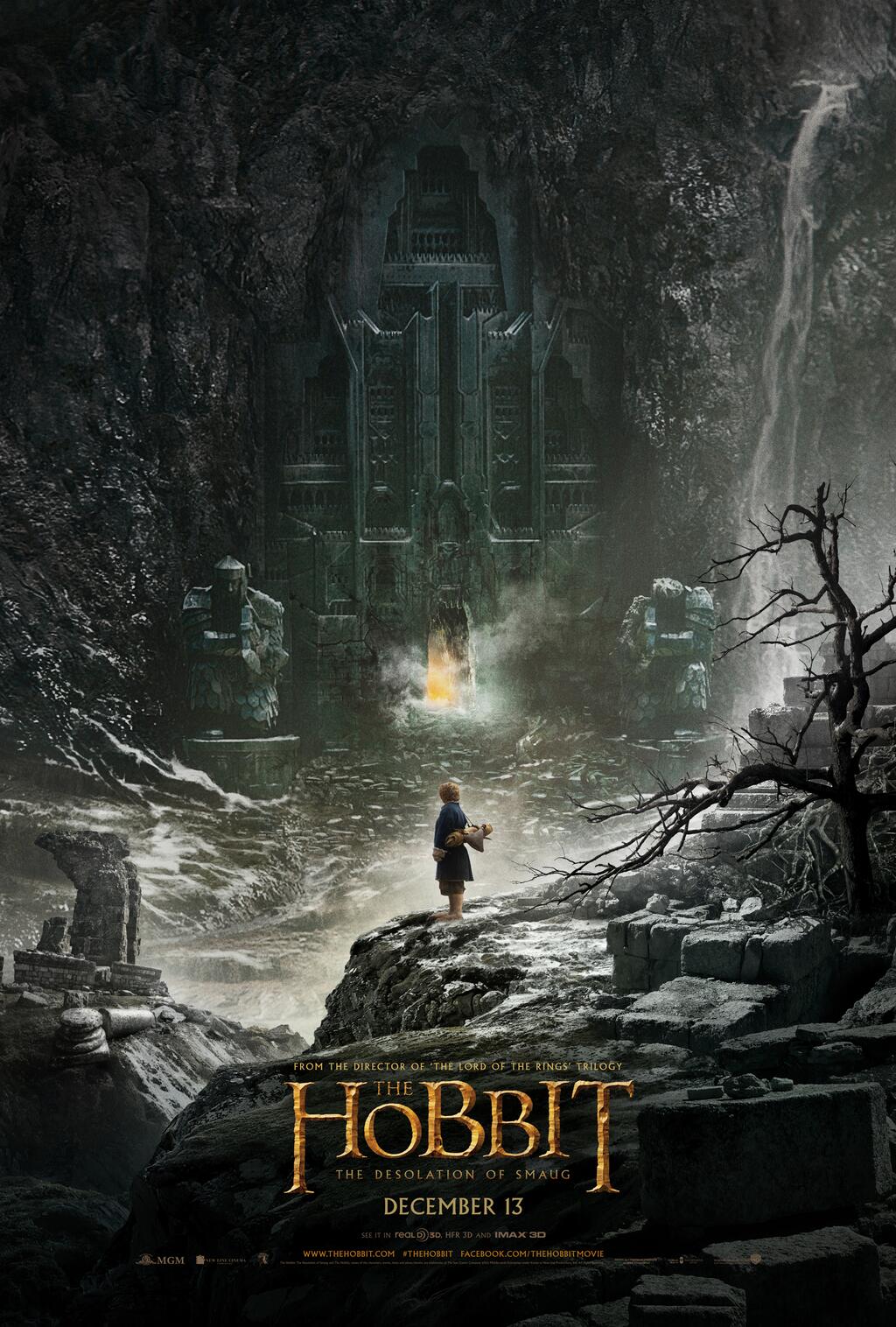
The Hobbit the Desolation of Smaug poster2-smallLet me begin with a confession: I’m an unabashed Tolkien fan. Since the first time I read The Hobbit as a wee lad, I’ve been hooked. When The Lord of the Rings movies came out a few years back (which I loved), my next question was, “When is Peter Jackson going to make The Hobbit?”

Finally, after legal battles and years of waiting, we got the first installment, The Unexpected Journey.

While I’m in the confessional mood, I’ll add that I wasn’t completely sure about the decision to split the book into three movies. After all, Mr. Jackson & Company did a pretty good job capturing the entire LoTR trilogy in three films. Why do they need the same amount of time to cover a single book? However, I had faith that the films’ creators knew what they were doing. Now, with the second movie about to be released, I’ve been ruminating about what I’ve seen so far.

What I desired most from The Hobbit movie(s) was to be transported back to the lush, mythic realm that had been created in the LoTR movies. And I got it in spades. Jackson even includes some scenes with Frodo and “old” Bilbo that serve as both a framing device and an introduction to the LoTR movies.

The movie also adds a bit of background to the story, showing how Smaug came to the mountain and evicted the dwarves. Usually, these kinds of pre-story narratives don’t interest me, but this one was so well-done that I didn’t mind. It actually gives us a brief glimpse of the dragon upfront and, in a stroke of genius, introduces the Arkenstone, which plays a big part at the end of the story, but which the book doesn’t explain much.

Once the actual story begins, I was locked in. (*cue tractor-beam sound*) The first thing that struck me was how cool and different the dwarves were. In the novel, the dwarves are portrayed as… well… buffoons. The movie included plenty of comic-relief, but it also gave us dwarves with more diverse personalities. The dinner party scene was just as fun and raucous as it is in my head when I read the book. It was also a nice touch how Gandalf attempts to convince Bilbo to go on the quest at the same time Balin is trying to talk Thorin out of it.
…

Read More Read More

New Treasures: Dark Melody of Madness by Cornell Woolrich

New Treasures: Dark Melody of Madness by Cornell Woolrich

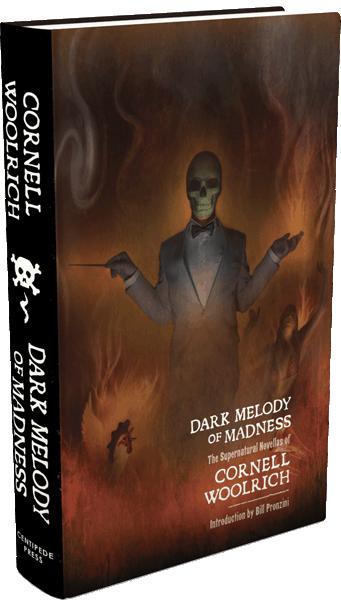
Dark Melody of Madness-smallI wish a knew more about Cornell Woolrich.

From what I understand, this is a common state of affairs, even for some of his most devoted fans. Woolrich was something of a recluse, especially in the last few years of his life, and there are only a handful of people alive today who had any real dealings with him. Barry N. Malzberg, Woolrich’s agent for much of the 1960s, is one of the few, and he’s provided a fascinating reminisce in his introduction to Phantom Lady, one of the handsome new Woolrich editions from Centipede Press.

Woolrich is revered by mystery and noir fans — and rightly so. Some three dozen films have been made of his taut thrillers, including Rear Window, Night Has a Thousand Eyes, The Bride Wore Black, and many others. But on occasion, he also wrote supernatural fiction and Dark Melody of Madness, one of the new Centipede Press volumes, collects four of his novellas for the first time: “Graves For The Living,” “Jane Brown’s Body,” “Dark Melody of Madness,” and “I’m Dangerous Tonight,” all originally published between 1935 and 1938.

Holding on to a loved one can be difficult, but certainly not as weird and treacherous as in this quartet of Cornell Woolrich novellas set in the mid-1930s. It’s a time of great incongruities — physical anguish of the Great Depression, lighthearted dancing to the rhythms of swing; near-legendary bank robbers, daredevil long-distance airplane pilots; head bashing of union members, air-conditioned comfort for movie goers.

Woolrich takes this milieu, adds an overlay of the supernatural, and places his protagonists in grotesque, untenable situations involving their lives and souls. Here is the eerie world of voodoo, Frankenstein-style reincarnation, live burial, and macabre garments — a mixture of cold sweat-producing dilemmas, where the characters find it near-impossible to separate the real from the unreal.

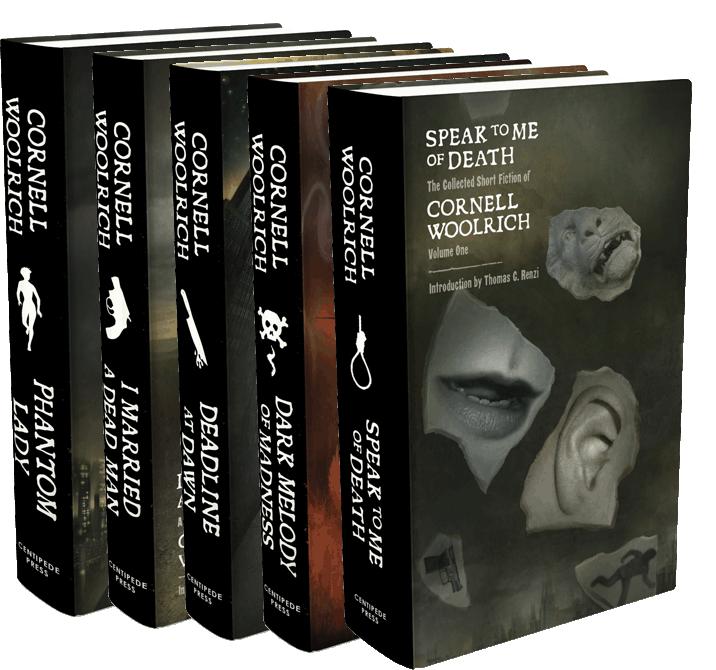
Dark Melody of Madness was published by Centipede Press on August 6, 2013. The introduction is by Bill Pronzini, and the cover and color interiors are by Matt Mahurin. The trade paperback is 296 pages, priced at $18; there’s also a limited edition, out-of-print hardcover. The hardcover edition lists an additional novella, “Mannequin,” on the TOC. For mystery and noir fans, Centipede Press offers three additional volumes in the series: Deadline at Dawn, I Married a Dead Man, and Speak to Me of Death (see the complete set here.)

The Whole Northern Thing: Hrolf Kraki’s Saga by Poul Anderson

The Whole Northern Thing: Hrolf Kraki’s Saga by Poul Anderson

oie_Ballantine Edition

Doom: Old English dom “law, judgment, condemnation,” from Proto-Germanic *domaz (cf. Old Saxon and Old Frisian dom, Old Norse domr

For a crime committed by King Frodhi the Peace-Good against the giantesses Fenja and Menja, a great doom is laid on the royal family of Denmark, the Skjöldungs.

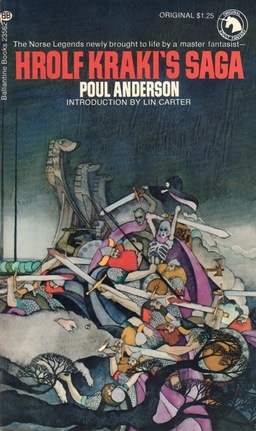
How that doom works its murderous effects on the Skjöldungs is the core of Hrolf Kraki’s Saga (1973), Poul Anderson’s gripping retelling of the sagas (read the original here) of the ancient Danish king, Hrolf. The book brings together the extant stories of the Skjöldungs (which, almost as an aside, include the tale of Beowulf) and welds them into a coherent novel of great potency.

According to legend, Hrolf was the greatest king of Denmark and the most outstanding member of the semi-divine Skjöldung family. With his canny intelligence, he thwarted most of his kingdom’s enemies and built up its wealth. His great nobility drew the North’s mightiest warriors to his court.

Whether real or mythical, Hrolf and his reign are remembered in Denmark as fondly as Arthur’s in Britain. And like Arthur, all Hrolf’s great works were destroyed and chaos ruled in his wake.

From a people whose myths foretold the annihilation of the gods themselves in the end times of Ragnarok, the bleakness that runs through so many of their stories isn’t surprising. Perhaps it’s traceable to the violence of the Great Migratory period when the Germanic people spread out from their ancient homelands in Scandinavia and northern Germany and came into conflict with the Roman Empire and Celtic tribes in Gaul and Britain. Maybe it was just the cold and diminished winter sunlight in Norway and Sweden that bred their melancholy. Whatever the causes, doom in its modern sense runs through almost every chapter of Hrolf Kraki’s Saga.

…

Read More Read More

New Treasures: Allegiance by Beth Bernobich

New Treasures: Allegiance by Beth Bernobich

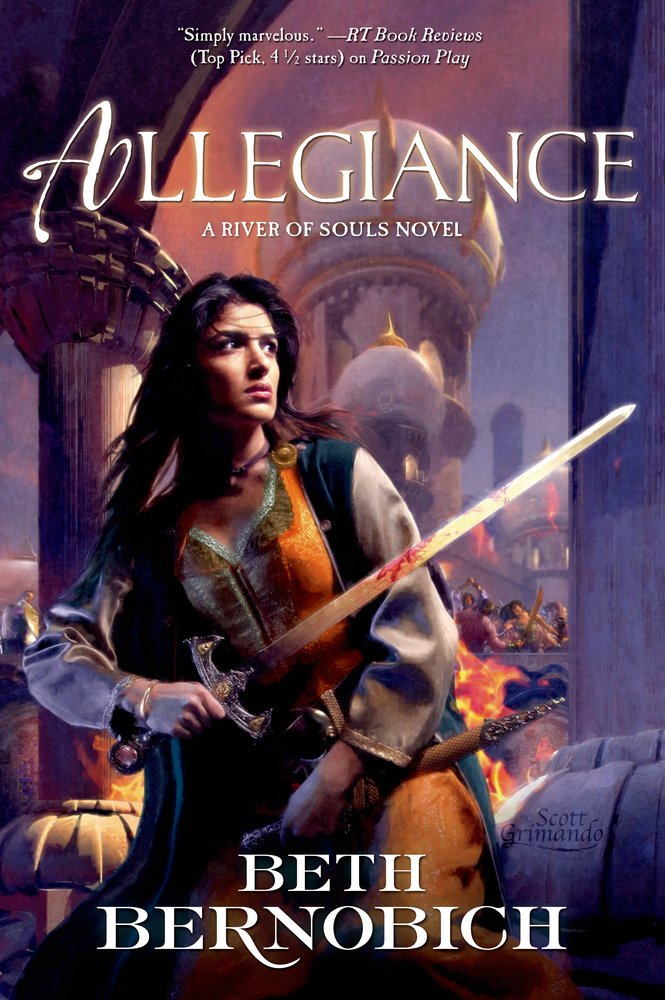
Allegiance Beth Bernobich-smallYou can always tell the books that get a serious buzz here at Black Gate — because the review copies always vanish. I try to track them down and discover they’ve been passed from hand to hand until almost everyone on staff has read them. Except for me, of course. I can never find the damn things.

That’s what it’s been like with the novels of Beth Bernobich and her River of Souls trilogy. I still have no idea what happened to the first volume, Passion Play… I gave up looking for it after I learned my son Tim took it off to college. I’m trying to run a blog here, people. Work with me.

And so it is with the third volume, Allegiance. I have no idea where it is. I’m writing this based on the release notes. I think I just have to accept the inevitable: that I’ll have to draft New Treasures posts for Beth Bernobich’s novels without ever having the book in hand. I’m forced to rely on what I can glean from brief sightings during staff meetings and scattered Internet rumors. Enjoy.

King Leos of Károví, the tyrannical despot whose magic made him near immortal and who controlled a tattered empire for centuries through fear and intimidation, is finally dead. Ilse Zhalina watched as the magical jewels that gave him such power reunited into a single essence, a manifestly God-like creature who then disappeared into the cosmic void. Ilse is now free to fulfill her promise to Valara Baussay, the rogue Queen of Morennioù, who wants to return to her kingdom and claim her throne.

Ilse will do all in her power to help Valara if only as a means to get to her home. Home to her lover, Raul Kosenmark, who is gathering forces in their homeland of Veraene now that Leos is dead in order to save them from an ill-advised war. Pulled by duty and honor, Ilse makes this long journey back to where her story began, to complete the journey she attempted lives and centuries before and bring peace between the kingdoms. Along the way she learns some hard truths and finally comes to a crossroads of power and magic. She must decide if duty is stronger than a love that she has sought through countless lifetimes.

Will Ilse give up her heart’s desire so that her nation can finally know lasting peace?

Allegiance was published by Tor Books on October 29. Best guess, it is 320 pages, priced at $25.99 in hardcover, and $12.99 for the digital edition. I dunno who painted the cover, but I like it.

A Fond Look Back at Bluejay Books

A Fond Look Back at Bluejay Books

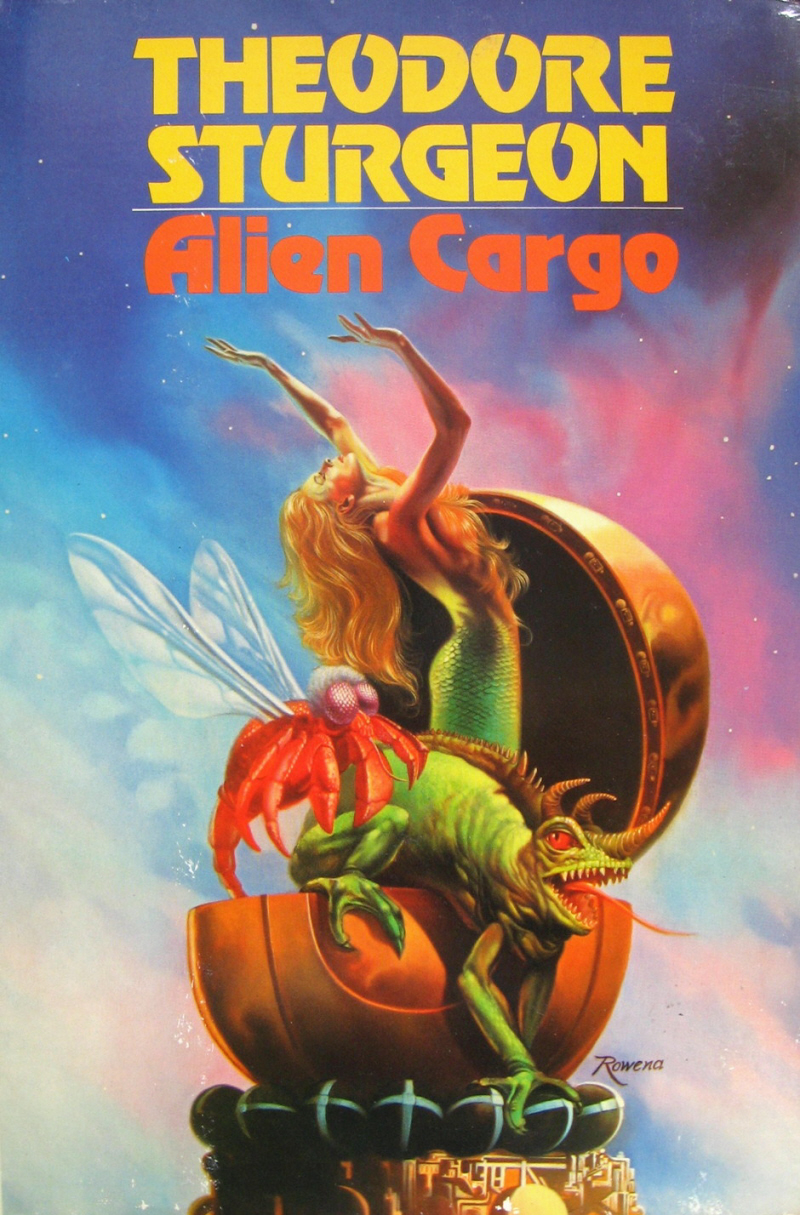
Alien Cargo Theodore Sturgeon-smallThe most popular article on the Black Gate website in July was our report on the departure of James Frenkel from Tor Books.

News articles like that are usually good for some decent traffic. It seems everyone had something to say about Frenkel stepping down from his post at the most powerful genre publisher in America and all that attention generated a lot of clicks.

Most conversations, however, dwelled on the circumstances of his departure, and overlooked his many accomplishments. During his years at Tor, Frenkel sure was busy. He acquired and edited some of their most important books, including volumes from Frederik Pohl, Dan Simmons, Jack Williamson, Timothy Zahn, Greg Bear, Andre Norton, Vernor Vinge, and many others.

But even before he joined Tor, Frenkel made major contributions to American SF and fantasy, particularly as publisher at Bluejay Books in the mid-80s. It’s Bluejay, and the beautiful books they produced before going out of business, that I want to talk about today.

Bluejay was active just as I was really discovering American fantasy and SF in the early 80s, haunting bookshops in downtown Ottawa. They were pioneers in the trade paperback market, hired excellent cover artists — including Rowena Morrill, Tom Kidd, Barclay Shaw, John Pierard, Jill Bauman, and others — and published many of the top writers in the field, such as Theodore Sturgeon, Philip K. Dick, Harlan Ellison, Vernor Vinge, and many more.

That was a powerful combination, and it meant that Bluejay was an imprint with enormous prestige — at least in my mind. I kept an eye out for their books on the shelves and always gave them special attention.

That prestige extended to all their titles, not just the authors I recognized (part of the magic of having a strong and easily recognizable visual brand). It also extended to the new authors they discovered and championed.

…

Read More Read More

A Ghost Put to Good Use: Ali Smith’s Hotel World

A Ghost Put to Good Use: Ali Smith’s Hotel World

Hotel WorldEarlier this week Mark Rigney put up an interesting post on the (narrative) uses of ghosts, and suggested a number of plot and thematic functions a ghost can serve in a story. The post resonated for me with the book I was reading at the time: Ali Smith’s Hotel World. And when I say ‘resonate’ I mean it seemed to echo some of the questions I had about the book, and to suggest some ways of looking at the novel that might help unriddle some of its more curious aspects. So here’s a look at the novel, bearing in mind the question: what’s that ghost doing there?

Hotel World is Smith’s second novel. Published in 2001, it followed 1997’s Like and two volumes of short stories, Free Love and Other Stories (1995, winner of the Saltire Society Scottish First Book of the Year Award) and 1999’s Other Stories and Other Stories. Hotel World was shortlisted for the Man Booker Prize and the Orange Prize, and won the Scottish Arts Council Book Award. It’s a short novel, made up of five longish interconnected stories and an epilogue. Each of the five main stories follows a woman in a city on the north of the UK; each woman is connected in some way with a certain hotel, a part of the worldwide Global Hotels chain.

The first story is the first-person recollections of one Sara Wilby, ghost. She was a maid in the hotel, who for a joke tried to fit herself into a dumbwaiter on the top floor of the hotel only to have the old dumbwaiter fall and kill her. Her story follows her attempt to understand her death, what happened, and what it means; she succeeds, through a final reconciliation with her former body. The second story follows Else, or Elspeth, a homeless woman who panhandles outside the elegant Global Hotel. She’s given a room for the night by Lise, the night clerk at the hotel, who is the subject of the third story. The fourth story follows a guest, Penny Warner, a newspaper writer working on a puff-piece about Global Hotels. The last of the five stories follows Clare Wilby, Sara’s sister, who, like Sara, is trying to understand Sara’s death. The last section pulls back to give us a wide-angle view of the world and all its connections and ghosts.

…

Read More Read More

Vintage Treasures: Shattered Glass by Elaine Bergstrom

Vintage Treasures: Shattered Glass by Elaine Bergstrom

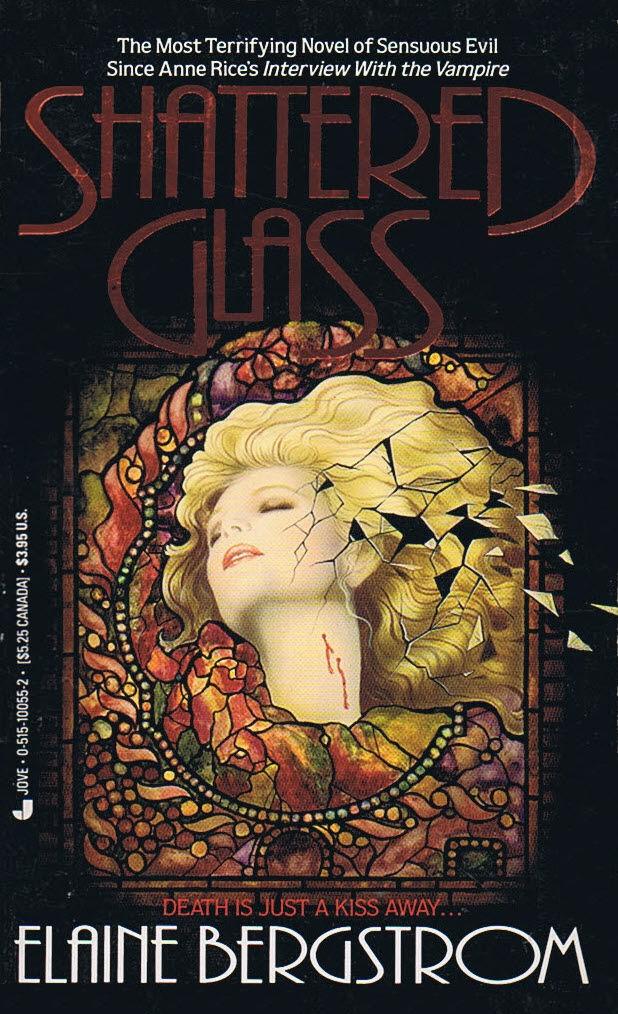
Shattered Glass Elaine Bergstrom-smallFor a long time, I credited the rise of the paranormal fantasy genre pretty much single-handedly to Buffy the Vampire Slayer. While I knew it was a little simplistic, it seemed obvious that the roots of the modern fascination with dating vampire, ghouls, werewolves, etc. arose from the long-running romance between the leads of Buffy and Angel, perhaps the two most successful horror TV shows of the our generation.

Of course, as I explore the modern history of dark fantasy, I find more and more evidence that paranormal romance was alive and well long before Joss Whedon penned his first screenplay. Chelsea Quinn Yarbro’s first vampire romance, Hôtel Transylvania, featuring Count Saint-Germain, was published in 1978, for example. (And the series is still going strong — with volume 26, Night Pilgrims, just released in August.)

Yarbro was hardly the only pioneer in the genre, however. Elaine Bergstrom was working as a copywriter when she wrote her widely acclaimed first novel, Shattered Glass (1989), one of the first vampire romances. It featured a family of vampiric immortals and received a Stoker nomination. She followed up with five additional novels of the Austra family: Blood Alone (1990), Blood Rites (1991), Daughter of the Night (1992), Nocturne (2003), and Beyond Sundown (2011). Here’s the back cover copy for the book that kicked it all off:

Modern technology has rendered the vampires’ night hunt obsolete. But some vampires continue to kill. By choice.

Stephen Austra is a prominent artist, renowned for his wondrous restorations of stained glass in cathedrals and churches. He is also a vampire. But he respects ordinary human lives, and would never hurt a soul. Or so his lover, Helen Wells, desperately wants to believe…

Chilling, erotic and provocative, this sensational new novel by Elaine Bergstrom will lure you into a world where immortal evil meets undying passion. And where a series of appalling murders leads a beautiful young woman into the depths of suspicion… and to new heights of terror.

Bergstrom has also written two Ravenloft novels: Tapestry of Dark Souls (1993) and Baroness of Blood (1995). Shattered Glass was published in July 1989 by Jove Books. It is 372 pages, originally priced at 3.95 in paperback. It is currently available in digital format for $3.99.

Tales of the Wold Newton Universe, Part 4 of 4

Tales of the Wold Newton Universe, Part 4 of 4

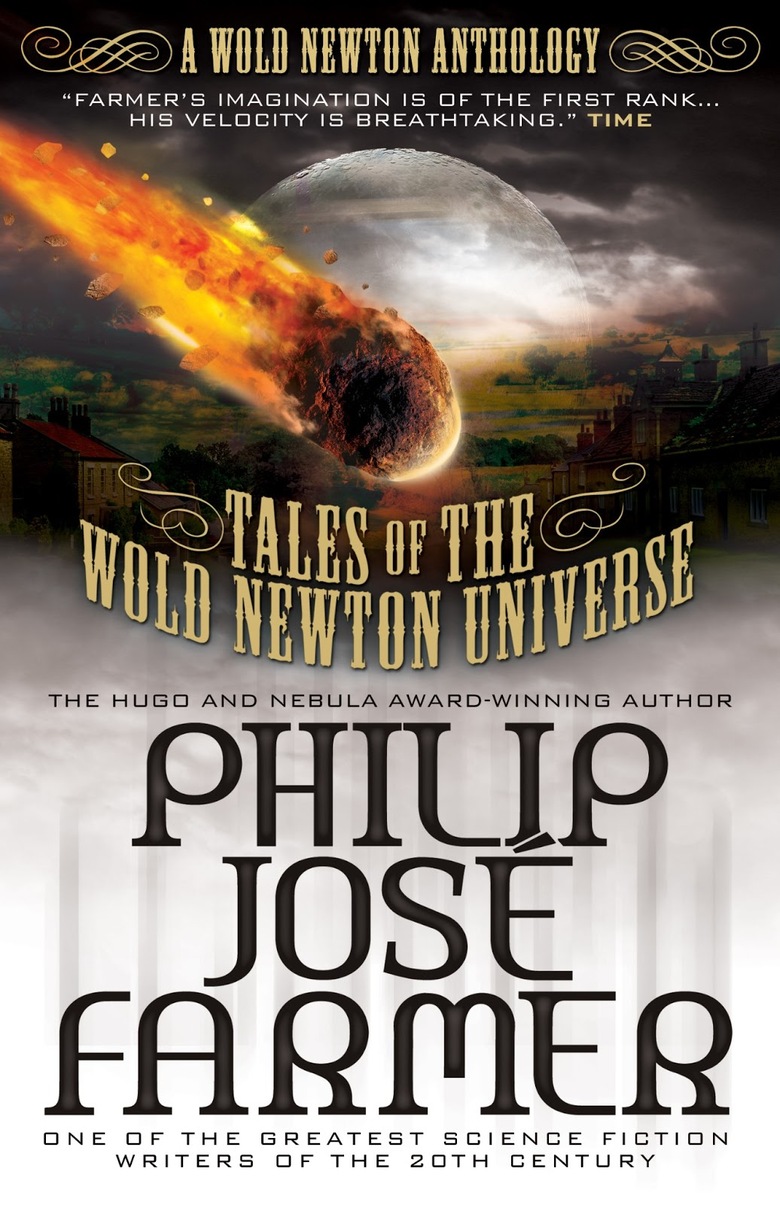
Tales of the Wold Newton Universe-smallOctober marked the release of Tales of the Wold Newton Universe, a new anthology from Titan Books that collects, for the first time ever in one volume, Philip José Farmer’s Wold Newton short fiction, as well as tales set in the mythos by other Farmerian authors.

The Wold Newton Family is a group of heroic and villainous literary figures that science fiction author Philip José Farmer postulated belonged to the same genetic family. Some of these characters are adventurers, some are detectives, some explorers and scientists, some espionage agents, and some are evil geniuses. According to Mr. Farmer, the Wold Newton Family originated when a radioactive meteor landed in Wold Newton, England, in the year 1795. The radiation caused a genetic mutation in those present, which endowed many of their descendants with extremely high intelligence and strength, as well as an exceptional capacity and drive to perform good, or, as the case may be, evil deeds. The Wold Newton Universe is the larger world in which the Wold Newton Family exists and interacts with other characters from popular literature.

To celebrate the release of the new anthology, we’ve asked the contributors to discuss their interest in Philip José Farmer’s work and to tell us something about how their stories in the book specifically fit into the Wold Newton mythos.

For today’s installment, please welcome author and co-editor of Tales of the Wold Newton Universe, Win Scott Eckert.

Christopher Paul Carey
Co-editor, Tales of the Wold Newton Universe

…

Read More Read More

Eccentric in Retrospect: Helen Simpson’s The Woman on the Beast

Eccentric in Retrospect: Helen Simpson’s The Woman on the Beast

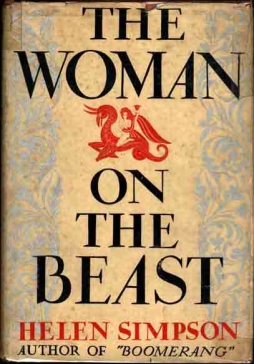
The Woman on the BeastOne of the distinct pleasures of used-book sales is finding an old book about which you know nothing, and making a cheap gamble: a literary bet that the story will prove worth the coin. You hope it pays off with unsuspected greatness, but for me as a reader the bet’s covered if I find something memorably strange. Not necessarily greatly strange, but eccentric, interesting, and outside the received narratives of literary histories (and genre histories past). Which brings me to Helen Simpson’s 1933 novel The Woman on the Beast: Seen From Three Angles.
According to the online Australian Dictionary of Biography, Simpson was born in Australia in 1897, went to England in 1914 to study, published some short plays, and returned to Australia in 1921, where she began publishing poetry, plays, and novels. She divided her life between Australia and England, and in 1939 was selected to be the Liberal candidate for Parliament for the Isle of Wight. Unfortunately she soon fell ill, and ultimately died of cancer in 1940. Among her prolific output were 1932’s Boomerang, which won the James Tait Black Memorial Prize for Fiction, and two books filmed by Alfred Hitchock: 1937’s Under Capricorn, and 1929’s Enter Sir John (written with Clemence Dane), which reached screens under the title Murder! (Her 1935 novel Saraband For Dead Lovers was also made into a movie, Saraband, in 1948.)

And then there’s The Woman on the Beast, which is strangeness of a different order: science fiction mixed with Christian fantasy. A preface lays out the theme — “that the most hateful actions are, as often as not, performed for the best of reasons” — and states that the book’s three stories have only that idea in common. After a prologue set in the dark ages, the three stories in question follow, set in India in the sixteenth century, in France during the Revolution, and in Australia in 1999. Then there’s a brief epilogue, depicting, as you might expect from the title, the Apocalypse. But which also makes clear that the three stories have more than theme in common.

…

Read More Read More

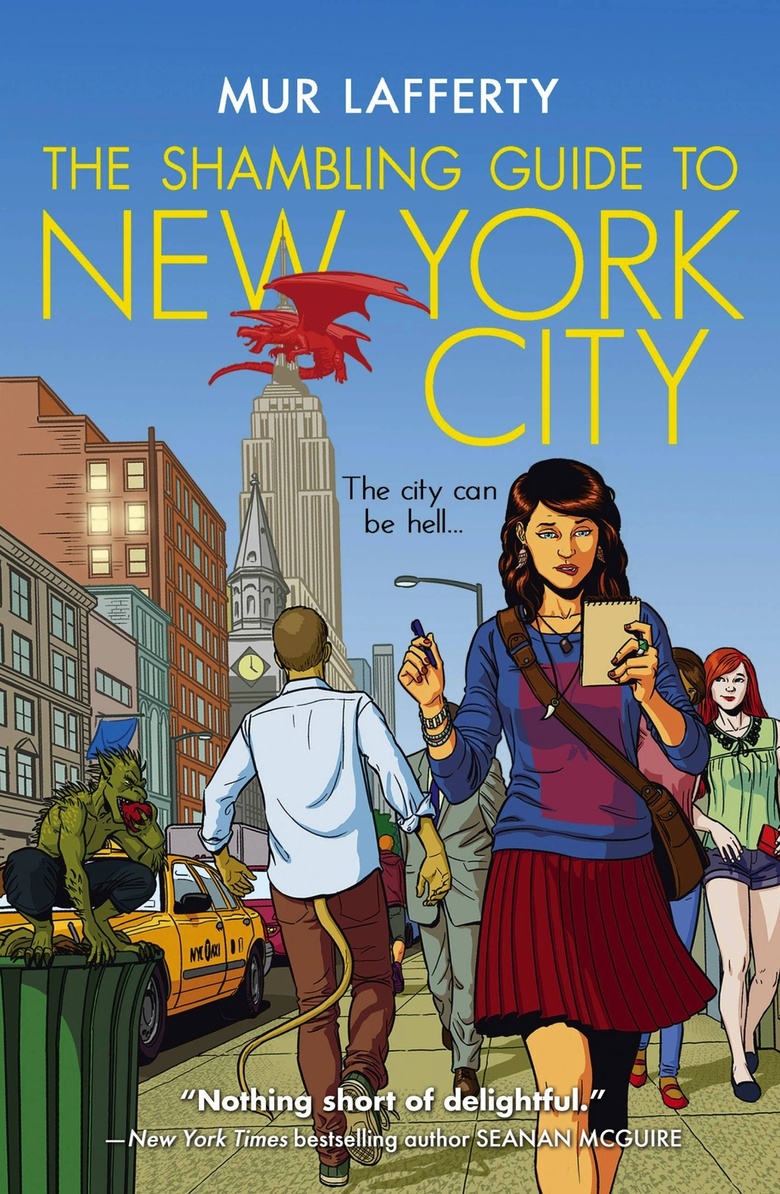
New Treasures: The Shambling Guide to New York City by Mur Lafferty

New Treasures: The Shambling Guide to New York City by Mur Lafferty

The Shambling Guide to New York City-smallMur Lafferty is something of a renaissance woman. She was the host and co-editor of the horror podcast Pseudopod until July 2007; in 2010 she became the editor and host of the weekly SF podcast magazine Escape Pod. She’s also the host of I Should be Writing (when does she find time to actually write?), and a winner of the Podcast Peer Award and the Parsec Award.

Apparently, she must make time somehow. She’s the author of two previous novels (Playing for Keeps, and Nanovor: Hacked), and her third novel is out from Orbit Books. Zoe Norris is a travel writer forced to take a job with a shady publishing company in New York, only to discover she’s been tasked with writing a tour guide for the undead. Scott Sigler said of The Shambling Guide to New York City, “If Buffy grew up… moved to New York and got a real job, it would look a lot like this.” Sounds plenty intriguing to me.

Because of the disaster that was her last job, Zoe is searching for a fresh start as a travel book editor in the tourist-centric New York City. After stumbling across a seemingly perfect position though, Zoe is blocked at every turn because of the one thing she can’t take off her resume — human.

Not to be put off by anything — especially not her blood drinking boss or death goddess coworker — Zoe delves deep into the monster world. But her job turns deadly when the careful balance between human and monsters starts to crumble — with Zoe right in the middle.

The Shambling Guide to New York City is the first novel in The Shambling Guides series; the second volume, Ghost Train to New Orleans, is due March 4, 2014.

The Shambling Guide to New York City was published by Orbit Books on May 28, 2013. It is 358 pages, priced at $15 in trade paperback and $9.99 for the digital edition. The marvelous cover is by Jamie McKelvie (click for a full-size version).