Browsed by
Category: Books

Robert Hood’s Fragments of a Broken Land: Valarl Undead Wins the Ditmar Award
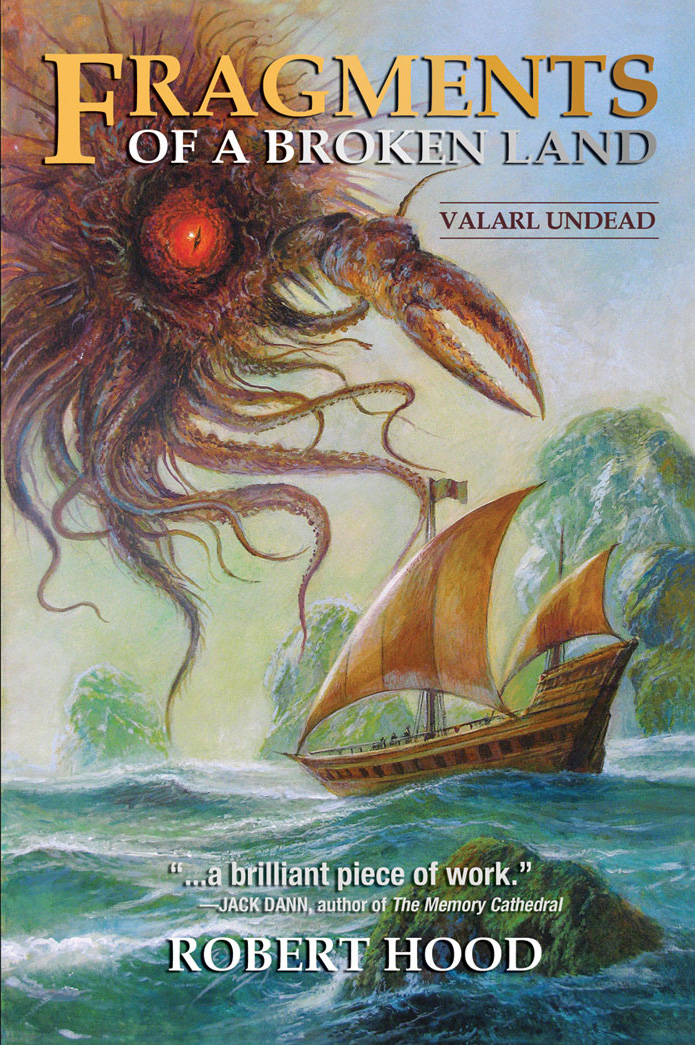
Robert Hood’s Fragments of a Broken Land: Valarl Undead Wins the Ditmar Award

fragments of a broken land-smallWhat the heck is the Ditmar Award?

The Ditmar Awarda are the Australian Hugo Awards, recognizing superior achievement in Australian science fiction, fantasy, and horror. They’ve been awarded every year since 1969. They’re named after Martin James Ditmar “Dick” Jenssen, an Australian fan who footed the bill for the awards way back when they were just getting off the ground. Awards are given for best novel, short story, fan writing, and other more boring categories.

All very interesting. But what’s more interesting is that a major international award just went to a fantasy novel with GIANT TENTACLES ON THE COVER. And a floating red eyeball.

This is watershed moment, people. Thousands of years from now, future civilizations will point to this moment and say, “Yep, right there, that was it.” There will be no need to explain further, because future people are cool and will understand immediately.

I do not have a copy of Fragments of a Broken Land: Valarl Undead. But I really, really want one. I want to know what all the cool future people are talking about, and those Australians with their funky awards. Plus. Giant tentacles.
Read More Read More

Strange Chemistry Shuts Down

Strange Chemistry Shuts Down

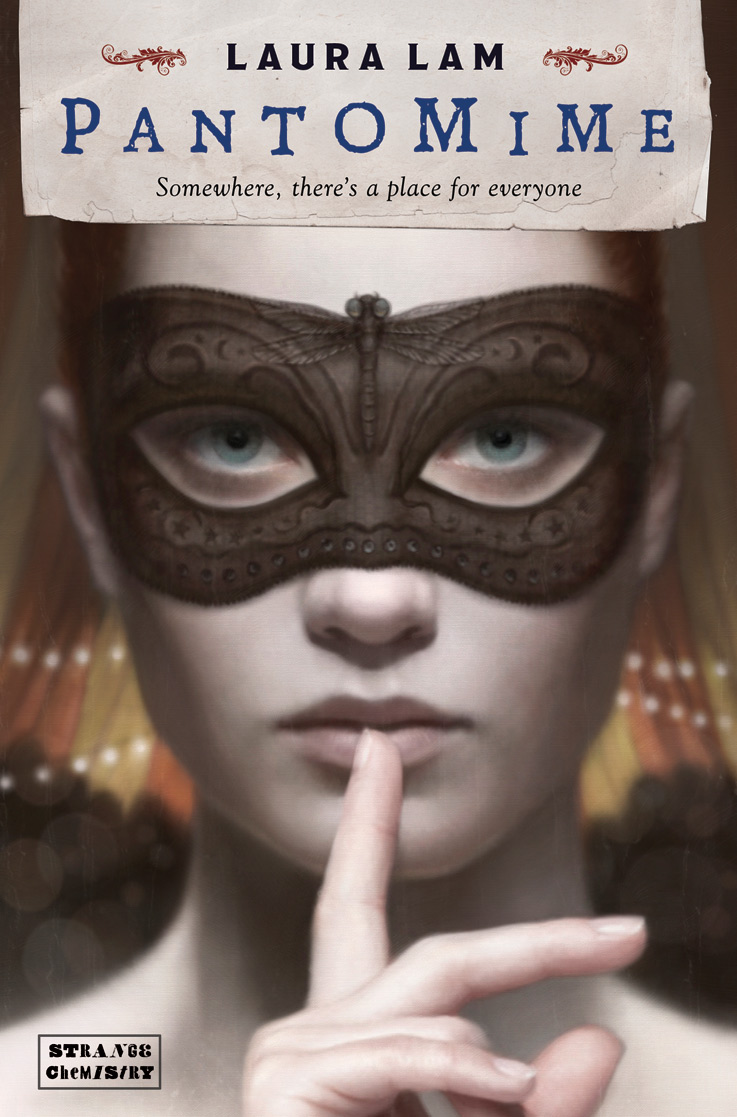
Pantomime by Laura Lam-smallStrange Chemistry, the innovative YA imprint of Angry Robot Books, has closed its doors. Here’s the announcement made earlier today by Caroline Lambe, Publicity Manager at Angry Robot:

Angry Robot Books has a history of innovation and we continue to go from strength to strength. We’re constantly trying out new concepts and new ideas, and we continue to publish popular and award-winning books. Our YA imprint Strange Chemistry and our crime/mystery imprint Exhibit A have – due mainly to market saturation – unfortunately been unable to carve out their own niches with as much success.

We have therefore made the difficult decision to discontinue Strange Chemistry and Exhibit A, effective immediately, and no further titles will be published from these two imprints.

Strange Chemistry launched in September 2012 with editor Amanda Rutter at the helm, and released 17 books in its first year. Last summer, they produced this splendid montage displaying all of their book covers, and we helped them celebrate their first birthday just last August.

Over the last two years, Strange Chemistry has published a marvelously diverse range of titles, including Martha Wells’s Emilie and the Hollow World, Jonathan L. Howard’s Katya’s World and its sequel Katya’s War, Broken by A. E. Rought, Black Dog by Rachel Neumeier, Pantomime by Laura Lam, and many others. The sudden shut down leaves nearly half a dozen previously announced titles in limbo, including Eliza Crewe’s Crushed, Rabble by Rosie Best, and A Curse of Ash and Iron by Christine Norris.

As disappointing as the news is, Angry Robot reports that their core SF and fantasy imprint is still very robust, and in fact they plan to increase output from two books a month to three. Read the complete announcement here.

New Treasures: Planets of Adventure by Murray Leinster

New Treasures: Planets of Adventure by Murray Leinster

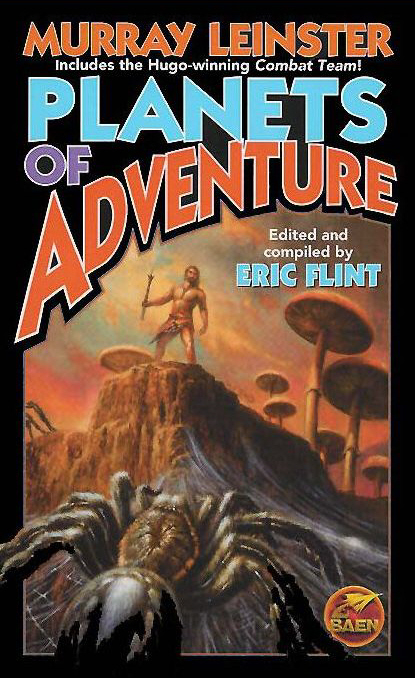
Planets of Adventure-smallThere’s lot of great new arrivals to tell you about this week. I’ve got them all stacked up beside my green chair, unread. Because the book I’m really excited about is Planets of Adventure by Murray Leinster, published by Baen Books over a decade ago.

That’s when I first bought it, too — over a decade ago. I went hunting for a copy as a birthday gift for my son last week, and was thrilled to find it was still in print. A fat omnibus of pulp science fiction from one of my favorite science fiction writers, still in print in mass market after nearly eleven years!

Just like that, my faith in humanity is restored. Here’s the back cover blurb, ’cause it’s awesome.

Breathtaking space adventure by a master of interplanetary science fiction. Including two complete novels, one of them a Hugo Award-winner.

The Planet Explorer: As humans spread throughout the galaxy, thousands of planets have been colonized. Often, the colonists discover too late that an apparently hospitable planet conceals a danger to their survival. The fate of these colonies scattered across the galaxy rests with one man, whose own fate is to race forever against looming interstellar disaster.

The Forgotten Planet: A ship is marooned on a planet whose existence has been mislaid by the galactic bureaucracy. And the planet’s ecology has gone wild, breeding deadly giant insects. The ship’s crew and passengers have no hope of rescue. Can they and their descendants survive? Tune in next millennium.

Plus more exciting adventures of men and women against the hostile stars.

Read More Read More

Why Pure Historical Fantasies Never Seem to be Bestsellers

Why Pure Historical Fantasies Never Seem to be Bestsellers

the-desert-of-souls-tp
Robert E Howard does Clark Ashton Smith with a setting by Harold Lamb

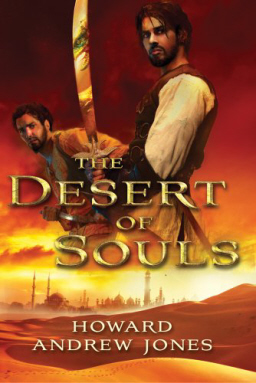
One of the best modern Heroic Fantasy books I’ve read — one of few modern ones I’ll reread — is Howard Andrew Jones’s The Desert of Souls. I’d describe it as “Robert E Howard does Clark Ashton Smith with a setting by Harold Lamb.” It’s an awesome Heroic Fantasy adventure set in the authentic Near East of Harun Al Raschid. I note, however that Howard only got two novels into the series before being forced to move on.

Another book I loved was Matthew Woodring Stover’s Iron Dawn and its sequel Jericho Moon. This time we’re following a party of Trojan-war veterans as they battle necromancers and killer deities. These yarns should have kicked off a series and perhaps a movie or two, but they didn’t and Stover seems best known now for Star Wars novels.

Other otherwise successful writers have tried their hand at Fantasy in a straight historical setting, for example Barbara Hambly has romped around Early Renaissance Italy. Nobody, however, seems to have made a fortune writing “pure” Historical Fantasy, that is Fantasy tales set in an accurately depicted historical setting.

I find this depressing.

Partly it’s selfish reasons; I’m a historian by academic background and have an interest in historical magic. This is a tune I would love to play. Mostly though, I’d love to read more about Dabir and Asim, and about Princess Bara and her misfits.

Why is an authentic historical setting a kiss of death?

Read More Read More

Vintage Treasures: The Stars Are the Styx by Theodore Sturgeon

Vintage Treasures: The Stars Are the Styx by Theodore Sturgeon

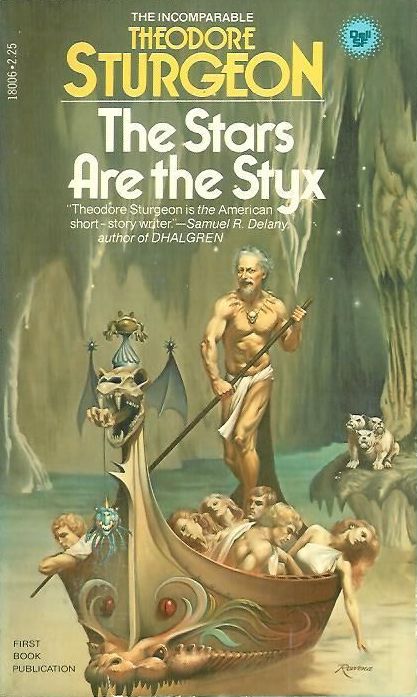
The Stars Are the Styx-smallWe’re living in a truly splendid era for fantasy fans. Fantasy films and TV shows routinely top box office charts and Nielsen ratings, fantasy novels crowd bestseller lists, and Gandalf, Harry Potter, and Tyrion Lannister are all household names. Believe it or not, there was a time when girls did not find you cool for talking about Wolverine or Captain America, or for being able to rattle off the names all 13 dwarves who accompanied Bilbo into the Misty Mountains. Hard to comprehend, I know.

Even those of us who cherish the history of the genre have a lot to celebrate. Many of the great fantasy books of the 20th Century are still in print, or at least available inexpensively online. Let’s face it — if you’re a fantasy fan, the world is your oyster.

Unless you’re a fan of short story collections, of course. In which case, you’re out of luck.

For most 20th Century fantasy writers, this has been a regrettable literary development, but not catastrophic. Most didn’t have short story collections anyway. But for some — like the great Theodore Sturgeon, who produced much of his best work at short length — it means that the 21st Century is rapidly forgetting them.

And that’s a tragedy. Yes, Sturgeon did leave behind a handful of novels, some of which — like More Than Human, The Dreaming Jewels, and Venus Plus X — are still in print today (in attractive trade paperback editions from Vintage Books actually; check ’em out.) But for decades before his death in 1985, he was justly renowned as one of the finest short story writers the field had ever seen.

Read More Read More

The HBO Season 4 Finale of Game of Thrones: How Different Was it from George R.R. Martin’s Version?

The HBO Season 4 Finale of Game of Thrones: How Different Was it from George R.R. Martin’s Version?

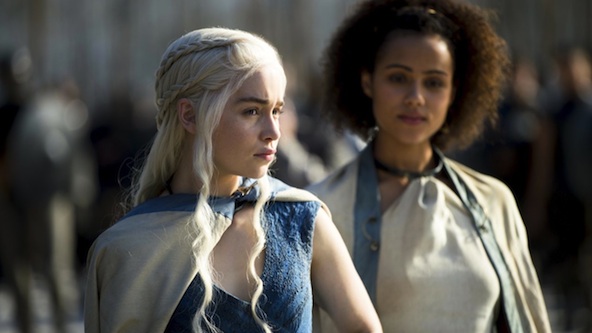
Daenerys Targaryen Sseason 4 Game of Thrones-smallThough it’s one of the best works in the epic fantasy genre, there’s no denying that George R.R. Martins A Song of Ice and Fire series has its share of flaws. The HBO series, based on the books, lacks in some areas in comparison (simply due to a more compressed narrative), but has proven itself to be as good, if not better, than the source material – especially when it comes to plot execution.

Which is why last Sunday’s finale (available on demand through HBOGo or DirecTV, if you haven’t seen it already) was as filled with surprises for those who have read the book as it was for show-only fans.

SPOILER ALERT! Spoilers for the Season 4 finale ahead.

For instance, as much as we love Daenerys, it’s obvious her story was in danger of becoming somewhat dry, which led the show’s editors David Benioff and DB Weiss to make the decision to bring the period of her rule in Meereen forward in time, as opposed to when it occurs in the books. They made the same choice with Bran Stark, who at the point in the novels where the events of the finale are happening in King’s Landing has yet to even cross the Wall.

The show’s producers also fleshed out what had been insignificant or smaller scenes, such as the battle at Craster’s Keep, and reorganized the series of events for most significant impact. Imagine if Jaime hadn’t been around to watch his son Joffrey die -– in the books, he returns shortly after, instead of weeks prior.

Read More Read More

My Favorite Fantasy Villains

My Favorite Fantasy Villains

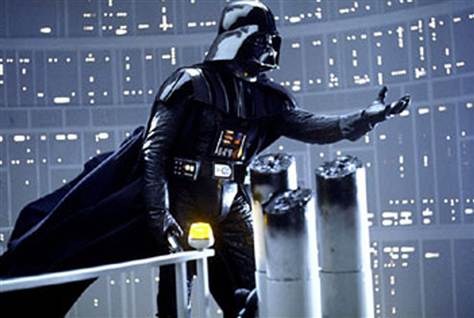
Darth Vader Wants to Shake Your HandLast month, I did an article about my favorite fantasy heroes. Now it’s time to give the bad guys some love.

And I do love villains. I was the kid in the theater rooting for the Death Star to shoot down those annoying rebel fighters. I cheered when Hannibal Lector escaped captivity. I laughed out loud when the horse died on the ferry boat in The Ring. (Hey, even Death needs a fan club.)

Anyway, as a young boy I would get so frustrated with shows, movies, and books because the villain always lost at the end, no matter how much smarter, tougher, or cooler they were than the “heroes.” And it continues to this day.

Also, villains are a blast to write. There’s something about viewing a story from that perspective—the person who wants what he wants and screw anyone who gets in the way—that is so sublime. And I accept it as a maxim that heroes (and even stories) are defined by their antagonists. Even the most dynamic and driven heroine looks drab when matched against a sub-par foe.

For all these reasons and more, here’s my list of some of my all-time favorite fantasy villains.

Read More Read More

New Treasures: Shanghai Sparrow by Gaie Sebold

New Treasures: Shanghai Sparrow by Gaie Sebold

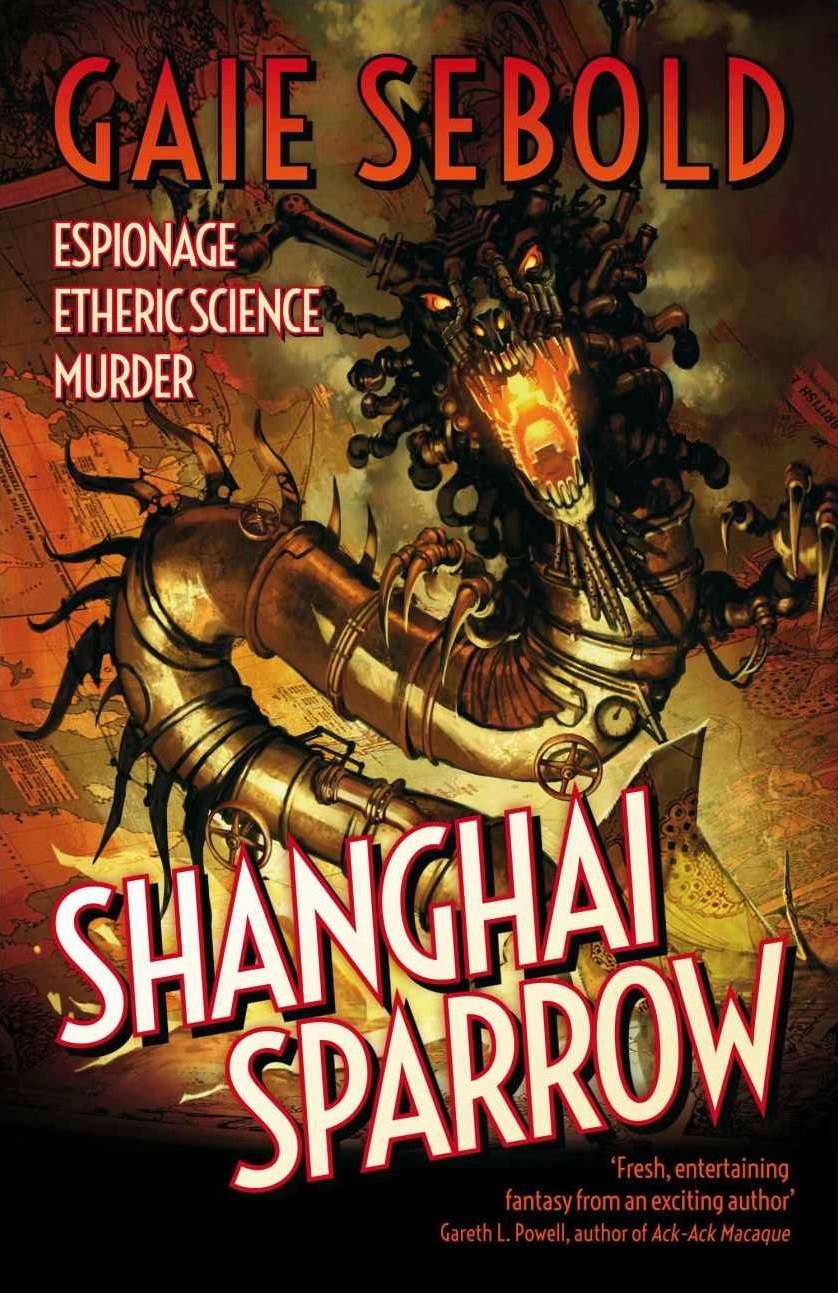
Shanghai Sparrow-smallGuess what I found at Barnes & Noble this Sunday? Guess guess guess. You’re right! Gaie Sebold’s latest novel, Shanghai Sparrow, a Far Eastern steampunk tale of Espionage, Etheric Science, and Murder, according to the cover blurb. Man, you’re a good guesser.

Gaie’s been on a tear recently. If you remember your Black Gate history, we published her funny and suspenseful contemporary fantasy “A Touch of Crystal” (co-written with Martin Owton), way back in BG 9, and reported on her first novel Babylon Steel (described in the press as “Sword & Sorcery for the girl who wants to be Conan”) here. Babylon Steel received two Gemmell Award nominations, and the sequel Dangerous Gifts appeared early last year. For her third novel, Gaie turns to the Far East and introduces us to a heroine she describes as “Someone who learned to lie, cheat, and steal in order to survive; and ended up rather good at it.” Here’s the back cover blurb.

Eveline Duchen is a thief and con-artist, surviving day by day on the streets of London, where the glittering spires of progress rise on the straining backs of the poor and disenfranchised. Where the Folk, the otherworldly children of fairy tales and legends, have all but withdrawn from the smoke of the furnaces and the clamour of iron.

Caught in an act of deception by the implacable Mr Holmforth, Evvie is offered a stark choice: transportation to the colonies, or an education – and utter commitment to Her Majesty’s Service – at Miss Cairngrim’s harsh school for female spies.

But on the decadent streets of Shanghai, where the corruption of the Empire is laid bare, Holmforth is about to make a devil’s bargain, and Eveline’s choices could change the future of two worlds…

Read Gaie’s article on Creating Shanghai Sparrow over at the Fantasy Fiction blog and try an excerpt from the novel here (note: excerpt is a PDF download).

Shanghai Sparrow was published by Solaris Books on April 29, 2014. It is 384 pages, priced at $7.99 in paperback and $6.99 for the digital edition.

The Public Life of Sherlock Holmes: New Treasures: The Game’s Afoot (Wordsworth)

The Public Life of Sherlock Holmes: New Treasures: The Game’s Afoot (Wordsworth)

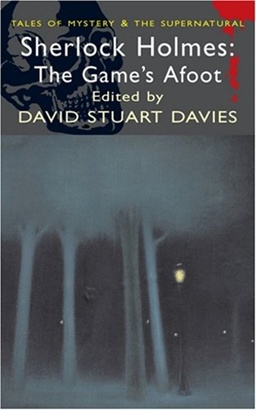
Wordsworth_GamesAfootOur fearless leader, John O’Neill, has been reviewing entries in Wordsworth’s Tales of Mystery & The Supernatural series: with emphasis on the supernatural end. So…I figured I’d look at one of the mystery entries.

Sherlock Holmes: The Game’s Afoot, offers twenty new tales of the world’s first private consulting detective. The real mystery is why I couldn’t find a single reference to this book anywhere on Wordsworth’s website. Curious, indeed.

Sherlockian pastiches are meant to emulate the style of Sir Arthur Conan Doyle’s original tales. As opposed to parodies, which spoof Holmes.

With the explosion of self-publishing, the quality of pastiches has come to vary wildly. There is quite a bit of dreck out there and the days of buying every Holmes story listed on Amazon are long gone.

The eleven authors who contributed to this collection worked hard to create the same kind of atmosphere Conan Doyle did. David Stuart Davies is the editor of this Wordsworth series and is a well-respected Sherlockian. He includes three of his tales. June Thomson, John Hall, Dennis O. Smith … there are some well-respected Sherlockian names in this collection.


Read More Read More

Were These the 10 Best Ghost Stories as of 1927?

Were These the 10 Best Ghost Stories as of 1927?

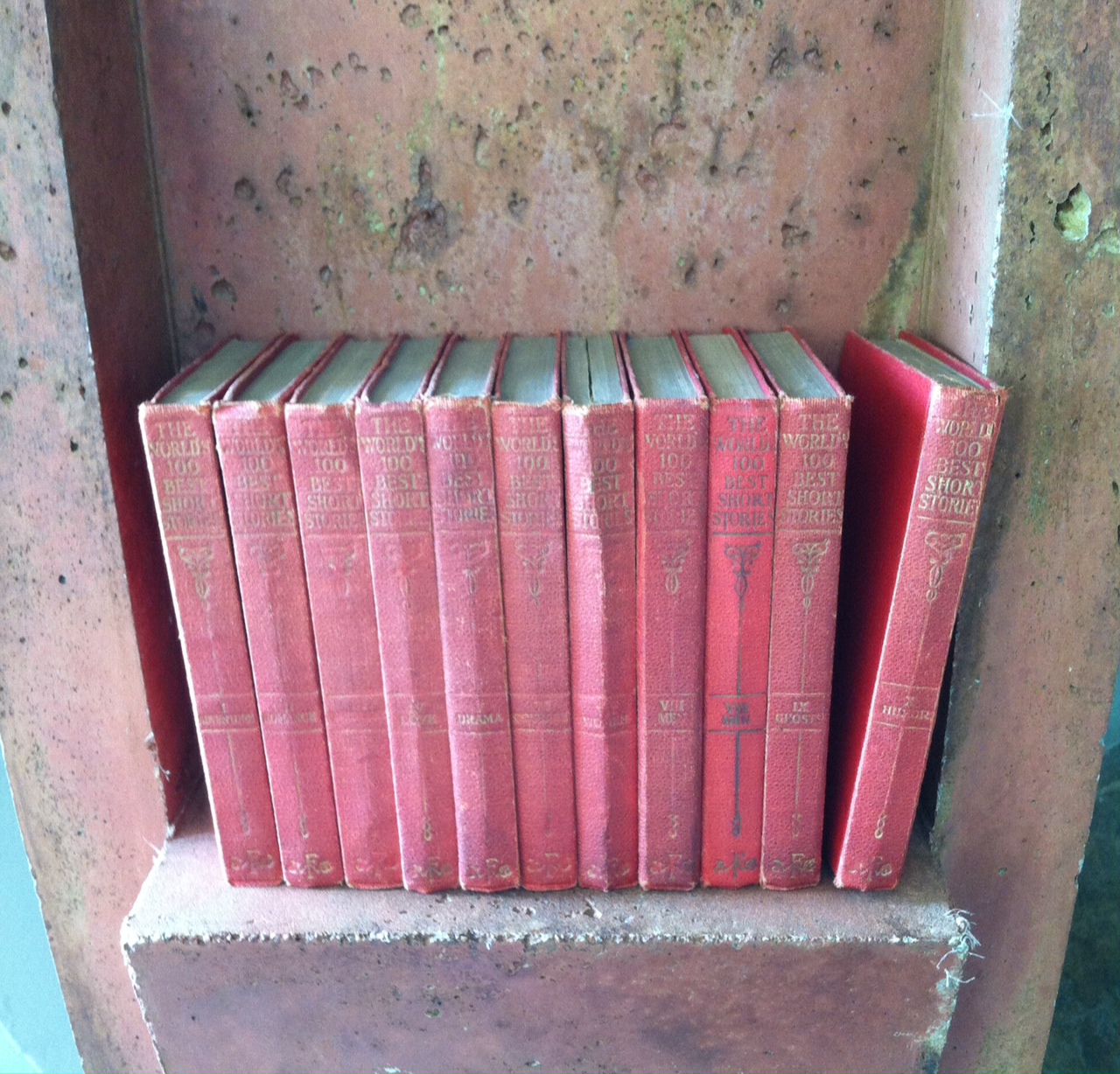
photo 1In 1927, Funk & Wagnalls Company published a 10-volume set titled The World’s One Hundred Best Short Stories. Edited by Grant Overton, each small (about 4” by 6.5”), red, hardbound book had a distinct sub-heading: V1. Adventure, V2. Romance, V3. Mystery, V4. Love, V5. Drama, V6. Courage, V7. Women, V8. Men, V9. Ghosts, V10. Humor.

Before I get to the meat-and-potatoes of this post (and if you think that would be volume 9, you would be eerily correct), a couple random observations about the series overall…

First: what an idiosyncratic parsing of genres! Four or five of them would be recognizable genres today, but I’ve yet to see a “courage” section in any bookstore.

Second: I wonder what distinguishes stories of “love” from stories of “romance”? My first thought was that maybe “romance” was being used in an earlier sense — as describing literature like the tales of King Arthur and stories that we would today classify as “fantasy.” Nope. A brief perusal was enough to see they’re romance stories in the modern sense.

Third: “Drama” here is meant to denote what we’d probably just deem mainstream or literary fiction. That volume includes stories by Kathleen Norris, Stephen Crane, and Guy de Maupassant (“The Necklace”, one of my first introductions to “literary fiction” in school — a story that fostered the oft-reinforced impression that “literary” fiction has to be depressing). “Drama” as it is used today — and back then too, for that matter — denotes stage scripts, at least in literary studies. Come to think of it, “drama” as Overton applied it to short stories back in 1927 is how it is now used in classifying films.

Okay, enough of the general observations. What really piqued my curiosity, when I came across these little volumes in a box dropped off at the bookstore where I work, was that ninth volume. Ghosts.

Read More Read More