Browsed by
Category: Books

A Great Collision of Awards Lists

A Great Collision of Awards Lists

1993
The Hugo Award: Most ancient of sf/f awards, armed with a point suitable for hunting prey.

OK, despite the title, there are no explosions or car crashes in this post.

However, as a Canadian, a SFWA member, an Asimov and Analog author and an audio listener, my thoughts on awards season can get a bit jumbled. Someday, I’ll make a nerd-pleasing Venn diagram about it…

The scifi/fantasy/horror field is in constant motion and there are a ton of brilliant writers out there. The Nebula and Hugo and Aurora nominees for the past few years, as well as the Year’s Best collections and the Locus Recommended Lists, give anyone a great place to start discovering the genre(s).

I feel a responsibility to the process, like I feel a responsibility to vote in elections. Here are the award areas I get involved in:

I nominate for both the Hugos and the Nebulas, often using the recommended lists as the bases for my reading; those lists are stored in the ultra-secret passages on the SFWA boards, guarded by three-headed dogs and passwords that have to have a number and a symbol in them. Members of SFWA can nominate and vote for the Nebulas. Anybody who is attending Worldcon or attended the last Worldcon can vote in the Hugos, as can people who have supporting memberships (which seem steep to me at $50, but it is what it is).

As I’m primarily an audio consumer, to round out my short fiction reading, I also listen to as much of Lightspeed, Clarkesworld, Tor.com, and Beneath Ceaseless Skies as I can.
Read More Read More

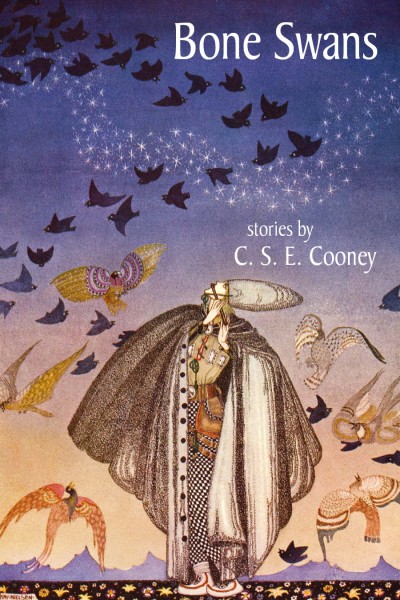
Bird People, Evil Clowns, and the Crooked One: Bone Swans by C.S.E. Cooney

Bird People, Evil Clowns, and the Crooked One: Bone Swans by C.S.E. Cooney

Bone Swans CSE Cooney-smallC.S.E. Cooney reports that she has signed a contract with Mythic Delirium Press for her newest collection Bone Swans, coming this summer.

Bone Swans will contain several of her most popular novellas, including The Big Bah-Ha, which Gene Wolfe called “Deep and wise and fabulous… [it] will leave you shuddering and strangely at peace. You could found a religion on it — or it may found a religion without you.” It also includes “The Bone Swans of Amandale,” the first installment of Silver and Bone: The Pied Piper Tales, and “Life on the Sun,” originally published here at Black Gate. Here’s the complete table of contents, with links to online versions where available:

Life on the Sun
The Bone Swans of Amandale
Martyr’s Gem
How the Milkmaid Struck a Bargain with the Crooked One
The Big Bah-Ha

C.S.E. Cooney is a podcast reader for Uncanny Magazine; Amal El-Mohtar recently reviewed her short story “Witch, Beast, Saint” at Tor.com, and Mark Rigney interviewed her in late October. The two C.S.E. Cooney short stories we presented here, “Godmother Lizard” and “Life on the Sun,” consistently rank among the most popular pieces we’ve ever published. She is a past website editor of Black Gate, and the author of How to Flirt in Faerieland and Other Wild Rhymes and Jack o’ the Hills.

Bone Swans will be published by Mythic Delirium Press on July 7th, 2015. Get more details on their website.

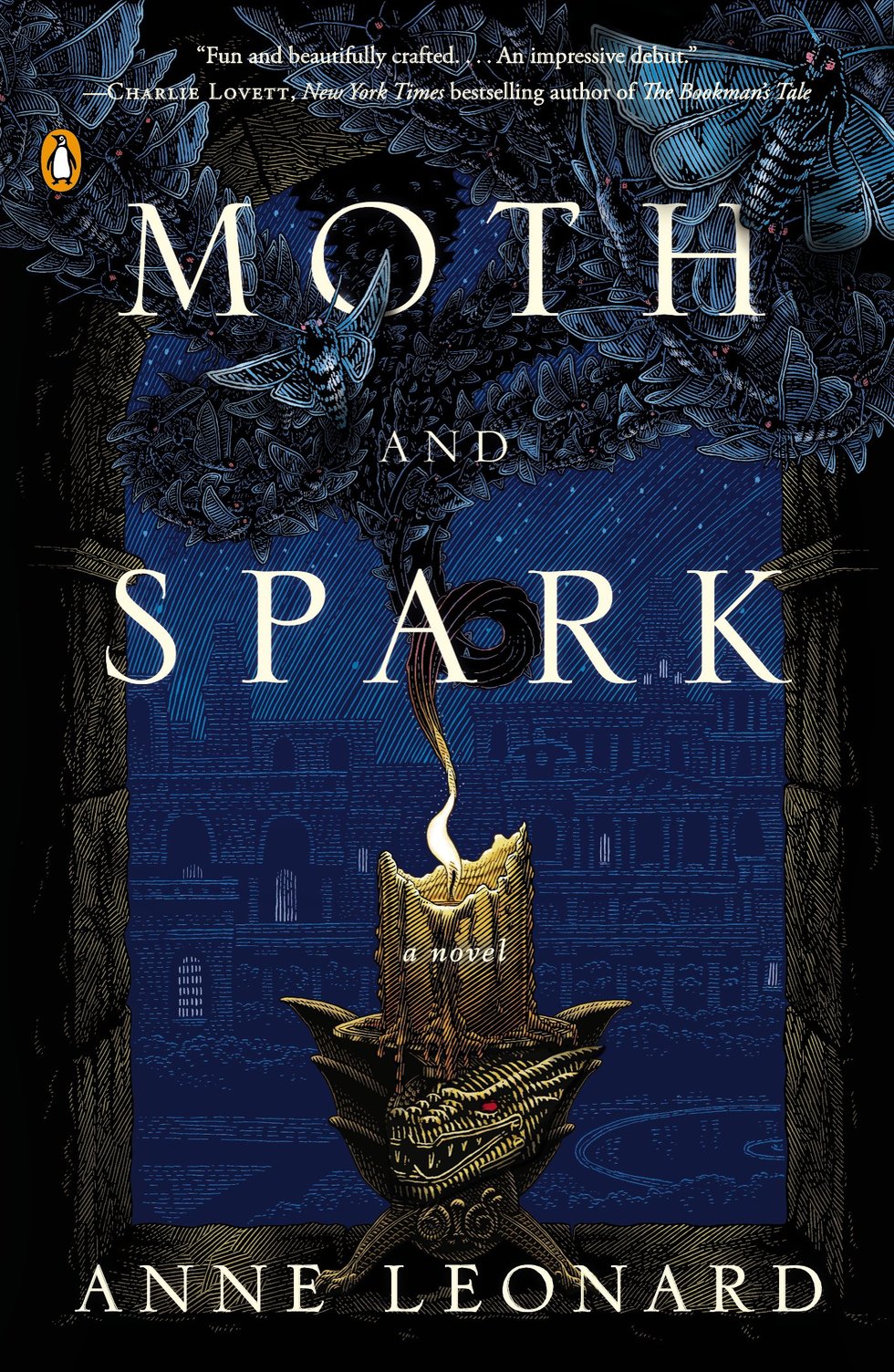
New Treasures: Moth and Spark by Anne Leonard

New Treasures: Moth and Spark by Anne Leonard

Moth and Spark-smallAnne Leonard’s debut novel, published earlier this week, is a romantic fantasy being compared to A Discovery of Witches. It also has dragons in it. Most romances could be improved by adding dragons, I think.

A prince with a quest, a beautiful commoner with mysterious powers, and dragons who demand to be freed — at any cost

Prince Corin has been chosen to free the dragons from their bondage to the power Mycenean Empire, but dragons aren’t big on directions. They have given him some of their power, but none of their knowledge. No one, not the dragons nor their riders, is even sure what keeps the dragons in the Empire’s control. Tam, sensible daughter of a well-respected doctor, had no idea before she arrived in Caithenor that she is a Seer, gifted with visions. When the two run into each other (quite literally) in the library, sparks fly and Corin impulsively asks Tam to dinner. But it’s not all happily ever after. Never mind that the prince isn’t allowed to marry a commoner: war is coming. Torn between his quest to free the dragons and his duty to his country, Tam and Corin must both figure out how to master their powers in order to save Caithen. With a little help from a village of secret wizards and rogue dragonrider, they just might pull it off.

Moth and Spark was published by Penguin Books on December 30, 2014. It is 384 pages, priced at $16 in trade paperback and $9.99 for the digital version.

See all of our recent New Treasures here.

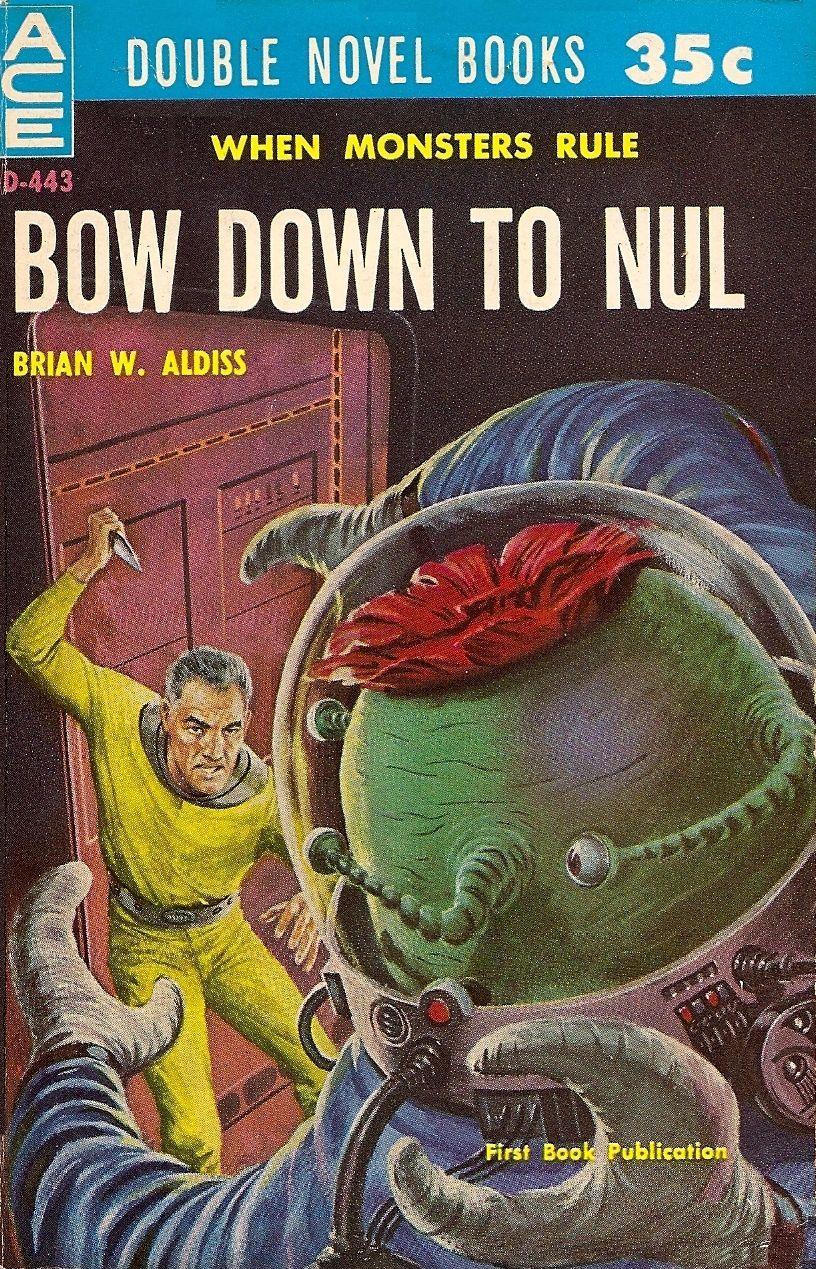
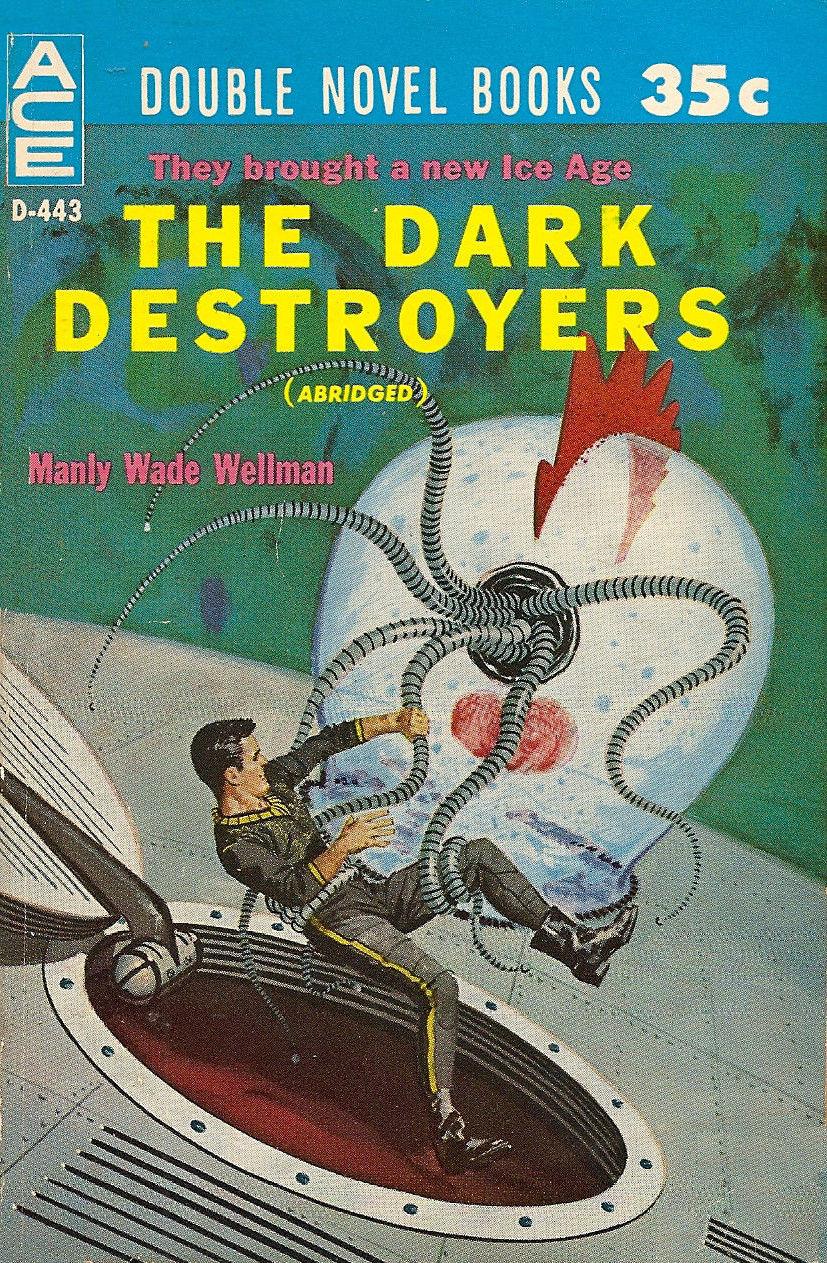
Vintage Treasures: Bow Down to Nul by Brian W. Aldiss / The Dark Destroyers by Manly Wade Wellman

Vintage Treasures: Bow Down to Nul by Brian W. Aldiss / The Dark Destroyers by Manly Wade Wellman

Bow Down to Nul-small The Dark Destroyers-small

We’re back to our survey of Ace Doubles, this time with a volume from 1960 containing lesser-known novels from two of science fiction’s brightest stars: Bow Down to Nul by Brian W. Aldiss and The Dark Destroyers by Manly Wade Wellman. Ace Doubles didn’t always have a clear connecting theme, but they did in this case, as both novels feature the struggle against brutal aliens who have conquered Earth.

Bow Down to Nul is a Galactic Empire novel, a fairly common theme in early pulp SF, made popular by writers like Asimov and Van Vogt. The empire in this case is a huge stellar realm controlled by the Nuls, an ancient race of giant three-limbed creatures. Earth is a backwater colony world, ruled by a Nul tyrant. The human resistance is disorganized, but aided by a Nul signatory attempting to bring to light abuses on Earth.

As Aldiss noted in his Note From The Author, the set-up strongly parallels the complex colonial relationships he witnessed first hand while serving in India and Indonesia in the forties.

Read More Read More

Revising and Editing II: The Nitty Gritty

Revising and Editing II: The Nitty Gritty

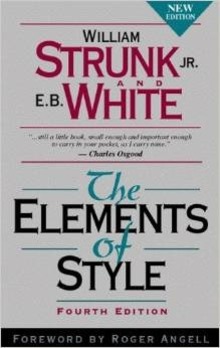
Strunk & WhiteI had occasion to read the first 3 chapters of a friend’s manuscript the other day. This is his first completed manuscript, and he wanted a second pair of eyes on what he was sending out to agents. I started off my critique by saying: “There’s good news. All your sentences are sentences, and all the words you use mean what you think they mean.”

Obviously, my friend wasn’t immediately gratified by this response,* at least, not until I explained how very often this isn’t the case. I had another friend (please note the past tense) who, when I suggested a word he used didn’t mean what he thought it meant, told me loftily that he knew that, but he was just trying it out to see if it would fit. He had, he explained, dashed it all down when he was drunk.

Which brings us to a piece of advice attributed to Ernest Hemingway. Write drunk. Edit Sober. Please note the order. Given Hemingway’s reputation, the assumption has always been that his advice was to be taken literally, but I’m not so sure. I know that people have achieved marvels while drinking/drunk, but I don’t think these were cases of cause and effect. Alcohol or its cultural equivalent can smooth the path of genius (at least for a while), but it doesn’t create the genius in the first place.

I choose to believe that what Hemingway meant was, write while inspired, edit with a clear head. All kinds of things might inspire you to write, and I often find that when the juices are flowing (creativity’s, not the bottle’s) I’m not even so much as aware of the passage of time, let alone the exact nature of every sentence and punctuation point.

Read More Read More

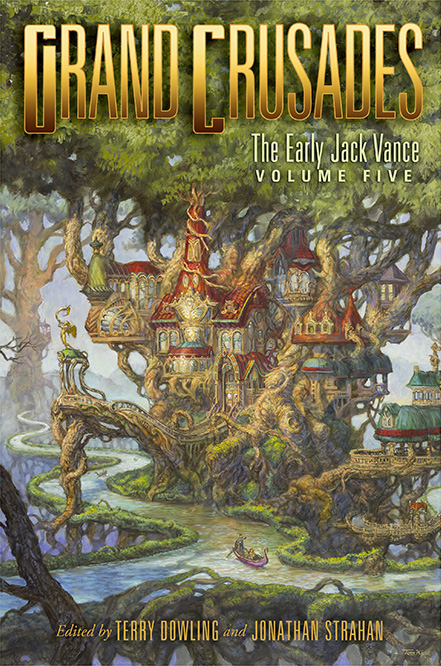
The Early Novels of Jack Vance: Grand Crusades: The Early Jack Vance, Volume Five, edited by Terry Dowling and Jonathan Strahan

The Early Novels of Jack Vance: Grand Crusades: The Early Jack Vance, Volume Five, edited by Terry Dowling and Jonathan Strahan

Grand Crusades The Early Jack Vance Volume Five-smallSubterranean Press is now accepting pre-orders on the fifth volume of their landmark series The Early Jack Vance.

New titles in the series are released every March. I covered Volume Two, Dream Castles, after I unexpectedly found a copy in the Dealer’s Room at Capricon 33 in 2013, and I reported on Volume Three, Magic Highways, last March.

Volume Five is by far the largest so far (at 472 pages); I was also surprised to see that it contains only five stories, all short novels, most published in pulp magazines between 1950 and 1954.

The Rapparee (Startling Stories, November 1950)
Crusade to Maxus (Thrilling Wonder Stories, February 1951)
Gold and Iron (Space Stories, December 1952)
The Houses of Iszm (Startling Stories, Spring 1954)
Space Opera (Pyramid Books, 1965)

This volume also contains a new introduction by the editors.

The first four books in The Early Jack Vance were a treasure trove for collectors, as they contained Vance stories that have been out of print for decades — and many that have never been reprinted. In contrast, this volume contains four short novels that have appeared in a handful of paperback editions over the decades (and under multiple titles), and one that has never been reprinted. This is first time they’ve been collected under one cover and the first time any have been in print for at least 30 years. I’ve selected a dozen covers from earlier printings below.

Read More Read More

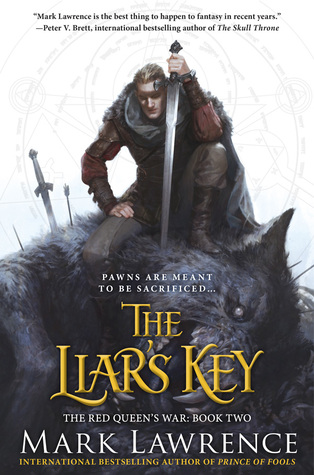
Future Treasures: The Liar’s Key, by Mark Lawrence

Future Treasures: The Liar’s Key, by Mark Lawrence

The Liar's Key-smallThe Liar’s Key, the second book in Mark Lawrence’s new series The Red Queen’s War, will be published this June. The first volume, Prince of Fools, was released in June 2013; this new volume continues the story of the unusual fellowship between a rogue prince and a weary warrior. It is set in the same world as his previous trilogy The Broken Empire (Prince of Thorns, King of Thorns, and the 2014 David Gemmell Legend Award winner Emperor of Thorns).

We published the first chapter of Prince of Thorns, with a brand new introduction by Mark, here, and Howard Andrew Jones’s interview with him is here. Mark’s long article on writing and selling The Prince of Thorns (and the rejections he got from Black Gate in the meantime) is here.

After harrowing adventure and near-death, Prince Jalan Kendeth and the Viking Snorri ver Snagason find themselves in possession of Loki’s Key, an artefact capable of opening any door, and sought by the most dangerous beings in the Broken Empire — including The Dead King.

Jal wants only to return home to his wine, women, and song, but Snorri has his own purpose for the key: to find the very door into death, throw it wide, and bring his family back into the land of the living.

And as Snorri prepares for his quest to find death’s door, Jal’s grandmother, the Red Queen continues to manipulate kings and pawns towards an endgame of her own design…

The Liar’s Key will be published by Ace Books on June 2, 2015. It is 496 pages, priced at $29.95 in hardcover and $12.99 for the digital edition.

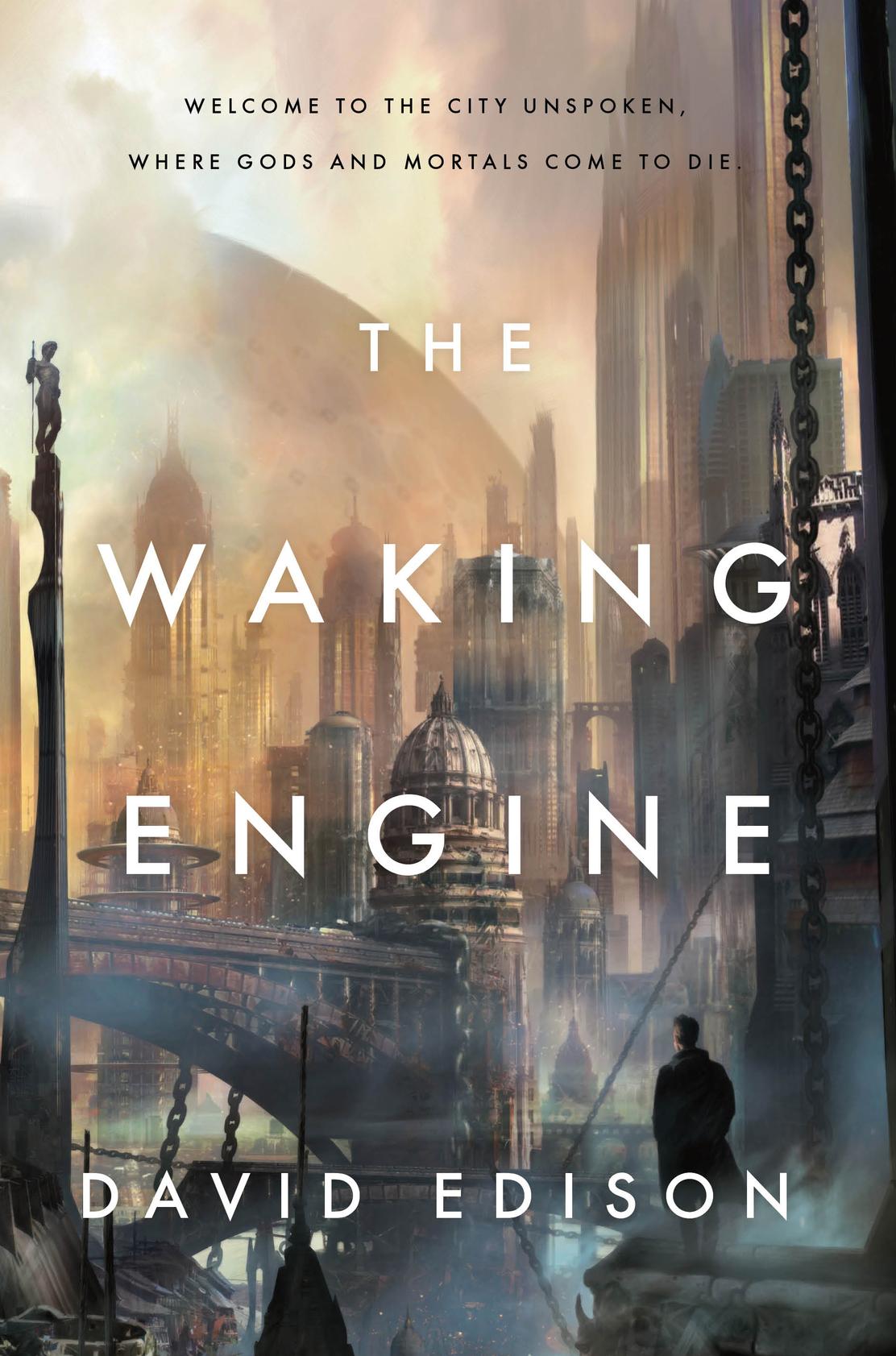
New Treasures: The Waking Engine by David Edison

New Treasures: The Waking Engine by David Edison

The Waking Engine-smallAt we wrap up each year, I usually look back at all the new books we’ve highlighted over the past twelve months and make one final effort to slip in a few titles we’ve overlooked. If a hardcover has been on the shelves too long to showcase as a New Treasure without embarrassing myself, I sometimes feature the paperback reprint instead. Usually I get away with it without too many complaints — Black Gate readers are an indulgent lot, especially when it comes to books.

I’m in  bit of a jam with The Waking Engine, though. David Edison’s debut novel has received lots of terrific press… I’m not sure how I managed to miss it when it first came out, but I can’t let the year close out without at least a mention.  The paperback’s not due until May 5th, however, so it looks like I need to fess up that I’m trying to pass off a February 2014 title as a new release, and hope everyone is too distracted by New Year’s festivities to notice. Thank you for your indulgence, and Happy New Year.

Contrary to popular wisdom, death is not the end, nor is it a passage to some transcendent afterlife. Those who die merely awake as themselves on one of a million worlds, where they are fated to live until they die again, and wake up somewhere new. All are born only once, but die many times… until they come at last to the City Unspoken, where the gateway to True Death can be found.

Wayfarers and pilgrims are drawn to the City, which is home to murderous aristocrats, disguised gods and goddesses, a sadistic faerie princess, immortal prostitutes and queens, a captive angel, gangs of feral Death Boys and Charnel Girls… and one very confused New Yorker.

Late of Manhattan, Cooper finds himself in a City that is not what it once was. The gateway to True Death is failing, so that the City is becoming overrun by the Dying, who clot its byzantine streets and alleys… and a spreading madness threatens to engulf the entire metaverse.

The Waking Engine was published by Tor Books on February 11, 2014. It is 396 pages, priced at $25.99 in hardcover and $12.99 for the digital edition. The cover is by Stephan Martiniere. Read an excerpt at Tor.com.

Vintage Treasures: The House in the High Wood by Jeffrey E. Barlough

Vintage Treasures: The House in the High Wood by Jeffrey E. Barlough

The House in the High Wood-smallJeffrey E. Barlough’s first three Western Lights novels were published in trade paperback by Ace over a decade ago, beginning with Dark Sleeper (2000), and followed by The House in the High Wood (2001) and Strange Cargo (2004). All three are highly prized today. Barlough began to publish them though his own Gresham & Doyle press beginning with the fourth volume, Bertram of Butter Cross (2007). I recently acquired the second book. Back when I was running SF Site, I recruited the author Victoria Strauss to write for us; here’s what she said about it the year it was published:

Framed in good Gothic style by ante and post scriptums in which a nameless narrator encounters the teller of the main tale (a somber, haunted Oliver Langley, 11 years later), The House in the High Wood is a homage to such classics of the Gothic genre as The Monk and Woman in White, replete with mystery, madness, illegitimacy, ghostly visitations, ancient ruins, brooding forests, sinister dwellings, and supernatural terror. Like the first in the series, Dark Sleeper, it’s a neo-Victorian pastiche, with an agreeably verbose 19th-century prose style and a large cast of eccentric characters. But where the previous book was as much digression as story, devoting entire chapters to character study and whole pages to the description of the contents of a single room, this novel is much more a straight-ahead narrative of suspense, proceeding grippingly from plot turn to plot turn, with moments that are genuinely bone-chilling.

The Western Lights novels have steadily been gathering acclaim (and readers) over the last few years. Jackson Kuhl reviewed the fifth volume Anchorwick for us in 2011, calling it “A Victorian Dying Earth —- gothic and claustrophobic yet confronted by its inhabitants with upper lips held stiff… It’s P.G. Wodehouse with woolly mammoths.” More recently, we covered What I Found at Hoole (2012) and the eighth volume, The Cobbler of Ridingham. We published an interview with him in 2013.

The House in the High Wood was published by Ace Books on August 1, 2001. It is 336 pages, originally priced at $14.95. The digital version is $17.99. The cover art is by Aleta Jenks.

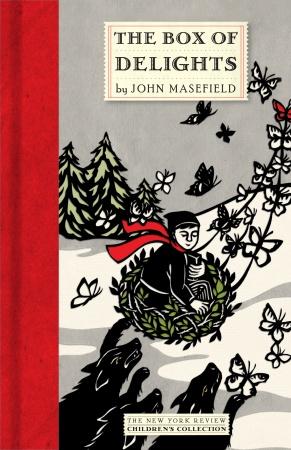
A Review of John Masefield’s Christmas Book The Box of Delights

A Review of John Masefield’s Christmas Book The Box of Delights

The cover of the edition from the New York Review of Books Children's Collection
The cover of the edition from the New York Review of Books Children’s Collection

Lately I’ve become interested in what may be termed “seasonal” books — stories or novels that are perennially suited for a particular time of year. I long have considered Hope Mirrlees’s Lud-in-the-Mist a spring book. Natalie Babbit’s Tuck Everlasting is a summer book. The fall season has any number of offerings: Ray Bradbury’s Something Wicked This Way Comes, the anthology October Dreams, Washington Irving’s “The Legend of Sleepy Hollow,” and this last fall I discovered John Masefield’s The Midnight Folk.

Perhaps in due time I will look at this last in more detail, but for now I want to examine Masefield’s “Christmas Book,” The Box of Delights, something that sits well alongside Charles Dickens’s A Christmas Carol, Dr. Seuss’s How the Grinch Stole Christmas, and Clement Clarke Moore’s “A Visit from St. Nicholas.”

The Box of Delights was published in 1935 and, like The Midnight Folk, contains many delightful period terms. I choose as just one example the word “scrobble,” which means to kidnap. In this book, all sorts of people get scrobbled. The antagonist of this book, Abner Brown, who also is the antagonist of The Midnight Folk, is attempting to steal the Box of Delights from “Punch and Judy man” Cole Hawlings, who has entrusted the Box to Kay Harker, the protagonist both of this book and of The Midnight Folk. Brown scrobbles Hawlings and, unable to get any information out of that magician, scrobbles anyone who was in the vicinity of Hawlings: two of Kay’s friends and all of the clergymen and servants attached to the Tatchester Cathedral. By the end of the book, the crisis of the tale becomes in equal measure one of keeping the Box from Brown’s villainous clutches and one of returning all of the religious to the Cathedral in time to hold the Christmas services at midnight.

Read More Read More