Browsed by
Category: Blog Entry

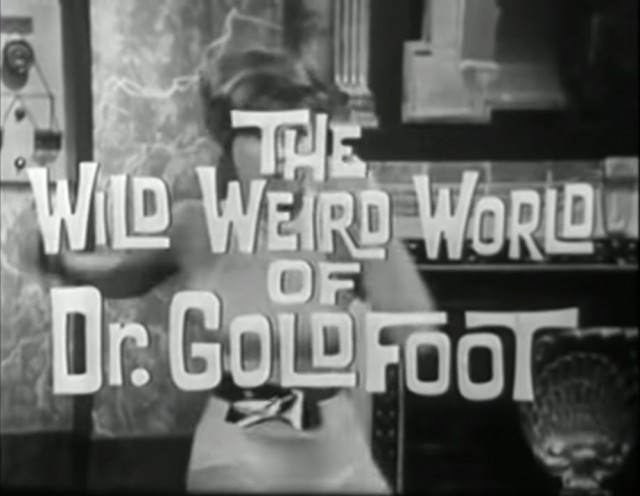
The Wild Weird World of Dr. Goldfoot

The Wild Weird World of Dr. Goldfoot

The Wild Weird World of Dr. Goldfoot title card

Those who complain that today’s movie obsession with sequels and spinoffs is different from yesterday’s Hollywood should be strapped into a chair and forced to watch Dr. Goldfoot and His Bikini Machine. If you don’t remember this epic, Vincent Price at his feyest played Dr. Goldfoot, modeled after Bond supervillains Dr. No and Goldfinger.  “My aim is diabolically simple. I am going to control the world. I have invented the ultimate in ultimate weapons, the one weapon that can positively destroy man: woman.”

Read More Read More

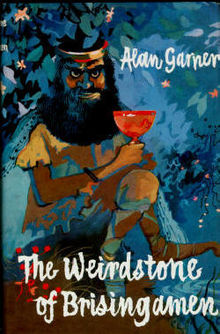
Mythic Landscape: The Weirdstone of Brisingamen by Alan Garner

Mythic Landscape: The Weirdstone of Brisingamen by Alan Garner

Weirdstone_of_BrisingamenHalfway through my recent reread of Alan Garner’s 1960 debut novel, The Weirdstone of Brisingamen, it became clear to me that the true protagonist was the land, not the ostensible ones, sister and brother Susan and Colin.

Alderley Edge, in Cheshire, England, is the name of both a village and a great sandstone cliff “six hundred feet high and three mile long.” For Garner there’s a connection between land and myth, artistically at least, that is deep. His depiction of a land of rolling plains littered with farms and woods, riddled with thousands of years’-worth of mines makes it easy to see the svart-alfar, the “maggot-breed of Ymir,” boiling out of the earth. There’s something deeper than that, though; something that reaches beyond mere physical for Garner. It’s as if the land itself bred those stories and they are intertwined with it intimately and inextricably. Just walking the woods and rises around Alderley Edge, they can be felt pushing themselves up from the earth and traveling along on the backs of breezes.

Before the story proper begins, Garner recounts a true legend of Alderley Edge — that of a farmer from the village of Mobberly and the strange white-bearded man he meets on the way to market. The farmer hopes to sell his white mare at market in Macclesfield and when he agrees to sell it to the bearded man instead, he is shown a secret cave protected by an iron gate and filled with treasures. Inside sleep 140 knights, each, save one, with a perfect white mare by his side. The wizard, for that is what he is, tells the farmer why the knights are there:

“Here they lie in enchanted sleep,” said the wizard, “until a day will come — and come it will — when England shall be in direst peril, and England’s mothers weep. Then out from the hill these must ride and, in a battle thrice lost, thrice won, upon the plain, drive the enemy into the sea.”

In payment, the wizard tells the farmer to take whatever gold and gems he can fit into his pockets. He does, with unexpected and dire consequences for the future.

Read More Read More

Boskone 55: Con Report

Boskone 55: Con Report

They set off together with a blithe sense of wrongdoing

This year, Boskone 55 was our third Boskone ever, and we had a frikkin MARVELOUS time.

No, I’m not using the Royal We — although  that is still a (perhaps unfortunate) habit of mine. At present, I am talking about myself and writer Carlos Hernandez (AKA “Doctor Husbandpants”), in whose august company I now traipse to most conventions. Kind of like our fridge magnet says (above).

Read More Read More

Birthday Reviews: Arthur Machen’s “The Coming of the Terror”

Birthday Reviews: Arthur Machen’s “The Coming of the Terror”

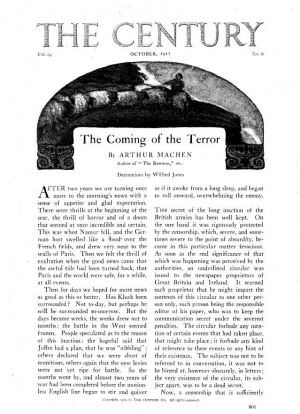
Cover by Wilfred Jones

Arthur Machen was born Arthur Llewellyn Jones on March 3, 1863 and died on December 15, 1947.

Machen had a strong interest in the occult and published his first poem, “Eleusinia” when he was 18 years old. He struggled as a writer before seeing more success in the 1890s, including the publications of his story “The Great God Pan” in 1894. In the early days of World War I he published the short story “The Bowman” which described phantom bowman from Agincourt called upon to help the British Expeditionary Force at the Battle of Mons. The story entered into popular culture as an actual description of the battle and led to the folklore around the “Angels of Mons.”

Machen originally published “The Coming of the Terror” in The Century, an illustrated magazine published from 1881 to 1930, although it grew out of Scribner’s Monthly, which dated back to 1870. The story was part of his longer novel The Terror and has rarely been reprinted only its own, only seeing print in 2003 in the Chaosium collection of Machen’s story’s The White People and Other Stories and that same year in Douglas Anderson’s anthology Tales Before Tolkien: The Roots of Modern Fantasy.

“The Coming of the Terror” feels a lot like one of the stories H.P. Lovecraft would begin publishing five years later, but with significant differences. Machen’s tale of mysterious deaths during the Great War slowly builds from reporting on the crash of an airman who hit a swarm of pigeons to the seemingly unrelated deaths and disappearances in a small village in Wales. The deaths lead to paranoia that the Germans have somehow managed to attack the English countryside undetected, either using a strange new weapon or by infiltrating the citizenry.

While Lovecraft cites Machen as one of his sources (and Machen mentions the original village of Dunwich in this story), “The Coming of the Terror” really isn’t Lovecraftian in nature. Machen doesn’t use excessively purple prose to describe the sinister events occurring around his Welsh village of Porth. Furthermore rather than being witnessed by a single individual, the effects are widespread. Everyone is aware that something is happening, and the fact that the newspapers refuse to report on it just make the conjectures that much more horrific. Machen allows events to build slowly, from a single incident to several, their relationship to each other only explicit because they are all taking place in the same story.

Read More Read More

Goth Chick News: Reality Really Does Bite… Apparently

Goth Chick News: Reality Really Does Bite… Apparently

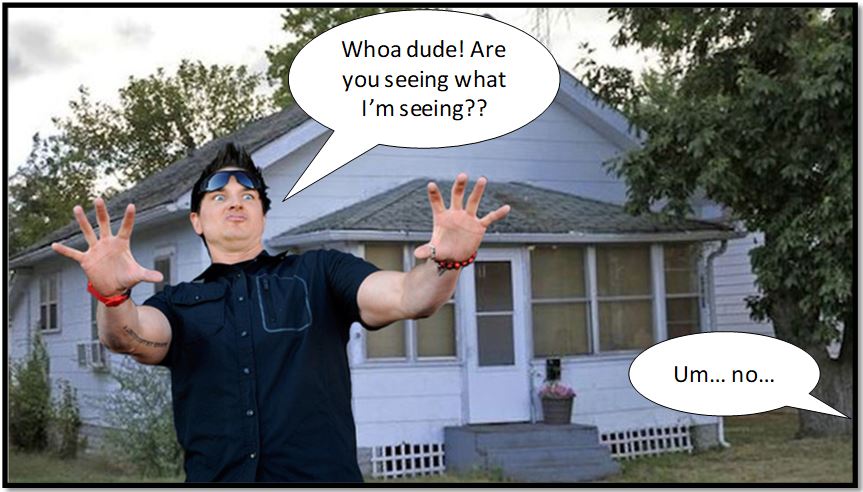
Goth Chick dude

Given my avocation it probably comes as no surprise that for a time I never missed an episode of the Travel Channel show Ghost Adventures. The hand-held-camera “reality” series follows paranormal investigator Zach Bagans and a small crew as they spend the night in various locations around the globe which are reportedly haunted.

By any series standards, Ghost Adventures has had an amazing run since premiering in 2008. Allegations that Bagans and crew play loose with the facts, and emphasizes showmanship over hardcore research is a bit of a non-sequitur considering the subject matter. But somewhere around 2013 the productions values as well as the dramatic, over-acting went too far and for me at least, the show lost its gritty fun. Then in 2014 a member of the original crew, Aaron Goodwin went on record telling the us all the shocking news that the Travel Channel faked most of the paranormal activity documented on the show. At that point my willingness to suspend my disbelief had been stretched to the breaking point and I was done. However, here we are in 2018 and Ghost Adventures just aired their 182nd episode in January, with new episodes coming in March.

So, color me shocked that it took ten years, but I’m here to tell you about the inevitable – a Ghost Adventures movie.

Read More Read More

Birthday Reviews: February Index

Birthday Reviews: February Index

Galactic-Empires-Dozois New Dimensions 2 Asimovs-Science-Fiction-April-May-2007-small

January index

At the one sixth mark in our journey through the year, here’s a look back at the birthday reviews that appeared at Black Gate in February.

February 1, Yevgeny Zamyatin: “The Cave
February 2, Selina Rosen: “Food Quart
February 3, Alex Bledsoe: “Shall We Gather
February 4, Neal Asher: “Owner Space
February 5, Joseph H. Delaney: “Survival Course
February 6, Eric Flint: “Portraits
February 7, Karen Joy Fowler: “Always
February 8, Mary Robinette Kowal: “Just Right

Read More Read More

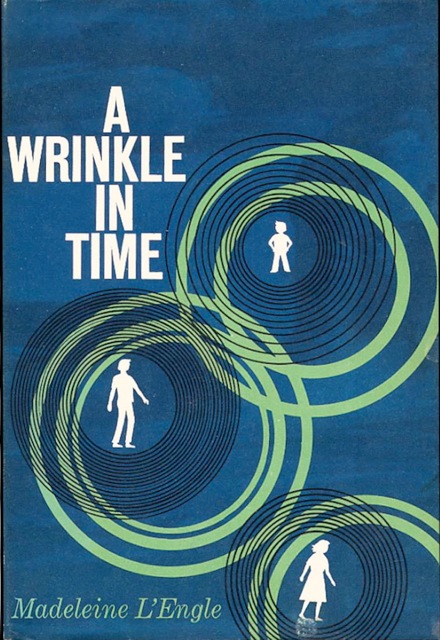
A Wrinkle in Time by Madeline L’Engle

A Wrinkle in Time by Madeline L’Engle

A Wrinkle in Time-smallGiven to me by the same friend who told me about A Wizard of Earthsea, Madeline L’Engle’s A Wrinkle in Time (1962) is another of the books that introduced me to fantasy and science fiction. The novel is a mix of science fiction, fantasy, and good dose of Christianity, and is completely unbound by any rules or expectations about genre. A children’s book, it is also an artifact of a time when fantasy wasn’t primarily a commercial designation. There’s a freshness to the book all these years later, and rereading it was an absolute joy.

Meg Murry is the fourteen-year-old daughter of scientists, and sister to twins Sandy and Denys and the strange, brilliant five-year-old Charles Wallace. Her father, employed by the government, has been missing for some time before the book’s opening, and there has been no word about what happened to him.

In her own eyes Meg is gawky and ugly, made so by her “mouse-brown” hair, glasses, and “teeth covered with braces.” Her self-impression and her worry over her father’s disappearance have caused her to become a poor student. Her principal, a man unsympathetic to her worry to the point of telling her she needs to “face the facts” about her father (implying he’s never returning), warns her she’s in danger of having to repeat ninth grade.

Read More Read More

Tell Me A Story: UnSpoiled

Tell Me A Story: UnSpoiled

Unspoiled Podcast

Full disclosure: I’m a little biased on this week’s podcast choice. I first discovered UnSpoiled when my friend, Maggie, was covering Stranger Things with network runner Natasha. In my defense, I’ve got a lot of friends whose podcasts will never be discussed here.

UnSpoiled” has become one of my favorite podcasts: the one I’ll drop everything for. A fandom and analysis podcast, UnSpoiled covers a broad variety of material, but always with the same concept and format: there are two people discussing the work in question. One of them is completely familiar with the material, and one of them is coming to it for the first time, completely unspoiled. They go through one episode, chapter, or movie at a time, discussing the themes and artistry involved.

And it is really good.

Listening to other people talk about Fantasy and Sci-Fi is always a dicey proposition. It can be dull. It can be annoying. But it can also be amazing, and some of my favorite podcasts fit under this umbrella. (West Wing Weekly is a solid standout here, as is The Greatest Generation, which is working it’s way through Star Trek: The Next Generation one episode at a time.) What makes the UnSpoiled family of podcasts great is their choice of hosts and material. Natasha Winters, the founder and editor of UnSpoiled, is a smart and insightful reader. She has the kind of keen eye for human nature that makes for sharp assessments of story, and a true compassion for human foibles that make for both a solid sense of humor and a good base for criticism.

Read More Read More

Wordsmiths: Black Gate Interviews Jim Butcher at ConFusion 2018

Wordsmiths: Black Gate Interviews Jim Butcher at ConFusion 2018

If you talk to Jim Butcher, he might tell you that he’s a “crazy hermit shut-in” and scoff at being referred to as the Jim Butcher — showing that even one of the greatest fantasy writers around might be as uncomfortable with accolades as the rest of us mere mortals. How do I know this? Because I got the chance to sit down with Jim at ConFusion last month, for an hour-long chat about his published work, his craft, and what makes him tick.

I’ve been a huge fan of Jim’s ever since a friend shoved Storm Front at me and insisted I read it, and I sincerely hope you enjoy watching it as much as I enjoyed taking part in it. There is a lot that can be learned from Jim Butcher, and I’m really happy with what we were able to get into here.

Read More Read More