Browsed by
Category: Blog Entry

Art of the Genre: The Art of Kickstarter, Advice #2

Art of the Genre: The Art of Kickstarter, Advice #2

Steampunk by David Deitrick, and everyone likes Steampunk right?
So a bit over a month ago I started my first every Kickstarter, a retro-fantasy book launch with Jeff Easley that ended earlier this week. It was a very interesting month and as people seem interested in Kickstarter’s and the possibilities that the Kickstarter site provides, I thought I’d continue blogging about it on Saturdays as long as I find out new and applicable facts concerning the program.

That being said, I’ll take you into the process once more and even append some of the numbers I initially reported during my first discourse into this topic.

This post will be about percentages, and how they can affect your project.

When I started my Kickstarter, my pledge numbers [which is to say those who became backers of the project and gave money] were mostly rolling in from feeds on Facebook. This was a cool fact, and showed that viral marketing through your social network does pay off. The percentage was roughly 70% Facebook and 30% Kickstarter internal marketing, and I was happy with that. As the month continued, however, the numbers started to realign with less and less Facebook traffic and more and more Kickstarter original pledging taking place.

Why is this, you might ask? Well, it’s an interesting thing. You see, Kickstarter has a tag it calls ‘Discover’ on its Home Page, and from that tag you can find various categories that might interest you as a possible backer. There are a bevy of them including Art, Music, Photography, Publishing, etc. One of these categories is ‘Recently Launched’ which is a nice way for Kickstarter to promote new projects and give them a bit of a boost when they start out. Still, as a Kickstarter page is laid out, a viewer can see only three projects across the top of their screen per category and perhaps another three below those before the ‘cut’. These first three projects featured at the top of the page are called ‘Staff Picks’ which are prime real estate for any project looking to draw the eye of a backer.

Read More Read More

Interzone #238: It’s All the Cards

Interzone #238: It’s All the Cards

interzone-238Ben Baldwin gets dibs as the cover artist for Interzone in 2012.  In his guest editorial, Baldwin explains his intention to foci “around the imagery and symbolism of some of the Major Arcana of the tarot deck.”  For the January-February issue, the subject  is The Moon.

This issue’s fiction includes “Fata Morgana” by Ray Cluley, “”Fearful Symmetry by Tyler Keevil, “God of the Gaps” by Carole Johnstone and “The Complex” by E.J. Swift along with the usual departments and columns.

Further details on this issue can be found on the Interzone web site.


New to the Interwebs: D&D Next

New to the Interwebs: D&D Next

Wizards of the Coast has just announced the creation of a new online portal which will feature information about the upcoming next iteration of Dungeons & Dragons. They seem to be specifically avoiding the “5th edition” label for the moment, instead going with the working title of D&D Next for the naming convention of the websites (although that name itself doesn’t appear in the text of most of the pages).

dndnext

The website includes links to some recent Q&A’s and other resources about the game, based upon the handful of demonstrations at the D&D Experience convention (and perhaps elsewhere), until the time when wide scale playtesting begins.

I repeat: Playtesting has not yet begun, but this portal allows you to sign up, in the hopes of getting access as early as possible. Once playtesting does begin, the relevant materials will be available for download through this website.

What are your thoughts on the next iteration of Dungeons & Dragons? What aspects of the game would you like to see kept (or reintroduced) from previous editions?

Blogging Alex Raymond’s Flash Gordon, Part Twenty-One – “Triumph in Tropica”

Blogging Alex Raymond’s Flash Gordon, Part Twenty-One – “Triumph in Tropica”

61jkjnlw5ml_sl500_aa300_1triumphintropica“Triumph in Tropica” was the twenty-first installment of Alex Raymond’s Flash Gordon Sunday comic strip serial for King Features Syndicate. Originally published between February 13 and August 13, 1944, “Triumph in Tropica” marked the transition from Alex Raymond to Austin Briggs as artist for the strip. The storyline picks up where the preceding installment, “Battle for Tropica” left off with Flash and Dale entering the capitol with Tartara and her son, Timor. The cowardly Timor turns Flash and Dale in to the secret police. A gunfight ensues ending in Timor’s death. Flash, Dale, and Tartara manage to elude the police with the aid of Trico, the beggar who poses as a half-blind cripple.

Trico hides the fugitive in his home and when the secret police arrive, searching all the houses in the neighborhood, he serves them poisoned brandy. Flash and Trico disguise themselves in the uniform of the secret police and, along with Tartara and Dale, they follow Trico to Tropica’s hidden criminal underworld from a secret passage beneath his home. Tartara is reluctant to trust the lowlife criminals. Gypsa, an exotic dancer who is the most desired woman in Tropica’s underworld, performs a wild Saraband dance with Flash. The revelry abruptly finishes when Brazor interrupts with a special broadcast announcing that Desira will be executed for treason the next day.

Read More Read More

Goth Chick News: Welcome to Scotland, Where Vampires Still Suck

Goth Chick News: Welcome to Scotland, Where Vampires Still Suck

image0041A few nights ago my inbox lit up with an email entitled, “They still suck over here.”

Now I believe I’ve already explained that one of the job hazards I face regularly (besides the toilet seat being left up in Black Gate’s unisex bathroom) is being the recipient of email clearly meant for an entirely different “Goth Chick” in an entirely different profession which is substantially older than my own.

However, in this particular case I recognize the sender as a former colleague from my time as an expat residing in the UK. “Ian” lives in eternal hope of enhancing Black Gate’s content by passing along what he considers appropriate Goth Chick fodder from the British Isles.

Honestly, to talk about the British horror industry is nearly as much of an oxymoron as British top chefs or British fashion designers. And as snarky a sweeping generalization as that may appear; suffice to say that if I ever penned the book A Yankee Goth Chick at Cambridge it would now stand as the primary source on adult bullying.

But even still, I did become chummy with a few nice, normal folks who weren’t still harboring secrets resentments over July 4th and one of these was my good friend Ian.

Read More Read More

Walter Jon Williams Explains Why UFOs Are Actually Made of Bread, and Other Little Known Facts

Walter Jon Williams Explains Why UFOs Are Actually Made of Bread, and Other Little Known Facts

williams1The first time I saw Walter Jon Williams, he was singing a song to mock Asimov’s then editor, Gardner Dozois. Melinda Snodgrass, Ellen Datlow, and Pat Cadigan sang backup.

My second sighting was a picture in that month’s Locus of Walter standing with Daniel Abraham and his bride, Kat, several other writers, and a toilet prominently displayed in the foreground. Said toilet was the writers’ group gift to the newlywed couple. Rather than slip a gift receipt into a card, or have the toilet delivered to the house, the writers group decided to carry the appliance into the reception on their shoulders.

And no, neither of those are the craziest stories I know about the award winning, bestselling author, Walter Jon Williams. By all means, read on!

Read More Read More

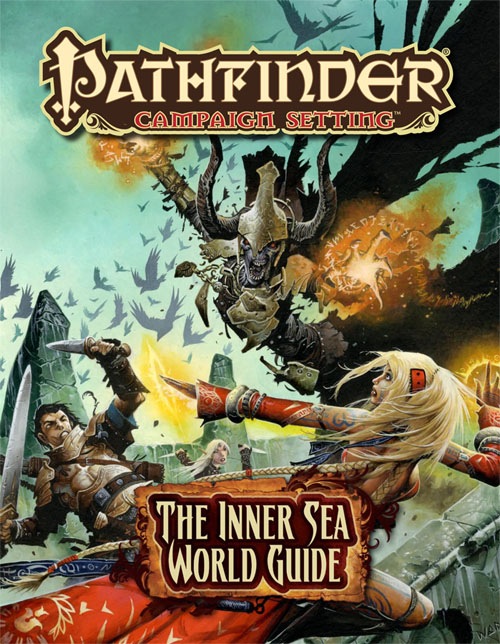
Art of the Genre: Curse of the Crimson Throne

Art of the Genre: Curse of the Crimson Throne

pzo9007_500Ok, so I don’t get to game as much as I like, and that’s a shame, but there are still times when I do get to have fun with RPGs. I mean, I’ve been doing this for 28 years, and during that period the bulk of what I’ve run as a Dungeon Master has been all home brew, which in gamer terms means I made it up. There is something to be said for the creativity of doing so, and as an imagination centered guy I get a great kick out of creating adventures, timelines, histories, legends, and anything else you can name.

That being said, I’ve also had the opportunity to sit back and use someone else’s creative spark to frame my adventures when I DM. In Old School terms this means using a module, and many and many again famed ones exist from the 1980s when D&D was new to the mass populace and DMs were raw and could use a little help when driving their business.

I’d like to say in my time within the genre ‘I’ve played them all’, which of course isn’t true, but I will debate the concept that I’ve played all the ones that truly matter… Yet for all their old school wonder, I was always on the lookout for something, anything, in today’s market that could rival the simple genius that were those original supplements.

Enter Paizo’s Pathfinder Adventure Paths. With ‘Edition Wars’ in full swing and Wizards of the Coast trying to rally a bloodied banner with 5th Edition, I’m not going to disparage any game that helps creative people gather around a table and share face time for fun, but I will hold up Paizo’s Pathfinder as an example of what ‘good’ really is in today’s RPG market.

Read More Read More

Real Magicians: Interviewing the Editors of Podcastle

Real Magicians: Interviewing the Editors of Podcastle

bgpodcastleThe thing is, I love Podcastle.

I can’t help it. I love theatre and oral storytelling, I read a lot, I listen to audiobooks myself; I love big collaborative projects that involve massive influxes of talent, that are broad-minded and multi-faceted, that promote both exciting new voices and the old classics. Podcastle — with its podsisters EscapePod and Pseudopod — does all that.

Every time I hear a story over at Podcastle that guts me or makes me fly a little, I want the whole world to hear about it. I only wish my voice were louder.

So, one day in the not too very distant past, riding on some Podcastle story high — maybe a Tim Pratt or a Leah Bobet — I asked the editors, Dave Thompson and Anna Schwind, if they wouldn’t mind doing an interview for Black Gate magazine. Like most collaborations (especially the ones I’m involved in, oops), this took more months than anticipated, but — also like most collaborations — was ultimately worth it.

Ladies and Gentlemen, may I introduce you to the movers and shakers of the Fantasy Podcast?

Read More Read More

Edgar Rice Burroughs’s Mars, Part 4: Thuvia, Maid of Mars

Edgar Rice Burroughs’s Mars, Part 4: Thuvia, Maid of Mars

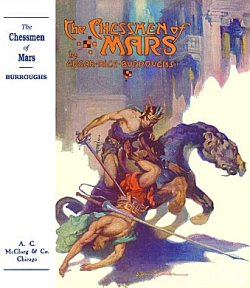
thuvia-maid-of-mars-mcclurg-coverJohn Carter’s story appeared finished with The Warlord of Mars. But readers wanted more, and Burroughs was fired with productive energy. Less than a year after “ending” the Martian novels, he launched into the second phase of the series, with a new hero, new heroine, and new point-of-view style.

Our Saga: The adventures of earthman John Carter, his progeny, and sundry other native and visitors, on the planet Mars, known to its inhabitants as Barsoom. A dry and slowly dying world, Barsoom contains four different human civilizations, one non-human one, a scattering of science among swashbuckling, and a plethora of religions, mystery cities, and strange beasts. The series spans 1912 to 1964 with nine novels, one volume of linked novellas, and two unrelated novellas.

Today’s Installment: Thuvia, Maid of Mars (1916)

Previous Installments: A Princess of Mars (1912), The Gods of Mars (1913), The Warlord of Mars (1913-14)

The Backstory

Burroughs wrote the fourth Barsoom novel in April–June of 1914 under the stunningly uninspired working title of “A Carthoris Story.” But it wouldn’t appear in magazine form until two years later, where it ran in All-Story in three installments in April 1916. Burroughs was deep in the middle of the busiest period of his life, and he spent most of 1915 trying to sell his new properties to Hollywood, all without success. The delay getting Thuvia, Maid of Mars to market may reflect how crazy the author’s life was getting — and that he realized that Tarzan was going to be his big franchise.

Read More Read More

It’s a World of Slaughter: Small World Board Game

It’s a World of Slaughter: Small World Board Game

smallworldSmall World (Amazon)
Days of Wonder ($49.99)
2 to 5 players
Recommended ages: 8+
Playtime: Around 1 hour

Reviewed by Andrew Zimmerman Jones

Small World is a game where various fantasy races get to fight over a world that’s just too small for them all to coexist. The intriguing gameplay mechanic ultimately drives your races into decline, forcing you to select new races to sweep in and take their place. The victor is the one with the most Victory Points at the end of the game.

Each Race has special powers which are randomly chosen each game, resulting in a total of 280 different possible Race & Special Power combinations, from Swamp Giants to Dragon Master Skeletons to Seafaring Dwarves. (Or, in another permutation, Dragon Master Giants, Seafaring Skeletons, and Swamp Dwarves.)

The set-up can be a bit overwhelming when you first open the game, but once you’ve played it once, it’s a quick, fun game for the whole family. One nice feature is that there’s nothing hidden about the game, so this is excellent for introducing younger players to gaming. Though the recommended age is 8+, my precocious 6-year-old son and I have played this game multiple times. He often has questions about the way certain powers work, so the game lasts longer than an hour, but it’s loads of fun.

Read More Read More