Browsed by
Category: Blog Entry

The Public Life of Sherlock Holmes: Adventures With Jeremy Brett

The Public Life of Sherlock Holmes: Adventures With Jeremy Brett

Brett46For several decades, Basil Rathbone, star of fourteen Holmes films in the thirties and forties, was generally the most recognizable and popular screen Holmes. And of course today, Benedict Cumberbatch and Robert Downey Jr are internationally recognized for their turns as the master detective.

But in between Rathbone and Cumberbatch, one actor (with apologies to Peter Cushing) stood above all other portrayers of Sherlock Holmes. And that was Jeremy Brett.

This is number one of a three part series looking at the first part (The Adventures) of the Granada television series, which ran in full from 1984 to 1994. To many fans, Brett is simply THE Holmes. So…

In 1980, Michael Cox was a producer at Granada, one of the Independent Television (ITV) contractors in England. At the same time in America, Charlton Heston was starring as Sherlock Holmes in the stage play, The Crucifer of Blood. His Watson was a handsome Englishman named Jeremy Brett.

The following year, Cox proposed an authentic Sherlock Holmes series; one that was as true to the original tales as could commercially be done in the television format. His idea was received positively, but Cox was told that an essential element of the deal would be a pre-sale agreement with American television. This would secure “up-front” money, which would be invested into the series. WGBH in Boston, host of the popular PBS series, Mystery!, was an ideal candidate for the partnership.
Read More Read More

Self-published Book Review: The Shard by Ted Cross

Self-published Book Review: The Shard by Ted Cross

If you have a book you’d like me to review, please see the submission guidelines here

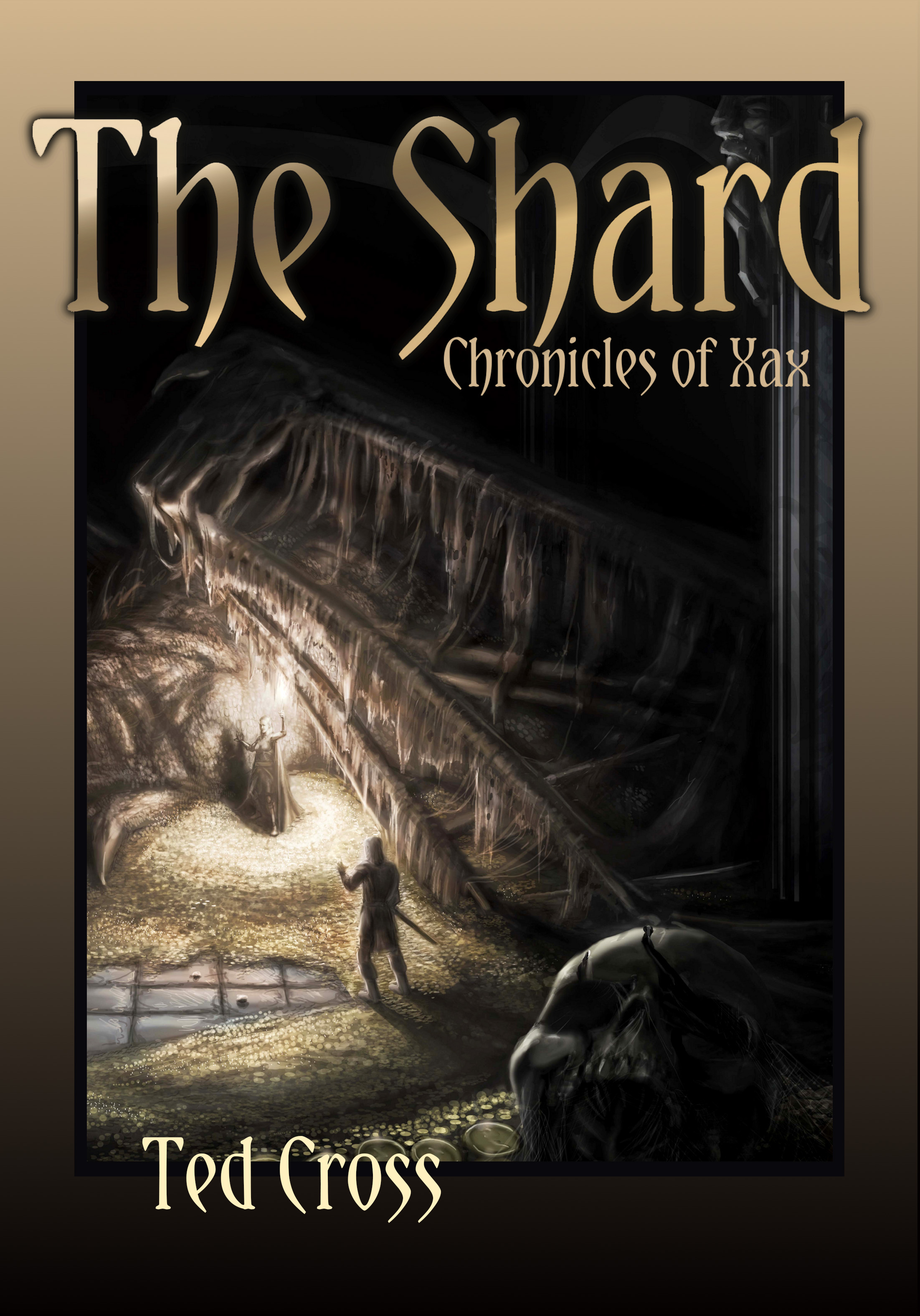
Shard coverTed Cross’s The Shard takes place in a world of elves, dwarves, and humans. Millenia ago, dwarves and elves warred against one another with devastating losses on both sides. Only when it was almost too late did they realize that they had been tricked by the corrupted wizard Bilach, leaving themselves vulnerable to his conquering armies. They combined forces and defeated Bilach. Afterward, the remaining wizards created a tower called the Spire of Light, with a great crystal atop enchanted to encourage peace. Centuries later, the dragon came and destroyed the tower and the crystal. Now a new threat has appeared, and the only way to defeat it is to find the sole remaining shard of the crystal, hidden in the lair of the dragon who destroyed it.

Wisely, the author doesn’t lay out the ancient history quite so directly as I’ve done here. Told this way, it seems too simple, too familiar. Instead, the history is told in bits and pieces, not through the eyes of the elves or the dwarves, but through the perspective of the humans, who came late to the region and saw the coming of the dragon, but know little of the history behind what it destroyed. In a sense, the story is told backward, each new story a revelation farther into the past, shedding light on a new person’s or people’s origin and role.

At the center of the large cast of characters is Midas. A lord of a minor holding, he is still mourning the loss of his son Miros when he discovers that someone is attempting to spark a war between the humans and the elves. He knows right away that such an act is foolhardy, and he makes contacts with the elves in order to try to ease tensions. The elf lady Alvanaria is eager to help keep the peace, but ultimately it’s the appearance of a new threat that prevents humans and elves from going to war. An army of wyrmen is rapidly approaching, and it will take humans, elves, and dwarves to stop them. But first, Midas, his sons, Alvanaria, the wizard Xax, and their companions will need to retrieve the shard of the Spire of Light from the dragon’s lair.

Read More Read More

Odysseus: An Original Barbarian Badass

Odysseus: An Original Barbarian Badass

As a performing storyteller (think bard), I’ve had the chance to participate in some epic tellings. And I mean EPIC! Up to three days of multiple tellers from across various countries telling a long and ancient story, one chapter at a time. It’s, well, it’s epic.

"I could string his bow, too, but everyone would just say the Hulk could have done it faster... It's not easy being me."
“I could string his bow, too, but everyone would just say the Hulk could have done it faster… It’s not easy being me.”

I’ve had the chance to tell The Odyssey twice, once in my hometown of Ottawa, the other time on the West Coast in Nanaimo, BC. The last telling was two weekends ago, and it struck me that you could take Odysseus out of his story and plop him into a sword and sorcery adventure and voilà! You have a perfect barbarian hero. Let me, in fact, count the ways:

He Has Super Strength
He’s so badass that he’s the only one who can string his ash bow. The only one! People try, fail and then go drink wine while mumbling.

He Knows How to Keep a Story Going
Okay, so we encounter him in The Iliad (bloody fun stuff). That war lasted ten years. Ten years! Then he takes another nine years to get home, while partaking of multiple adventures. Kind of makes you understand why Epic Fantasy is so, well, Epic.

Read More Read More

Blade Runner: Edmond Hamilton’s Tears in the Rain?

Blade Runner: Edmond Hamilton’s Tears in the Rain?

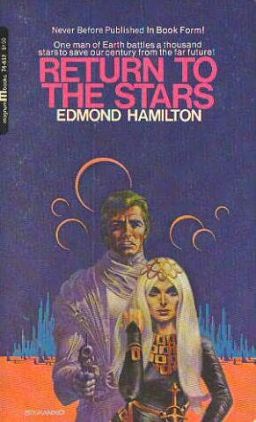
HamiltonReturnToTheStars
“I’ve… seen things you people wouldn’t believe…”

Get this:

I heard the sunrise music that the crystal peaks make above Throon when Canopus comes to warm them. I feasted with the star-kings in the Hall of Stars. And at the end, I led the fleets of the Empire against our enemies, the men from the League of Dark Worlds. I saw the ships die like swarming fireflies off the shores of the Hercules Cluster. I’ve shot the Orion Nebula. I’ve been into the Cloud, where the drowned suns burn in a haze of darkness. I’ve killed men, Doctor. And in that last battle, I —

Oddly familiar? Actually, that’s Gordon’s monologue to his shrink in Edmond Hamilton’s Return to the Stars.

How about this one?

I’ve… seen things you people wouldn’t believe… Attack ships on fire off the shoulder of Orion. I watched c-beams glitter in the dark near the Tannhäuser Gate. All those… moments… will be lost in time, like [small cough] tears… in… rain. Time… to die…

Of course, that’s Roy Batty’s dying monologue in Blade Runner. Hauer is supposed to have improved on the original script, which had…

I have known adventures, seen places you people will never see, I’ve been Offworld and back… frontiers! I’ve stood on the back deck of a blinker bound for the Plutition Camps with sweat in my eyes watching the stars fight on the shoulder of Orion… I’ve felt wind in my hair, riding test boats off the black galaxies and seen an attack fleet burn like a match and disappear. I’ve seen it, felt it…!

Read More Read More

The 2015 Hugo Nominations

The 2015 Hugo Nominations

Loncon 3 Hugo statue-smallI am I suppose coming a little bit late to the party, but I wanted to join in and express my views on the Sad Puppies/Rabid Puppies slates, and their effect on the Hugos. I will mention up front that of all the points of view I have seen expressed, I am most in sympathy with George R. R. Martin’s … you can read his views at his Not a Blog.

I should add as well that I do have a horse in this race. I am a Hugo nominee again as part of the editorial team for Lightspeed, which was nominated for Best Semiprozine. (We were fortunate enough to win last year, one of my biggest thrills in my time in the field.) I’ll be honest: one of the things that bothers me about this whole kerfuffle is that I’ll be at Sasquan as a nominee, my first time to be at the Hugos in person as a nominee. (I was unable to make it to London last year.) And I can’t help but think that the whole experience will be, certainly not ruined, but marred, by the aftermath of the whole mess. (For example – it would have been pretty darn cool to receive a Hugo from Connie Willis, if we were so lucky!) But you have every right not to care about that – that doesn’t matter at all in reality.

Anyway, here’s a quick summary of my positions:

Bloc voting is wrong. Making recommendations is not wrong. Promoting your own work strikes me as distasteful, but I’m not going to condemn those who do so. Promoting other people’s work is good.

Read More Read More

The Proxy Culture War for the Soul of Middle Earth

The Proxy Culture War for the Soul of Middle Earth

Culture War-smallThe culture war has been going on for a while. We’re used to it played out large. Trying to boil down 50 years of social history and politics into a paragraph is going to lose some nuance but, in broad strokes, you’ve people for whom established mores work, usually from homogenous communities, and people for whom they don’t — who are frequently labeled with various flavors of moral degeneracy. Usually to the scorn of history.

It’s played out in government, often in schools. We’re used to that. But now it’s also playing out in our fandom, our games, our conventions. This year the Hugo Awards took some collateral damage from being a battlefield in a war that is part of that narrative but is also somewhat removed from how we’ve been used to thinking of this fight.

Safe Space and the Geek Social Fallacy

There is a social movement of, largely, white male nerds misusing the concept of safe space to exclude people from geekdom.

Safe space is an area where anyone can be comfortable in who they are without recrimination, without bullying and without threat.

Most of our society isn’t safe. The litany of violence, abuse, and microaggression thrown at people because of fundamental aspects of their person is well documented

Read More Read More

March Short Story Roundup

March Short Story Roundup

oie_2831152onP2pF5uThere are a whole lot of new-to-me goings on out there in the world of magazines and short fiction (see John O’Neill’s recent posts). So much so that I’m a little behind this month trying to catch up. I haven’t gotten to any of Beneath Ceaseless Skies most recent issues yet.

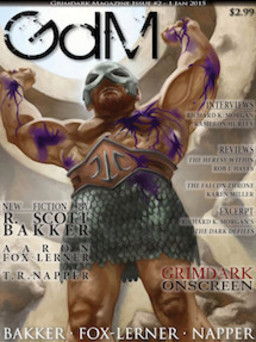
From a swords & sorcery perspective, the biggest — and potentially most interesting — new publication out there is Grimdark Magazine. The first issue, completely unbeknownst to me, appeared last fall. The third issue hit the virtual newsstand on March 25. Like the title says, it’s filled with grim and dark stuff.

The term grimdark, lifted from Warhammer 40K, was originally one of opprobrium for a certain type of fantasy, and was later taken up as a badge of honor by its creators. For those who managed to miss all the talk about the subject a few years back, here’s a quick definition: grimdark fantasy is nihlistic/realistic storytelling that moves the genre forward/destroys the genre, and features characters with realistic motives/who are utterly vile. Whether you like or hate the fiction coming out under the rubric, Grimdark Magazine, by its very nature, is going to feature S&S.

Each issue is packed with original stories, interviews with some of grimdark’s leading lights, and reviews. The magazine has a definite point of view as stated by editor Adrian Collins in the first issue:

Grimdark Magazine started out as the identification of a gap in the niche ezine market coupled with an obsession with grim stories told in a dark world by morally ambiguous protagonists.

As far as I’m concerned, grimdark is just another marketing term, like splatterpunk was for supposedly extra-bloody horror back in the mid-1980s. As much as some writers and fans have claimed that grimdark is both about introducing more realism as well as being a revolt against black-and-white morality that they say saturates much fantasy, I don’t think it’s all that different from lots of what’s gone before (just check out any of Karl Edward Wagner or Michael Moorcock’s fantasies).

Read More Read More

Adventures In Near-Future Sci-Fi: Black Mirror

Adventures In Near-Future Sci-Fi: Black Mirror

Black Mirror White BearI don’t watch television. Or not, let’s say, broadcast television. Since the first X-Files video tape showed up, I have, instead, binge-watched episodic TV in irregular, spasmodic doses via VHS, DVD, and Netflix. I watch with my wife, and we’re not (to the shows) faithful: if a particular series bores us, we move on. Even Breaking Bad, after three seasons, felt like a joke gone on too long.

But Black Mirror. Holy cats!

It’s the best sci-fi you’ve never heard of.

A British show made for Channel Four, Black Mirror is the brainchild of one Charlie Brooker — whom you haven’t heard of, either. The series aired in the UK from 2011 through 2013. Based on that time span, you’d think it was a fabulous success spanning dozens of episodes. Only half true. Black Mirror consists of six shows total (plus a 2014 “Christmas Special,” which I have yet to see), and each is self-contained, a hermetic “What If?” often compared to Rod Serling’s Twilight Zone. The reference is not especially apt, but like Velcro and old chewing gum, it’s a label that seems to have stuck.

Read More Read More

How I Discovered David Drake by Accident: Confusion, Redliners, and Why I’m Glad I Made a Mistake

How I Discovered David Drake by Accident: Confusion, Redliners, and Why I’m Glad I Made a Mistake

david-drake
David Drake

Back in 2007, when I was getting ready to attend my first World Fantasy Convention in Saratoga Springs, New York, I was trying to remember a book.

I’d read it years earlier: a science-fiction thriller about colonists who unwisely set down on an alien planet with an environment so hostile that their top high-tech special forces are about as equipped to handle it as the Kardashian sisters if they were dropped onto the beaches of Normandy on D-Day. The planet is lush, tropical: at first blush very inviting, having all the necessary elements for survival. Only one problem: evolution on this planet has followed a very lethal trajectory, developing predators that would make our own Earthly alpha predators – tigers, sharks – seem like domesticated pets in comparison. The bottom of the food chain on this planet would eat the top of our food chain for a quick snack. A seemingly innocuous, pretty flower is likely concealing fly-trap jaws full of acid. If you get ten yards in this jungle environment still in possession of most of your limbs, you count your lucky stars that you’re still alive.

So. What was that book? Obviously, I turned to Google. And engaged in a pursuit most of us have at one time or another: search for a book without knowing the title or the author, hoping that I could locate the elusive text with the right combination of key words.

Read More Read More

The Public Life of Sherlock Holmes: Richard Diamond, Private Eye

The Public Life of Sherlock Holmes: Richard Diamond, Private Eye

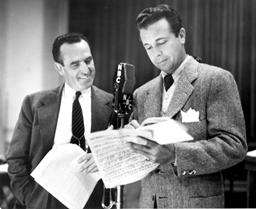
Diamond_PowellA topic that I’ve long intended to visit is that of old time radio shows. Of course, it’s no surprise that Sherlock Holmes has been a popular subject for radio dramas. Arthur Wontner (who I’m sure you read about here) and William Gillette (again, here…) reprised their film roles for radio.

Richard Gordon, John Stanley and Richard Hobbs had long runs as Holmes. And of course, the most popular film Holmes, Basil Rathbone, had a long-running serial with his Watson, Nigel Bruce.

More recently, Clive Merrison starred in the entire Canon (and more) for BBC Radio. Also, Jim French’s Imagination Theater features new Holmes radio dramas (along with several other characters). I’ll certainly be writing about those two.

In the forties and fifties, detectives, newspaper reporters and even insurance investigators were popular heroes for radio dramas. Sam Spade, Philip Marlowe, The Fat Man (ostensibly created by Dashiell Hammett) and Johnny Dollar were some of the radio stars of the day. One of the most fun was Richard Diamond, Private Detective.

Read More Read More