Browsed by
Category: Blog Entry

Adventures in RPGs: Long Arc or Short Arc?
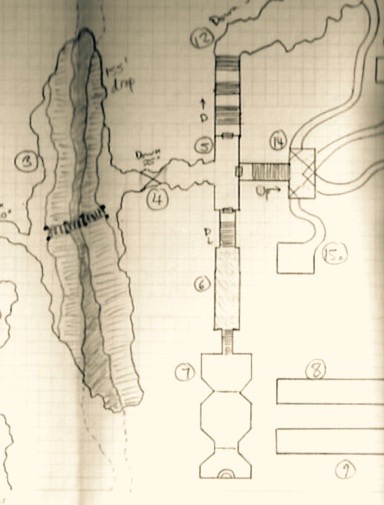
Adventures in RPGs: Long Arc or Short Arc?

Scan 11AD&D carried me from middle school right through college, and about seventy-five percent of the time, I wound up as the referee. The core group with whom I played continued right on getting together for another fifteen years or so after graduation, engaging in annual reunions all over the country.

And I kept right on refereeing. After all, I had unfinished stories to “tell.” These story arcs played out over weeks, months, semesters, and then years. Many remain unfinished to this day. In the main, the rest of the group enjoyed my epic, often convoluted approach. For better or for worse, we weren’t much for hack-and-slash, in-and-out heroism.

Or were we? I’ll never forget Eric S. musing, as one reunion year wound down, that it sure would be nice if for once we could storm the castle, rescue the maiden, and be done.

His wistful comment stemmed in part from my having that very year posed a variant on that longed-for maiden-in-the-tower paternalistic standby: Orcus hired the party to rescue a damsel in distress, but this particular blushing violet turned out to be a truly enormous, deformed frog that had to be kissed in order to… well. Let’s just say there aren’t enough kisses in creation to make the wife of Orcus any more desirable.

Read More Read More

The Public Life of Sherlock Holmes: Jeremy Brett’s Adventures Begin

The Public Life of Sherlock Holmes: Jeremy Brett’s Adventures Begin

Brettstrand1Last week I posted part one of our look at Granada’s The Adventures of Sherlock Holmes, starring Jeremy Brett.

The Adventures were divided into two parts; seven episodes in the first; six in the latter. A Scandal in Bohemia aired on April 24, 1984. Can it be thirty-one years since Jeremy Brett first graced television sets as the great detective? Scandal was actually the third story to be filmed.

Producer Michael Cox wanted Brett and his Watson, David Burke, to become comfortable with their roles before filming one of the most famous tales in the Canon, so he didn’t start taping with this one.

Watson enters their Baker Street lodgings, having been gone on a trip. He sees the empty syringe case and fears his flat mate has turned to cocaine. Shortly after our first vision of Holmes, Brett gives the “My mind rebels at stagnation” speech. It is completely understated but still paints a portrait of Holmes’ need for work (compare it to the over-the-top reading of Matthew Frewer).

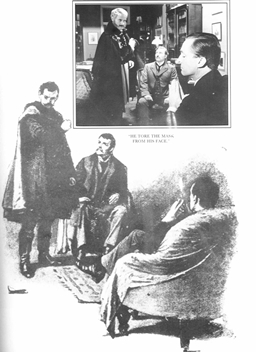
The script is remarkably faithful to the story and is filled with original dialogue from Doyle. The influence of Sidney Paget is blatantly obvious. The King of Bohemia’s unmasking is a replica of the original drawing, and Brett’s ‘drunken groom’ disguise is nearly identical to Paget’s drawing. We even get the famous “Good Night Mr. Holmes” scene.

David Burke is as far from Nigel Bruce as one can imagine. He is thoughtful, intelligent, amusing without being a buffoon and utterly dependable. There is a valid film reason for Bruce’s un-Canonical portrayal as comic relief, but Burke reinvents Watson as his original self: the way Doyle wrote him.

Read More Read More

Want to Break Into Comics?

Want to Break Into Comics?

onibk_292  If you want to break into the big comic publishers, a bit of internet research, or visiting a local comic-con will reveal the accepted wisdom pretty quickly:

  • If you’re an artist, show your portfolio to editors at a con, or establish an online portfolio and email the editors. There’s lots of advice in different places about breaking in as an artist, and lots of places to learn (the comicsexperience.com podcast seems to me to be a great place to start).
  • If you’re a writer, pair up with an artist, make a comic, sell to the smaller comic presses to show your abilities and then approach bigger publishers, who, of course, offer a bit more money.

There isn’t really an advertised direct route in for writers either way. The submission guidelines at DC are pretty clear that they’re only looking for artists.

Marvel does let on that they’re looking for writers and artists, but mostly through the process laid out above.

Read More Read More

The March of the 10,000

The March of the 10,000

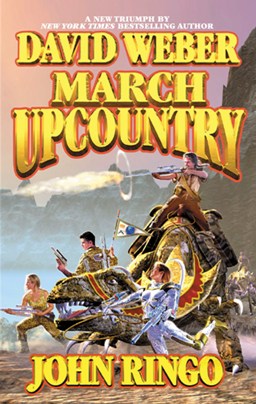
WeberRingoMarchUpCountry
The mercenaries that became heroes. The heroes that became a trope.
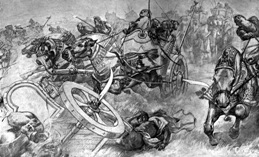
Holy ****! Scythed chariots!!!
Holy Cow! Actual scythed chariots.

The mercenaries that became heroes.

The heroes that became a trope.

401 BCE and Cyrus the Younger draws up his rebel army on the banks of the River Euphrates near Cunaxa.

We’re in what will be modern Iraq, deep inside the Persian Empire. Even so, the right flank belongs to 10,000 Greek mercenaries, mostly heavily armoured hoplites and veterans of both sides of the brutal Peloponnesian War.

At midday, a white cloud of dust rises over the the horizon, a cloud so vast that it casts a shadow on the plain. At last, the sun flashes on bronze spear points and the army of King Artaxerxes trundles into view; 40,000 men drawn from the reaches of the empire… heavy infantry, archers, exotic skirmishers, armoured cavalry… oh and — Holy Cow! — actual scythed chariots.

Chanting their paen, rattling spear on shield, the Greeks dress their ranks and march into action…

Read More Read More

The Top 50 Black Gate Posts in April

The Top 50 Black Gate Posts in April

Hugo Award Black GateLooking over our traffic stats for last month, I want to give a shout-out to M Harold Page, who managed to heroically crack the Top 10 without once mentioning the Hugo Awards or Rabid Puppies. Well done, Mr. Page!

He was the only one to accomplish that extraordinary feat, however. Every other article in the Top 10 for April (and more than a few in the Top 25) directly addressed the ongoing Hugo Awards controversy, which began on April 4th when Worldcon announced the nominees for the 2015 Hugo Awards — a group which usually represents the finest science fiction and fantasy of the year, but this year was largely dictated by a single individual, Vox Day (Theo Beale), and his Rabid Puppy supporters, who crammed the slate with 11 nominees from Theo’s tiny publishing house, Castalia House, and nominated Vox Day personally for two Hugo Awards.

Not coincidentally, Black Gate received the first Hugo nomination in our history, and one of our bloggers, Matthew David Surridge, was nominated for Best Fan Writer, both as a direct result of being included on the Rabid Puppy slate. We declined those nominations, for reasons that I think should be fairly obvious.

The most popular article on the BG blog last month — indeed, one of the most popular posts in our history — was Matthew’s “A Detailed Explanation,” in which he analyzed the extraordinary events around this year’s Hugo nominations, and enumerated the reasons why he declined science fiction’s highest honor. It the few weeks since it has been posted, it has been read over 50,000 times.

Read More Read More

Knock, Knock: Or, The Portal Fantasy Revisited

Knock, Knock: Or, The Portal Fantasy Revisited

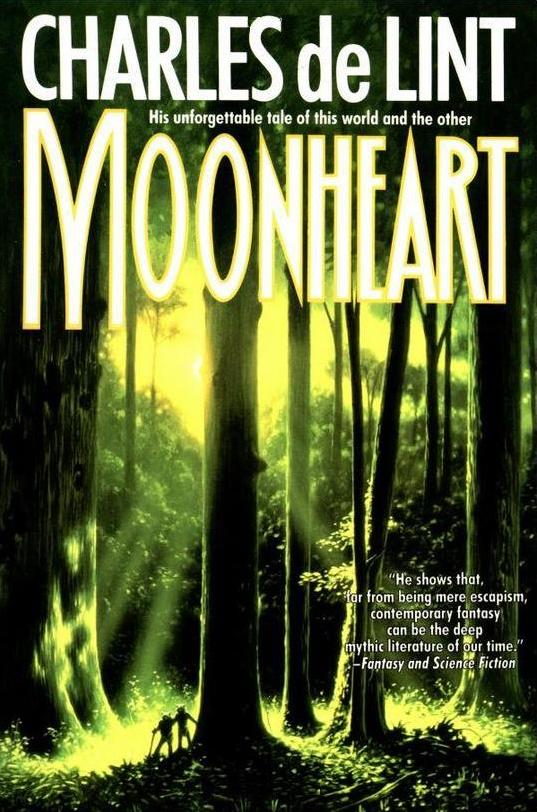
Moonheart-smallThis week I participated in a Mild Meld over on SFSignal on the theme of portal fantasies. I’m not the only person who did, and you can see the whole post here, but, as is so often the case when you’re asked to consider an intriguing idea, I’m still thinking about it. Warning: For the sake of clarity I repeat some of my SFSignal observations, but I don’t overlap much.

Working on that post, and thinking about classic portal fantasies such as the The Wizard of Oz or the The Chronicles of Narnia, or the more recent Chronicles of Thomas Covenant (though even they aren’t particularly “recent,” are they?) got me wondering about the evolution of the portal fantasy over the last 35 years.

Let me review the classic version: Human beings from our world find an entrance to a secondary world where magic works, the supernatural exists, etc., and adventures are undertaken. Often there’s a kind “quest” element involved as well, in that the protagonists have to complete a task in order to be able to return to our world. These are often called “primary world fantasies” even though most or all of the action takes place in the other world.

Again, in the classic version of the portal fantasy, the reader is riding the shoulder of the protagonist, seeing and learning everything about the new world at the same time the protagonist does. CS Lewis even introduced new protagonists, so that he could keep explaining things in later books without seeming repetitious. Of course we all recognize this as a use of the stranger-in-a-strange-land trope (SISL), which is invariably interdependent with the portal trope.

Read More Read More

The Woman Who Was a Man Who Was a Woman: Alice Sheldon and James Tiptree Jr.

The Woman Who Was a Man Who Was a Woman: Alice Sheldon and James Tiptree Jr.

Tiptree Biography-smallAlice Hastings Bradley Davey Sheldon was a remarkable person — world traveler, painter, sportswoman, CIA analyst, PhD in experimental psychology… and one of the greatest of all science fiction writers. If you don’t recognize her name, that’s partly by her own design.

Born in 1915, from an early age Alice was a lover of this new genre that was in those days still called “scientifiction,” devouring every copy of Weird Tales, Wonder Stories, and Amazing Stories that she could find, but it wasn’t until the mid 60’s that she tried her hand at writing any SF herself. After some false starts, she completed a few stories and in 1967, when she was 51, she sent them off to John Campbell at Analog, not really expecting anything to come of it. As she considered the whole thing something of a lark, she submitted the manuscripts under a goofy pseudonym that she and her husband, Huntington (Ting) Sheldon, cooked up one day while they were grocery shopping — James Tiptree Jr. The Tiptree came from a jar of Tiptree jam; Ting added the junior.

To Alice’s professed surprise, Campbell bought one of the stories, “Birth of a Salesman.” A new science fiction writer was born, one who would, in the space of just a few years, make a tremendous impact on the genre (as two Hugos, three Nebulas, and a World Fantasy Award attest, to say nothing of the James Tiptree Jr. Award, which is given to works which expand or explore our understandings of gender).

Alice Sheldon never looked back. She also never let anyone know that James Tiptree Jr. wasn’t a man; all of her many contacts and correspondents in the SF field assumed that the courtly “Tip” who had had such a wide-ranging life and wrote such witty letters was an all-American male. (Who wouldn’t take phone calls or meet anyone — including his agent — in person and would never show up to accept any awards. What began as a joke became, without Alice’s really planning it, an elaborate deception worthy of… well, of the CIA, and a banana peel that countless readers and critics would embarrassingly slip on.)

Read More Read More

Alcalá de Henares: Visiting the Birthplace of Cervantes

Alcalá de Henares: Visiting the Birthplace of Cervantes

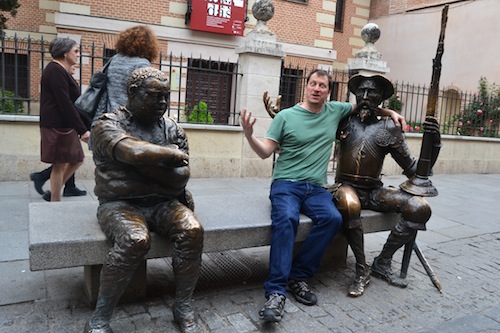
Yours truly hanging out with Don Quixote outside the Cervantes' old home. Sancho Panza looks unimpressed. I actually had to stand in line for this shot, it's that touristy. Copyright Almudena Alonso-Herrero.
Yours truly hanging out with Don Quixote outside the Cervantes’ old home. Sancho Panza looks unimpressed. I actually had to stand in line for this shot, it’s that touristy. Copyright Almudena Alonso-Herrero.

Spring has finally sprung here in Madrid. The sidewalk cafes are full, and those who can’t find a seat have set off to the countryside to go hiking. It’s a good time to leave the museums and galleries behind and take a look at what the surrounding area has to offer.

This past weekend my family and I visited Alcalá de Henares, a small city 40 minutes on the suburban train outside of Madrid. Its main claim to fame is being the birthplace of Cervantes, who has been in the news recently because Spanish archaeologists discovered his tomb.

Like many Spanish cities, it has its roots in prehistory and came to prominence in Roman times, when it was called Complutum. After the fall of the empire it was a Visigothic settlement and was later taken over by the Moors, who built a citadel (“al-qal’a” in Arabic, a common place name in Spain). During the Moorish period it was a thriving town with large Christian and Jewish quarters.

Read More Read More

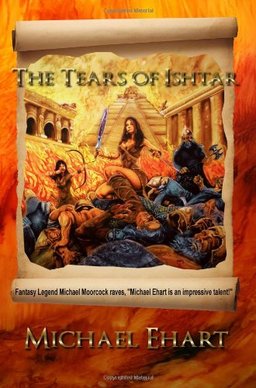
The Tears of Ishtar by Michael Ehart

The Tears of Ishtar by Michael Ehart

oie_351436BG5v7xydWhen my renewed interest in swords and sorcery was sparked a few years ago, one of the first and best books of new writing I found was The Return of the Sword, edited by Jason M. Waltz (reviewed at BG by Ryan Harvey). It’s filled with a passel of great stories and turned me on to several writers I follow closely to this day. Among them are Bill Ward, James Enge, and Bruce Durham. It’s the book that convinced me that there was a renaissance in heroic fiction and that it was worth blogging about.

One of the most intriguing stories, with imagery that’s stayed with me over the years, is “To Destroy All Flesh” by Michael Ehart. I wasn’t surprised to learn it was part of an ongoing series of linked stories. “Flesh” references characters and quests that clearly predate the action at hand.

Ehart’s protagonist, Ninshi, a woman from Ugarit in Bronze Age Syria, is enslaved by a flesh-eating demon, the Manthycore. She must provide corpses of warriors for the beast to devour. Her terrible master gave her immortality, great strength, and enhanced healing in order to carry out this task.

By the time I could see again, it had already begun to feed. As always, it started with the soft parts. The belly and the face were its favorites and because it fed so seldom, it showed little restraint. This time it chose to wear the head of a lion, which seemed to be well suited for the task.

It felt the force of my gaze, but did not react right away, engrossed in some particularly savory morsel from the belly of one of the corpses. I took care not to take note of which one. It is a matter of pride that I not look away, but I long ago learned to look without seeing.

She is sustained over the centuries of her servitude by the dream of freeing herself and forcing the Manthycore to restore her lover to life. That quest sets the stage for the tales collected in The Tears of Ishtar.

Read More Read More

Ode to a J.R.R. Tolkien Coffee Mug

Ode to a J.R.R. Tolkien Coffee Mug

photo 1-7I’ve been drinking coffee from this mug since way back in the twentieth century. It was a gift, of that I’m pretty sure, but I’ve had it so long I can no longer tell you who I got it from or when.

It survived my first marriage, a move from Arizona to Minnesota and several subsequent moves all over the Land of 10,000 Lakes, and being left through one brutal winter in a cow pasture (I lost it on a walk late in the fall; the following spring it was still there where I’d left it, sitting on the hood of a rusted old jalopy!).

It is a little worse for wear — a chip on the rim and another one on the base. The litho, though — incredibly — is pristine and unfaded, even though it’s been through hundreds of cycles in the dishwasher.

The caricature of Tolkien as a hobbit, which is repeated on either side of the mug, was done by Steven Cragg. The text, which is attributed to “Largely Literary Designs, Inc.,” reads as follows:

Ever since we were no bigger than a billiard ball we’ve wanted something important we could call our own — a yacht, for example, or a cottage in the Bahamas, or a marriage counselor who could go an entire hour without saying the word “feelings,” or, well, a mythology of Middle-Earth, to be perfectly honest with you, a unique vision of history and pre-history, good and evil, gods, devils, the whole shebang, the sort of thing J.R.R. Tolkien devised more than a half a century ago, which means we’re lucky as Frodo, of course, because thanks to modern printing technology and a newfangled bartering system called “money,” we now need go no further than our corner bookstore, pick up a copy of The Hobbit and suddenly we’re there, chucked head over heels into Tolkien’s magical kingdom, thankful that when our own world becomes too much for us, we can always turn to his.

Read More Read More