Vintage Treasures: Worlds Imagined: 14 Short Science Fiction Novels, Compiled by Robert Silverberg and Martin H. Greenberg
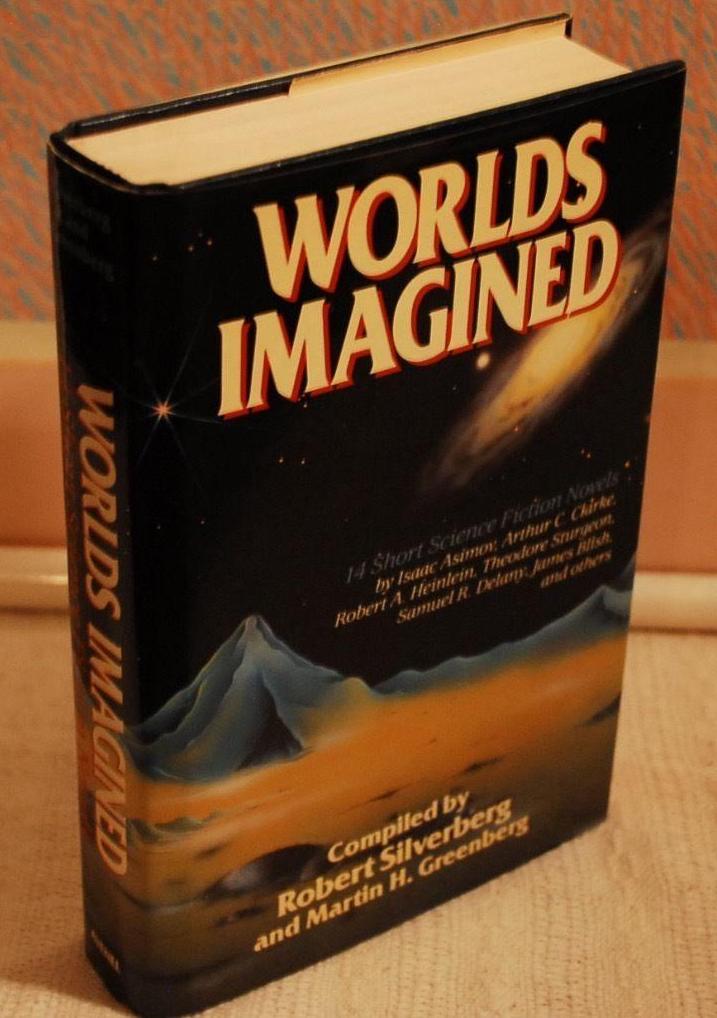 I bought a fine anthology of science fiction novellas on eBay last week for 5 cents. With $3.99 shipping, that brought the whole thing to $4.04 — about 28 cents per novella. Pretty sweet deal.
The anthology is Worlds Imagined, published by Avenel in April 1989, and edited by Robert Silverberg and Martin H. Greenberg. Excuse me, ‘Compiled by,” not edited by. I guess Silverberg and Greenberg didn’t feel comfortable with the title of editors, for merely selecting the fiction. That’s editorial integrity for you.
One of the things I love about this book is the editors’ (erm, compilers’) impassioned defense of the novella in their intro. I read it years ago, and much of it stayed with me. Here it is, in part.
The short novel — or “novella,” as some prefer to call it — is one of the richest and most rewarding of literary forms. Spanning twenty to thirty thousand words, usually, it allows for more extended development of theme and character than does the short story, without making the elaborate structural demands of the full-length book… Some of the greatest works in modern literature fall into the class of novellas. Consider Mann’s “Death in Venice,” Joyce’s “The Dead,” Melville’s “Billy Budd,” and Conrad’s “Heart of Darkness” — or Faulkner’s “The Bear,” Tolstoi’s “The Death of Ivan Ilych,” Carson McCuller’s “Ballad of the Sad Cafe”…
Since a prime task of the science fiction writer is to create carefully detailed worlds of the imagination, room for invention is a necessity. The short story can give only a single vivid glimpse of the invented world; the full-length novel frequently becomes so enmeshed in the obligations of plot and counterplot that the background recedes to a secondary position. But the short novel, leisurely without being discursive, is ideal for the sort of world-creation that is science fiction’s specialty. and since the days of H.G. Wells and his classic novella “The Time Machine” it has exerted a powerful attraction for science fiction writers.
Preach, brothers!