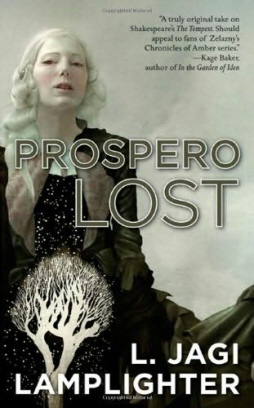
 Prospero Lost, by L. Jagi Lamplighter
Tor (448 pages, $7.99, June 2010)
Prospero Lost is the first book of a trilogy and the first published novel by L. Jagi Lamplighter, whose name I assume is not a pseudonym, though it sounds as if it could be a character in her own book. As you might gather from the title, the story has something to do with what many critics perceive as Shakespeare’s alter ego in his final play, The Tempest, while also somehow involving hell and rebellious offspring given the allusion to Milton’s Paradise Lost. What you might not expect is just about every fantasy trope you can think of, including (I kid you not), Santa Claus.
It’s perhaps not surprising that Lamplighter is married to John C. Wright, who also favors the everything-including-the-kitchen sink approach to fantasy and manages to make it work. In many respects, Lamplighter’s book reminds me of Wright’s Chronicles of Chaos series which deals with the foibles of family relationships among seeming humans possessed of fantastical natures. Of course, the root of this is Greek/Roman mythology in which imperfect gods irrationally vie among each other out of jealously, envy, egotism or other petty and irrational motivations. They are, in other words, normal human beings dressed up in magical togas.
According to Lamplighter, the inspiration for her novel’s fantasy world stemmed from a roleplaying game.
Somewhere in the early Nineties, John and I were invited to play in a roleplaying game run by a friend. He was a new moderator for us, so I decided to write a short story demonstrating what my character could do, so there would be no misunderstandings. For my character, I picked Miranda, the daughter of the magician Prospero from Shakespeare’s Tempest, only in the game, Prospero would turn out to be one of the magicians in the game background…We only played in that game a few times, but I liked the character and the story I had written.
Miranda is the narrator and focus of the novel (indeed, the overarching title of the trilogy is Prospero’s Daughter) and Prospero remains totally off-stage. He is lost, and Miranda is trying to find out what happened to him.
…
Read More Read More

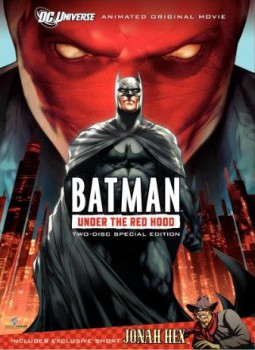 Batman: Under the Red Hood (2010)
 Predicting the weather is an art and a science… yes, really, it’s a science, believe me. I spent four years at Penn State University learning chemistry, calculus, physics, thermodynamics, and fluid dynamics to earn my Meteorology Degree – I should know.
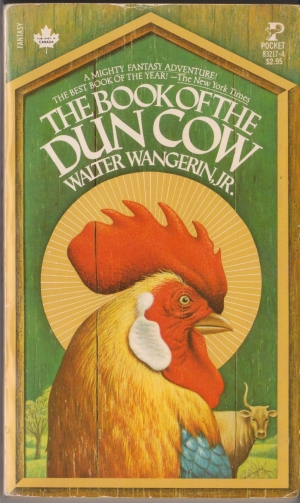 One of the characteristics of a great book is that you can go back to it at different times in your life and get different things out of it. But then sometimes the reverse happens: you read a book before you’re ready. If you’re lucky, though, the book hangs around in the back of your mind, and eventually you pick it up again and find out what you weren’t able to grasp the first time around.