The Nightmare Men: “The Enemy of Evil”

The Nightmare Men: “The Enemy of Evil”

JohnThunstoneManly Wade Wellman is responsible for the creation of a number of supernatural sleuths, occult detectives and werewolf punchers, including Judge Pursuivant. But, arguably one of the more well-known of Wellman’s coterie of heroes is John Thunstone. Big and blocky, with a well-groomed moustache and eyes like flint, Thunstone is an implacable and self-described ‘enemy of evil’. He hunts it with the verve of a Van Helsing and strikes with the speed and viciousness that puts Anton Zarnak to shame.

Well read and well-armed against vampires, werewolves and all things dark and devilish, Thunstone seeks out malevolent occult menaces in a variety of locales. The sixteen stories and two novels have settings which range from the steel and glass corridors of Manhattan to the mountains of the rural South, or the pastoral fields of England. He faces off against Inuit sorcerers, demonic familiars and worse things in the name of protecting the Earth and all its peoples from the hungry shapes in the dark that would otherwise devour it and them.

Read More Read More

Have Fun Storming the Chaostle

Have Fun Storming the Chaostle

chaostleChaostle (Amazon)
Chivalry Games ($69.99, May 2011)

Reviewed by Andrew Zimmerman Jones

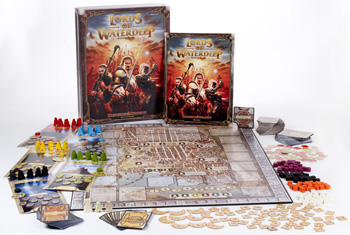
Many fantasy board games have you performing some sort of dungeon crawl, but the approach in Chaostle is a bit different. Instead of crawling through the bowels of a castle’s lower levels, you are instead moving through various levels, leaping from floor to floor in an effort to make it through the castle as quickly as possible. There are a variety of different paths to take and these choices are as significant as any others that you make in the game.

Designed for 2 to 8 players (ages 10 and up), the goal of Chaostle is to beat the other groups of adventurers through the castle. Once you enter the Sanctuary in the center of the castle, you still haven’t won until you are able to beat the castle itself, meaning that the other players do have an opportunity to catch up and sweep in for victory at the last minute.

The game has a fairly sophisticated style of play, so it’s not for the feint of heart. If you are an experienced fantasy gamer, then this will be  fun game, but be warned:

Do not use this game as a means to get your kids, girlfriend, spouse, or other non-gamer involved in the genre.

If you’ve already got a solid group of gamer friends available to you, though, Chaostle can provides hours of entertainment with combat and surprises aplenty.

Read More Read More

After the Golden Age: A Review

After the Golden Age: A Review

After the Golden AgeAfter the Golden Age
Carrie Vaughn
Tor Books (A Tom Doherty Associates Book; 304 pp, $24.99 USD, $29.99 CDN; hardcover April 2011, paperback January 2012)
Reviewed by Matthew David Surridge

Celia West is an accountant in her mid-twenties. She seems normal enough, but appearances are deceiving. Celia lives in Commerce City, home to a number of super-powered heroes and their archenemies. She’s not one of them, though, being in fact the non-powered daughter of two of Commerce City’s greatest champions, Captain Olympus and Spark, leaders of the group called the Olympiad. Now the Olympiad’s worst enemy, the Destructor, has been arrested, and Celia’s skills as an accountant can help to find the fiscal evidence to put him behind bars — only, once, years ago, Celia joined the Destructor as an ally. Can she overcome that act of youthful rebellion to build her own life, and see that justice is done?

That’s the question driving the plot of Carrie Vaughn’s novel After the Golden Age. Super-heroes arguably started in prose, with the exploits of Zorro, the Spider, the Shadow, and Doc Savage, to name some of the best known, but the full-blown super-hero — with exceptional powers, a distinctive costume, and an alter-ego — was really a development of comics. A costumed hero is inherently visual, and many of the best super-hero powers lend themselves to illustration. Can prose present a super-hero story as well as comics can? It’s notable that a lot of the better prose super-hero tales have been shorter works: the best of the Wild Cards shared-world books, for example (a series for which Vaughn writes), or the 2008 anthology Who Can Save Us Now?, or Daryl Gregory’s excellent story from the same year “The Illustrated Biography of Lord Grimm.” Perhaps the strangeness of powers and costumes works better at that length.

Read More Read More

Charlene Brusso Reviews The Way of Kings

Charlene Brusso Reviews The Way of Kings

wayofkings255b8255d1The Way of Kings
Brandon Sanderson
Tor (1280 pp, $8.99, May 2011 mass market)
Reviewed by Charlene Brusso

When does the end justify the means? That is the overarching question posed in the first volume of Sanderson’s new series. It’s a tough one, and an excellent choice for exploration within an epic fantasy framework. Working on the Wheel of Time series has made Sanderson’s writing longer, but thankfully it hasn’t dulled his skill at worldbuilding, or his masterful ability to create vivid characters caught up in challenging situations.

The Way of Kings is an ancient text which discusses how to protect a nation and govern honorably. Most of its teachings, however, are poorly regarded – in fact, outright heretical – by the powerful Vorin church in contemporary Roshar, some 4500 years after it was written. The text comes from the time of the lost Radiants, noble warriors whose mighty Shardblades gave them powers beyond normal men. But the Radiants disbanded, abandoning their responsibilities, and none now knows the truth of those times. And so the text has fallen into disfavor.

Millennia later, the current king, Elhokar, has his hands full fighting off Parshendi incursions, and no time or interest in reading heretical philosophy. His father’s assassination left him in control of a vast kingdom under siege, and he is determined to do whatever he must to hold it together. The last thing he needs is to lose his top commander and most trusted advisor, his uncle Dalinar, to insanity.

Read More Read More

Art of the Genre: The Art of Kickstarter, Advice #2

Art of the Genre: The Art of Kickstarter, Advice #2

Steampunk by David Deitrick, and everyone likes Steampunk right?
So a bit over a month ago I started my first every Kickstarter, a retro-fantasy book launch with Jeff Easley that ended earlier this week. It was a very interesting month and as people seem interested in Kickstarter’s and the possibilities that the Kickstarter site provides, I thought I’d continue blogging about it on Saturdays as long as I find out new and applicable facts concerning the program.

That being said, I’ll take you into the process once more and even append some of the numbers I initially reported during my first discourse into this topic.

This post will be about percentages, and how they can affect your project.

When I started my Kickstarter, my pledge numbers [which is to say those who became backers of the project and gave money] were mostly rolling in from feeds on Facebook. This was a cool fact, and showed that viral marketing through your social network does pay off. The percentage was roughly 70% Facebook and 30% Kickstarter internal marketing, and I was happy with that. As the month continued, however, the numbers started to realign with less and less Facebook traffic and more and more Kickstarter original pledging taking place.

Why is this, you might ask? Well, it’s an interesting thing. You see, Kickstarter has a tag it calls ‘Discover’ on its Home Page, and from that tag you can find various categories that might interest you as a possible backer. There are a bevy of them including Art, Music, Photography, Publishing, etc. One of these categories is ‘Recently Launched’ which is a nice way for Kickstarter to promote new projects and give them a bit of a boost when they start out. Still, as a Kickstarter page is laid out, a viewer can see only three projects across the top of their screen per category and perhaps another three below those before the ‘cut’. These first three projects featured at the top of the page are called ‘Staff Picks’ which are prime real estate for any project looking to draw the eye of a backer.

Read More Read More

Interzone #238: It’s All the Cards

Interzone #238: It’s All the Cards

interzone-238Ben Baldwin gets dibs as the cover artist for Interzone in 2012.  In his guest editorial, Baldwin explains his intention to foci “around the imagery and symbolism of some of the Major Arcana of the tarot deck.”  For the January-February issue, the subject  is The Moon.

This issue’s fiction includes “Fata Morgana” by Ray Cluley, “”Fearful Symmetry by Tyler Keevil, “God of the Gaps” by Carole Johnstone and “The Complex” by E.J. Swift along with the usual departments and columns.

Further details on this issue can be found on the Interzone web site.


“As Good As it Gets:” B&N Explorations on John Fultz’s Seven Princes

“As Good As it Gets:” B&N Explorations on John Fultz’s Seven Princes

seven-princesThe accolades continue to come in for John Fultz’s debut novel Seven Princes, the first installment in the Books of the Shaper. Here’s Paul Goat Allen from Explorations,  Barnes & Noble’s Science Fiction & Fantasy blog:

Set in a sprawling world saturated with dark magic and inhabited by giants, humans, and a vast array of fantastical creatures, the novel begins with the realm on the verge of war. An ancient sorcerer named Elhathym has returned and, after a necromantic bloodbath, has usurped the throne of Yaskatha… the singular brilliance of this novel – the reason it succeeds when so many others come across as formulaic – comes down to Fultz’s ability to tell a story so richly detailed, so emotionally powerful and soulful, that readers will become completely immersed in the narrative.

Fultz’s fluid, lyrical writing style and meticulous attention to detail make for a gloriously immersive read. Literally every single page is filled with some kind of vibrant description… It’s a wondrous read filled with countless jaw-dropping plot twists and I would hate to diminish anyone’s experience by revealing something inadvertently. And even though this is the first book in a trilogy, the conclusion is immensely satisfying and sets the stage for a grand-scale story that could rival the very best fantasy sagas on the shelves today.

The bottom line is this: Fultz’s debut novel is flawless – and timeless – epic fantasy. For fans of epic fantasy, Seven Princes is as good as it gets.

Read the complete piece here.

This is just the latest great coverage for Fultz — we summarized some of the other glowing reviews he’s received just a few weeks ago. You can read more about Seven Princes here, or sample excerpts from the highly acclaimed short stories he’s published in Black Gate, including “Oblivion Is the Sweetest Wine” (BG 12), “Return of the Quill” (BG 13), and “The Vintages of Dream” (BG 15).

Seven Princes is now on sale at better bookstores and virtual outlets around the country, and you can take advantage of our back issue sale to buy issues of Black Gate at a great discount in our online store.

New to the Interwebs: D&D Next

New to the Interwebs: D&D Next

Wizards of the Coast has just announced the creation of a new online portal which will feature information about the upcoming next iteration of Dungeons & Dragons. They seem to be specifically avoiding the “5th edition” label for the moment, instead going with the working title of D&D Next for the naming convention of the websites (although that name itself doesn’t appear in the text of most of the pages).

dndnext

The website includes links to some recent Q&A’s and other resources about the game, based upon the handful of demonstrations at the D&D Experience convention (and perhaps elsewhere), until the time when wide scale playtesting begins.

I repeat: Playtesting has not yet begun, but this portal allows you to sign up, in the hopes of getting access as early as possible. Once playtesting does begin, the relevant materials will be available for download through this website.

What are your thoughts on the next iteration of Dungeons & Dragons? What aspects of the game would you like to see kept (or reintroduced) from previous editions?

Blogging Alex Raymond’s Flash Gordon, Part Twenty-One – “Triumph in Tropica”

Blogging Alex Raymond’s Flash Gordon, Part Twenty-One – “Triumph in Tropica”

61jkjnlw5ml_sl500_aa300_1triumphintropica“Triumph in Tropica” was the twenty-first installment of Alex Raymond’s Flash Gordon Sunday comic strip serial for King Features Syndicate. Originally published between February 13 and August 13, 1944, “Triumph in Tropica” marked the transition from Alex Raymond to Austin Briggs as artist for the strip. The storyline picks up where the preceding installment, “Battle for Tropica” left off with Flash and Dale entering the capitol with Tartara and her son, Timor. The cowardly Timor turns Flash and Dale in to the secret police. A gunfight ensues ending in Timor’s death. Flash, Dale, and Tartara manage to elude the police with the aid of Trico, the beggar who poses as a half-blind cripple.

Trico hides the fugitive in his home and when the secret police arrive, searching all the houses in the neighborhood, he serves them poisoned brandy. Flash and Trico disguise themselves in the uniform of the secret police and, along with Tartara and Dale, they follow Trico to Tropica’s hidden criminal underworld from a secret passage beneath his home. Tartara is reluctant to trust the lowlife criminals. Gypsa, an exotic dancer who is the most desired woman in Tropica’s underworld, performs a wild Saraband dance with Flash. The revelry abruptly finishes when Brazor interrupts with a special broadcast announcing that Desira will be executed for treason the next day.

Read More Read More

Part I of C.S.E. Cooney’s Jack o’ the Hills Audiobook now Available

Part I of C.S.E. Cooney’s Jack o’ the Hills Audiobook now Available

jack-of-the-hillsYou know that here at Black Gate we toil day and night to bring you the latest news, reviews and opinion on the vast and varied field of modern fantasy. Some of us, however, are not content with merely reporting on great fantasy — we must create it ourselves. When that happens, we celebrate it here with joy and fellowship.

Some of us, mind you, aren’t content with merely creating. No no no. There are those among us who, once they’ve finished creating, skip right along to organizing mass readings, commissioning cover art, and even making an audiobook. Which they read themselves. These folks we don’t so much celebrate as stand around and gawk at in awe.

Of course, I’m talking about the mighty C.S.E. Cooney, Website Editor here at Black Gate, who published the much-praised Jack o’ the Hills, a collection of two linked short stories, in trade paperback just last year through Papaveria Press. Now comes word that C.S.E. has released the first part of Jack o’ the Hills as an audiobook:

Jack Yap is “his Marm’s good boy, maple-syrup mouth, toffee-tongue, such sweetness” — or is he? He’s a rascal, a rapscallion, a downright ragamuffin, and he’s one of the most memorable characters I’ve ever read. It is therefore with great delight that I announce the release of the audiobook of “Stone Shoes,” the first of the two tales that make up Jack o’ the Hills, read by author C.S.E. Cooney and arranged by Jeremy Cooney. Many thanks go out to Jeremy, who also helped with “this GarageBand mumbojumbo.” The audiobook can be purchased exclusively from Papaveria for the outrageously low cost of £1.69 — that’s approximately $2.99 for our American friends.

To celebrate the release of the audio, Papaveria Press has also made the paperback more widely available. You can now purchase Jack at Amazon.com for $9.99 — or just 99 cents for the Kindle version!

Papaveria Press promises to get the audio version of the second half of Jack o’ the Hills, “Oubliette’s Egg,” produced soon.