Vintage Treasures: A Box of 1950s SF and Fantasy Magazines, and the End of the First Era of Space Exploration
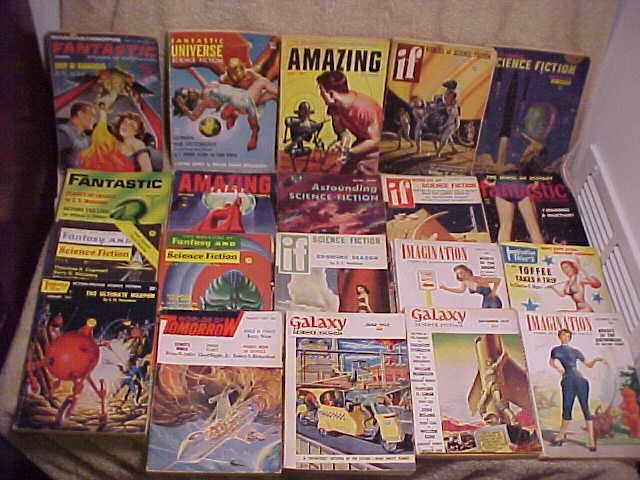
I bought a box of 1950s SF and fantasy digests in an online auction at the end of July, an assortment of chiefly lesser-known magazines such as Imagination, Worlds of Tomorrow, Fantastic Universe, and Imaginative Tales. The box has been sitting in my library for three weeks while I puttered around it, like an unopened Christmas present. I finally unpacked it this morning. Just as I’d hoped, it was filled with wonders.
Holding these the day after the death of Neil Armstrong gives me the powerful sense of the passage of history. Every one of these magazines was published before Armstrong walked on the moon — in most cases at least a decade before. The era of space exploration, with all its incredible promise and danger, was firmly in mankind’s future. Looking at them now, as the first era of space exploration draws to a close with the death of its most famous hero at age 82, I feel like I’m looking back through not one but two eras, to a time when landing on the moon was something that many still scoffed at. When the future was a place where robots carried guns, aliens were green-skinned and wore khakis, and housewives walked alien dogs who didn’t know what to do with a fire hydrant.
Even setting aside all the musings on history, there’s still a lot of wonder packed into these yellowing pages. Marvelous artwork, and even more marvelous stories, from some of the brightest lights in the genre. This box of 20 magazines, which I purchased for 48 bucks, is a splendid sampling of some of the best work of the decade.

 This post is part of an ongoing series about fantasy and the literary movement called Romanticism; specifically, English Romanticism in the late eighteenth and early nineteenth centuries. The series began with
  You know the prologue. Contracting an illness (possibly scarlet fever or meningitis) at the age of nineteen months, Helen Adams Keller survived, but was left both deaf and blind. Keller’s parents would eventually contact Anne Sullivan, herself blind, to tutor their daughter (who, at the age of six, still had not grasped the concept of words representing things). By pressing her hand into the girl’s palm, Sullivan was able to teach the girl to read sign language through touch. After that breakthrough, Helen Keller went on to write twelve books, meet thirteen U.S. Presidents, help found the American Civil Liberties Union, and introduce the Akita breed of dog to the United States.