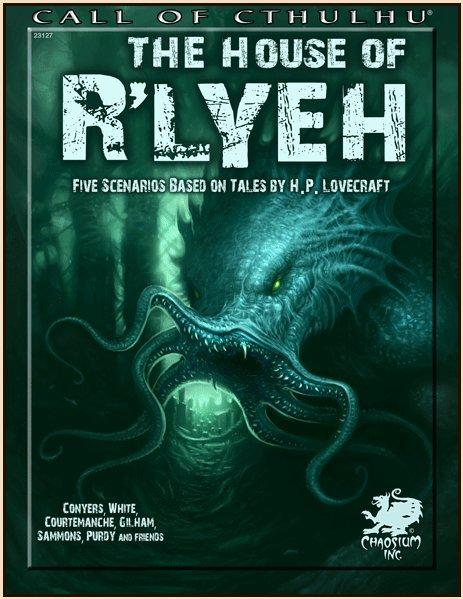
New Treasures: The House of R’lyeh: Five Scenarios Based on Tales by H.P. Lovecraft
 I feel like I’m in the middle of H.P. Lovecraft week.
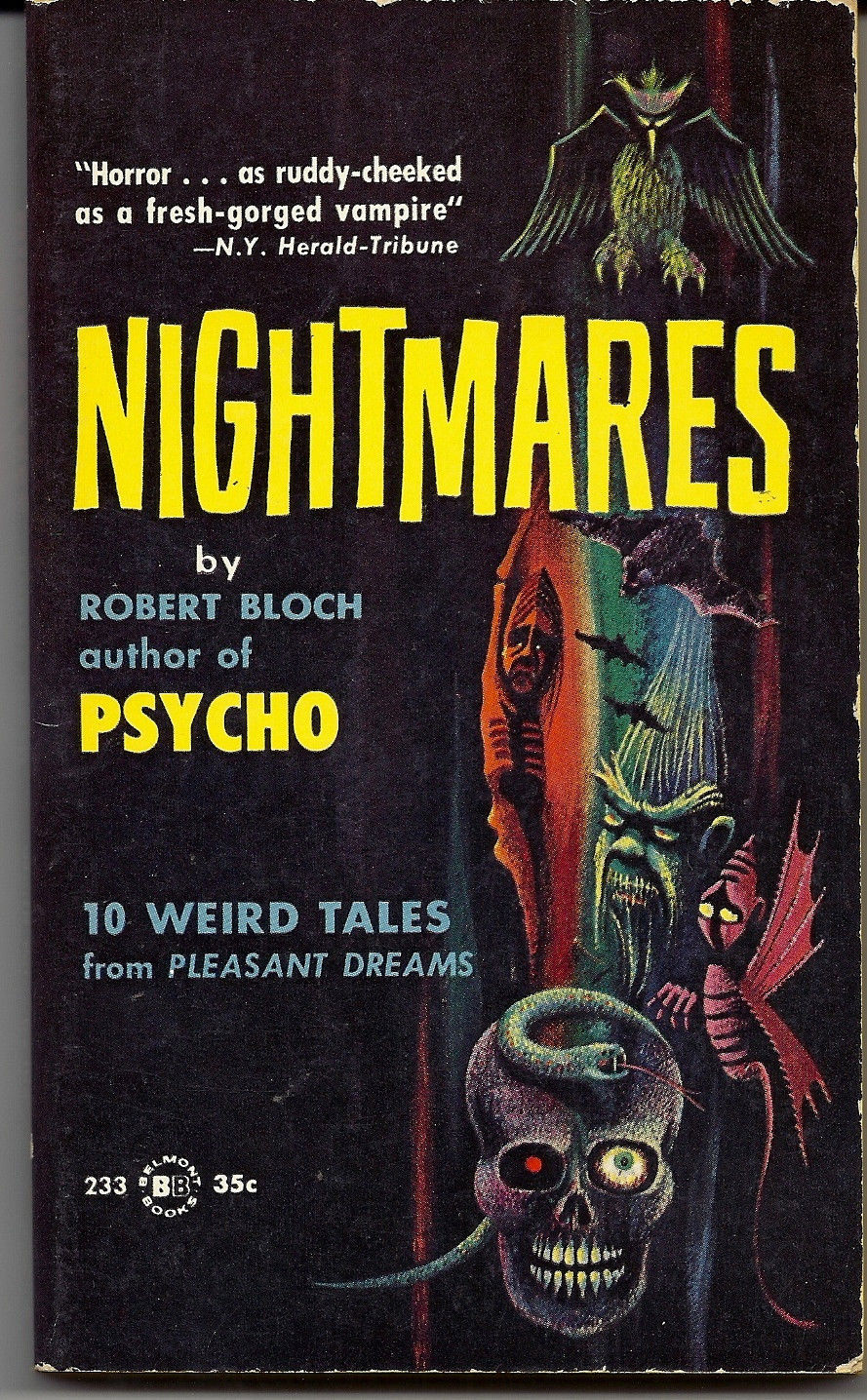
On Sunday I talked extensively about Lovecraft, a propos of his inclusion in the latest round of Advanced Readings in D&D. This morning I invoked his name while discussing Robert Bloch’s Nightmares collection. Now here we are again, with the latest collection on adventures for one of my favorite role-playing games, Call of Cthulhu, based on the work of H.P. Lovecraft.
I bought my first CoC adventure — the classic Shadows of Yog-Sothoth — over 30 years ago (yes, I’m aware that’s longer than most of you have been alive. Shut up), and the most recent, Cthulhu By Gaslight, last April. I haven’t played CoC in years (decades, probably), but the adventures are marvelously inventive and always a pleasure to read for a veteran game master like me. But The House of R’lyeh has extra appeal for Lovecraft fans of all kinds, not just CoC players, I think: it draws directly from five of the Master’s short stories. I’m looking forward to digging in and seeing how successful it is.
The House of R’lyeh contains five Call of Cthulhu scenarios that follow or expand upon events in five of H.P. Lovecraft’s stories: “Pickman’s Model,” “The Haunter of the Dark,” “The Hound,” “Arthur Jermyn,” and “The Nameless City.” Set in Boston, Providence, the British Isles, continental Europe, and the Middle East, none of the scenarios need be played at set dates or in a set order, but they could be run in the order presented to form a loose campaign using optional link between scenarios to draw investigators from one to the other.
Alternatively, the scenarios may be used to supplement classic Call of Cthulhu campaigns such as The Shadows of Yog-Sothoth which suggests that its component scenarios should be interspersed with others.
 There’s a certain kind of structure I’ve lately begun to notice in certain novels. These books read like puzzles, telling one story directly and overtly while implying a second story, or highly variant reading of the first story, through carefully-placed gaps, contradictions, and seemingly-irrelevant details. Throwaway references in highly-disparate points of the book might imply a completely different way to read at least the plot and often the tone or theme. It’s something Gene Wolfe does a lot; other examples I’ve noticed lately are
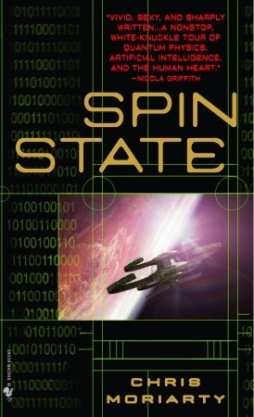 My reading’s defined, largely, by sheer chance. I stumble across something at a used-book sale, buy it along with a box of other books, put it on my shelf and forget about it, then finally years later take it down and read it and, often, realise I should have started in on it long before. Which is a long way around to explaining how I just now came to read Chris Moriarty’s debut novel Spin State, which was published in 2003. And why I’m only now writing about the best work of 21st-century science fiction I personally have read.