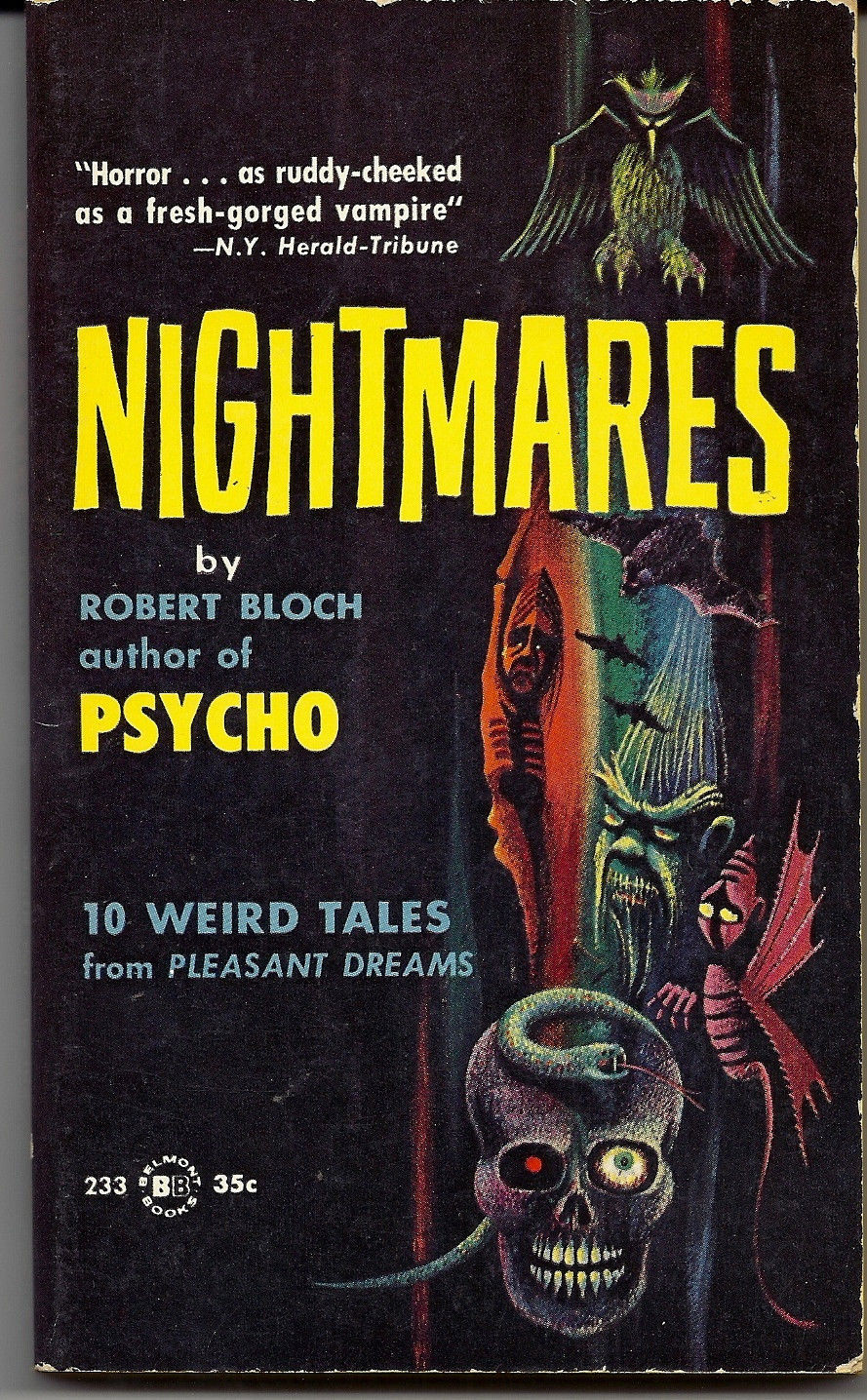
Vintage Treasures: Nightmares by Robert Bloch
 I’ve been on something of a Robert Bloch kick recently.
It started with the Vintage Treasures article on The Best of Robert Bloch I wrote back in July, the second in my series on Lester Del Rey’s Classics of Science Fiction. That lead me to his Lovecraftian novel Strange Eons, first published in 1979, which I wrote about in October.
Strange Eons was fun, but honestly I think I prefer Bloch’s short stories. And he certainly has a lot of them, gathered in dozens of collections starting with The Opener of the Way, published in 1945 by Arkham House when he was just 28 years old, and ending the year he died with his final collection The Early Fears (1994, Fedogan & Bremer) — which won the Bram Stoker Award for Superior Achievement in a Fiction Collection.
As usual, I tend to gravitate towards the paperbacks. Last week I bought a copy of Nightmares, a slender 1961 paperback from Belmont which contains 10 short stories originally published in Weird Tales, Fantastic, The Magazine of Fantasy and Science Fiction, and other fine publications.
Nightmare is a selection of tales from Pleasant Dreams — Nightmares (1960), an Arkham House hardcover which contained 16 short stories and novelettes (and cost, according to a note on the copyright page, an outrageous $4). The paperback is dedicated to August Derleth, Fritz Lieber (sic), and Star Trek writer Samuel A. Peeples, author of “”Where No Man Has Gone Before” (one of my favorite episodes, incidentally, although doubtless he’s listed here for his horror work).
And yes, Fritz’s Leiber’s name was misspelled. Clearly the paperback editions were not edited as tightly as they could have been, or Fritz Leiber wasn’t yet a big name. Probably both.
 There’s a certain kind of structure I’ve lately begun to notice in certain novels. These books read like puzzles, telling one story directly and overtly while implying a second story, or highly variant reading of the first story, through carefully-placed gaps, contradictions, and seemingly-irrelevant details. Throwaway references in highly-disparate points of the book might imply a completely different way to read at least the plot and often the tone or theme. It’s something Gene Wolfe does a lot; other examples I’ve noticed lately are
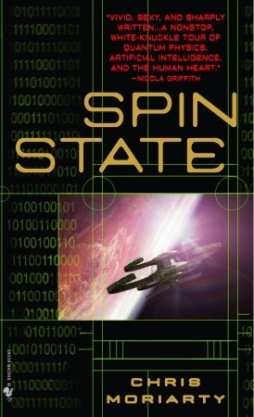 My reading’s defined, largely, by sheer chance. I stumble across something at a used-book sale, buy it along with a box of other books, put it on my shelf and forget about it, then finally years later take it down and read it and, often, realise I should have started in on it long before. Which is a long way around to explaining how I just now came to read Chris Moriarty’s debut novel Spin State, which was published in 2003. And why I’m only now writing about the best work of 21st-century science fiction I personally have read.