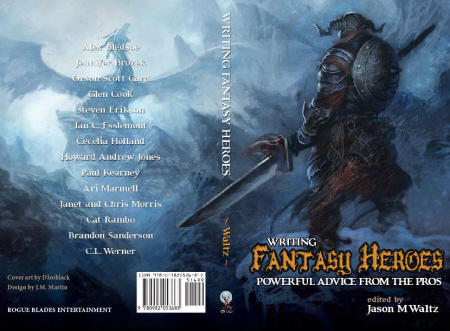
I’m a few essays into Writing Fantasy Heroes: Powerful Advice from the Pros. The editor of Writing Fantasy Heroes, Jason M. Waltz, was being published in the pages of Black Gateback when Black Gatehad literal paper pages and I was just a glimmer in the slushpile. The book has been mentioned on this site a time or three by others, and will certainly come up again, so I wanted to get a look at it for myself. It turns out there’s enough variation among the essays to keep me busy for more than one post, too.
So far, what’s most striking to me is how different the authors’ imagined readers are. The imagined readers all want to write heroic fantasy, of course, but how long have they been writing? How plugged in are they to the traditions and cliches of writing workshops and fiction manuals? How much life experience have these imagined readers gathered? One of the things I’m enjoying about Writing Fantasy Heroes is coming unstuck in time, relative to the writerly life cycle. From the essay I would have needed when I was in my teens, I turn the page to find the essay I need right now, which is followed by the essay I could hand my students next week.
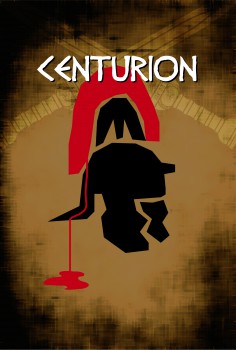
Sword’s Edge Publishing’s great Kickstarter experiment – Centurion: Legionaries of Rome – has completed. I’m still waiting for the final tally on actual money raised (I’ll get to the discrepancy between promises and cold hard cash later), and while I count it a success, only slightly so. That’s not Kickstarter’s fault. Totally mine.
The biggest problem I faced was one of planning. I did a fair amount of it, and my Kickstarter page was ready to launch eight days before my deadline. I verified Amazon payments two weeks before the campaign was to launch, and then could get the approval from Kickstarter more than a week before my drop-dead date. That was due to planning and the fear of delays pushing my launch date back.
If you’re out there building interest in your campaign, you’re likely giving people a date when they can expect the Kickstarter to – sorry for this – kick off (heh heh). Now, one way of avoiding screwing yourself with delays is not to have a hard launch date. I could have said something like “first week in March” or “early in March,” and that could have given me a good buffer of time. I mean, if people were excited, they would likely have seen the multiple messages I sent through comms in the month of the campaign.
Here’s the thing: I needed to do a lot more publicity than I did. I hit all the social media I regularly used – and even went to Facebook, which I really only use to share photos with friends, so really don’t have a business presence there – and did a few podcasts. Not enough.
A mystery writer friend of mine once remarked that he didn’t care for crime novels that included either cats or recipes – unless they were recipes on how to cook cats. My friend was kidding (mostly), but I’m sure plenty would agree with his sentiments. Not everyone is fascinated by food or cooking, and that can affect readers’ reactions when they encounter these things in the books they’re reading.
But like it or not, there’s a purpose being served by every mouthful of food and every drop of drink in every book or story we read – or write.
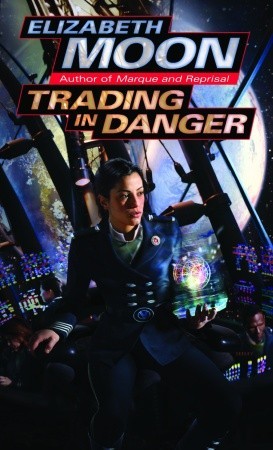
No matter the genre, food and drink can certainly provide motivation in terms of characters’ taking action to acquire some. Every book that has a trading empire at its core (think Elizabeth Moon’s Ky Vatta books, or Robin Hobb’s The Liveship Traders) deals at least in part with the availability of foods, especially spices.
As a general rule, however, food and drink don’t drive the plot. Even in the mystery novels, the recipes aren’t usually directly involved in either the crime or the solution – though the same can’t be said for the cats.
It’s tempting to come up with some cheap shot punchline about how tax returns are a subgenre of fantasy literature. I’d poke at the puzzle longer, but I believe in the rule of law, so my tax returns are a good-faith attempt at nonfiction. There are times when I wish I hadn’t been drawn up as a Lawful Good character — goodness knows I tried at least to be Chaotic, but I could never keep it up for long.

One of my favorite quirks of private practice as a tutor is the unlikely list of expenses that truly are for work. Yes, some of these books are things I would have read anyway, but not necessarily things I would have bought anyway. I once spent three months rereading and rereading every short story in Garth Nix’s Across the Wall collection, because my students couldn’t get enough of his Old Kingdom, and I had to be a few levels deeper into the book than my students were, no matter what they did with it.
When I returned from GenCon last year, I mentioned just how excellent the Writer’s Symposium was. I’d heard about the Writer’s Symposium, but had never attended. I found it extremely well organized, well-run, and, most importantly, it seemed a fine way for those interested in writing and publishing to pick up tips from the pros.
Here’s the official press release, freshly published last week. On that alphabetical list of names, you’ll see a lot that probably look pretty familiar, especially if you’ve frequented the Black Gate web site:
What’s the difference between a catfish and a lawyer? One’s an ugly, scum-sucking bottom feeder, and the other is a fish.
An old joke, but a good one. As a joke, it works because of the shock, the unexpected conclusion. As an insult, it works because of a little concept called hierarchy.
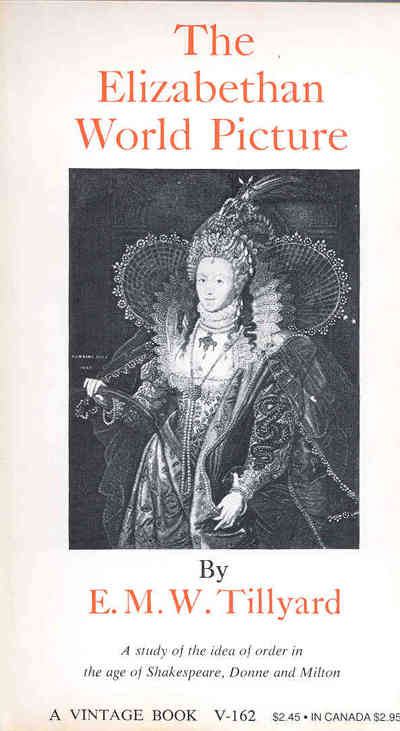
Anyone who’s ever studied Shakespeare has read a book called The Elizabethan World Picture. It’s a great book, and essentially describes how people thought about the world back in Shakespeare’s day. I’d highly recommend reading it for yourself, but if I can sum it up quickly for you, it goes like this: up = good, down = bad.
What does that mean? Think it through: everything that’s high in the sky, you know, where the gods live, is good, and the higher the better. So, heaven, the sun, light itself, and so on. Everything that’s lower down is bad, and the lower it is, the worse it is. So, dirt, darkness, etc. Everything, including people, has a place on this scale. There’s a reason it’s the white knight who charges to the rescue, and that Goths dress in black. (I dress in black myself, so no mail please). Even people who’ve never watched a western know what it means to be a white hat.
This hierarchy permeates everything we do and think, everything we write and create – at least here in the western world. And very often without our being aware of it.
Hierarchy is the reason the Greek gods live on Olympus (highest mountain in Greece) and it’s the reason that Zeus (god of sky, thunder, etc.) is the ruler of said gods, and not Poseidon or Hades. It’s why kings had a divine right to rule, (they’re on top of the human hierarchy), and it’s why cleanliness is next to godliness – that is, it’s how we know cleanliness is a good thing.
The first Kickstarter success, and it was a true joy!
In early November 2011, I attended World Fantasy Con in San Diego with John O’Neill and the Black Gate crew. It was a truly eye-opening experience for the ‘writer me’ as I’d attended many conventions in my day, but nothing that was so cloistered and dedicated specifically to the art of writing.
I well remember sitting in my room after the first day of listening to readings and thinking to myself, ‘Holy Crap, you absolutely C-A-N’-T do this!’ [Seriously, just listen to Claire Cooney recite any of her works from memory and tremble beneath the power of a truly gifted writer].
After I got home from the convention, I crawled into bed for three days and didn’t come out again because for the first time in my life I felt the power of ‘real’ writers and how far I had to go to reach the level of their talent.
When I finally emerged from my cocoon of despair, I clicked on Facebook and found a post from old time D&D artist Jeff Dee concerning something he called Kickstarter. It was a curious thing, this Kickstarter platform, and the more I researched it, the more I thought, ‘Huh, maybe I’m not Claire Cooney, but I bet I can get a book made anyway.’
At the same time, John O’Neill, our fearless leader at Black Gate, was thinking of creating his own line of novels from Black Gate under the power of the current business model he’d used to help found the magazine, namely his own pocket venture capital. I asked him to try Kickstarter and he declined, so I bet him, in no uncertain terms, that no matter what he managed to do with his book line at Black Gate, that using Kickstarter I would outsell him by a multiple of 10 and produce twice as many original books as he could.
Thus began 2012, something I like to call ‘The Year of Kickstarter’. Not only had I discovered this platform, now three years old in the marketplace and ready to tip the balance of acceptability, but so had EVERYONE else.
By February of 2012, Kickstarter money contribution records were falling almost weekly in every category imaginable, especially in computer games. Funding was surging to unforeseen levels with millions of dollars going to video games, art books, albums, miniatures, you name it.
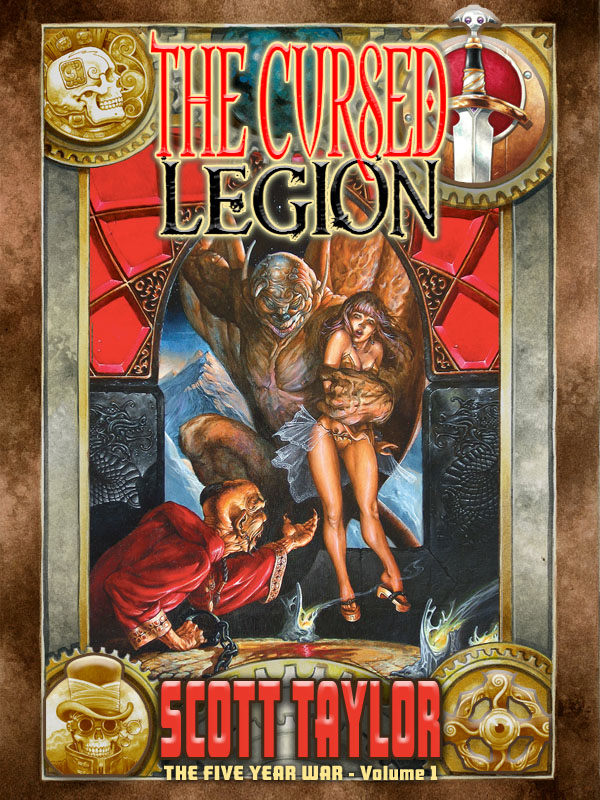
I watched, I studied, and I saw the evolution taking place right before my eyes, but in so doing I also caught the wave and road with it on my new publishing company I’d affectionately named Art of the Genre after this blog. By February, I’d managed my first successful Kickstarter, The Cursed Legion novel, with former AD&D art legend Jeff Easley.
Swearing. Profanity. “Cussing” (as opposed to “cursing” which is entirely different).
We’ve all been told at one time or another (usually by people we’re swearing at) that using profanity is a sign of a weak vocabulary. It’s lazy, they’ll say. It’s easier to tell someone what he can do with himself than to really go to town on him, Shakespeare-style.
But that phrase “go to town on someone” makes me think of another aspect of language. Whether we call it “slang”, or “figures of speech”, or just “common expressions”, we all use these devices every day, often without being aware of them – or of where they come from.
Though there are all kinds of sources in the real world to help us with that last one.
But what about our Fantasy and SF worlds? We’d certainly better be aware of expressions when we’re writing, hadn’t we? Just think of the extent to which verbal expressions depend on existing technology.
Sword Noir worked out because I knew everyone with whom I worked. I knew my friends wouldn’t let me down. Unfortunately, Ed Northcott, who did the art for Sword Noir (and was an industry professional long before working on my game) had quit as a freelance artist. A friend’s wife introduced me to an artist of her acquaintance who wanted to get into the RPG industry. I saw his portfolio and we made a deal. He would have accepted much less, but I wanted to pay the standard referenced by Steve Jackson Games – trying to be a professional over here.
I gave the artist three specific scenes I wanted to see and left the fourth to his imagination, suggesting anything inspired by the movie The 13th Warrior or the comic series Northlanders. I sent along links to pics on the Internet which could provide inspiration and references.
As I write this, April is just around the corner, and now that Hollywood’s best and brightest studios no longer know how to calculate the beginning of summer, I smell blockbuster season ripening fast on the vine. Just think, in mere weeks, we can all flock to see Star Trek: Into Darkness, Iron Man 3, Wolverine, Oblivion, Pacific Rim, Elysium, and Man of Steel.
What do nearly all of these movies have in common? I’ll tell you, spoiler-free: the fate of the world will hang in the balance.
Which is why I shall be staying home –– again –– for blockbuster season. If I have learned anything in all my forays into drama, it is this: cinema offers no more boring subject, no greater snoozefest, than global peril.