Browsed by
Category: Magazines

Amazing Stories, December 1964: A Retro-Review

Amazing Stories, December 1964: A Retro-Review

Amazing Stories December 1964-smallThe cover to this issue is by Robert Adragna. Interiors are by Adragna and George Schelling. The editorial concerns Sam Moskowitz’ series of Profiles of SF writers, and signals a change to essays by Moskowitz addressing SF’s treatment of certain themes, beginning in this issue with a discussion of Philip Jose Farmer and — you guessed it! — sex and SF.

The article — a fairly long one — begins with a review of some of the SF stories that occasioned controversy by brushing up against sexual issues, and continues with a detailed look at Farmer’s career to date (1964), including of course the controversy surrounding “The Lovers,” but also mentioning I Owe For the Flesh, the first version of To Your Scattered Bodies Go, which had been written for a contest in the early ’50s, and won, and was lost (I understand) after the contest sponsor (Shasta) ran out of money. On the whole, it’s an interesting and worthwhile piece, one of the better things I’ve seen from Moskowitz.

Robert Silverberg’s book review column covers Alfred Bester’s collection The Dark Side of the Earth, Fritz Leiber’s novel The Wanderer, and The Astounding Science Fiction Anthology, edited by John W. Campbell, Jr. Silverberg approves of all three books, and reserves especial praise for The Wanderer — a book which, I would suggest, has not retained much of a reputation (I myself have not got through it on two tries, though it has been a long time, and I suppose I should give it another chance.)

The stories are:

Short Novel

“The Further Sky,” by Keith Laumer (20,000 words)
…

Read More Read More

September/October Magazine of Fantasy & Science Fiction Now on Sale

September/October Magazine of Fantasy & Science Fiction Now on Sale

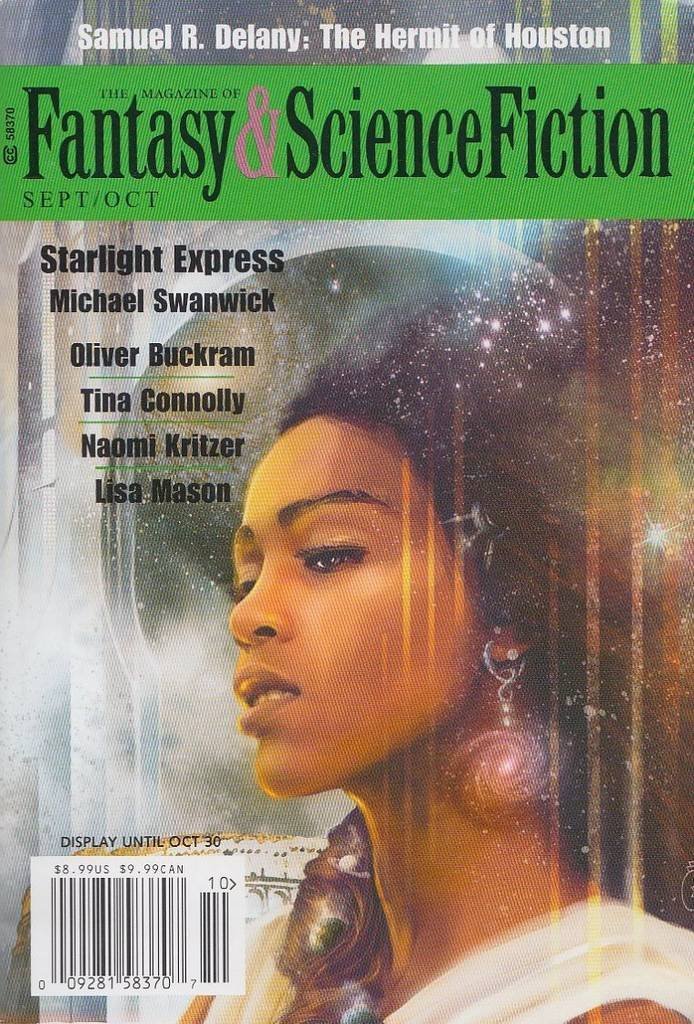
The Magazine of Fantasy & Science Fiction September October 2017-smallThe September/October F&SF is the 68th Anniversary issue, and it contains some nice special atractions, including fiction by Robert Reed, Michael Swanwick, Tina Connolly — and, most surprising of all, a brand new novelette by the brilliant Samuel R. Delany, who hasn’t appeared in F&SF in 40 years. Here’s a snippet from Charles Finlay’s intro.

Throughout his career, Delany’s work has pushed the boundaries of sf to address more adult situations and issues, particularly at the intersections and language and memory, sexuality and society. He returns to these themes again in his first new science fiction story in a decade… this new story would get an NC-17 rating at the movies and is not appropriate for younger readers.

It’s tough to compete with the return of a Grand Master, but Michael Swanwick manages it with his cover story, “Starlight Express.” Here’s Jason McGregor’s review at Tangent Online.

Via Flaminio’s eyes we learn about Roma in the far, far future and the woman who seemed, not to go to the carrier beam of the transmission station relic as suicidal people often do, but to come from the carrier beam where, as far as most people know, people haven’t come from for millennia. How her universe has changed, and how she changes his, makes the bulk of the tale.

I could understand seeing this as a dull and underplotted story if the poetry of it all doesn’t speak to you but, if it does, it’s a really remarkable story (if more bitter than sweet) which strongly evokes deep time and vast space and an enduring humanity… beautiful. Recommended.

Read Jason’s complete review here.

I note that the cover price has increased a buck this issue, to $8.99 — still a bargain, if you ask me. Here’s the complete Table of Contents.

…

Read More Read More

Companion Robots, Grave Robbing, and Monster-haunted Catacombs: July/August 2017 Magazine of Fantasy and Science Fiction

Companion Robots, Grave Robbing, and Monster-haunted Catacombs: July/August 2017 Magazine of Fantasy and Science Fiction

Magazine of Fantasy and Science Fiction July August 2017-smallCover art by Nicholas Grunas, based off “There was a Crooked Man, He flipped a Crooked House.”

“In a Wide Sky, Hidden” by William Ledbetter. This story gets the issue off to a strong start. MC and his companion robot are crossing the depths of space to unknown worlds looking for the MC’s sister. Not an easy task since humanity has never found a way to beat the light-speed barrier, so people have to have their body destroyed in one place and then sent to a quantum-linked box in another to be rebuilt. The MC had wanted to be an explorer, his sister had wanted to be an artist. He gave up on his dreams because robots do that work now, but she succeeded in hers, at least until she disappeared into one of the hundreds of uninhabited worlds out there and challenged him to find her. I liked this story quite a bit: short and with a great deal of depth and heart. And I don’t just say that because Ledbetter is an editor at Heroic Fantasy Quarterly either! Nor do I say it because he scored a Nebula last year!

“The Masochists Assistant” by Auston Habershaw. Young wanna-be fop Georges is a famulus to the mage Hugarth Madswom. A famulus is not quite an apprentice, and not quite a servant, more of an intern/helper. Magus Hugarth’s particular area of magical expertise is that of killing himself and then resurrecting himself — which makes him a bit of an odd-man out in the etiquette-heavy world they live in. This is one of those stories that manages to successfully navigate the grisly with the funny and make Georges’ struggles to better his station in life actually mean something.

“The Bride in Sea-Green Velvet” by Robin Furth. Grave-robbing, necromancy, and masturbation make for a powerful combination in this story. It is all a bit much, but like “Masochists Assistant” it is quite well written and moves quite fast. The story suffers, I think, from having a cast of not-likable characters; at the end one can see why, but the larger point of the story would, I think, have made a stronger impact if there had been some redeemable person in the cast.

Column — Books to Look For, by Charles De Lint. De Lint dishes de dirt on books, going into enough detail without giving anything away. Books reviewed: Tillie Madison Vs. Reality (P.L. Winn), In Times Like These, The Chronothon, and The Day After Never (Nathan Van Coops), Goblin Market (Chrstina Rossetti and Omar Rayyan), Silence Fallen (Patricia Briggs), Gods & Goddesses: the Fantasy Illustration Library Volume Two (edited by Malcolm and Michael Phifer), Creaking Staircases: Gothic Tales of Supernatural Suspense (James Coplin).

…

Read More Read More

September/October 2017 Asimov’s Science Fiction Now on Sale

September/October 2017 Asimov’s Science Fiction Now on Sale

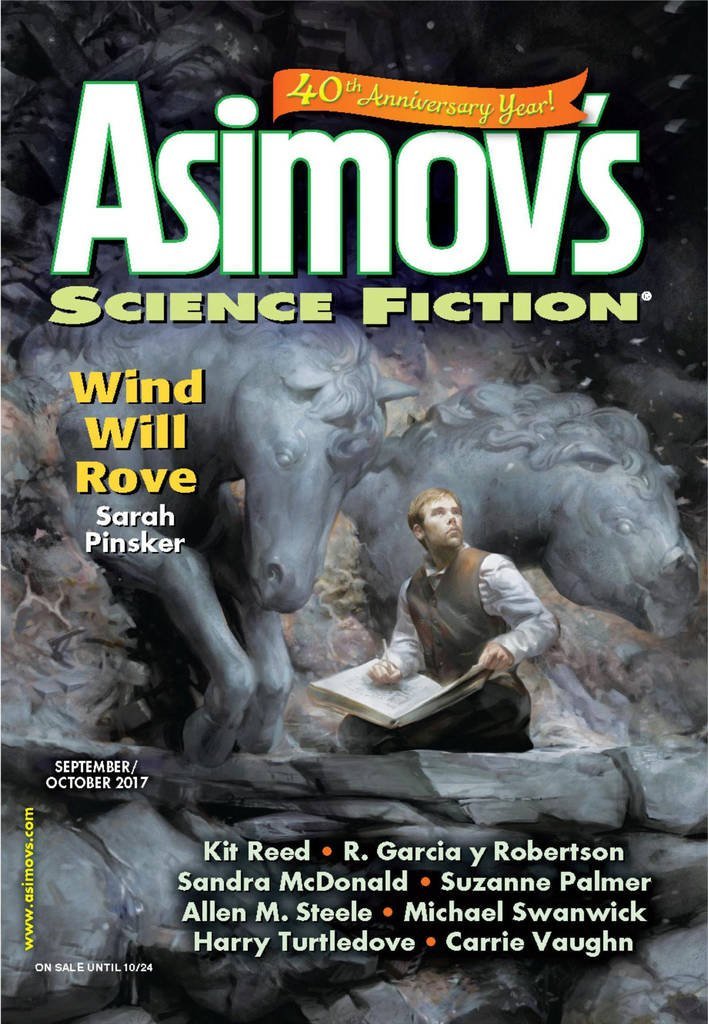
Asimov's Science Fiction September October 2017-smallSaturday I visited my local Barnes & Noble here in St. Charles, which has an excellent magazine rack, and spent too much money on a big stack of magazines: Retro Gamer, Rue Morgue Library #11: The Weird World of HP Lovecraft, Analog, F&SF, and Asimov’s Science Fiction. The first one I sat down with Asimov’s, and that’s chiefly because of Sam Tomaino enthusiastic review of the issue at SF Revu.

The September/October 2017 issue of Asimov’s Science Fiction has a lot of very good stories including one Hugo-worthy. The fiction begins with the novelette “Wind Will Rove” by Sarah Pinsker. -+- Rosie Clay is of the third generation on a generational ship, her grandmother was one of the originals who started on the voyage. Rosie Clay is in her 50s, teaches history, and regularly plays her grandmother’s old fiddle with other traditionalists. One important song is from 1974, called “Wind Will Rise.” One of her students does not want to learn history and wants the past ignored. How can she best deal with this rebellion? A beautiful, poignant tale.

“Universe Box” by Michael Swanwick -+- Another story this month, from one of the best. Howard Pendleton is going to ask his girlfriend, Mimi, to marry him on Valentine’s Day in the most boring, conventional way possible. Mimi anticipates this and is going to dump him. But someone calling himself “Uncle Paulie” arrives at Howard’s door and turns his life inside out. He is a traveler from the stars and has pulled off a tremendous heist. This all starts a wild romp of a story which was loads of fun to read. Swanwick is a devotee of that most original writer R.A. Lafferty and R.A.L. would have got a kick out of this story! This will be on my Hugo Shortlist for Best Novelette next year!

“Dead Men in Central City” by Carrie Vaughan -+- Ricardo must shoot his horse when it breaks two legs and he winds up in the nearby boom mining town of Central City, Colorado. In a bar there, he meets a man who coughs a lot and is dealing faro — one Doctor John Holliday. Ricardo gets a room that shields him from the sun because he is actually a 350-year-old vampire but he only takes as much blood as he needs. Holliday knows what he is but they wind up with some mutual respect for each other. Great little tale!…

September/October, traditionally the “slightly spooky issue” of Asimov’s, contains tales of ghosts, vampires, mysterious spirits, spooky carnivals, and more. It includes fiction by Harry Turtledove, Allen M. Steele, Kit Reed, R. Garcia y Robertson, Sandra McDonald, Suzanne Palmer, Tim McDaniel, William Preston, Dennis E. Staples, and — just like last issue — two tales by James Gunn set in the world of his Transcendental Trilogy.

…

Read More Read More

The August Fantasy Magazine Rack

The August Fantasy Magazine Rack

Apex Magazine August 2017-rack Clarkesworld 131-rack Lightspeed Magazine August 2017-rack Nightmare Magazine August 2017-rack
Locus Magazine August 2017-rack The Dark Magazine August 2017-rack Uncanny Magazine July August 2017-rack Weirdbook 36-rack

Lots of great reading in August’s fiction magazines. In addition to those we’ve covered here during the month — including Analog, Black Static, F&SF, Graphic Classics, Heroic Fantasy Quarterly 33, and Interzone — there’s plenty more on the shelves to keep you busy in those idle hours, including all those above. Click on any of the thumbnail images to visit their respective websites.

Our additional magazine coverage in the past few weeks includes Steve Case’s interview with Scott H. Andrews, editor of Beneath Ceaseless Skies, Fletcher Vredenburgh’s August Short Story Roundup, and Apex Magazine‘s report on the Best Short Fiction Reviews. For our vintage magazine fans, we have Retro-Reviews of the November 1953 issue of Galaxy Science Fiction (by Matthew Wuertz), the November 1969 Galaxy (by Adrian Simmons), and the July 1964 Amazing Stories (Rich Horton).

Our July Fantasy Magazine Rack is here.

…

Read More Read More

Galaxy Science Fiction November 1969: A Retro-Review

Galaxy Science Fiction November 1969: A Retro-Review

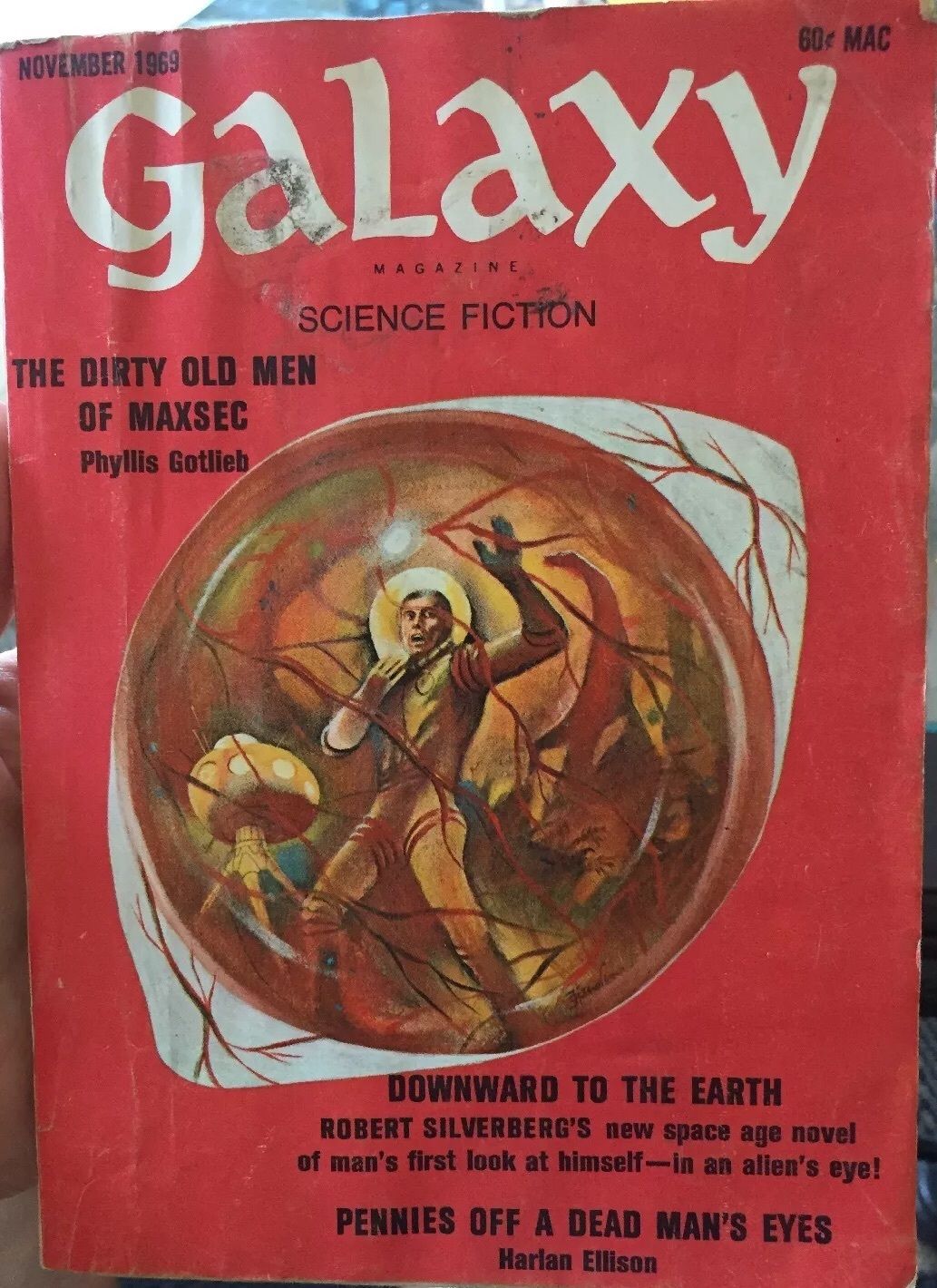
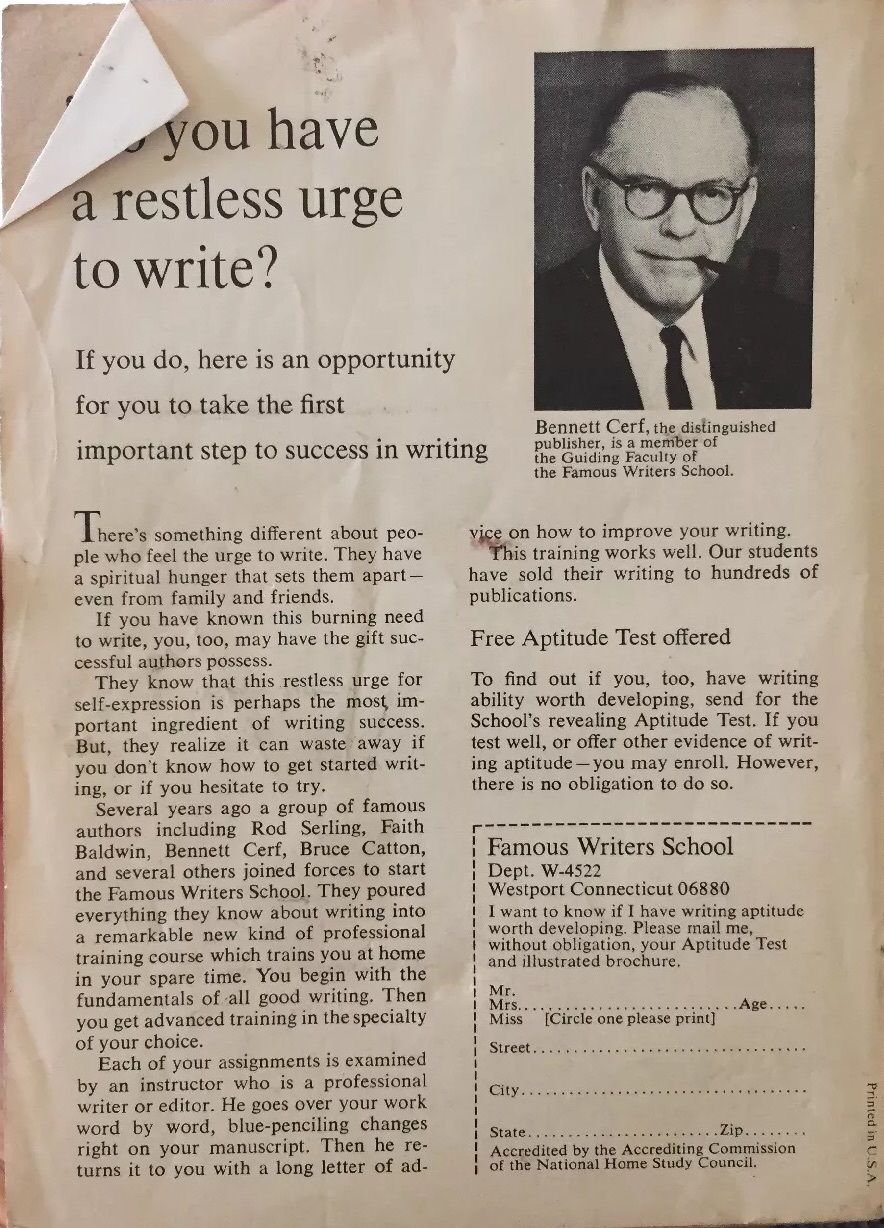
Galaxy Science Fiction November 1969-small Galaxy Science Fiction November 1969 back cover-small

This is Part 2 of a Decadal Review of vintage science fiction magazines published in November 1969. The articles are:

Amazing Stories, November 1969
Galaxy Science Fiction, November 1969
The Magazine of Fantasy & Science Fiction, November 1969
Worlds of If, November 1969
Analog Science Fiction/Science Fact, November 1969

Cover by Gaughan, the TOC notes that it was “Suggested from Downward to the Earth.”

Editorial, “Brain Pollution” by Ejler Jakobsson. This delves straight into race issues, in a kind of winking/new-wavy way. There was, it would seem, an article or articles on IQ tests between blacks and whites making waves, with Jakobssen quoting an editorial by John W. Campbell.

If they, (the blacks) basic intelligence pattern is of a different type — naturally it’s harder for them to fit into the Scholarly type that Caucasoids developed — with unquestionable and world-shaking success — so that although they’ve been working into Western culture for as long as time as the Scots, they haven’t been able to fit in anywhere near as well.

Jackobsson doesn’t agree, or at least I don’t think he does. His weird addled-fanboy style makes it hard to tell if he disagrees with the fundamental IQ test issue, or just the way J.W.C. stated it. The former… I think.

…

Read More Read More

The Opportunity for Awe: An Interview with Scott Andrews

The Opportunity for Awe: An Interview with Scott Andrews

Scott H Andrews Beneath Ceaseless Skies-smallBeneath Ceaseless Skies is a five-time Hugo and seven-time World Fantasy Award-finalist online magazine of literary adventure fantasy. In nine years, BCS has published over 475 stories and 200 audio podcasts by authors such as Saladin Ahmed, Richard Parks, Marie Brennan, Yoon Ha Lee, Aliette de Bodard, Bradley P. Beaulieu, Seth Dickinson, and more.  Find their ebooks and Best of BCS anthologies on Amazon and WeightlessBooks.com, their podcasts on Google Play and iTunes, and stories, artwork, new issues, and more at beneath-ceaseless-skies.com.

For nearly a decade now, BCS has been showcasing the work of both new and established writers in the realms of fantasy with a literary bent. My first professional sale was to BCS, and the magazine has published several of my stories since then, including my most recent, “Deathspeaker,” in the August 3rd issue. Recently I approached BCS editor Scott Andrews with some questions about “literary adventure fantasy” and its appeal to readers of sword & sorcery.

Beneath Ceaseless Skies publishes “literary adventure fantasy.” It’s pretty clear what those first two words mean separately, but can you explain the juxtaposition? What does adventure fantasy lack when it’s not literary (or gain when it is)? What does literary fantasy miss when it lacks adventure?

“Literary adventure fantasy” is my tagline for literary fantasy set in other worlds. The literary element that’s for me the most enjoyable and rewarding is a focus on character. A lot of secondary-world fantasy feels to me focused on the setting or the plot, but I like it on the characters, for example using narrative approaches like close points-of-view or conflicts that are internal in addition to external.

What adventure fantasy gains for me when it’s literary like that is the human highs and lows, the emotional exhilaration and gut-punch, that great literary fiction has. I love the line from Faulkner’s Nobel Prize speech that the only thing worth writing about is the human heart in conflict with itself. That may sound like highbrow English-class stuff, but there’s an author in SF/F/H today who I’ve heard reference that Faulkner quote:  George R. R. Martin. His fantasy is the most popular in the world, and he’s constantly praised for his characters and how realistic and emotive they feel. His work absolutely has those human highs and lows, those profound comments on what it feels like to be a parent or a sibling or a hero or a failure or a survivor. That’s character-centered focus I love to read.

…

Read More Read More

July/August Issue of Black Static Now Available

July/August Issue of Black Static Now Available

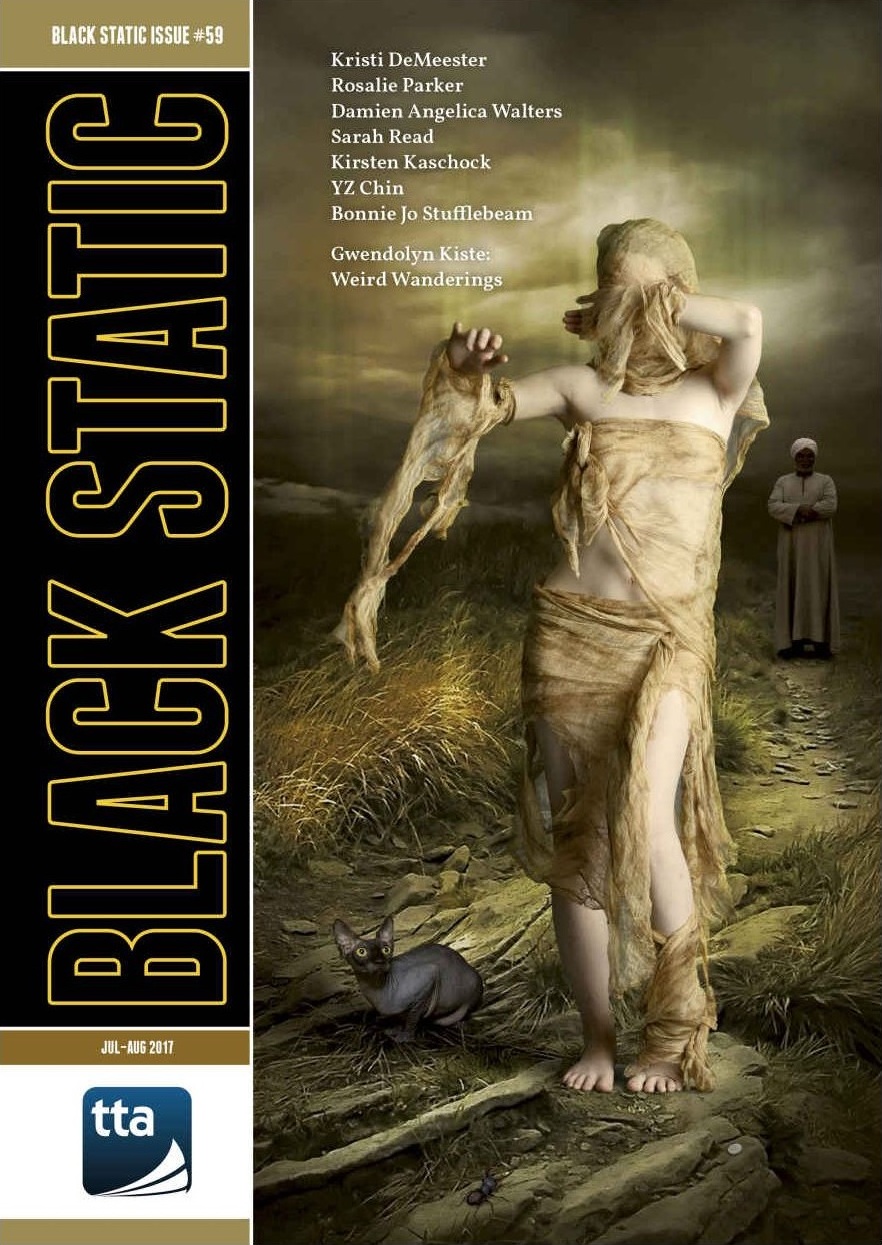
Black Static July August 2017-smallBritish horror magazine Black Static #59, cover-dated July/August 2017, is now available. Over at Tangent Online, Jennifer Burroughs offers a detailed review of the entire issue, including “Ghost Town” by Bonnie Jo Stufflebeam.

“Ghost Town” is a story of dark magic and gruesome secrets that explores the difficult question of what the living owe the dead… A river full of a strange substance flows around a small town haunted by thousands of ghosts, the economy fueled by a black market for human bodies. Three years ago, the body of Rae’s dead wife, Emily, was stolen, which has prevented Emily’s spirit from fully passing on. She haunts Rae every night…

Stufflebeam has imagined a strange place full of horrors caused both by the power of the river and simple human ingenuity. She raises an interesting question about what people would do in a reality where the dead need a corpse, any corpse, in order to leave the physical world, and there are more ghosts than corpses. This is an eerie tale that leaves the reader with several layers of meaning to contemplate.

And “Endoskeletal” by Sara Read

A well-executed, nightmarish tale of body horror. Ashley, an ambitious archaeologist, ignores rules of policy and respect for a strange discovery found in a Swedish mountain cave, where a strange burial has been hidden away for tens of thousands of years. She finds several jars inexplicably sealed after all this time, and takes one back to the lab, setting off a horrifying chain of events…

Not a story for the squeamish, “Endoskeletal” reads like a fevered nightmare full of warnings about foolish mistakes.

Read the complete review here.

…

Read More Read More

August Short Story Roundup

August Short Story Roundup

oie_225359V0Ky2mKfWith summer’s end in sight, I’m back with another short story roundup. For those paying attention, you probably noticed I’m calling this the August roundup instead of the July one. That’s because there’s so much stuff I have to pick and choose from (and more coming soon – see this post at Howard Andrew Jones’ site), I can’t always get to it in a timely manner. From now on, each roundup will focus on whatever new short stories I’ve managed to read since the previous one. It’s a minor thing, but there it is.

Heroic Fantasy Quarterly, produced under the expert guidance of Adrian Simmons and company, continues to be the fieriest star in the S&S heavens. #33 contains not only the usual three stories and three poems, but an announcement that HFQ’s second Best of collection has been fully funded and will appear this fall. I really dug the first one and have high hopes for this one. Also, they played a fun game in this issue that I won’t describe, but it’s clever and I applaud the editors for pulling it off.

The new issue kicks off with “Between Sea and Flame” by Evan Dicken. Set in an alternate universe where Tenochtitlan fell not to Cortes, but to a strange priesthood from the sea, it’s a sequel to “Mouth of the Jaguar.” Once again, Hummingbird, refugee warrior from the fallen Mexica Empire, finds herself at the center of chaos and death. This time around she is caught between two deadly and evil forces: the Sea People who serve the terrible god Dagon, and that of the even more malevolent Destroyer. Convinced by one of the Sea People’s generals, she joins them and their allies to storm the stronghold of the Destroyer’s great follower, Pedrarias. Her decision brings her to a land already being twisted by the Destroyer’s malign aura:

If Hummingbird had any doubts about the threat posed by the Destroyer, the mountain put them to rest. Ometepe’s animals had become strange, monstrous things, twisted as if by some terrible hand. Flocks of bat-winged hummingbirds flitted around the war party, darting in to stab at the warriors with beaks barbed like fishing harpoons. If they were not crushed quickly enough, they burrowed inside the body. Many Mankeme fell shrieking down the hill, digging at their own flesh with knives and axes.

Clawed hands reached down from the tangled foliage above to pluck the heads from passing warriors. Diriangen would’ve been among them had not Hernández dragged him back at the last moment. Hummingbird joined the Mankeme in flinging javelins into the trees. What fell resembled sloths, but grown large and bloated. Their arms were thin, boneless things, little more than ropes of muscle with claws sharp as knapped flint. A warrior buried her axe in one of the things, only to have the creature burst like an overripe fruit to disgorge a swarm of fleshy mosquitos.

This is a swell story, filled with well-paced and -choreographed action. Dicken effortlessly combines elements of real history with his fictional reality, and has created a darkly wonderful world of elder terrors and bold, strong-armed adventurers.

…

Read More Read More

Galaxy Science Fiction, November 1953: A Retro-Review

Galaxy Science Fiction, November 1953: A Retro-Review

Galaxy Science Fiction November 1953

The November, 1953 issue of Galaxy Science Fiction is one of the better ones, from my perspective. Aside from the continuation of The Caves of Steel by Asimov, Michael Shaara and Roger Dee contributed a pair of good tales.  (The cover art is by Ed Emshwiller.)

“Keep Your Shape” by Robert Sheckley – Pid and his crew arrive on Earth to prepare for a mass invasion. All previous teams failed in their missions for unknown reasons. The Grom (a race of shape-shifters), conquer new worlds as a course of survival. The dangers of Alterationism and Shapelessness are at the forefront of Pid’s mind, but he’s determined to succeed where all other teams failed.

Sheckley does a good job with the Grom, who aren’t very close to humans but still have motives and ideas that I can understand. It’s a fun read.

…

Read More Read More