Browsed by
Category: Books

Inspiration and Emulation, Tolkien and Gygax
Inspiration and Emulation, Tolkien and Gygax

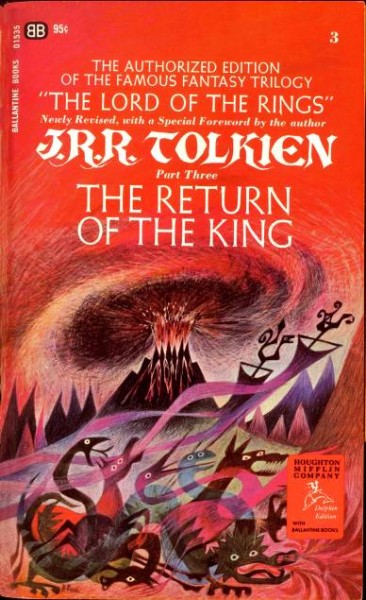
Ballantine The Return of the King-smallTo say that I have an abiding interest in the relationship between tabletop roleplaying games and the literary inspirations of their creators is something of an understatement.

Notice, though, that I said “inspirations” rather than another word that frequently gets bandied about when discussing the relationship between literature and RPGs – emulation. I can’t recall precisely when I first heard the term “emulation” used in the context of roleplaying games, but I’d be surprised if it were before the late 1980s. That’s about a decade after I entered the hobby, so my memory is admittedly fuzzy and I could well be mistaken. On the other hand, I heard the term “inspiration” a great deal, most notably in (you knew this was coming!) Gary Gygax’s 1979 Appendix N and the “Inspirational Source Material” found in the 1981 Tom Moldvay-edited edition of Dungeons & Dragons. Back in those days, game creators often talked about the books whose characters, plots, and ideas had fired their imaginations to such a degree that they decided to create a RPG that drew on them; they still do.

“Emulation” is something different. It’s one thing, I believe, to create a fantasy roleplaying game inspired by, say, Robert E. Howard’s stories of Conan the Cimmerian, but an entirely different thing to create a roleplaying game intended to emulate the adventures of Conan. Emulation implies a degree of fidelity to its literary sources (at least thematically), as well as some means – whether rules or advice – to ensure that experience of playing the game imitates that source material. An example of what I’m talking about that comes immediately to mind is Chaosium’s Call of Cthulhu RPG. While its rules do not explicitly talk about emulation, they do include game mechanics for the loss of sanity that results from encounters with blasphemous tomes and eldritch horrors. The creator of a game that’s merely inspired by some literary source is under no such obligations. After all, inspiration can take many forms, many of which do not include aping one’s sources of inspiration.

I mention all of this as a prologue to a large, more contentious discussion, namely the place of the works of J.R.R. Tolkien in the creation of Dungeons & Dragons.
…

Read More Read More

The Magic Goes Away by Larry Niven

The Magic Goes Away by Larry Niven

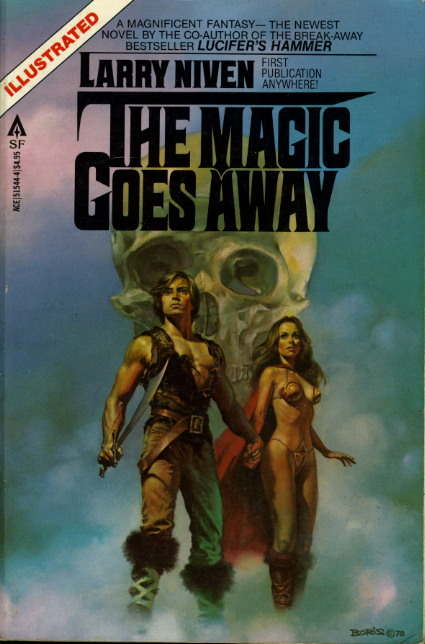
The Magic Goes Away-small

A swordsman battled a sorcerer once upon a time. In that age such battles were frequent. A natural antipathy exists between swordsmen and sorcerers, as between cats and small birds, or between rats and men. Usually the swordsman lost, and humanity’s average intelligence rose some trifling fraction. Sometimes the swordsman won, and again the species was improved; for a sorcerer who cannot kill one miserable swordsman is a poor excuse for a sorcerer.

So begins “Not Long Before the End” (1969), the first story in Larry Niven’s The Magic Goes Away series. His approach to swords & sorcery is the same as the one he brought to the hard science fiction he’s best known for: extravagant and colorful yet built on a framework of logic.

As you might infer from the tone of the quote, he also has a bias against the warrior hero typical of the genre and in favor of the sorcerer. In the short story above, its sequel “What Good Is a Glass Dagger?”, and the short novel The Magic Goes Away, he chronicled the adventures of a sorcerer called Warlock in a pre-historic Earth located somewhere to the right of Robert E. Howard’s Hyboria.

Niven’s starting point was to theorize how magic might work in a rational way. In his model, sorcery is powered by mana, a finite source. Instead of telling stories of the glory days when wizards built flying castles, and dragons and gods walked the earth, these tales are set in the magical world’s fading days. It’s a clever setup and one that drew me in enough to read the whole trilogy this past week.

“Not Long Before the End” is an inversion of the too-common S&S story of barbarian swordsman rescues girl from wicked sorcerer. Here Warlock discovers the nature of mana and realizes it’s running out.

…

Read More Read More

New Treasures: The Harsh Suns by Jason E. Thummel

New Treasures: The Harsh Suns by Jason E. Thummel

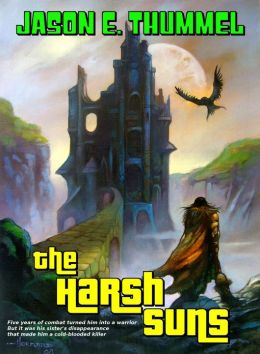
The Harsh SunsThere I was, minding my own business, peacefully editing Connor Gormley’s Robert E. Howard tribute “Who Took the Flowers Out of my Prose?” and listening to him grouse about modern prose, when suddenly Conner took an abrupt right turn and started praising Black Gate author Jason E. Thummel.

Unfortunately, modern fantasy seems, for the most part, to neglect prose. And that’s a shame, because it means all those distinct literary personalities — the whimsy of Leiber, the melancholy of Moorcock, and the fury of Howard — are a thing of the past. Everyone seems to have adopted the same bland, middle ground style that isn’t really anything above functional…

Don’t get me wrong — there are a few standouts. I love Jason E. Thummel’s prose…

Well, that was a pleasant surprise. We’ve published three tales from Jason E. Thummel in the past 12 months — including the debut story in the Black Gate online fiction line, ”The Duelist,” which Adventures Fantastic said “Set a high standard,” and two stories of Gunnerman Clap, “The Gunnerman” and “Assault and Battery.”

Apparently it takes more than that to stay on top of Jason, however. Looking for an image to accompany Conner’s comments, I stumbled on the cover of Jason’s new book: The Harsh Suns, a handsome collection of three sword & sorcery tales published earlier this year.

I immediately ordered a copy and it arrived just in time to accompany me on my plane ride to San Francisco last Wednesday.

…

Read More Read More

Vintage Treasures: The Karma Corps by Neal Barrett, Jr.

Vintage Treasures: The Karma Corps by Neal Barrett, Jr.

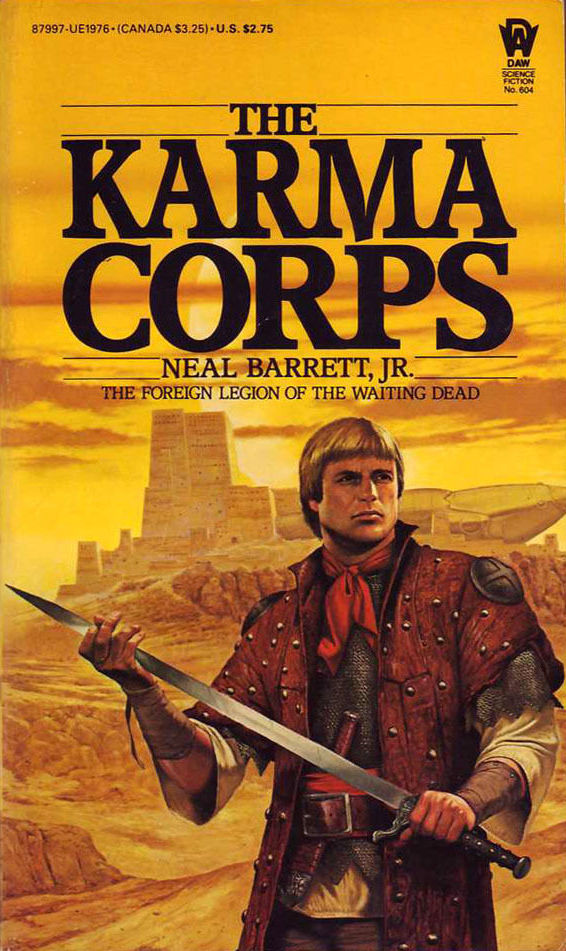
The Karma Corps-smallLast month, I bought a small collection of fantasy novels that included Mark Frost’s The List of 7, a terrific Clark Ashton Smith paperback, some vintage Lovecraft — and four early fantasy novels by Texas author Neal Barrett, Jr. I was especially curious about the Barrett, all four volumes in his Aldair series, published between 1976 and 1982. I first encountered Barrett in the late 80s with his post-apocalyptic novel, Through Darkest America (1987), and then his gonzo magic realist offering from Ziesing Books, The Hereafter Gang (1991). Those were more than enough to win my respect for Barrett’s gifted imagination, but I wasn’t familiar with his earlier work.

The four Aldair books rekindled my interest and I set off in search of what else I might find. The first title I found was The Karma Corps, an unusual science fantasy of demons, holy warriors, and a distant space colony with a very serious problem.

Captain Lars Haggart was a soul waiting to be reborn… but before that blessed event he has been inducted into the Arm of God Regiment fighting for the beleaguered Churchers on a newly colonized planet. Their foe — demons who could pop into existence, slay and pop out of existence the next instant. The demons were winning that war, sending their Unborn opponents back to limbo, driving the living colonists toward extermination.

But this was no fantasy, no business of the religious imagination. The fight was real, blood was blood, and swords cut sharp, for the Unborn were very much alive. Haggart was aware that this was frighteningly contradictory but first he had to fight the demons on their own terms — learn how to appear behind their lines and do to them what they were doing to the humans.

An unusual science fiction novel of a space colony in deepest trouble and of aliens who knew planetary secrets that were never in anyone’s Holy Book.

Given what I know of Neal Barrett, Jr. already, I didn’t really expect to find his name on a novel of space colonization. Throw in a strange religion and demons who defy our notion of reality, however, and now you’re talking.

…

Read More Read More

The Roots of Early Love Go Deep: Five Stories Which Affected Me Deeply in My Early Teens

The Roots of Early Love Go Deep: Five Stories Which Affected Me Deeply in My Early Teens

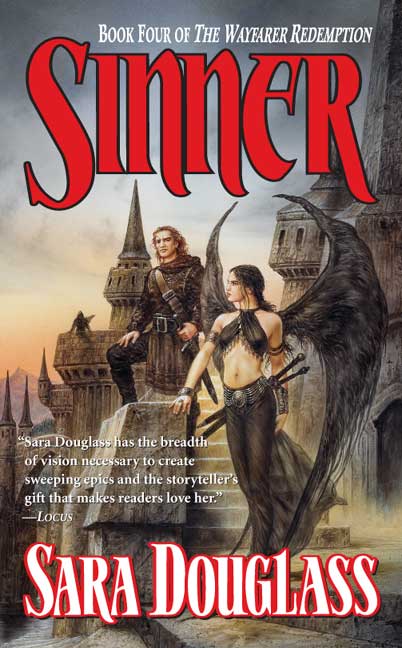
Sinner Sara Douglass-smallOne of the many minor consequences of having a child – in my case, anyway – is the extent to which you suddenly become nostalgic for the stories of your youth.

As such, and even though my shelves are overflowing with new and as-yet unread books, my thoughts keep straying to stories I loved in my early teens. And not just novels, but games, films, and TV shows, too. Revisiting these narratives as an adult, however, can be something of a mixed blessing: for every thrill experienced on finding that a particular story touches me just as deeply now as then, there’s often a corresponding moment of disappointment on identifying a hitherto unnoticed, winceworthy problem.

Even so, there’s an important difference between acknowledging that the things we love – and particularly the things we first loved as teens and children – are flawed, and throwing them out entirely. We cannot wholly excise our passions without removing something vital of ourselves; instead, we must learn to live with them.

What follows here, then, in no particular order, is a slightly different list to the sort of thing I might usually compile: five stories which affected me deeply in my early teens and which continue to influence me now, sometimes without my even consciously realizing it. The roots of our early loves go deep and even though I haven’t explored some of these stories in years, as I go about revisiting them, I’m consistently amazed to find echoes of them, not only in my own work, but in my expectations for the works of others.

…

Read More Read More

John Bellairs, Fred Saberhagen and Appendix N: Advanced Readings in D&D

John Bellairs, Fred Saberhagen and Appendix N: Advanced Readings in D&D

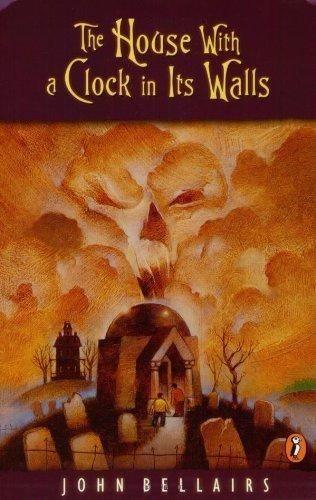
The House With a Clock in its Walls-smallI know John Bellairs mostly as the author of a host of YA fantasy mysteries — rather dark fantasy mysteries, actually, with a twinge of horror. The first one I purchased was The House With a Clock in its Walls, back when my kids were very young, but I imagined they’d thank me as they grew older and started devouring the fantasy library I’d diligently built for them.

Never happened. Instead, they did the exact same thing I did at their age: found their own books and steadfastly ignored the stuff their boring parents kept recommending.

They read Christopher Paolini’s Eragon series, and Suzanne Collins’s Gregor books, John A. Flanagan’s Ranger’s Apprentice, and Suzanne Collins’s Hunger Games. I ended up with stacks of unread John Bellairs titles like The Eyes of the Killer Robot and The Spell of the Sorcerer’s Skull. At least they looked good on the shelves.

John Bellairs also wrote at least one adult fantasy, The Face in the Frost. And that was apparently enough to win him a space in Gary Gygax’s Appendix N in the back of the Dungeon Masters Guide, which is why we’re talking about him today.

Mordicai Knode and Tim Callahan are examining one Appendix N writer per week at Tor.com, in their Advanced Readings in D&D series. They’ve done 15 installments so far, and for number 16 Tim turns to John Bellairs.

But first, he briefly returns to subject #15, Lin Carter, to say a few words about his exceptional treatise on adult fantasy, Imaginary Worlds.

…

Read More Read More

Crowdfunding Kaleidoscope: An Interview with Julia Rios

Crowdfunding Kaleidoscope: An Interview with Julia Rios

Herein we have Black Gate (or at least MOI, in my guise as doughty avatar) interviewing the inimitable Julia Rios, one of the editors for an upcoming YA fantasy anthology called Kaleidoscope.

Julia is straight-up The Right Stuff, in the humble opinion of this blogger, and everything she touches has a tendency to turn to rainbows.

I’m a product of the early eighties.

I like rainbows.

I am very excited for this anthology.

JuliaRiosBG: What is Kaleidoscope and how did the project come about?

Kaleidoscope is an anthology of diverse YA contemporary fantasy stories. I’m co-editing it with Alisa Krasnostein, the publisher at Twelfth Planet Press in Australia. Right now, we’re having a fundraiser on Pozible so we can afford to make the book and pay our authors the SFWA professional rate of $0.05 per word.

As for how this started, Kaleidoscope is a project born of podcasts! I host the Outer Alliance Podcast, which celebrates QUILTBAG content in SF/F. Alisa, my co-editor, is one of the members of Galactic Suburbia, which is an Australian feminist SF podcast. I love Galactic Suburbia, and apparently I’m not the only one, because they’ve racked up *two* Hugo nominations.

…

Read More Read More

Tales of the Wold Newton Universe, Part 1 of 4

Tales of the Wold Newton Universe, Part 1 of 4

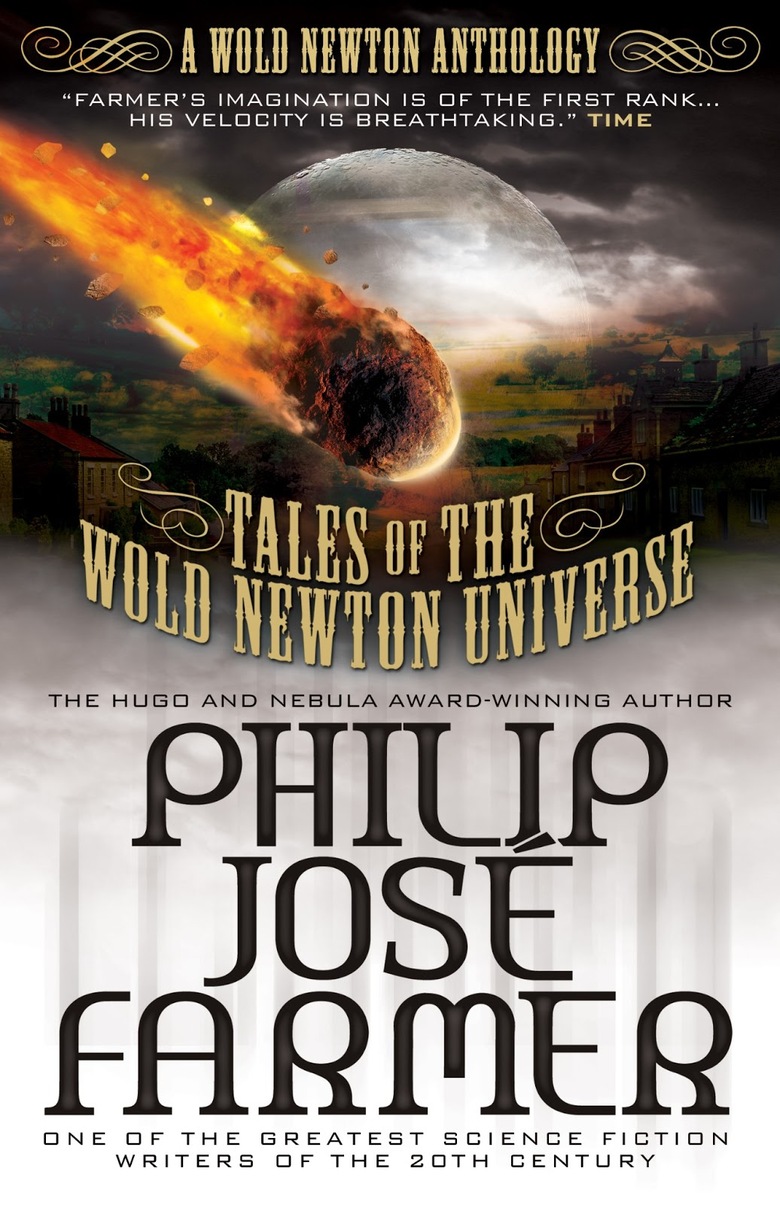
Tales of the Wold Newton Universe-smallThis month marks the release of Tales of the Wold Newton Universe, a new anthology from Titan Books that collects, for the first time ever in one volume, Philip José Farmer’s Wold Newton short fiction, as well as tales set in the mythos by other Farmerian authors.

The Wold Newton Family is a group of heroic and villainous literary figures that science fiction author Philip José Farmer postulated belonged to the same genetic family. Some of these characters are adventurers, some are detectives, some explorers and scientists, some espionage agents, and some are evil geniuses.

According to Mr. Farmer, the Wold Newton Family originated when a radioactive meteor landed in Wold Newton, England, in the year 1795. The radiation caused a genetic mutation in those present, which endowed many of their descendants with extremely high intelligence and strength, as well as an exceptional capacity and drive to perform good, or, as the case may be, evil deeds. The Wold Newton Universe is the larger world in which the Wold Newton Family exists and interacts with other characters from popular literature.

To celebrate the release of the new anthology, we’ve asked the contributors to discuss their interest in Philip José Farmer’s work and to tell us something about how their stories in the book specifically fit into the Wold Newton mythos.

For today’s installment, please join us in welcoming author John Small.

Win Scott Eckert and Christopher Paul Carey,
Editors, Tales of the Wold Newton Universe

…

Read More Read More

New Treasures: Dying is My Business by Nicholas Kaufmann

New Treasures: Dying is My Business by Nicholas Kaufmann

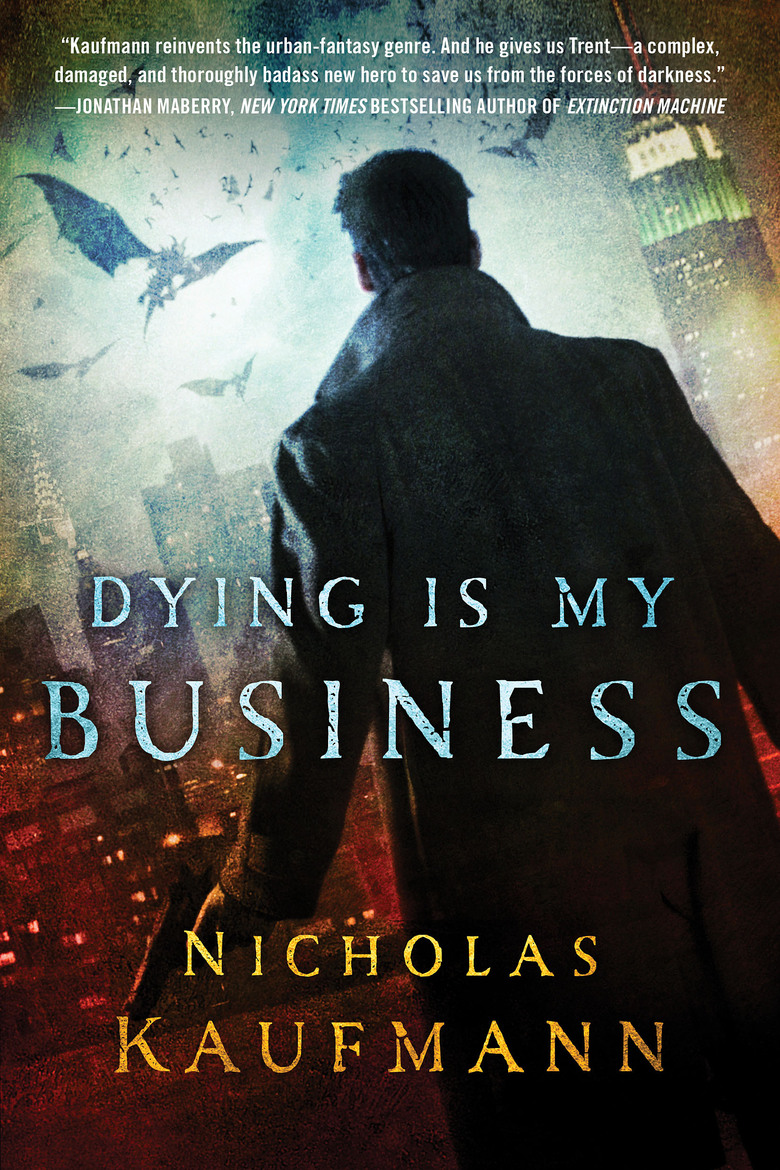
Dying is my Business-smallI love these Chris McGrath covers. He does terrific character portraits and unique things with light. His characters perpetually seem spotlighted by a fog-drenched glow and no artist today makes his heroes more stylish. Just check out his gorgeous covers for Ken Scholes’s Canticle or Max Gladstone’s Three Parts Dead (or see a more complete gallery at his website.)

Art directors choose artists primarily for two reasons: to create an eye-catching cover and to subconsciously remind buyers of other successful series they’ve enjoyed. McGrath is the cover artist for Jim Butcher’s bestselling Dresden Files, as well as Seanan McGuire’s October Daye novels, Kelly Gay’s Charlie Madigan books, Warren Hammond’s KOP novels, D. B. Jackson’s Thieftaker Chronicles, and many other well-loved series.

I think McGrath was an excellent choice for Nicholas Kaufmann’s dark urban fantasy, Dying Is My Business, the tale of a badass hero facing down the forces of darkness in modern-day Brooklyn.

Given his line of work in the employ of a psychotic Brooklyn crime boss, Trent finds himself on the wrong end of too many bullets. Yet each time he’s killed, he wakes a few minutes later completely healed of his wounds but with no memory of his past identity. What’s worse, each time he cheats death someone else dies in his place.

Sent to steal an antique box from some squatters in an abandoned warehouse near the West Side Highway, Trent soon finds himself stumbling into an age-old struggle between the forces of good and evil, revealing a secret world where dangerous magic turns people into inhuman monstrosities, where impossible creatures hide in plain sight, and where the line between the living and the dead is never quite clear. And when the mysterious box is opened, he discovers he has only twenty-four hours to save New York City from certain destruction.

Nicholas Kaufmann is the Bram Stoker Award-nominated author of General Slocum’s Gold and Chasing the Dragon. This is his second novel.

Dying is my Business was published by St. Martin’s Griffin on October 8. It is 369 pages, priced at $15.99 in trade paperback and $9.99 for the digital edition.

Look Over There, See the Pretty Castle?

Look Over There, See the Pretty Castle?

pretty blue castle-smallI have very little visual memory for places and possibly even less visual imagination. One time, I needed to know the type of paving in Madrid’s Plaza Mayor – you know, the stuff you walk on? Keep in mind that I’ve been walking on this stuff regularly since I was six. I drew a complete blank (no pun intended) and had to ask my husband, who, at the time, had been there exactly once. He was able to tell me that it’s cobblestones, by the way. Unless you’re under the arcade, where it’s flagstones.

Last week, I talked about describing characters and particularly the difficulties of describing point-of-view characters. But as writers, we’re far more often required to describe places and spaces, both interior and exterior. For fantasy writers, this often means versions of places that exist (or existed) historically in our own world. If you’re the kind of person who, like my husband, can call to mind the descriptive details of things you’ve seen, this will mean a certain degree of ease in your life as a writer.

If you’re my kind of person, alas, you’re not going to be able to tell your friends what colour their living room is painted, no matter how many times you’ve been to their house, let alone describe the halls of a castle or the streets of a town.

So, what do you do? Since that Plaza Mayor episode, I’ve tried to remedy my poor visual memory by taking and collecting photographs. Lots and lots of photographs. While I’m travelling, I take photos of anything and everything that I think might be useful in terms of exteriors or interiors. In The Sleeping God, I use the interior of a restaurant in Trujillo in western Spain, in The Soldier King, the punishment square and prison in Elvas, in Portugal, and the cistern system from another Portuguese town, Monserrat, in The Storm Witch. I also used the map of Elvas to lay out my characters’ escape route, but that’s not really the type of description I’m talking about here.

…

Read More Read More