Browsed by
Category: Blog Entry

Tell Me A Story: When does the Disbelief Get Too Heavy to Suspend?

Tell Me A Story: When does the Disbelief Get Too Heavy to Suspend?

Tell Me a Story-smallI’m going to pause in my Podcast ramblings to ask a question: When does inaccuracy pull you out of the story?

I have unusual parameters on that one. I’m a Classicist by training, which means I know far more than is healthy about the Roman Empire and Greek Civilization ca 100 BCE. But I can usually set it aside, especially for movies. “Gladiator” remains one of my all time favorites. My first piece of writing for Black Gate was a review of Clash of the Titans, and I had good things about to say about both versions!

In other words, my expectations on historical accuracy are low, especially when the movie is going for “fun”. The more seriously it takes itself, the more likely I am to give it hell for screwing up. If you want to see me apoplectic, as me about The DaVinci Code.

On the other hand, some things drive me up the wall. For example, I was recently re-listening to Blood Rites, book six of Jim Butcher’s Dresden Files.

Anyone who lives in Chicago is already nodding.

Butcher originally wanted to set his story in another city, the story goes, and his publishers required him to set it somewhere better known. He picked Chicago, despite not knowing the city at all. Which isn’t a problem for the most part.

Until you get to a scene at the climax of Blood Rites in which an important even takes place at Wrigley Field. It’s after dark, late in the evening. And Harry Dresden stops to remark how eerie the whole place is. The giant, empty, acres-wide parking lot. The silence. The ghostly nature of a place made to be full when it is completely empty.

That sound you just heard was the needle scratching across my mental track.

Read More Read More

Modular: Take Command of Star Trek Adventures

Modular: Take Command of Star Trek Adventures

Star-Trek-The-Command-Division-Cover-No-LogosFans love Star Trek for different reasons, and when a fan moves into gaming within the Star Trek universe, those reasons usually inform the type of character they want to emphasize in their games. Do they want to be, like Spock or Data, the science officer who can coolly reason through any problem that comes up? Do they want to be the medical officer who saves lives while chaos erupts around them? The security officer who goes hand-to-hand with a Klingon warrior? The engineer who can make any technological miracle into reality? The hotshot pilot who can maneuver through any cluster of asteroids? Or the Captain of a starship, in charge of herding together all of these elements as they explore the distant unknown regions of space?

A handful of games have been versatile enough to cater to all of these types of fans. The video game Star Trek Online just celebrated its 8th anniversary, and it has a diverse style that allows easily for group or solo play, where players can create characters and take missions that interest them. There are missions that are mostly story-driven diplomatic missions, and some that are primarily about shooting the bad guys, either on ground away missions or in starship combat.

Last August, at GenCon, Modiphius Entertainment released the public version of their tabletop roleplaying game Star Trek Adventures. I’ve been running a group through since December 2016, when the game came out in a public playtest, and have been really pleased with it through all of the transformations into the official release. The system does a great job of allowing for diverse characters and capturing the feel of an episode of whichever Star Trek series is your cup of tea. (Earl Grey, hot, of course.)

Read More Read More

Modular: Dead Suns Adventure Path for Starfinder

Modular: Dead Suns Adventure Path for Starfinder

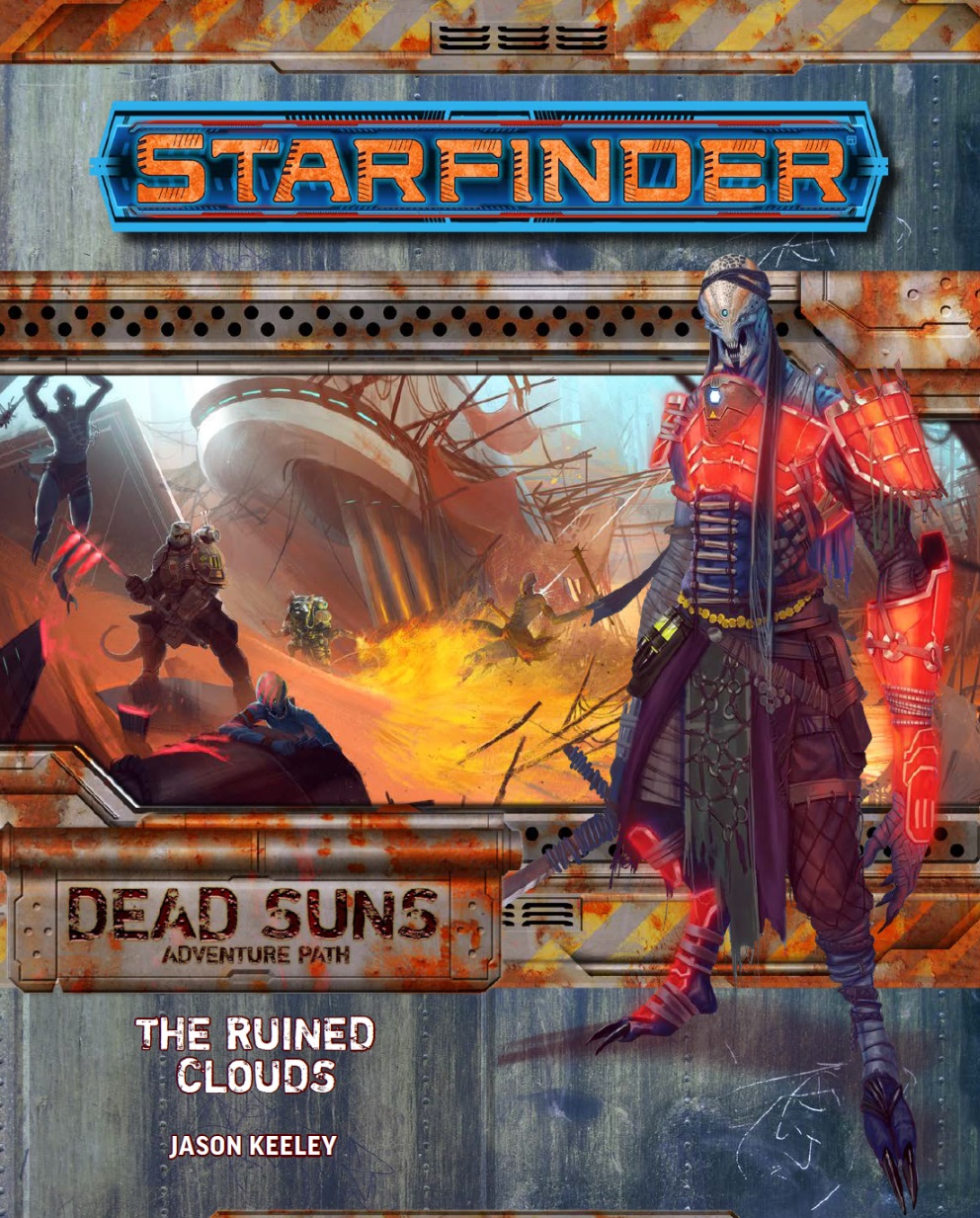
StarfinderDeadSuns4Last fall, the game publisher Paizo began releasing their line of Starfinder products, taking their Pathfinder setting into a distant science fantasy RPG setting. In addition to the main Starfinder Core Rulebook (Amazon, Paizo), they also began releasing the Dead Suns Adventure Path. With four of the six Dead Suns books now out, it’s about time to look back on what they’ve released to see what all the series has got to offer for fans looking for material.

Paizo’s Pathfinder Adventure Path books have long been a staple of the company’s product line. It provides a broad campaign of adventures across six 92-page books, each released on a monthly schedule. In addition to the adventure, each book contained setting, culture, and religious information, a Bestiary supplement, and original fiction.

Dead Suns continues that tradition in their Starfinder campaign setting, with the only significant difference in format being that these books are released on a bi-monthly schedule, so it takes a year to release the full Adventure Path as opposed to the two Adventure Path schedule for Pathfinder. Starfinder is on a less aggressive production schedule than Pathfinder, without associated Player Companion or Campaign Setting resources released monthly, so the Adventure Path provide supplements to the two hardcover Starfinder supplements slated for release each year. (The Alien Archive was released in the fall, and the Pact Worlds setting book is slated for release this month.)

As the first Starfinder Adventure Path, Dead Suns is a planet-hopping quest through the Pact Worlds, as the players get their own starship and begin following the clues across planets, running afoul of massive corporations, space monsters, undead starships and necrotech, and the troublesome Cult of the Devourer, as they uncover the secret behind a lost superweapon.

Read More Read More

The Wild Weird World of Dr. Goldfoot

The Wild Weird World of Dr. Goldfoot

The Wild Weird World of Dr. Goldfoot title card

Those who complain that today’s movie obsession with sequels and spinoffs is different from yesterday’s Hollywood should be strapped into a chair and forced to watch Dr. Goldfoot and His Bikini Machine. If you don’t remember this epic, Vincent Price at his feyest played Dr. Goldfoot, modeled after Bond supervillains Dr. No and Goldfinger.  “My aim is diabolically simple. I am going to control the world. I have invented the ultimate in ultimate weapons, the one weapon that can positively destroy man: woman.”

Read More Read More

Mythic Landscape: The Weirdstone of Brisingamen by Alan Garner

Mythic Landscape: The Weirdstone of Brisingamen by Alan Garner

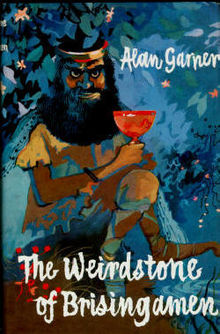
Weirdstone_of_BrisingamenHalfway through my recent reread of Alan Garner’s 1960 debut novel, The Weirdstone of Brisingamen, it became clear to me that the true protagonist was the land, not the ostensible ones, sister and brother Susan and Colin.

Alderley Edge, in Cheshire, England, is the name of both a village and a great sandstone cliff “six hundred feet high and three mile long.” For Garner there’s a connection between land and myth, artistically at least, that is deep. His depiction of a land of rolling plains littered with farms and woods, riddled with thousands of years’-worth of mines makes it easy to see the svart-alfar, the “maggot-breed of Ymir,” boiling out of the earth. There’s something deeper than that, though; something that reaches beyond mere physical for Garner. It’s as if the land itself bred those stories and they are intertwined with it intimately and inextricably. Just walking the woods and rises around Alderley Edge, they can be felt pushing themselves up from the earth and traveling along on the backs of breezes.

Before the story proper begins, Garner recounts a true legend of Alderley Edge — that of a farmer from the village of Mobberly and the strange white-bearded man he meets on the way to market. The farmer hopes to sell his white mare at market in Macclesfield and when he agrees to sell it to the bearded man instead, he is shown a secret cave protected by an iron gate and filled with treasures. Inside sleep 140 knights, each, save one, with a perfect white mare by his side. The wizard, for that is what he is, tells the farmer why the knights are there:

“Here they lie in enchanted sleep,” said the wizard, “until a day will come — and come it will — when England shall be in direst peril, and England’s mothers weep. Then out from the hill these must ride and, in a battle thrice lost, thrice won, upon the plain, drive the enemy into the sea.”

In payment, the wizard tells the farmer to take whatever gold and gems he can fit into his pockets. He does, with unexpected and dire consequences for the future.

Read More Read More

Boskone 55: Con Report

Boskone 55: Con Report

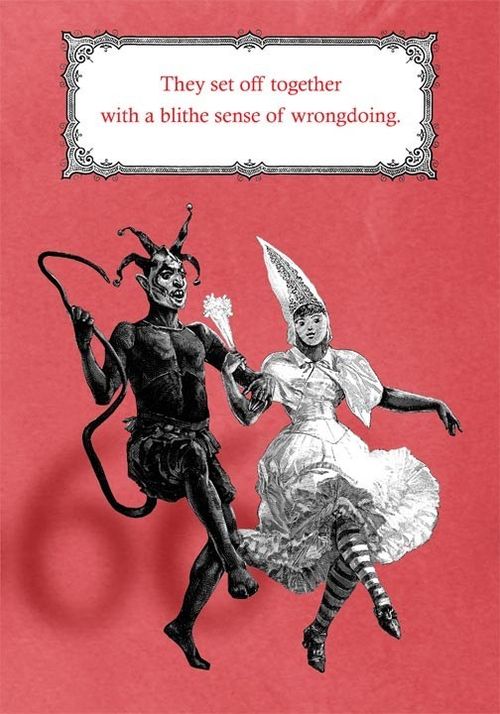
They set off together with a blithe sense of wrongdoing

This year, Boskone 55 was our third Boskone ever, and we had a frikkin MARVELOUS time.

No, I’m not using the Royal We — although  that is still a (perhaps unfortunate) habit of mine. At present, I am talking about myself and writer Carlos Hernandez (AKA “Doctor Husbandpants”), in whose august company I now traipse to most conventions. Kind of like our fridge magnet says (above).

Read More Read More

Birthday Reviews: Arthur Machen’s “The Coming of the Terror”

Birthday Reviews: Arthur Machen’s “The Coming of the Terror”

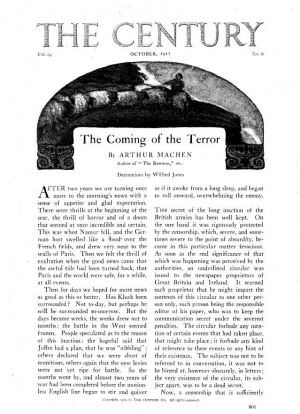
Cover by Wilfred Jones

Arthur Machen was born Arthur Llewellyn Jones on March 3, 1863 and died on December 15, 1947.

Machen had a strong interest in the occult and published his first poem, “Eleusinia” when he was 18 years old. He struggled as a writer before seeing more success in the 1890s, including the publications of his story “The Great God Pan” in 1894. In the early days of World War I he published the short story “The Bowman” which described phantom bowman from Agincourt called upon to help the British Expeditionary Force at the Battle of Mons. The story entered into popular culture as an actual description of the battle and led to the folklore around the “Angels of Mons.”

Machen originally published “The Coming of the Terror” in The Century, an illustrated magazine published from 1881 to 1930, although it grew out of Scribner’s Monthly, which dated back to 1870. The story was part of his longer novel The Terror and has rarely been reprinted only its own, only seeing print in 2003 in the Chaosium collection of Machen’s story’s The White People and Other Stories and that same year in Douglas Anderson’s anthology Tales Before Tolkien: The Roots of Modern Fantasy.

“The Coming of the Terror” feels a lot like one of the stories H.P. Lovecraft would begin publishing five years later, but with significant differences. Machen’s tale of mysterious deaths during the Great War slowly builds from reporting on the crash of an airman who hit a swarm of pigeons to the seemingly unrelated deaths and disappearances in a small village in Wales. The deaths lead to paranoia that the Germans have somehow managed to attack the English countryside undetected, either using a strange new weapon or by infiltrating the citizenry.

While Lovecraft cites Machen as one of his sources (and Machen mentions the original village of Dunwich in this story), “The Coming of the Terror” really isn’t Lovecraftian in nature. Machen doesn’t use excessively purple prose to describe the sinister events occurring around his Welsh village of Porth. Furthermore rather than being witnessed by a single individual, the effects are widespread. Everyone is aware that something is happening, and the fact that the newspapers refuse to report on it just make the conjectures that much more horrific. Machen allows events to build slowly, from a single incident to several, their relationship to each other only explicit because they are all taking place in the same story.

Read More Read More

Goth Chick News: Reality Really Does Bite… Apparently

Goth Chick News: Reality Really Does Bite… Apparently

Goth Chick dude

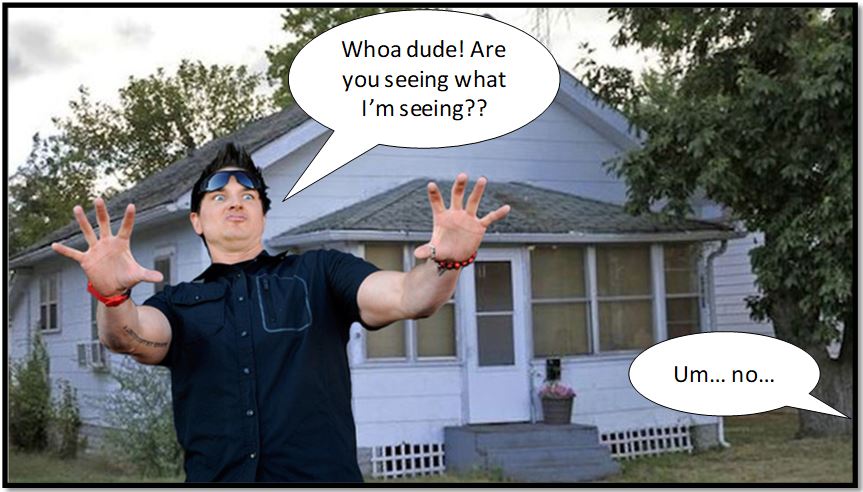
Given my avocation it probably comes as no surprise that for a time I never missed an episode of the Travel Channel show Ghost Adventures. The hand-held-camera “reality” series follows paranormal investigator Zach Bagans and a small crew as they spend the night in various locations around the globe which are reportedly haunted.

By any series standards, Ghost Adventures has had an amazing run since premiering in 2008. Allegations that Bagans and crew play loose with the facts, and emphasizes showmanship over hardcore research is a bit of a non-sequitur considering the subject matter. But somewhere around 2013 the productions values as well as the dramatic, over-acting went too far and for me at least, the show lost its gritty fun. Then in 2014 a member of the original crew, Aaron Goodwin went on record telling the us all the shocking news that the Travel Channel faked most of the paranormal activity documented on the show. At that point my willingness to suspend my disbelief had been stretched to the breaking point and I was done. However, here we are in 2018 and Ghost Adventures just aired their 182nd episode in January, with new episodes coming in March.

So, color me shocked that it took ten years, but I’m here to tell you about the inevitable – a Ghost Adventures movie.

Read More Read More

Birthday Reviews: February Index

Birthday Reviews: February Index

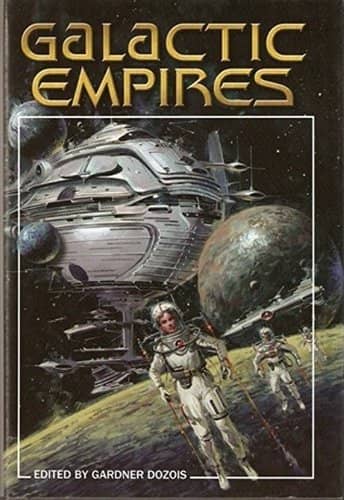
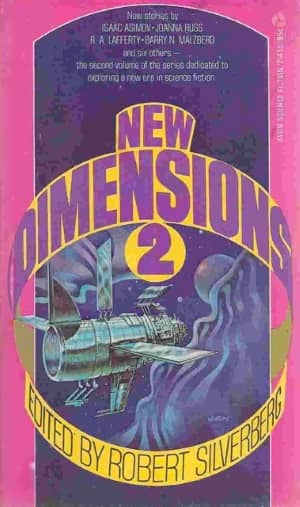
Galactic-Empires-Dozois New Dimensions 2 Asimovs-Science-Fiction-April-May-2007-small

January index

At the one sixth mark in our journey through the year, here’s a look back at the birthday reviews that appeared at Black Gate in February.

February 1, Yevgeny Zamyatin: “The Cave
February 2, Selina Rosen: “Food Quart
February 3, Alex Bledsoe: “Shall We Gather
February 4, Neal Asher: “Owner Space
February 5, Joseph H. Delaney: “Survival Course
February 6, Eric Flint: “Portraits
February 7, Karen Joy Fowler: “Always
February 8, Mary Robinette Kowal: “Just Right

Read More Read More