Weird Times 8: The International Scene
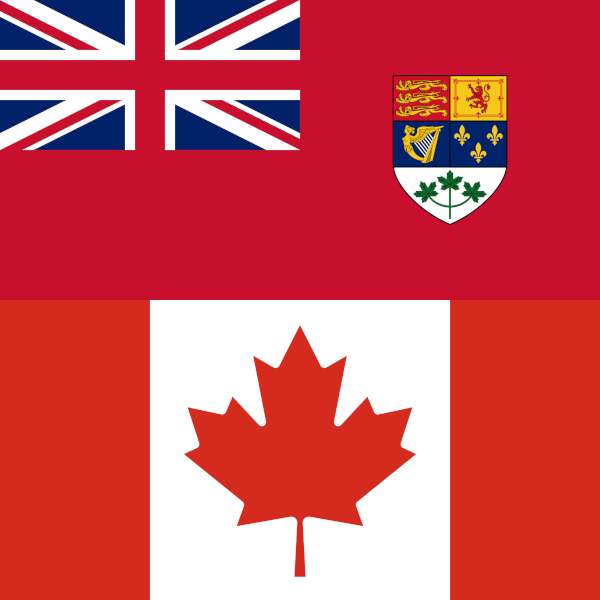
The Canadian Red Ensign as used from 1922 to 1957 (top), and the current flag of Canada, the Maple Leaf or l’Unifolié.
Perhaps, just possibly, you’ll walk past a hotel or other building with a display of flags of the world. In which case you might see a flag representing Canada. You won’t find a Canadian consulate or legation, as Canada doesn’t have any of those in 1923. The reason why not will be hinted at by the Canadian flag you’ll see. Officially, the national flag of Canada in 1923 is the Royal Union Flag, also known as the Union Jack. But there is another flag more specifically associated with Canada: the Canadian Red Ensign. The original Red Ensign, flown by British merchantmen, is a field of red with the Union Jack in the upper left corner. The Canadian Red Ensign formerly added the coat of arms of the nine provinces to the red field; in 1922 when King George V granted Canada a coat of arms the new heraldry replaced the provincial insignia. The Red Ensign’s not an official flag, and in fact will only be formally authorised for use on Canadian government buildings outside Canada in 1924, but it’s widely-used nevertheless and during the Great War was a common symbol of Canadian identity. You will certainly not see a red-bordered flag with a red maple leaf against a white background; in 1923, you’re more than 40 years too early for that.
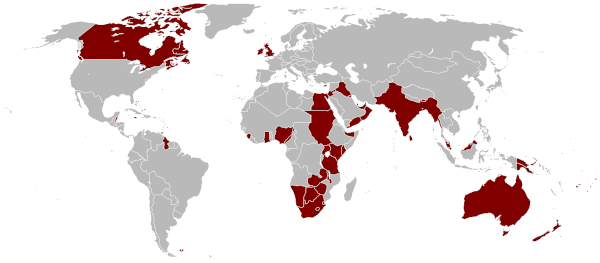
A map of the British Empire at its greatest extent.
The sight of the Red Ensign flag points to the fact that the world of 1923 was a very different one than that of 2026, and that even the most familiar places may have some profound differences. Therefore I’ll use this post to give a very brief look around the globe. This is in no way exhaustive and certainly not systematically detailed; I mainly want to reflect on places that turn up, to one degree or another, in stories in Weird Tales. And I will start with Canada, and with the British Empire.
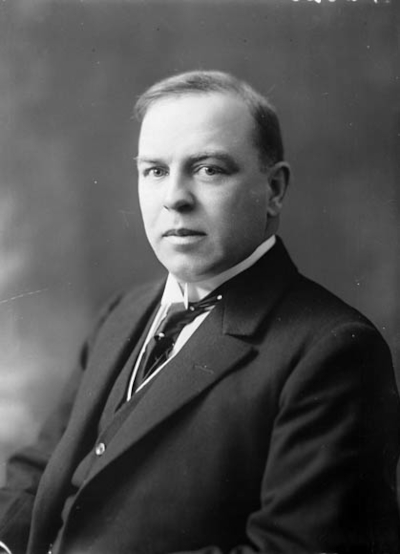
William Lyon Mackenzie King in 1919.
King himself, elected in 1921, will prove to be a key figure in establishing Canada’s de facto political independence from Britain. Officially, in 1923 Britain still determines foreign policy for Dominions like Canada, but King is already working toward the 1931 Statute of Westminster that will give Canada complete autonomy; so in 1923 Canada will sign a fishing treaty with the United States without British involvement. This issue of independence will become more pointed in 1926 with what is generally called the King-Byng affair but more memorably named the King-Byng Wing Ding. King, leading a minority government, will seek to call a new election but be refused by British Governor-General Lord Byng and resign; a Conservative minority government will last three days; King will then be re-elected after running a campaign based on rejecting British interference in Canadian affairs, and go on to become the longest-serving and one of the greatest Prime Ministers in Canadian history, seeing the country through much of the Great Depression and World War II. He will also hide until after his death an interest in spiritualism that began at least as early as 1919; he will record in his diaries participation in seances that successfully invoke the spirits of Leonardo da Vinci, Franklin Delano Roosevelt, his mother, his grandfather, and several of his dogs.
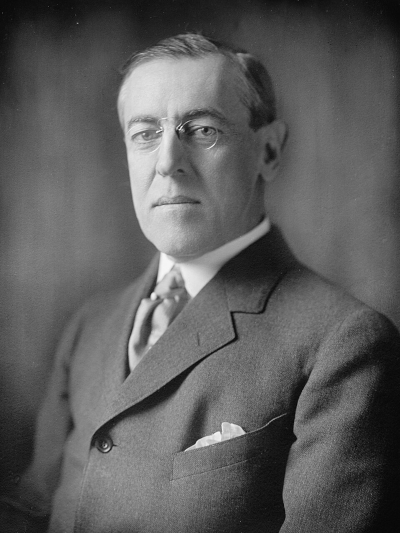
American President Woodrow Wilson, who won the Nobel Peace Prize for his involvement in the creation of the League of Nations.
So the creation of the League of Nations after the end of the War, urged by American President Woodrow Wilson among others, can be seen as a rejection of the idea of a few great empires having de facto control of the entire globe. The League is an international organisation of countries, which aims to prevent future wars and to create a venue for international arbitration of disputes. There were 42 members at the first Assembly of the League in 1920; there will ultimately be 63 different countries in the League, though not all at one time (and while the United States signed the Covenant of the League of Nations, the signing wasn’t ratified by Congress, so the US is not a member). In 1923 it’s widely hoped that the League will foster international collaboration and the global rule of law, but without an army of its own it’s difficult to see how it’ll function if great powers come into conflict.
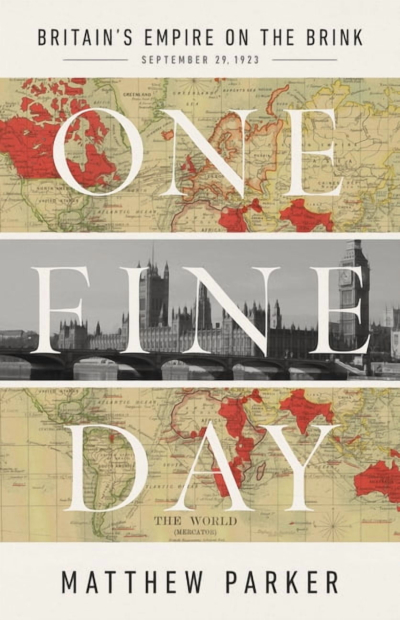
One Fine Day: Britain’s Empire on the Brink, by Matthew Parker
On the other side of the political spectrum, in Italy late in 1922 (just a few months ago as you walk to the newsstand in early 1923) Benito Mussolini’s far-right Fascists led a March on Rome that resulted in a Fascist government. Explicitly opposed to socialism, as Mussolini himself wrote, the nationalists of the Fascist Party are equally totalitarian; there will be an election of dubious fairness in 1924, marked by voter intimidation, but in 1925 Italy will officially become a one-party state. Meanwhile, in Germany, fascists will attempt to stage a putsch similar to the March on Rome later in 1923, marching on the Minister-President of Bavaria while he speaks in a Munich beer hall, but the attempt will fail, resulting in the death of 4 police officers and 15 fascists.
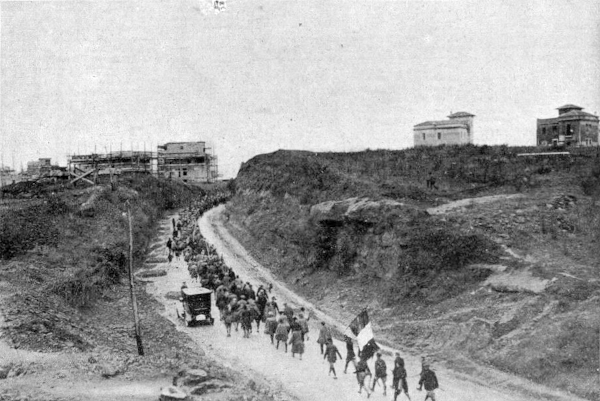
The Fascist March on Rome
The different territories are governed in different ways, with different levels of autonomy and democracy. The British are quite creative in finding various ways to configure their colonies, and various ways of exerting control, whether through direct governance or as some form of patron to a client kingdom. The British do not, for example, formally rule Persia, but in 1921 supported a coup led by a military officer named Reza Khan (later Reza Shah Pahlavi, founder of the Pahlevi dynasty), and now have considerable influence in the country.
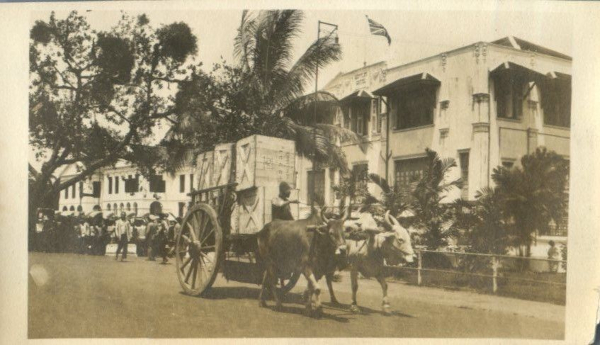
Singapore in 1923
Sometimes the terrible toll of the Empire is exacted directly by the authorities. To take one notorious example, in 1919 in the Indian city of Amritsar a British Brigadier-General responded to a protest against a law allowing police a variety of extraordinary powers by having his men open fire. Hundreds of protestors died, and martial law was subsequently declared across the Punjab, in which authorities further abused their powers. The massacre inspired a broad revulsion against the British and a ‘noncooperation movement’ led by Mahatma Gandhi, in which Indians were to resign government positions, boycott institutions like schools and courts, and refuse to pay taxes. When the movement erupted into violence Gandhi called it off; he himself was arrested and in early 1923 is still in jail.
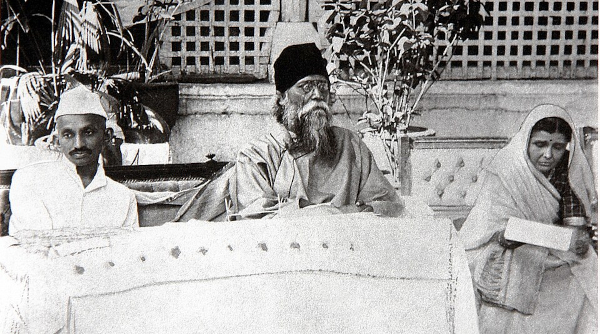
A photograph from 1920 showing Mahatma Gandhi (far left), with Rabindranath Tagore (centre) and social worker Sharda Mehta.
The British Empire, meanwhile, has reached what will turn out to be its greatest geographical extent through the addition of former territories of the Ottoman Empire. The Ottomans, among the losers of the Great War, had their territory partitioned by the victors, with France and Britain acquiring some former Ottoman territory as ‘mandates’ under the League of Nations. Mandates are functionally indistinguishable from colonies, though nominally the possessing nation has greater responsibilities to the people in the mandated territory. Palestine, for example, is a former Ottoman territory the British now rule as a mandate. Even before acquiring Palestine, in 1917 the British government issued the Balfour Declaration, supporting the creation of a Jewish homeland in the then-Ottoman territory; in 1921 the British reported that approximately 11% of the mandate’s population was Jewish, after significant immigration over the previous decades, and that there had recently begun to be some tension between the Jews and Palestinian Arabs suspicious of British intentions.
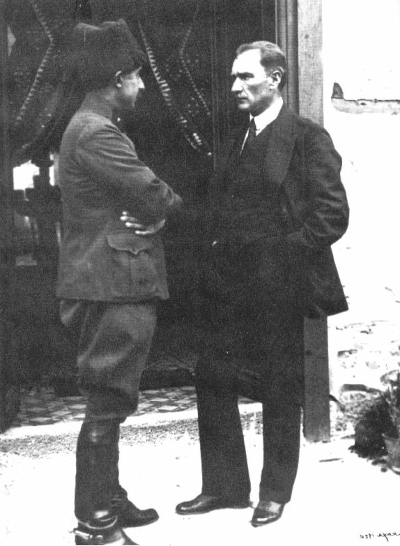
Mustafa Kemal (right) in 1920.
While the British gained Ottoman lands in the Middle East from the Ottomans, they have also nominally allowed Egypt its independence, though continuing to station British troops in the country. Britain’s territories elsewhere in Africa are extensive; as an example, in 1914 they united the Southern Nigerian Protectorate and the Northern Nigerian Protectorate into one colony, creating a territory of 365,000 square miles — as big as Britain, France, and Belgium together. Over 18 million people live in this new Nigeria, from over 250 different ethnic groups. Again: this is only one of Britain’s African colonies. Surprisingly, this year the British Governor of Nigeria, Sir Hugh Clifford, at the urging of the recently-formed National Congress of British West Africa will allow elections for seats on a Legislative Council, which will take place later in 1923 and lead to limited democratic reforms in the British colonies of Sierra Leone and the Gold Coast over the next two years.
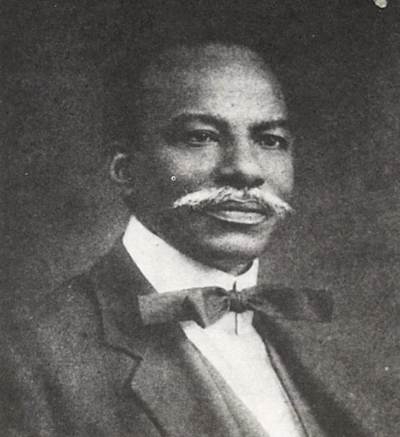
Herbert Macaulay
I have spent a lot of time on the British Empire because it is so extensive, and I could continue almost indefinitely. But of course things are happening elsewhere in the world in 1923. Last year Pope Benedict XV, who worked for peace and humanitarian causes during the War, died; he was been succeeded by Pope Pius XI, a staunch anti-communist. In the Arabian peninsula the Sultanate of Nejd is ruled by the Emir of Riyadh, Abdulaziz ibn Saud, who in 1925 will take over another independent Arab state, the Kingdom of Hejaz, with tacit British support to create the Kingdom of Saudi Arabia.
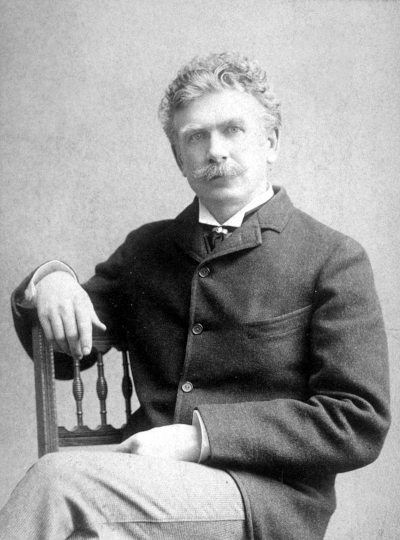
Ambrose Bierce in 1892.
Further south, American neocolonialism is bringing an export boom to much of Latin America. Wealthy landowners are the main beneficiaries of this, but the middle class is growing in many countries. This is relative; as late as 1930 Argentina’s middle class will only be approximately a quarter to a third of the country. And Argentina is one of the wealthier countries in South America; indeed, by GDP per capita, it was one of the ten wealthiest countries in the world on the eve of the Great War. Uruguay is also outperforming much of Latin America, while Chile, having been quite wealthy in the 19th century, has declined.
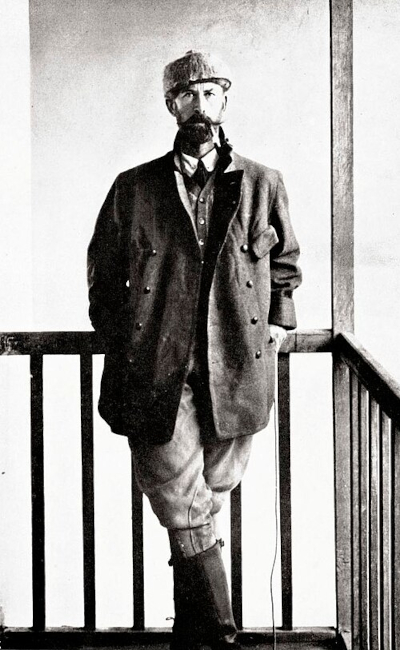
Percy Fawcett
Before ending this brief and inadequate survey of the globe in 1923 there must be some mention of East Asia. In Japan, after the United States forced Japan to end its policy of isolation in 1854, the nation modernised at a frantic pace, ending the feudal caste system, sending observers abroad to learn from industrialised countries, and recruiting Westerners to teach technology and science. A new constitution was adopted in 1889 based on the Prussian model, and in 1895 Japan defeated China in a war over influence in Korea, at the time ruled by its long-standing Joseon dynasty. Korea became a Japanese protectorate in 1905 and was fully annexed by the Japanese Empire in 1910. By that time, the Japanese had won a war against Russia (fought in 1904-5) and emerged as one of the great powers of the world; indeed, the only non-white great power.
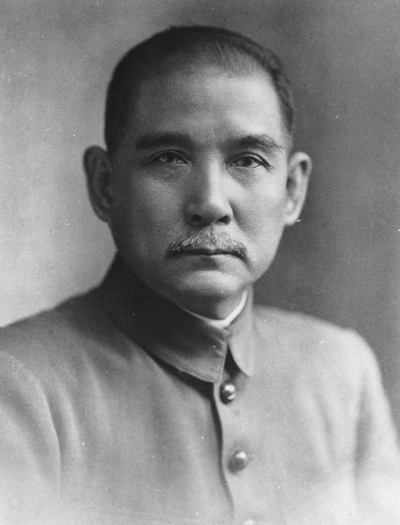
Dr. Sun Yat-sen in 1922.
Much English-language writing about China is less concerned with accuracy. From the late 19th century onward, racist attitudes to Chinese immigrants in the United States fused with German colonial propaganda to create the narrative of the Yellow Peril, loosely the idea that the vast population of China and East Asia generally are both inferior to white Westerners and yet also by sheer numbers a threat to Western civilisation. This has had many awful effects, perhaps the most relevant to Weird Tales being the creation of a set of stereotyped tropes and images in adventure fiction epitomised by Sax Rohmer’s character of Fu Manchu, introduced in 1912. Over the last decade, knockoffs of Fu Manchu have proliferated in the pulps, reinforcing racist ideas of the Chinese for Western readers.
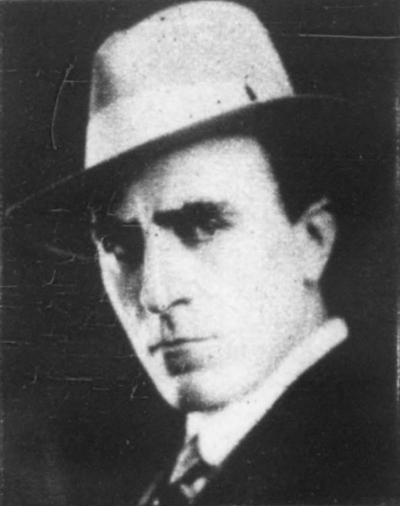
Sax Rohmer circa 1929.
An American in 1923 has fewer ways to get information about distant parts of the world than an American in 2026. Writers telling stories for pulp magazines might have their own experiences to draw on (as might be the case for men who’d been posted abroad during the War; or as certainly was the case for historian and adventure writer Harold Lamb, who in 1946 estimated he’d travelled 59,000 miles in the Middle East). Or they might happen to know someone from a part of the world they’re writing about. There are magazines and newspapers, of course, but these texts will necessarily be mediated by the person writing them — usually, though not always, someone not native to the area. In general there are fewer nonfiction books and significantly fewer nonfiction movies, which are likely more difficult to find, and also often heavily slanted — Matthew Parker notes in One Fine Day that there were seven ‘documentaries’ released about Africa in 1923 and another seven in 1924, “making them the two biggest years for African non-fiction films in cinema history” to that point, but the movies “spoke to their audiences’ preconceptions about ‘natives’ and wilfully misinterpreted the purposes of the indigenous ceremonies they filmed … The films’ intention, however, was to create a visual celebration of the white hunter.”
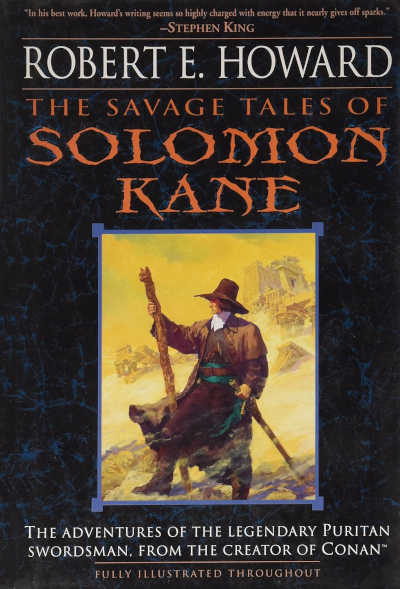
The Savage Tales of Solomon Kane, a posthumous collection of Robert E. Howard’s Solomon Kane stories.
I mention this because in 2024 Robert E. Howard scholar Patrice Louinet discovered a letter in one of these columns with a series of questions about Africa, from one “R.E.H. of Cross Plains, Texas.” In other words, Louinet found a letter from Robert E. Howard gathering research on Africa, the setting for several of his stories, including a number of Solomon Kane tales. Pulp writers in 1923 are doing different things than the E.M. Forsters of the world. But the best of them at least understand there’s value in knowing something about the settings they use.
Find all my posts about Weird Tales here!
Matthew David Surridge is the author of “The Word of Azrael,” from Black Gate 14. You can buy collections of his essays on fantasy novels here and here. His Patreon, hosting a short fiction project based around the lore within a Victorian Book of Days, is here. You can find him on Facebook, or follow his Bluesky account, @bookofdays.