Browsed by
Category: Blog Entry

Those Thrilling Days of Yesteryear
Those Thrilling Days of Yesteryear

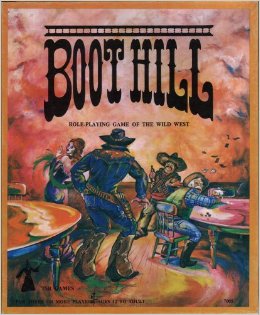
boothillAs my children will tell you, a frequent refrain around my house is “I’m so glad I was a kid in the 1970s.” I say it often enough that my teenage daughter – Lord, help her – is starting to wish she’d grown up during the “Me” Decade as well. I could probably write several posts about why I say this and why I say it with conviction, but I’ll spare my readers such blather at this time. However, I will explain how it’s pertinent to the present post.

Television during the 1970s was a funny thing. Outside of “prime time,” first-run programming was broadly limited to game shows, soap operas, news broadcasts, and, of course, Saturday morning cartoons. That left a lot of air time to be filled, which, coupled with new rules passed by the Federal Communications Commission intended to foster the creation of local content (but generally didn’t, at least in my neck of the woods), meant that I saw reruns of many, many old TV shows and almost as many old movies.

Even though I started watching most of this stuff because there was nothing else on, in retrospect, I’m glad that I did so. Not only did it expose me to content, genres, and actors with which I might otherwise have never become familiar, it also provided me with pop cultural connections to my parents, grandparents, and even just the older guys I’d later encounter in the hobby shops. That’s why, to this day, I’m very much a man out of time, with the tastes and interests of the generation before mine, such as my abiding interest in the Second World War. I suspect many of my age peers are similar in this respect.

One of those pop cultural connections to earlier generations was the Western, a genre that had peaked during the 1960s and was well on its way out the door by the time I was born. Yet, thanks to syndication, I got to see plenty of Westerns (as well as shows, like Gunsmoke and Bonanza, which were still being produced in my early childhood). It’s no surprise, then, that, once I discovered roleplaying games, I’d seek out any that recalled the Western TV shows and movies I’d enjoyed. The first – and, as it turned out, only – one I ever played was TSR’s Boot Hill, co-authored by Brian Blume and Gary Gygax.
Read More Read More

The End of the Story: Sorceress of the Witch World by Andre Norton

The End of the Story: Sorceress of the Witch World by Andre Norton

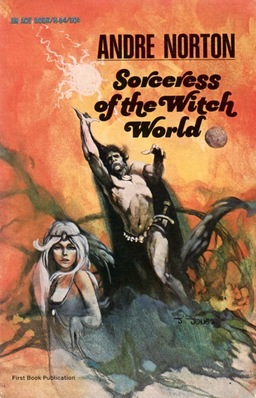
oie_324651kfYzNZDkAndre Norton’s Sorceress of the Witch World (1968) completes the trilogy begun with Three Against the Witch World and continued in Warlock of the Witch World. (Follow the links to read my reviews here on Black Gate). The trilogy itself is a continuation of Norton’s Witch World saga begun in Witch World and followed with Web of the Witch World.

The heroes of the first two novels, Simon Tregarth and his wife Jaelithe, mysteriously disappear at the beginning of the trilogy. Their triplets, born between Web of the Witch World and this trilogy, are searching for them. Each volume tells the adventures of one of the siblings, Kyllan, Kemoc, and Kaththea.

In Three, brothers Kyllan and Kemoc rescue their sister Kaththea from her forced induction into the ranks of the Witches and escape into the magically hidden eastern land, Escore. In addition, the warrior Kyllan’s talents are put to the test against a growing horde of vile enemies. In Warlock, the scholarly Kemoc travels across dimensions to rescue his sister from her evil suitor.

You can probably tell from the title that Kaththea herself takes center stage in Sorceress of the Witch World. For reasons related to her situation in the previous book, Kaththea is spiritually damaged. Sadly, for the reader that damage seems to have rendered her a little boring also. She narrates the entire story in a dull voice that distances the reader from the action.

At the end of Warlock, Kaththea lost most of her magical abilities. Now, fearing that stripped of her defenses she is vulnerable to control by the powers of Shadow, she decides she must return to the West and seek guidance from the very same Witches from whom she once fled.

While trying to cross the mountains back into the West Kaththea’s party is caught in an avalanche. She is taken prisoner by a hunter from the Inuit-like nomads, the Vupsall. She manages to escape from the tribe during a bloody attack on their camp by raiders. Armed with magical knowledge gleaned from the possessions of the tribe’s wise woman, she makes for a great ruined city nearby. Hoping to escape the forces of Shadow she still fears, she enters an old dimensional gate. She doesn’t know what lay on the other side, only hoping it will be some sort of sanctuary. What she encounters are tremendous dangers in an utterly alien world.

Read More Read More

Hallowe’en 2014 Post Mortem (Hallowe’en Post #2)

Hallowe’en 2014 Post Mortem (Hallowe’en Post #2)

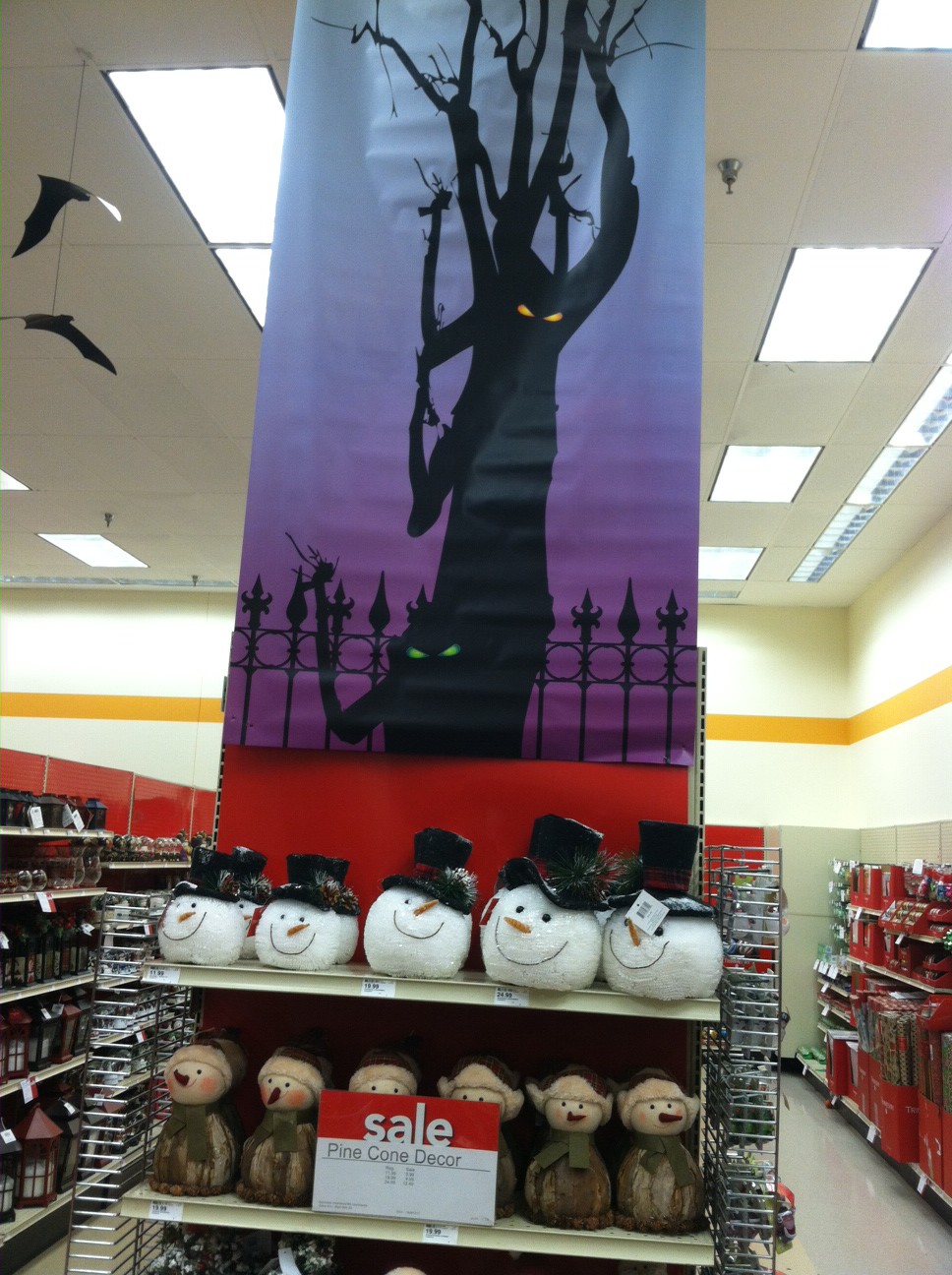
In the strange retail "nightmare before Christmas" time, Hallowe'en and XMas displays intermix
In the strange retail “nightmare before Christmas” time, Hallowe’en and XMas displays intermix

On Friday night, as the light waned and the sky turned the color of mildewed pumpkins, that familiar holy chant began resounding up and down the streets: “Trick or Treat!”

Wee supplicants bedecked in strange garb began their door-to-door pilgrimages to receive the benediction of sugared confections by the handfuls.

Hallowe’en partly descends from All Hallows’ Eve (on its good Catholic mother side — the one who married some pagan dude and their offspring got really weird and started bobbing for apples and wearing William Shatner masks). All Hallows’ Eve was once a prologue to All Saints’ Day. Not many recall that that one nowadays. By dint of Hallowe’en falling on Friday this year, many bars, restaurants, and homes expanded their Hallowe’en celebrations to encompass Saturday, creating the irony of All Hallows’ Eve not only overshadowing, but completely usurping the day of the saints.

The time of feasts and holy days is nigh upon us. Now our most cherished holidays both secular and religious come in quick succession: after Hallowe’en, Thanksgiving and Christmas before the lull of the long, gray winter.

After a couple dull months, a certain bow-wielding matchmaker sneaks in to liven things up a little. He is soon followed by those green-bedecked, Guinness-swigging leprechauns who are ambassadors of a saint who drove snakes out of a place that never had any snakes.

Valentine and Patrick won’t miss losing All Saints’ Day since they each have their own, but they — one a third-century Roman martyr and the other a fifth-century Romano-British missionary — might well wonder how they became the de facto saints of heart-shaped candy and risqué greeting cards on the one hand and green beer on the other. Along with a certain fourth-century Greek bishop named Nikolaos, they could form a support group for saints whose legends bear little resemblance to their actual lives, while also making their names among the most well-known on the planet.

Not that it matters to most of us. The holy days and the names attached to them were always more-or-less excuses to do what humans have been doing (or wanting to do and feeling really guilty about it) throughout history: looking for reasons to get together and celebrate and dress in silly clothes. If there is a benevolent God, that Prime Mover may well wonder why we feel such a strong need to have an excuse.

Read More Read More

Future Treasures: Covenant’s End by Ari Marmell

Future Treasures: Covenant’s End by Ari Marmell

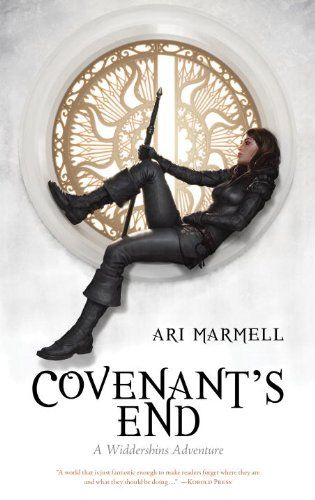
Covenant's End Ari Marmell-smallAri Marmell has been making a name for himself as a gaming writer and as a novelist for the past decade. He’s co-authored several excellent D&D releases, including Complete Mage (2006), Heroes of Horror (2005), Cityscape (2006), the Neverwinter Campaign Setting (2011), and the 4th Edition Tomb of Horrors (2010). Anyone who can adapt Gygax’s diabolical player-killer Tomb of Horrors and make it playable has serious cred in my book.

But it’s his recent fantasy novels that have really begun to get a lot of attention, including The Goblin Corps (2011), Hot Lead, Cold Iron (2014), and The Conqueror’s Shadow (2010), which John Ottinger III reviewed for us here. Perhaps his most successful series has been his YA novels featuring the thief Widdershins, starting with Thief’s Covenant (Feb 2012), False Covenant (June 2012), and Lost Covenant (Dec 2013).

Next year, Ari brings us a fourth Widdershins novel, with the rather ominous title Covenant’s End. Is this the final book in a much-loved series? You’ll have to wait until February to find out.

The thief Widdershins and her own “personal god,” Olgun, return to their home city of Davillon after almost a year away. While Shins expects only to face the difficulty of making up with her friends, what she actually finds is far, far worse. Her nemesis, Lisette, has returned, and she is not alone. Lisette has made a dark pact with supernatural powers that have granted her abilities far greater than anything Widdershins and Olgun can match.

Together, Widdershins and Olgun will face enemies on both sides of the law, for Lisette’s schemes have given her power in both Davillon’s government and its underworld. For even a slim chance, Shins must call on both old friends — some of whom haven’t yet forgiven her — and new allies.

Even with their help, Widdershins may be required to make the hardest sacrifice of her life, if she is to rid Davillon — and herself — of Lisette once and for all.

Covenant’s End will by published by Pyr on February 3, 2015. It is 273 pages, priced at $17.99 in hardcover and $11.99 for the digital version. The cover art is by Jason Chan.

The Public Life of Sherlock Holmes: Elementary is Back

The Public Life of Sherlock Holmes: Elementary is Back

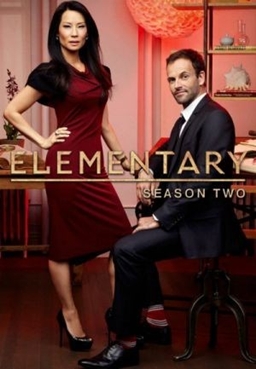
Elementary_PosterIn September of 2012, Elementary debuted on CBS television in America. It was a modern day Sherlock Holmes series, set in New York City. It followed closely on the heels of the BBC’s Sherlock, which had aired three episode seasons in 2010 and again in 2012.

The BBC series was a clever updating of Arthur Conan Doyle’s original stories (at least, it was until the third season) and was full of Easter eggs to please old school Holmes fans (like me), while appealing to a new generation (including females who swoon at the sight of Benedict Cumberbatch: ‘Cumberbunnies’).

Elementary sprinkles in bits from Sir Arthur Conan Doyle’s works, but it’s really a police procedural with a Holmes overlay. I think it’s inaccurate to say it’s based on Doyle’s stories.

Holmes is a recovering drug addict who sleeps with women. Watson is, well, a woman who starts as Holmes’s life coach. Mycroft is nothing like the original and his relationship with Sherlock has even less to do with the stories.

Irene Adler and Moriarty were completely transformed. Gregson (who was the best of a bad lot) is actually a competent policeman, which is a nice change. On the other hand, there are bits for Sherlockians, such as Holmes keeping bees on the roof and being an expert single stick fighter.

Read More Read More

Amazing Stories, July 1962: A Retro-Review

Amazing Stories, July 1962: A Retro-Review

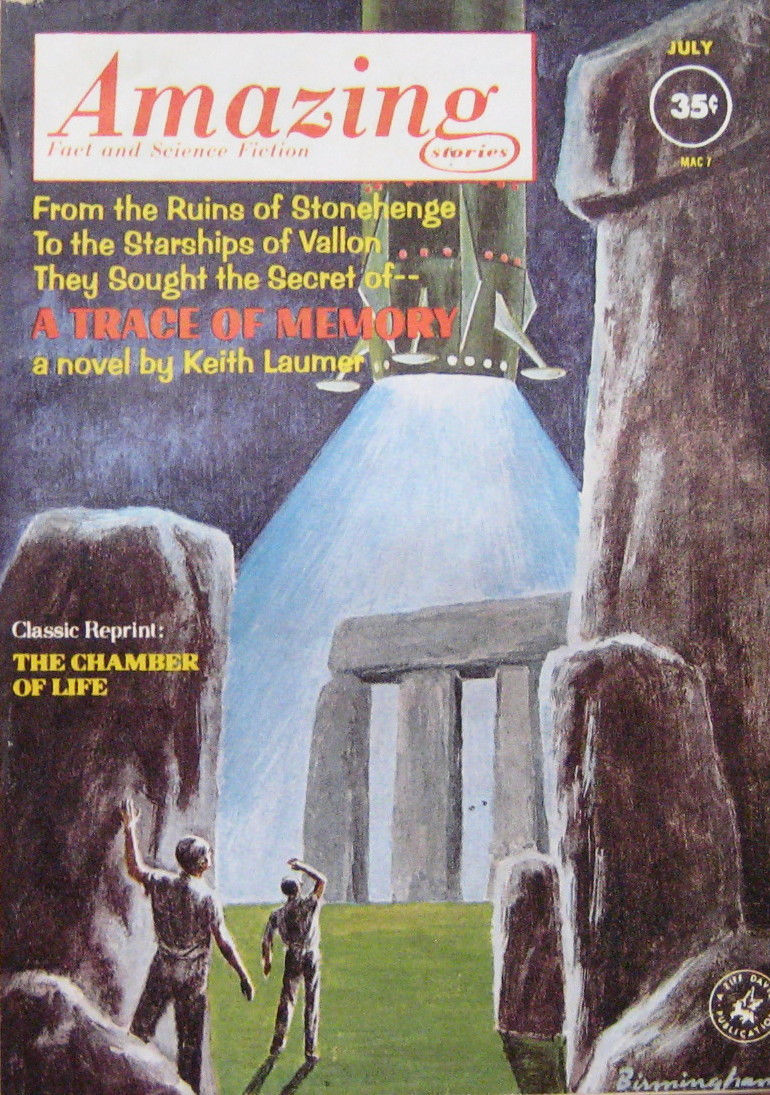
Amazing Stories July 1962-smallBack to Cele Goldsmith’s tenure at Amazing/Fantastic. This is a pretty strong issue, with, notably and perhaps surprisingly, a strong “Classic Reprint” novelet, and a strong serial opener. (The shorter fiction is less impressive.)

The cover is by Lloyd Birmingham, a semi-regular at Amazing/Fantastic throughout the ’60s, who also had one cover for Analog, one for an Ace Double, and a couple more. But he was never well-known in the field. It illustrates the serial in this issue, part one of Keith Laumer’s A Trace of Memory, competently but not particularly specially. Interiors are by Birmingham again, Leo Summers, Virgil Finlay, Dan Adkins, and Austin Briggs.

Norman Lobsenz’s editorial discusses some evidence that may or may not support the Big Bang theory. (This was a couple of years before the discovery of the 3 degree background radiation of the universe.) The lettercol, “ … or So you Say”, features a long letter by Julian Reid complaining about two recent Mark Clifton stories (“Hang Head, Vandal!” and the serial Pawn of the Black Feet), following a very long defense of his work by Clifton himself.

This response may be the last thing Clifton ever published. (He died in 1963, and I am sure he published no more stories after “Hang Head, Vandal!”) I think Clifton gets the better of the argument, pointing out for one thing that Pawn of the Black Fleet (aka When They Come From Space) is a spoof, which Reid took altogether too seriously.

S. E. Cotts’s book review column, “The Spectroscope,” covers Damon Knight anthology A Century of Science Fiction, with very high praise for the stories, but some quibbling about Knight’s categorization of different aspects of the field; and J. F. Bone’s The Lani People, which Cotts considers not very original, but quite fun. There is a very brief “Benedict Breadfruit” squib by “Grandall Barretton” (Randall Garrett) … these are decidedly sub-Feghootian to begin with and this one is worse than usual. Ben Bova (or “Ben Ben Bova” as the TOC has it) contributes an article on “The Three Requirements of Life in the Solar System,” second in a four-article series on the possibilities of alien life, this one covering possibilities for life on other planets in our system.

Read More Read More

Michael Bishop on Tom Hanks’ Story in The New Yorker

Michael Bishop on Tom Hanks’ Story in The New Yorker

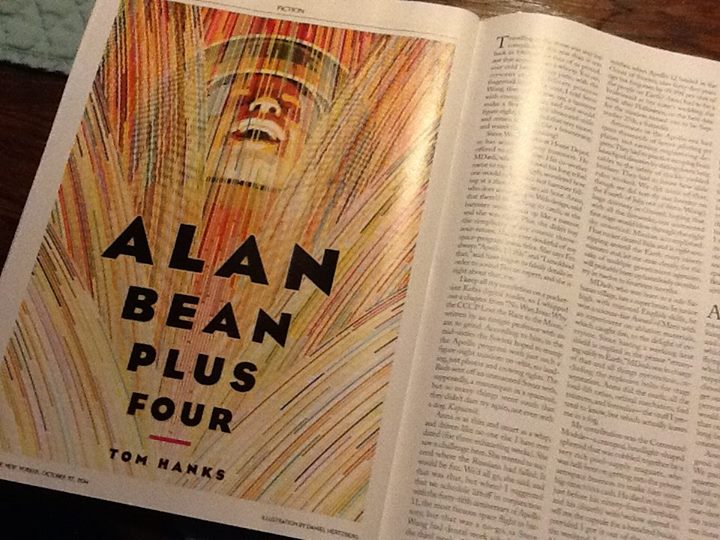
Tom Hanks in The New Yorker-smallMichael Bishop, Nebula Award-winning author of No Enemy But Time, Ancient of Days, and Philip K Dick Is Dead, Alas, has posted a brief review of Tom Hanks science fiction story in The New Yorker magazine.

Yes, Tom Hanks has a story in The New Yorker. And yes, it’s science fiction. It’s titled “Alan Bean Plus Four.” Yes, the Tom Hanks who played Forrest Gump and Captain Phillips. Look, just read what Michael said.

I read it with some initial skepticism. Sure, Hanks is an Academy Award-winning actor, but can he write?

Well, yes, he can. This tale works at the level that Hanks shoots for, and the prose, pointedly colloquial and science-savvy, shows him to have a fine command of 21st-century English as well as of current cultural, social, and technological innovations. I really like it.

You can read the complete story online here. There’s even an audio version on the same page (read by Tom Hanks. How cool is that?).

Read Michael Bishop’s complete comments on his Facebook page.

Amal El-Mohtar reviews “Witch, Beast, Saint” by C.S.E. Cooney

Amal El-Mohtar reviews “Witch, Beast, Saint” by C.S.E. Cooney

C.S.E. Cooney
C.S.E. Cooney

Erotic fiction makes me blush. You know how some people have to cover their eyes when watching horror movies? I’m like that with erotic fiction. When C.S.E. Cooney submitted short stories to Black Gate, I had to peek between my fingers to read them. We published two, “Godmother Lizard” and “Life on the Sun,” (which Tangent Online called “bold and powerful… on a scale of 1 to 10, I rank this one as a twelve”), and I had to look the other way while editing them.

Fortuantely, there are readers braver than I. Over at Tor.com, Amal El-Mohtar has reviewed C.S.E’s new story, “Witch, Beast, Saint: an Erotic Fairy Tale,” saying in part:

Absolutely no one writes fairy tales like Cooney…what Cooney does is make you feel as if you’re a citizen of fairy tale space, inhabiting the lands and experiencing the stories adjacent to those better-known: Cinderella might be a few towns over, but she doesn’t matter here. Cooney writes new fairy tales with a vigour and velocity that make me remember how I felt on first discovering The Snow Queen in a book too big for my lap…

A witch discovers a beast dying in a forest, and takes him home to keep. She can tell right away that he was once a man; she washes and revives him, feeds him, takes care of him, and they become companionable. Soon they become rather more than that; not long afterwards, the arrival of an itinerant saint troubles their romance…

It was shockingly delightful to me to see such a beautiful depiction of enthusiastic consent, kink, and polyamory in a fairy tale setting — no technical terms, no rhetoric, just the cheerful twining of compatible desires in a magical world.

C.S.E. Cooney is a past website editor of Black Gate, and the author of How to Flirt in Faerieland and Other Wild Rhymes and Jack o’ the Hills. “Witch, Beast, Saint” was published at Strange Horizons; read the complete story here. And read Mark’s recent interview with C.S.E. Cooney here.

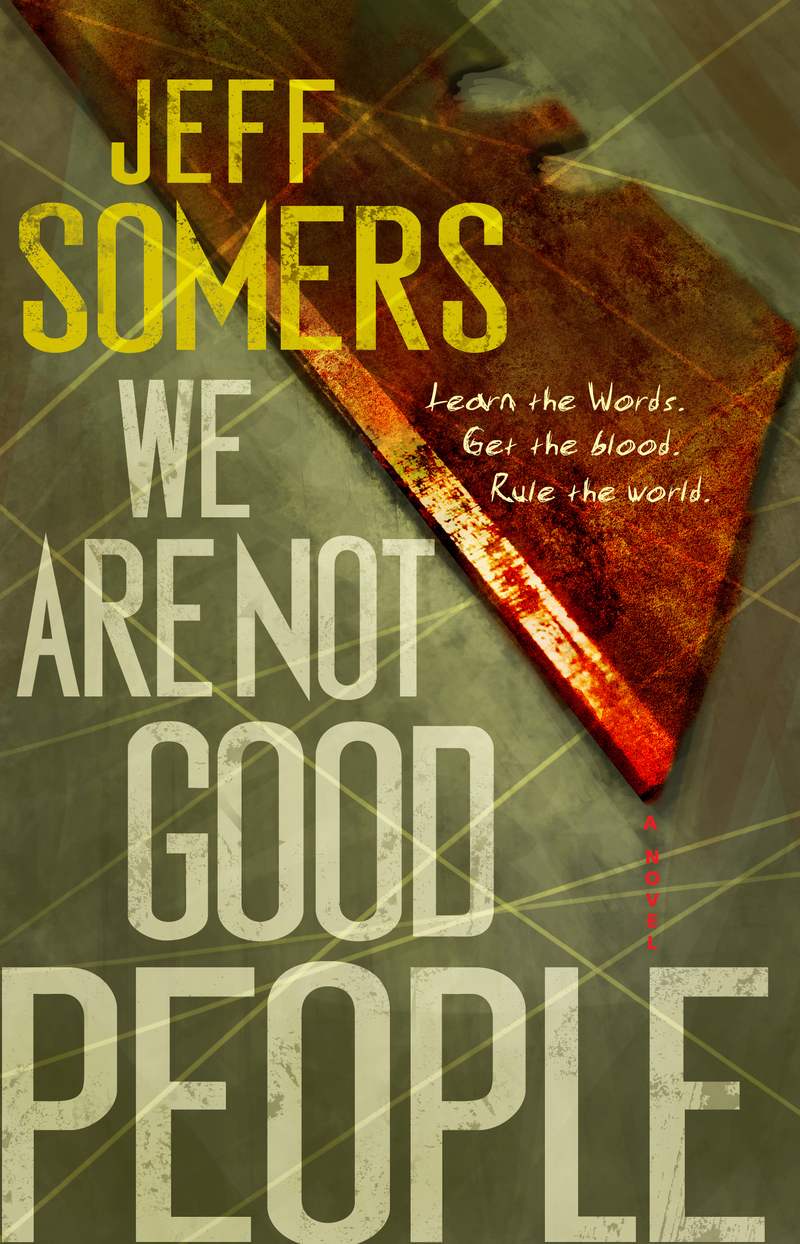
New Treasures: We Are Not Good People by Jeff Somers

New Treasures: We Are Not Good People by Jeff Somers

We are not Good People-smallJeff Somers has made quite a name for himself as an SF writer. His first novel, The Electric Church (2007), launched what eventually became know as the Avery Cates series (five volumes, including the most recent, The Final Evolution in 2011.) He’s less well known as a fantasy writer. His first fantasy novel, Trickster, published by Pocket Books last year, introduced Lem and Mags, two unlikely heroes in an underground world of blood magic. But Trickster was only the first half of the tale, and now it has been re-packaged with the second half and re-released by a new publisher as We Are Not Good People.

Ethics in the world of blood magic is gray at best. Unbeknownst to most, powerful mages have orchestrated disasters — plane crashes, floods, wars — for centuries to fuel their spells with blood. Lesser practitioners, Tricksters like Lem Vonnegan, work smaller magical grifts to eke out a living using only their own gas. For refusing to bleed innocents for his spells, Lem has pretty much condemned himself and his massive, dumb sidekick, Mags, to a life of transient poverty. So when the pair finds Claire Mannice, marked with runes of deep magic and stuffed inside the trunk of a car, Lem knows the rescuing her may be noble or may be infatuation disguised as redemption. Either way, it is most definitely fatal.

For the world’s most powerful mage, Mika Renar, has earth-shattering plans for Claire — and the old woman has noticed their interference. Hopelessly outclassed, and both intrigued by the mysterious girl and devoted to protecting the pet-like Mags, Lem engages his Trickster knack for misdirection and survival to follow the trail of ling cons that Renar and the other archmages have going.

But even if Lem and Mags win, they can still lose. Dealing with the kind of power that doesn’t heed mercy — or death — the duo is fighting for nothing less than reality itself. For magic is nothing but cons all the way down.

We last covered Jeff Somers when we linked to his Huffington Post article, Fantasy Series Better Than Harry Potter. We Are Not Good People was published by Gallery Books on October 7, 2014. It is 514 pages, priced at $16.99 in trade paperback and $12.99 for the digital edition.

Selling Short Fantasy, Science Fiction and Horror Fiction, Part II

Selling Short Fantasy, Science Fiction and Horror Fiction, Part II

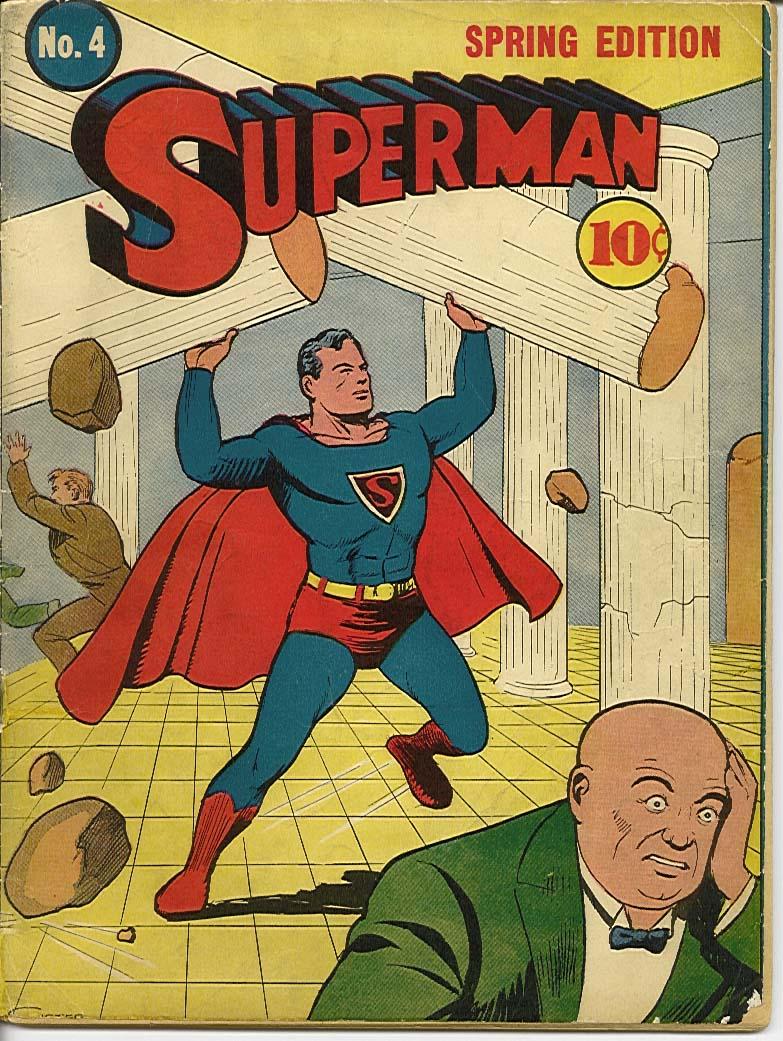
Superman004
Don’t sell your copyright. Superman smash!!

Hey everybody. Welcome to the second of a three-post series on selling short fiction. Last time, I talked about knowing the markets and how your own writing fits into them. This week, I want to talk about sales, contracts, payments, and what rights you’re selling when you sell short fiction. This blog post is in no way a sleep-aid, despite the fact that the last sentence included the words sales, contracts, and rights.

To snap you awake, let’s assume you’re new and you’ve written something. What’s your second worry, after worrying about backing up your masterpiece of short fiction? That nobody steals your shit! You’ve heard about Siegel and Shuster. DC owns Superman. Same with Batman. They sold the copyrights.

You’ve probably heard some variant of “brilliant-but-shy-artist-shows-his-genius-to-a-Hollywood-producer-who-says-no-and-three-years-later-sees-his-magnum-opus-on-the-big-screen-with-all-the-names-changed.” I’ve felt that fear. I’ve written stuff I thought was genius. Hahahahaha. No, seriously. People are worried about losing what they created.

So, first thing: You own it. Only you can sell the rights. And the rights you sell are always described in a contract, that you can choose to either sign or not sign. So, sigh of relief. Let me explain what you are being offered by way of example.

Read More Read More