Browsed by
Category: Blog Entry

The Poison Apple: A Cosplayer’s Best Friend, Interview with Photographer Bruce Heinsius

The Poison Apple: A Cosplayer’s Best Friend, Interview with Photographer Bruce Heinsius

Josephine Chang as Silk

Josephine Chang as Silk

I wanted to preface that when I first met Bruce, we were both working as Still Photographers in Hollywood, and he was on Power Rangers, which has made a comeback with a new feature film after twenty-five years or so.

BH: I worked on the television show the first season shooting everything from action on the set to special shoots for calendars, trading cards, video box covers and magazines.

You and I have been out of touch for a while, but we reconnected on Facebook, because you took photos of someone else I was already friends with, and that’s when I noticed you started taking photos of cosplayers at conventions. Why don’t you share with the readers how you got involved with that?

Back in 2006, I was supposed to be doing a movie shoot. When I showed up, the person who hired me apologized and said he forgot to tell me it was cancelled because everyone was going to a cosplay event instead. So, I tagged along and was surprised how many comic book and animé characters were there. I wasn’t really doing action photos on that first event, but I still tried to create good portraiture while photographing people in costume.

Read More Read More

World Weaver Press Open for Submissions, Both Novels and Short Stories for a New Anthology

World Weaver Press Open for Submissions, Both Novels and Short Stories for a New Anthology

solarpunk-banner-submissions_2_origCongratulations are in order for World Weaver Press. Their Kickstarter Campaign is funded! (But don’t neglect those stretch goals, they still have cool stuff they want to do.) This means the Brazilian anthology, Solarpunk: Ecological and Fantastic Stories in a Sustainable World will be coming out in English. It also means that World Weaver will be releasing another solarpunk anthology of original stories written in English called Glass and Gardens: Solarpunk Summers. They’ve posted their call for submissions, and in it they say:

Solarpunk is a type of eco-conscious science fiction that imagines an optimistic future founded on renewable energies. It might take place in a wind-powered skyscraper or on a solar-powered robotic farm, in a bustling green-roofed metropolis or in a small but tech-saavy desert village. Often coupled with an art nouveau aesthetic, and always inclusive and diverse, solarpunk stories show the ways we have adapted to climate change, or the ways we have overcome it.

For this anthology, I want to see solarpunk summers. Show me futuristic stories that take place in summer, whether that involves a summer night in a rooftop garden, or characters adapting to extreme heat and weather, or an annual migration to cooler lands. Keep it planet-based (Earth or other), and optimistic. Solarpunk worlds aren’t necessarily utopias, but they definitely aren’t dystopias.

We’re a northern hemisphere publisher, but southern hemisphere summers are also welcome!

Their site even provides suggested reading for inspiration.

Read More Read More

Fantasia 2017, Days 7 to 9: The Laplace’s Demon

Fantasia 2017, Days 7 to 9: The Laplace’s Demon

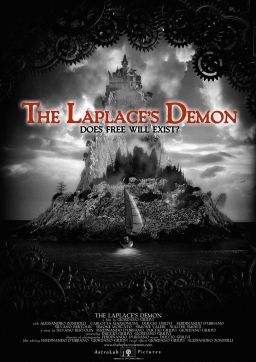
The Laplace's DemonAfter two days off, I returned to Fantasia on June 21 fit, trim, and rested. Randomness defines my festival schedule — it happened that the previous two days had nothing I wanted to see. But that Friday afternoon I was looking forward to one of the most intriguing movies listed in Fantasia’s catalogue: The Laplace’s Demon, directed by Giordano Giulivi.
A team of scientists has worked out how to calculate the complexities of glass shattering. Their mathematics imply a deterministic universe, if the code can be more fully cracked. The movie begins with them on their way to a mysterious island, summoned to the mansion of a reclusive genius. There, in his empty mansion, they find the terrible truth — their host, speaking to them by videotape, is playing a terrible game. He’s gone further than them, pushed the math beyond human sanity. Now the researchers are elements in a vaster experiment: the horrific mechanisms in the isolated house will eliminate them, one by one, if the equations are correct. Can they find a flaw in the math and save themselves? Is there room in the universe for free will?

Watching the film play out I saw science-fiction and mystery and horror blend in a classic plot framework. The movie feels like an artifact from Hollywood’s Golden Age, some previously-unknown Val Lewton piece, a forgotten film by James Whale. It’s shot in a heavily-shadowed black and white, much of it in one elaborately-furnished room filled with dark corners and rich art-nouveau details. Close-ups and odd foreshortening adds to an air of unreality, fostered by an unusually tasteful use of CGI. The characters here are caught in a metafictional plot, which can be predicted but not evaded. Clever, well-crafted, it evokes Halloween frissons of delicate horror, surprising while generating a sense of inevitability, moving to a creaky but effective plot climax that resolves its themes with the bleakness of a death’s-head inevitable grin at a deterministic universe.

Read More Read More

Modular: Dungeon Delving Tips – Part II

Modular: Dungeon Delving Tips – Part II

Delve_ESEarlier this year, Modular looked at the first dozen tips for dungeon delving from Creighton Broadhurst of Raging Swan Press. Today, we follow up and tackle thirteen more to get to 25. Good dungeon delving used to be a lot more important than it is today.

While characters seemed to die at a great pace in Gary Gygax’s original campaigns, for most of us who grew up on pen and paper, our characters were not disposable. We tried hard to keep them alive. Necromancer Games (who you surely read about here!) even put out a 3rd Edition D&D supplement, Raise the Dead, containing party quests to bring back that lost character.

In today’s MMO/video game world, death is simply something you undo by reloading the most recent saved game. A character can die dozens of times and we still get to play them over and over again.

But when death is a real threat, that party delving into the dungeons deep needs to employ strategies and tactics to accomplish the goal and get back out alive. Every character mattered (Kinda like, ‘No one left behind’ as a party slogan). So, here are thirteen more tactics to add to the first dozen to help keep your party alive.

Read More Read More

It’s So Weird I Can’t Look Away: DC Comics’ Young Animal Imprint

It’s So Weird I Can’t Look Away: DC Comics’ Young Animal Imprint

CCHACE

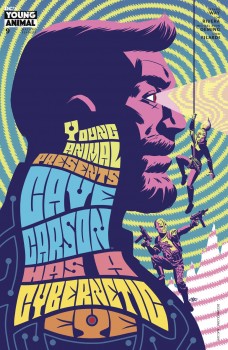
In 2016, DC launched a new imprint called Young Animal, an offshoot of its Vertigo stuff, led by Gerard Way and editors Jamie Rich and Mark Doyle. Young Animal’s goal is to relaunch some DC characters for mature audiences. I hadn’t been paying attention, but got drawn in by Cave Carson Has A Cybernetic Eye.

Read More Read More

GenCon 2017 Pt. 3, Youth Edition

GenCon 2017 Pt. 3, Youth Edition

StuffedFablesDemoI’ve been making my through the games that I saw at this year’s GenCon, first of fantasy deck-building games and then some science fiction games, but I’d like to focus now on games with a particular audience focus: games for kids.

Stuffed Fables

Over the years, I’ve become a huge fan of RPG-in-a-box style games. While I love my old school Dungeons & Dragons, the fact of the matter is that I don’t always have the time to create an ongoing, engaging storyline, create NPCs, and so on. Games that can generate  the storytelling experience that I love from role-playing games, but eliminate much of the up front work, are definitely things that catch my eye. One of the knockout games of this type is Plaid Hat Games’ Mice & Mystics (Amazon, Plaid Hat), which I first learned about and discussed at GenCon in 2012. My youngest son was a mere 2 years old at the time, so too young for the game, but now it’s one of his favorite games, and one of the more epic games that are enjoyed equally by myself, both my kids, and my wife. The game has two expansions, Heart of Glorm and Downwood Tales, as well as a spin-off Tail Feathers (Amazon, Plaid Hat), which is more of a tactical wargame in a box, as you play mice and rats who wage war on each other by riding on the back of sparrows and ravens. There are also infantry troops, and the heroes and villains from Mice & Mystics can be incorporated as solo units in Tail Feathers.

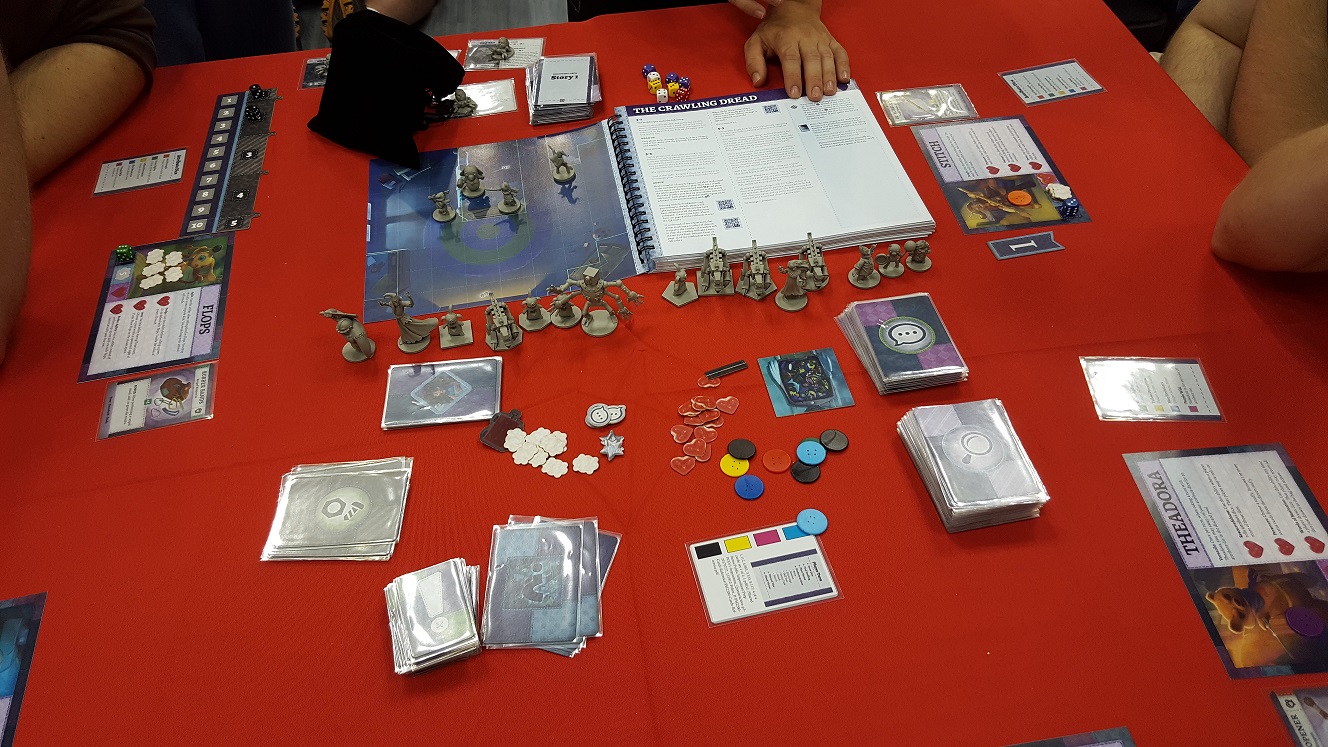
Jerry Hawthorne, creator of these games, has a new release coming up from Plaid Hat Games, which seems like it will be equally endearing. The game, Stuffed Fables, tells the story of a group of stuffed animals who, upon the first night that their child owner is in her big girl bed, learn that there are evil forces that seek to draw her into a world of nightmares. The first in Plaid Hat Games’ AdventureBook series, Stuffed Fables is an adventures that takes place by proceeding through pages in a book. The book contains both the map for the scene that is unfolding, as well as the storyline you follow as you play, giving you directions of what encounters take place on the given map, what happens when villains are defeated (or not), whether any new information is provided about the storyline, and so on. (This is one advantage over Mice & Mystics, which includes an expansive tile-based game board but then has you flipping through a separate story book to figure out what happens on a particular tile.)

Read More Read More

Once It’s Invented, You Can’t Uninvent It

Once It’s Invented, You Can’t Uninvent It

old vs new phoneMuch has been said about technology and the changes it brings with respect to our day-to-day world. It’s even been said that SF is the literature of change, exploring how evolution in technology, in scientific knowledge, in philosophical and political thought might, could, or does, affect our lives.
Changes in technology screw with one particular aspect of our lives that touches us all here at Black Gate very closely. They change what writers can and can’t write.1  If what you’re working on has anything to do with the present day world as we know it, every cell phone update can screw with your manuscript.

This is a kind of double-reverse example, but consider Larry Niven’s short story, “The Alibi Machine,” which essentially explores what would happen to crime and crime detection if instantaneous matter transfer was invented. If you could literally be anywhere, anytime in a matter of moments, how could you establish an alibi? How would the police eliminate you as a suspect?

Read More Read More

Lore of the Witch World by Andre Norton

Lore of the Witch World by Andre Norton

By the western wall of Klavenport on the Sea of Autumn Mists — but you do not want a bard’s beginning to my tale, Goodmen? Well enough, I have no speak-harp to twang at all the proper times. And this is not altogether a tale for lords-in-their-halls. Though the beginning did lie in Klavenport right enough.
— from “Legacy from Sorn Fen”

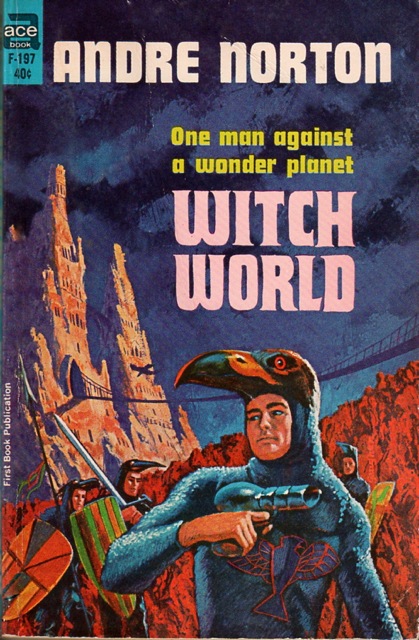
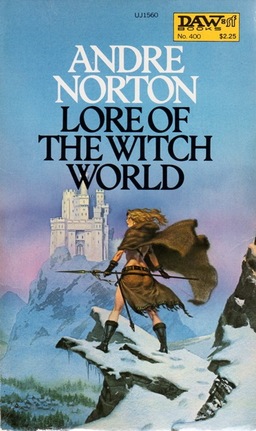
oie_2962753vGY7eZ66I’ve written before that Andre Norton’s Witch World books is a series I avoided for way too long. There were two things that kept me away from them over the years. The first, when I was younger, was their name: Witch World. It seemed a little too twee. When I was older there were so many other things I wanted to read that it never crossed my mind to investigate Andre Norton’s catalogue. If she ever occurred to me at all, it was as the author of Starman’s Son and several other books shelved in the children’s section at my local library. Later, I found a few scattered Norton volumes in the boxes of paperbacks my dad kept in the attic but, again, nothing prompted me to read them. At the time, the cover of “Witch World” turned me off. (Today I love the goofy looking thing.)

Not until I started contemplating blogging about swords & sorcery did I actually read anything by Andre Norton. When I started expanding my library of S&S books, there were several anthologies I finally picked up, one being Flashing Swords #2, edited by Lin Carter. I had read some of its stories before, but not Norton’s Witch World story, “The Toads of Grimmerdale.”

I was surprised by the darkness of the story. Like I said, I had assumed the Witch World stuff was light and airy and my first encounter with it was a story of revenge for rape, set in a country savaged by years of war. Well I was hooked, and I scanned my shelves for any other Witch World stories. I found “Spider Silk” in Flashing Swords #3, and “Falcon Blood” in Amazons!, edited by Jessica Amanda Salmonson. I rooted through boxes in the Vredenburgh attic and dug out my dad’s ancient copy of the first novel, Witch World, and devoured it. Its inventiveness, fast pacing, and the sheer fun of it made me an instant fan.

Read More Read More

Until Two Weeks Ago, I Had Never Reread a Novel

Until Two Weeks Ago, I Had Never Reread a Novel

oie_252050527ET7j1y7The title for this post is no exaggeration – until recently, I had never successfully reread a book. I don’t know if anyone else is in the same boat, but I’m blessed/cursed with an almost encyclopedic memory for storylines and characters. If someone asks a question about an old show I’m familiar with – whether it’s Fringe or 24 or The Good Wife – odds are that I can answer it, sometimes with exacting detail.

For example, this past semester a teacher friend and I were describing the ridiculousness of 24 to another colleague, and I could summarize each season in order, without hesitation. For some reason, I can still watch a movie or TV show I’ve seen before and enjoy it, but with novels I couldn’t seem to lose myself in the story the same as when I first read it. So I stopped trying.

But that spell seems to have been broken, courtesy of Jim Butcher. A couple weeks ago I was looking at my to-read shelf and didn’t feel like starting anything there (which sort of blew, since there are about twenty titles sitting there, staring at me with their lonely and judging eyes). There were several books there that needed to be read, either for the Aurora awards or for upcoming review posts here, but I knew forcing myself to read one of those would color my perceptions.

I was also hitting a point in discovery writing my new novel where I needed something to inspire me, and when you pick up a new book there’s always the chance it’ll disappoint you – like going on a first date, really (“he’s still single, ladies”). I ended up walking away from the shelf and figured I’d watch Netflix or play Fallout 4 or something, and try to pick a book another day.

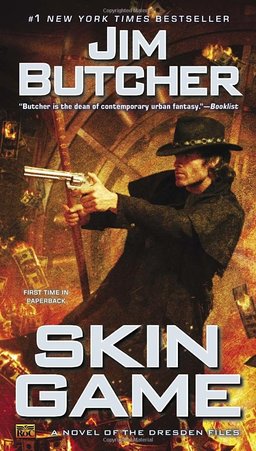
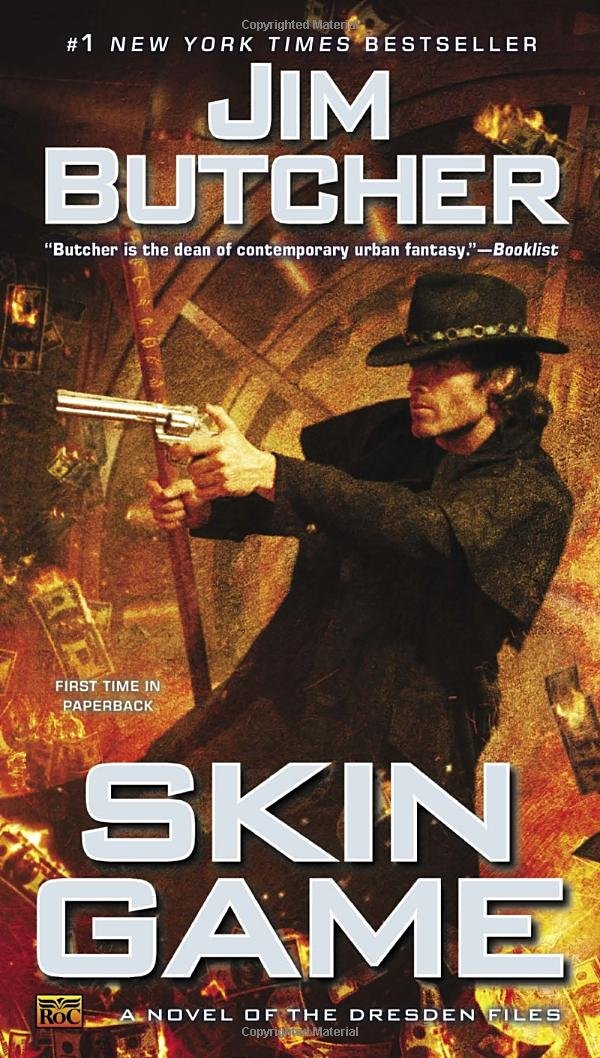
Then I remembered talking with one of my best friends about The Dresden Files, and how we’re both waiting for the next book like dogs salivating over prime rib behind a glass divider (in the off-chance that Mr. Butcher reads this, we’re not those brutal fans that rag on writers for taking too long to finish a manuscript – you take your time, sir). He’s reread the series a couple of times, but obviously I haven’t. Part of the reason why I’m such a huge fan is because it’s fast-paced, character-driven, and emotionally riveting – the main things I want to accomplish with my new novel. I’ve reread the occasional scene from a Dresden book for inspiration, and since the compelling voice in my head urging me to read something wouldn’t shut up, I decided to try my luck with Butcher’s most recent installment, Skin Game (which was on my Top Ten Books of 2016). Worst case, I wouldn’t make it very far, return the book to my shelf, and find something else to do with my time.

Read More Read More

The Opportunity for Awe: An Interview with Scott Andrews

The Opportunity for Awe: An Interview with Scott Andrews

Scott H Andrews Beneath Ceaseless Skies-smallBeneath Ceaseless Skies is a five-time Hugo and seven-time World Fantasy Award-finalist online magazine of literary adventure fantasy. In nine years, BCS has published over 475 stories and 200 audio podcasts by authors such as Saladin Ahmed, Richard Parks, Marie Brennan, Yoon Ha Lee, Aliette de Bodard, Bradley P. Beaulieu, Seth Dickinson, and more.  Find their ebooks and Best of BCS anthologies on Amazon and WeightlessBooks.com, their podcasts on Google Play and iTunes, and stories, artwork, new issues, and more at beneath-ceaseless-skies.com.

For nearly a decade now, BCS has been showcasing the work of both new and established writers in the realms of fantasy with a literary bent. My first professional sale was to BCS, and the magazine has published several of my stories since then, including my most recent, “Deathspeaker,” in the August 3rd issue. Recently I approached BCS editor Scott Andrews with some questions about “literary adventure fantasy” and its appeal to readers of sword & sorcery.

Beneath Ceaseless Skies publishes “literary adventure fantasy.” It’s pretty clear what those first two words mean separately, but can you explain the juxtaposition? What does adventure fantasy lack when it’s not literary (or gain when it is)? What does literary fantasy miss when it lacks adventure?

“Literary adventure fantasy” is my tagline for literary fantasy set in other worlds. The literary element that’s for me the most enjoyable and rewarding is a focus on character. A lot of secondary-world fantasy feels to me focused on the setting or the plot, but I like it on the characters, for example using narrative approaches like close points-of-view or conflicts that are internal in addition to external.

What adventure fantasy gains for me when it’s literary like that is the human highs and lows, the emotional exhilaration and gut-punch, that great literary fiction has. I love the line from Faulkner’s Nobel Prize speech that the only thing worth writing about is the human heart in conflict with itself. That may sound like highbrow English-class stuff, but there’s an author in SF/F/H today who I’ve heard reference that Faulkner quote:  George R. R. Martin. His fantasy is the most popular in the world, and he’s constantly praised for his characters and how realistic and emotive they feel. His work absolutely has those human highs and lows, those profound comments on what it feels like to be a parent or a sibling or a hero or a failure or a survivor. That’s character-centered focus I love to read.

Read More Read More