Browsed by
Author: John ONeill

The Fantasy of Lucius Shepard: A Handbook of American Prayer

The Fantasy of Lucius Shepard: A Handbook of American Prayer

A Handbook of American Prayer-smallLucius Shepard died on March 18 and, to commemorate his profound contributions to fantasy, we are surveying his books here. Today, we continue with a short novel with a fascinating premise: A Handbook of American Prayer.

Wardlin Stuart is in prison for manslaughter when he begins to write letters to God. He soon finds that his prayers are answered — all of them. Wardlin seems to have accidently stumbled on the correct way to supplicate God… or, at least, a god. But when he publishes his prayers, he sets himself up for a confrontation with a powerful fundamentalist minister. And in the meantime, God appears to have arrived on Earth…

A man walks into a bar. A dispute ensues, and the bartender kills him. He’s sentenced to ten years for manslaughter. In prison, the convict, Wardlin Stuart, writes prayers addressed to no god in particular. Inexplicably, his prayers — whether it’s a request for a girlfriend or a special favor for a fellow inmate — are answered, be it in days or weeks. When his collection of supplications, A Handbook of American Prayer, is published by a New York press, Stuart emerges a celebrity author. Settling into a new life in Arizona, he encounters a fundamentalist minister. The two are destined for a confrontation. In the interim, it seems that the god to whom Stuart has been praying has manifested himself on the earth. In this short novel about America’s conflicting love triangle — celebrity, spirituality, and money — Shepard negotiates the thin line between the real and the surreal, expounding upon violence and redemption along the way. This story of an unlikely American messiah shows why The Wall Street Journal has compared Shepard, an award-winning author, to Graham Greene, Robert Stone, and Ward Just.

We previously discussed Shepard’s acclaimed collection The Dragon Griaule and his vampire novel, The Golden.

A Handbook of American Prayer was published by Thunder’s Mouth Press on September 14, 2004. It is 272 pages in hardcover. A trade paperback edition was published simultaneously. Both are out of print; there is no digital edition.

Future Treasures: Prince of Fools by Mark Lawrence

Future Treasures: Prince of Fools by Mark Lawrence

Prince of Fools Mark Lawrence-smallIn The Broken Empire trilogy (Prince of Thorns, King of Thorns, and Emperor of Thorns), Mark Lawrence told the tale of Jorg Ancrath’s devastating rise to power. In a blog post for us shortly before Prince of Thorns was released, Mark Lawrence explained some of the genesis of the series:

The book I’ve written, Prince of Thorns, has layers, rather like an onion (or an ogre). I hope it can be enjoyed as a violent swords and sorcery romp. Get your teeth into it though and there’s more there – it’s as much about our prince as it is about what he does. This is a damaged person and although the story is told in his words without a hint of excuse, there are lessons to be learned between the lines. It wasn’t until tonight though, desperately scratching at the subject in the effort to come up with something to say in this blog post I was invited to supply, that I discovered another layer, deeper still…

In Prince of Thorns the main character has suffered a personal disaster. It’s not the ‘evil threatens the village’ of classic fantasy. It’s not injured pride or a looming darkness in the east. He’s been screwed over, a tsunami has rolled through his life and left devastation. And the book is in large part his reaction to that… It’s only through the lens of half a decade and more that I see I was writing out… not a version of my own experience, but a mapping of the emotions.

We published the first chapter of Prince of Thorns, with a brand new introduction by Mark, online here.

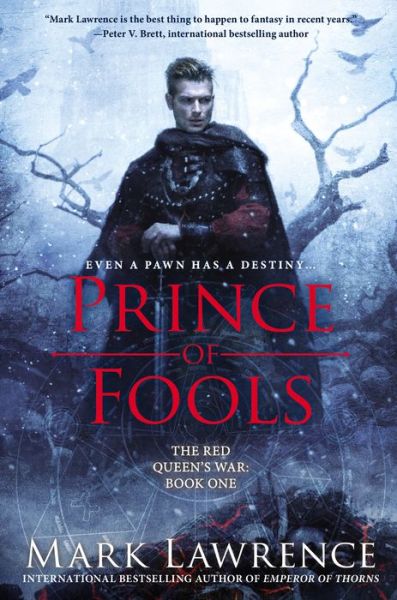
The numerous fans of The Broken Empire trilogy will be thrilled to hear that Mark Lawrence returns to the Broken Empire with his next book, coming June 3. Prince of Fools tells the tale of The Red Queen’s grandson, Prince Jalan Kendeth, a man tenth in line for the throne, who nonetheless finds life quickly becoming very complicated indeed…

Read More Read More

Vintage Treasures: Six Worlds Yonder / The Space Willies by Eric Frank Russell

Vintage Treasures: Six Worlds Yonder / The Space Willies by Eric Frank Russell

Six Worlds Yonder-smallWe’re back with our continued look at some of the most interesting Ace Doubles.

Last time we discussed Eric Frank Russell’s first Ace release, his 1954 novel Sentinels of Space (with a brief aside to look at his 1958 paperback collection from Berkley, Men, Martians, and Machines.) So I thought it apropos to examine his first Ace Double pair: Six Worlds Yonder / The Space Willies, published in 1958.

Six Worlds Yonder is a rather uniquely themed collection: stories of first landings on far planets, all published in Astounding between 1955 and 1957. Here’s the book description:

THE PLANET MAPPERS

One thing’s certain about the exploration of outer space — there’s not going to be two worlds alike! In this new collection of interstellar explorers, the fertile and original mind of Eric Frank Russell presents a half-dozen of the more extraordinary possibilities.

There’s the world where everything moves at a pace so different from ours that it would take a couple of lifetimes to establish communication. There’s the planet of immortals, with all that that really signifies. There’s the puzzling problem of keeping important messages secret when surrounded by truculent aliens. And there’s more…

Every story is different, every world is unique, and every adventure is science-fiction at its best.

Russell’s stories were frequently more whimsical than most others depicting the grim business of interstellar exploration in 1950s SF digests. I think perhaps Bud Webster described Russell’s style best in his book Past Masters, in his appreciation of the stories in Men, Martians and Machines.

Read More Read More

A Ride Along with the Thought Police: John C. Wright, Foz Meadows, and Rachel Aaron

A Ride Along with the Thought Police: John C. Wright, Foz Meadows, and Rachel Aaron

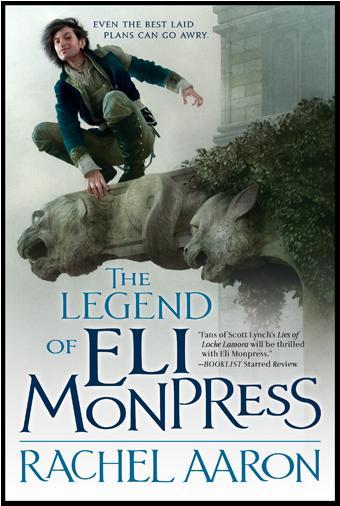
the-legend-of-eli-monpress2There’s been a lively and far-ranging debate that’s arisen out of the 2014 Hugo nominations, recent turmoil inside SFWA, and even the lingering controversy over WisCon withdrawing Elizabeth Moon’s Guest of Honor invitation back in 2010. It began earlier this week with author John C. Wright drawing the threads of these (and other) issues together to illuminate a broad conspiracy to silence conservative writers, in his article Heinlein, Hugos, and Hogwash:

The lamps of the intellect were put out one by one, first in society at large, then in literature, then in our little corner called science fiction. What we have now instead is a smothering fog of caution, of silence, of an unwillingness to speak for fear of offending the perpetually hypersensitive. Science fiction is under the control of the thought police…

When Larry Correia was nominated for a Hugo Award, the gossips reacted with astonishing venom, vocal enough to be mentioned in the Washington Post and USA Today. He was accused of the typical menu of thought crimes. You know the selection: racism, sexism, homophobia, xenophobia, insensitivity, fascism… The lunatic Left planned and struggled for years, decades, to achieve their cultural influence. Let us imitate their perseverance, and retake our lost home one mind, one institution, at a time. Start by praying.

Black Gate blogger Foz Meadows posted a thoughtful (and frequently very funny) response, “Silence Is Not Synonymous With Uproar: A Response To John C. Wright,” in which she ably disputes John C. Wright’s complaints point by point. Here’s an example:

You cannot state, as your opening premise, that SFF fandom is being handicapped by silence and an unwillingness to speak out, and then support that premise by stating the exact polar opposite: that there has, in your own words, been vocal uproarDoubtless, what Wright meant to imply is that the persons against whom the uproar is directed are being silenced by it – that he, and others like him, such as Larry Correia and Theodore Beale, are now suffering under the burden of enforced quietude. But given that all three men are still writing publicly and vocally, not just about the issues Wright raises, but about any number of other topics, the idea that their output is being curtailed by their own “unwillingness to speak for fear of offending” is patently false.

In her post “The Loudest Sound in the World is a Bigot Screaming That he’s Being Silenced,” Rachel Aaron, author of the The Legend of Eli Monpress and, under the name Rachel Bach, the military SF series Fortune’s Pawn, presents the radical idea that having readers react strongly to your ideas isn’t the same thing as being a victim of “thought police” — it’s something called criticism, a vital part of a free society.

Read More Read More

Vintage Treasures: The Book of Skaith: The Adventures of Eric John Stark by Leigh Brackett

Vintage Treasures: The Book of Skaith: The Adventures of Eric John Stark by Leigh Brackett

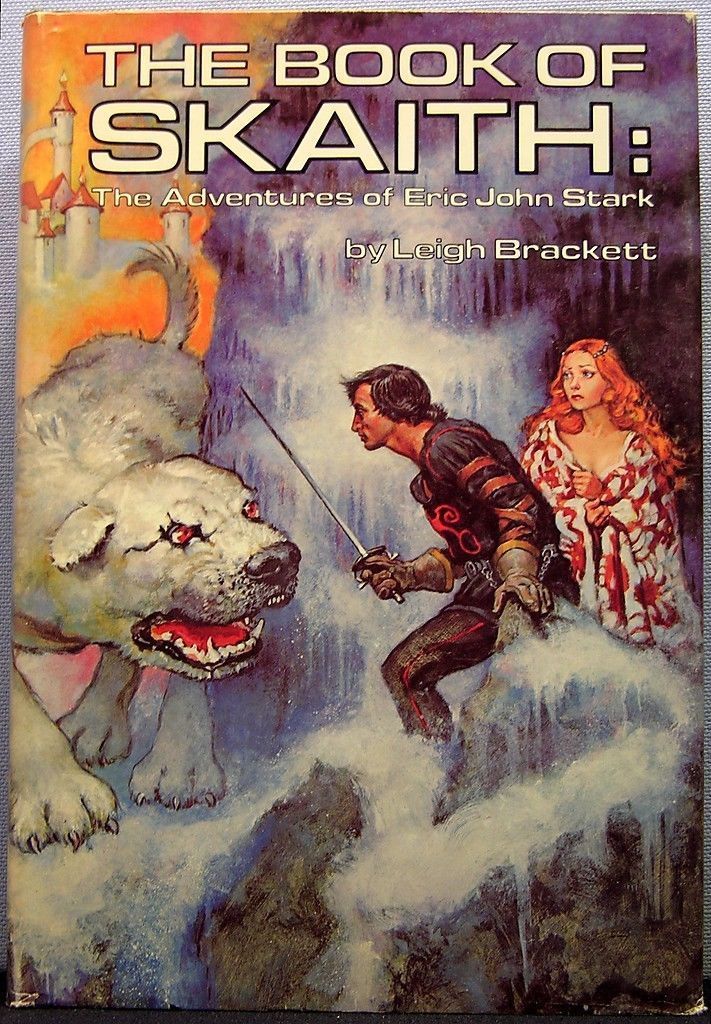
Leigh Brackett The Book of Skaith-smallI joined the Science Fiction Book Club in the fall of 1975, when I was in my last year at St. Francis Junior High School in Halifax, Nova Scotia. Before I joined, I agonized over my introductory selection — three books for a just a dollar! — for days, reading and re-reading the tiny paragraphs in the brochure, and then waiting impatiently for my selections to arrive in the mail. My friend John MacMaster enrolled me and I’m pretty sure I’ll remember the contents of my enrollment package until the day I die: The Foundation Trilogy by Isaac Asimov, The Hugo Winners, Volumes One and Two, edited by Isaac Asimov, and Before the Golden Age, edited by (can you guess?) Isaac Asimov.

John had introduced me to science fiction earlier that year, loaning me Clifford D. Simak’s Shakespeare’s Planet and Piers Anthony’s Ox when I was home sick from school. I devoured them both and wanted more. John explained how the club worked and it sounded terrific. “They sometimes have these big collections, a bunch of novels gathered into one book,” he said. “They’re the best.”

John was right. The year after I joined, in 1976, the featured selection for the month was The Book of Skaith: The Adventures of Eric John Stark, an omnibus of three novels by Leigh Brackett, under a new cover by Don Maitz. It was a marvelous introduction to one of SF’s great pulp writers, in an attractive and affordable package offered exclusively through the Science Fiction Book Club.

That’s one of the great things about the SFBC: its exclusive omnibus editions, highly collectible as they are, are generally still available at excellent prices. In February of this year, nearly 40 years after it was published, I bought a copy of The Book of Skaith in excellent condition on eBay for just $2.99.

Read More Read More

New Treasures: Valour and Vanity by Mary Robinette Kowal

New Treasures: Valour and Vanity by Mary Robinette Kowal

Valour and Vanity-smallBack in February, I had the good fortune to attend Capricon 34 here in Chicago, where I heard Mary Robinette Kowal read from her upcoming novel Valour and Vanity. It was a delightful affair, not least because Mary gave us a highly entertaining peek behind the scenes at what it really takes to produce a period fantasy novel.

Valour and Vanity is the fourth book in the successful Glamourist Histories, following Shades of Milk and Honey (2010), Glamour in Glass (2012), and Without a Summer (2013). Mary’s first collection, Scenting the Dark and Other Stories, was released by Subterranean Press in 2009.

Acclaimed fantasist Mary Robinette Kowal has enchanted many fans with her beloved novels featuring a Regency setting in which magic — known here as glamour — is real. In Valour and Vanity, master glamourists Jane and Vincent find themselves in the sort of a magical adventure that might result if Jane Austen wrote Ocean’s Eleven.

After Melody’s wedding, the Ellsworths and Vincents accompany the young couple on their tour of the continent. Jane and Vincent plan to separate from the party and travel to Murano to study with glassblowers there, but their ship is set upon by Barbary corsairs while en route. It is their good fortune that they are not enslaved, but they lose everything to the pirates and arrive in Murano destitute.

Jane and Vincent are helped by a kind local they meet en route, but Vincent is determined to become self-reliant and get their money back, and hatches a plan to do so. But when so many things are not what they seem, even the best laid plans conceal a few pitfalls. The ensuing adventure is a combination of the best parts of magical fantasy and heist novels, set against a glorious Regency backdrop.

Valour and Vanity was published on April 29 by Tor Books. It is 408 pages, priced at 25.99 in hardcover and $12.99 for the digital version. The jacket art is by Larry Rostant.

Baen Announces 2014 Fantasy Adventure Award

Baen Announces 2014 Fantasy Adventure Award

Baen Books logoAll right, all you aspiring fantasy writers. Here’s your chance to make a splash.

Baen Books has announced a new short story contest for the best original fantasy adventure tale under 8,000 words. They’re accepting entries in all categories of fantasy, including sword and sorcery, epic fantasy, heroic fantasy, urban fantasy, etc. Here’s the official announcement:

Baen Books is proud to announce the inaugural Baen Fantasy Adventure Award, to be given at this year’s Gen Con to the best piece of original short fiction that captures the spirit and tradition of such great storytellers as Larry Correia, Robert E. Howard, Mercedes Lackey, Elizabeth Moon, Andre Norton, J.R.R. Tolkien, David Weber and Marion Zimmer Bradley.

There’s no entry fee, but you’re limited to one entry per person. The story has to be original and not a reprint.

Only entries in English will be considered. Poetry or licensed fiction set in some else’s sandbox (such as Pathfinder, Star Wars, Doctor Who, or Twilight fanfic) will not be considered.

All submissions must be by e-mail. The contest is now open and entries must be submitted by June 30, 2014. A single winner will be announced at this year’s Gen Con.

Complete submission instructions are at the Baen website. Read them carefully, as they include very specific instructions.

Good luck!

May/June Magazine of Fantasy & Science Fiction now on Sale

May/June Magazine of Fantasy & Science Fiction now on Sale

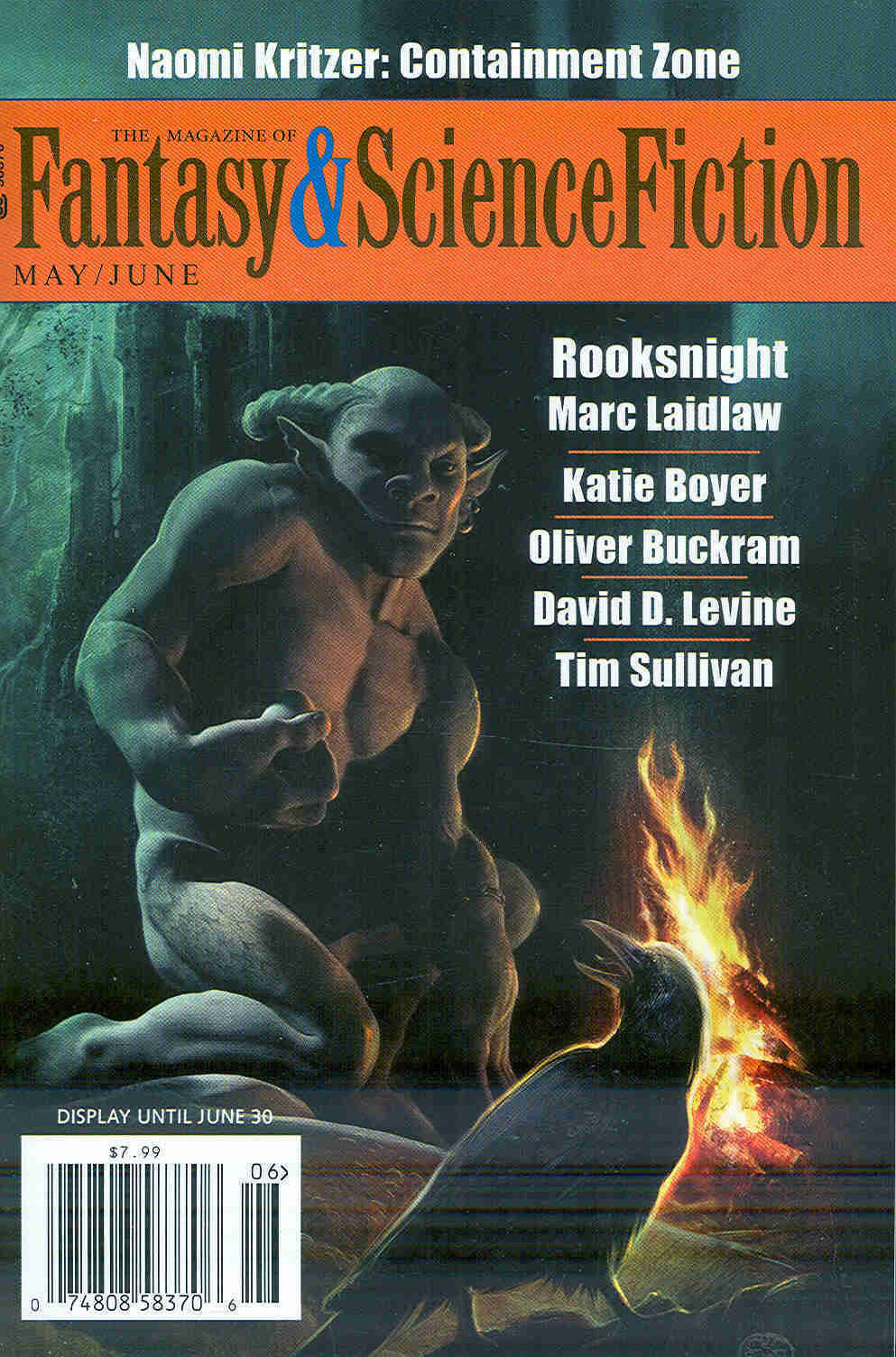
Fantasy and Science Fiction May June 2014-smallI’m so proud of myself. I had the latest issue of F&SF with me for my flight to New Orleans this week — which means I actually read it before it was time to tell you about it, for once. There I was, reading tales about mermaids and private eyes on Venus at 30,000 feet, while the guy on my left was playing solitaire and the woman on my right occupied herself with an article on Scarlett Johansson in Vanity Fair. Losers. Although admittedly, I kept getting distracted by glamor shots of Scarlett Johansson and tried to steal her copy of Vanity Fair when she started to nod off.

Anyway, I enjoyed this issue. It opens with David D. Levine’s pulp SF-hard boiled detective homage “The End of the Silk Road,” in which our hero, Mike Drayton (a man whose first thought is “Nice gams” when a woman collides with him in zero-g), takes a commercial prop-plane to Venus, land of foot-powered taxis and Venusian spider-silk factories, where he’s been hired to investigate a drug ring run by a froggie, a frog-like native. Of course, things aren’t what they appear to be and pretty soon the thick air of Venus is filled with the sound of gunshots, curses, and a lot of tough talk.

I was more impressed with Alyssa Wong’s first published story, “The Fisher Queen.” I was going to tell you all about it, but I made the mistake of checking Tangent Online first and discovered that the reviewers there (as usual) noticed a lot more than I did — including obvious allusions to William Faulkner and Angela Carter. So I’ll shut up and let Martha Burns & C. D. Lewis tell you about it.

“The Fisher Queen” by Alyssa Wong is stunning and smart. The first line, “My mother was a fish,” echoes a line in Faulkner’s As I Lay Dying. In Faulkner’s novel, a young boy’s lament that his dead mother is a fish functions as a metaphor for the boy’s grief together with a less obvious comment on the way women are caricatured and discarded. In Wong’s story, fifteen-year-old Lily’s mother truly is a fish or, rather, a mermaid. Her father jokes about this with his three daughters. In the early parts of the tale, this seems like a sweet way a beloved father helps his girls cope with their mother abandoning them, but when Dad’s fishing crew catches a different kind of mermaid on a deep sea expedition, Lily finds out the gut-wrenching truth. Like Faulkner’s novel, this is a meditation on the effects of motherlessness and brutality against women. It is also a deeply satisfying revenge story. Angela Carter is the acknowledged mother of retold fairy tales where the heroines are no Disney princesses. Now she has a daughter in Alyssa Wong.

Read the complete Tangent review here.

Read More Read More

Vintage Treasures: Fantastic Novels, July 1948

Vintage Treasures: Fantastic Novels, July 1948

Fantastic Novels July 1948-smallYesterday, I talked about finding a copy of the hardcover edition of Damon Knight’s Science Fiction of the 30’s on a sale table at Windy City Pulp and Paper for just $3.33. Items on the table were priced at 3 for $10, so before I could buy it, I had to find two additional items I could live with.

Didn’t turn out to be that hard. Right next to Knight’s dusty hardcover was a copy of the July 1948 Fantastic Novels magazine, with the gorgeous Lawrence cover at left. Admit it, that cover alone is worth $3.33. I snapped it up and didn’t even look inside.

I didn’t figure there was all that much to know about the contents, anyway. Fantastic Novels was famous for including a complete novel with each issue, which usually didn’t leave much room for filler. In addition to the cover story — Garrett P. Serviss’s 1911 novel The Second Deluge — this issue had only one additional story: Frank Lillie Pollock’s “Finis,” reprinted from the June 1906 issue of The Argosy magazine.

I imagine it had to be pretty cheap to produce a magazine containing only two reprints (assuming the editors paid anything for them at all). So what did the publishers of Fantastic Novels spend their money on? Beautiful art, that’s what. In addition to the cover by Lawrence, this issue had several full pages of art by Lawrence and the great Virgil Finlay. Click on the image at left to see the full-sized version. I have no idea what The Second Deluge is all about, but I want to frame this magazine and put it on my wall.

Alas, there were no other copies of Fantastic Novels to be found on the table — and no other hardcovers of interest. For my third item, I settled on an issue of The Original Science Fiction Stories from January 1956 that looked like it had just come off the printing press. It also has fiction by Randall Garrett and James Blish, so maybe it will turn out to be worth $3.33 too.  Either way, it’s fine by me; I got my ten bucks’ worth — and more — with the first two items.

Read More Read More

New Treasures: Thornlost by Melanie Rawn

New Treasures: Thornlost by Melanie Rawn

Thornlost Melanie Rawn-smallMelanie Rawn burst onto the fantasy scene in 1988 with her debut novel Dragon Prince, an instant success that became the first part of the Dragon Prince Trilogy (and, at nearly 600 pages, certainly helped usher in the 90s fat fantasy craze.)

How successful was Dragon Prince and its fat fantasy sequels? 26 years later, they’re all still in print. Pretty darned amazing, especially when you consider that half the New Treasures I’ve covered in the past six months are out of print already.

Rawn followed her breakout success with the Dragon Star trilogy (1991-94) and the first two novels of the Exiles trilogy. And then… silence, for nearly ten years.

She eventually set the Exiles trilogy aside (the final volume, The Captal’s Tower, is still listed as forthcoming on her website) and turned to urban fantasy with Spellbinder (2006), telling fans in a postscript to that book that she was battling clinical depression and needed to move on to other projects to speed her recovery. Fire Raiser arrived in 2009 and she returned to epic fantasy at last with The Diviner (2012).

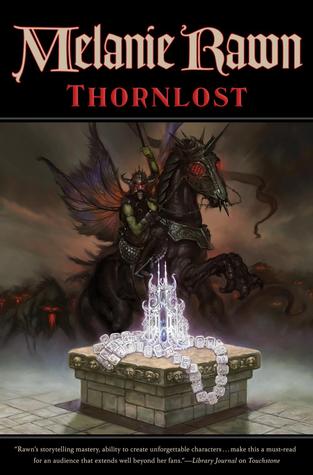
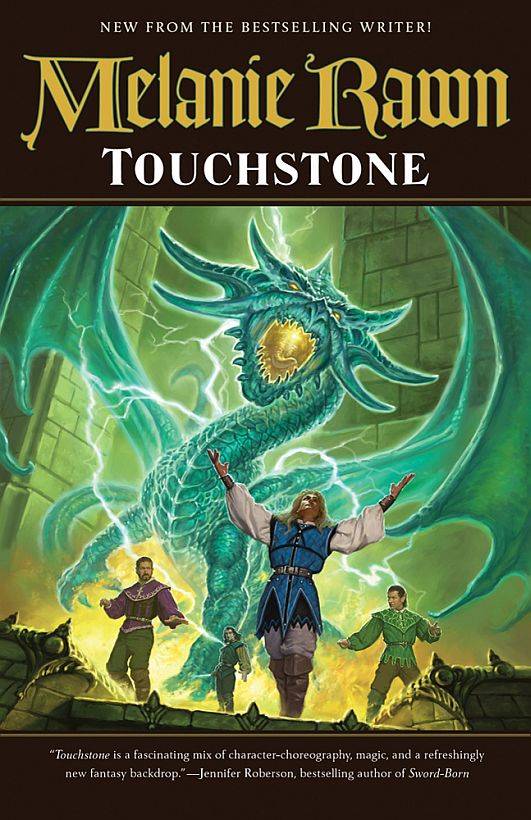
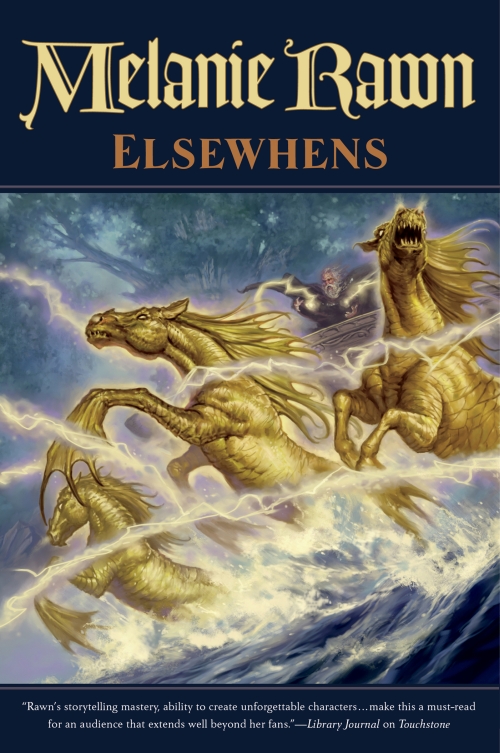
She’s been working tirelessly ever since, delivering the first two volumes of the Glass Thorns series: Touchstone (2012) and Elsewhens (2013). Now she returns to the rich fantasy world of those volumes with Thornlost, the third volume in the series.

Read More Read More