Vintage Treasures: Weird Tales #1, edited by Lin Carter
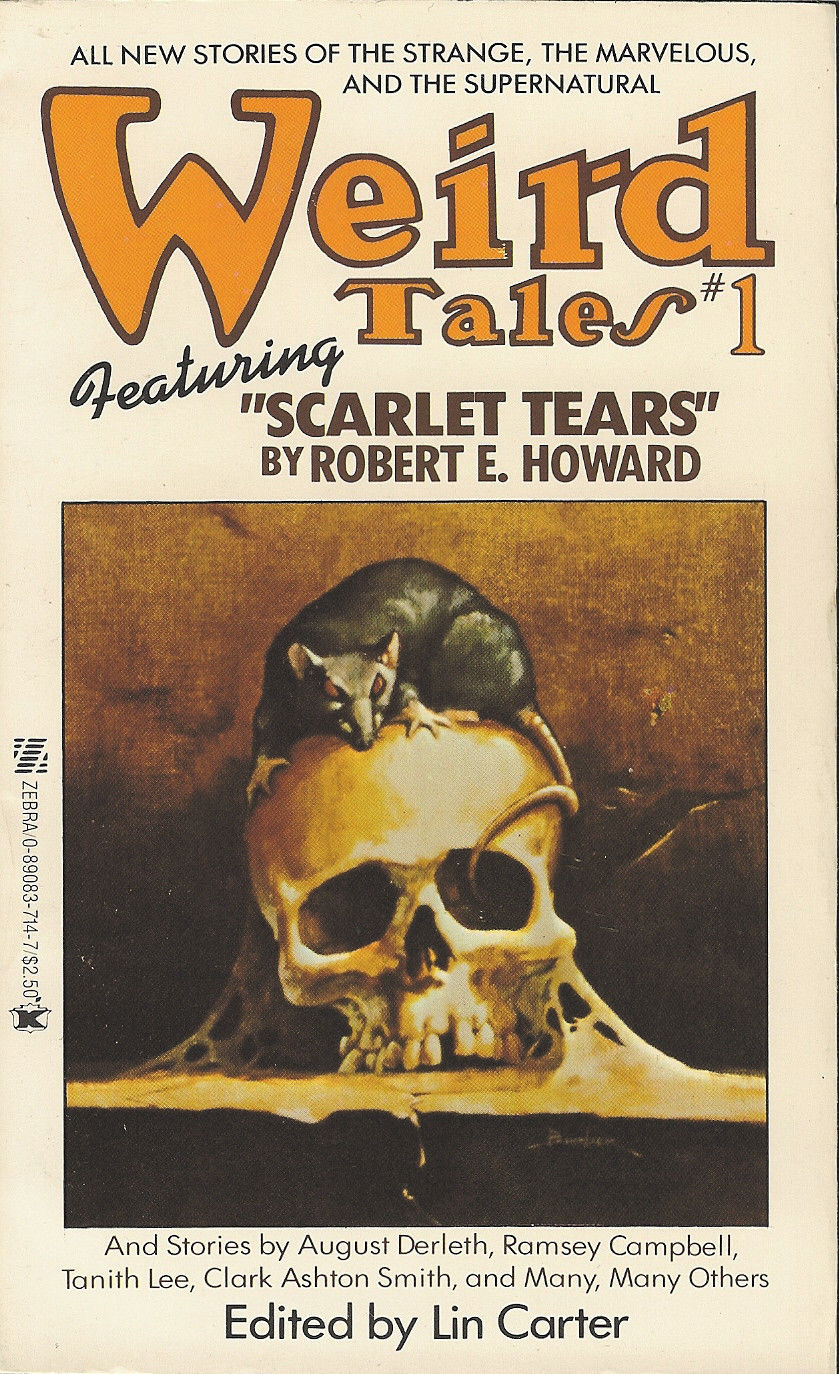 If you’ve hung around Black Gate for any length of time, you’ve heard us talk about Weird Tales, the greatest and most influential pulp fantasy magazine every published.
Weird Tales has died many times, and crawled out of the grave and shambled back to life just as often (if you’re a Weird Tales fan, you’ve heard countless zombie metaphors about your favorite magazine). When the pulp version of the magazine died in September 1954 after 279 issues, many believed it was for the final time. But it returned to life in the early 1970s, edited by Sam Moskowitz and published by Leo Margulies, and then perished again after four issues.
Bob Weinberg and Victor Dricks purchased the rights to the name from Margulies some time after that, and in December 1980 a brand new version appeared: Weird Tales #1, an original paperback anthology of horror and weird fantasy edited by none other than Lin Carter. On the inside front cover (under the heading The Eyrie, the name of the old editorial column in the pulp magazine) Carter introduced his anthology to a new generation of fantasy readers:
WEIRD TALES was the first and most famous of all the fantasy-fiction pulp magazines. It featured tales of the strange, the marvelous, and the supernatural by the finest authors of the macabre and the fantastic, old and new, from its first issue in 1923 until its 279th and last consecutive issue in 1954.
Now it is back, with all new stories — and even such an exciting find as “Scarlet Tears,” a recently discovered and never before published novelette by Robert E. Howard.
Over the years many great writers were published in the pages of WEIRD TALES, and now a great tradition is being continued into its second half-century.
“Scarlet Tears,” a Robert E. Howard story featuring his private detective Brent Kirby, never sold in his lifetime, and it’s not hard to see why (Kirby, a brawler who leads with his fists, doesn’t actually do much “detecting.”) Nonetheless, this kind of star billing for a Robert E. Howard trunk story gives you some indication just how much his reputation had grown since his death 44 years earlier.