No doubt somewhere someone is writing a vampire series based on Hamlet (there is, alas, a Romeo and Juliet and Vampires novel) but, for now, they are separate categories for two of my reviews posted on the current (mid-May) SF Site.
The first is Orson Scott Card’s retelling of Hamlet, which pretty much follows the play’s plot, but with a twist at the end I suspect the original author no more would have thought of than, well, making Hamlet a vampire.
The second is Cherie Priest’s kickoff of an “urban fantasy” (a term which I take to mean “vampires who live and suck blood in cities”) called Bloodshot, featuring Raylene Pendle (aka Cheshire Red), and thief for hire who also happens to be a slightly neurotic vampire.
The Sorcerers’ Plague
David B. Coe
Tor (496 pages, $7.99, February 2009 (originally December 2007))
Reviewed by Bill Ward
The Sorcerer’s Plague from David B. Coe is the first book in a planned trilogy entitled The Blood of the Southlands, which takes place in a different section of a world already established in Coe’s previous series, The Winds of the Forelands. While some characters and basic information is carried over from Coe’s previous series, familiarity with these elements is not necessary to the enjoyment of The Sorcerer’s Plague.
The Southlands are divided along racial and clan lines, and much of the back-story of this book goes into describing the various divisions and antagonisms between its competing peoples. No love is lost between the Qirsi, white-haired and pale-eyed sorcerers, and the Eandi, dark-haired people incapable of magic. Between these two racial groups are the Mettai and the Y’Qatt, people that inhabit the Companion Lakes Region in which most of the book’s action takes place. These two groups blur the distinction between the races as the Y’Qatt are Qirsi who refuse, for religious reasons, to use any magic, and the Mettai are Eandi who are actually powerful magicians — only the Mettai use earth and blood magic rather than the Qirsi’s channeling of their life essence for purposes of sorcery. The competing abilities and philosophies of these groups are fertile ground for the plot.
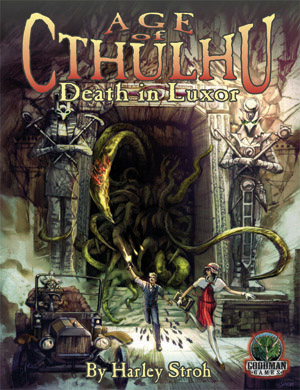
If you’re in the mood for some good horror encounters with the dark forces of the Great Old Ones, then the new Age of Cthulhu line from Goodman Games may be of interest. Vincent Darlage reviewed the first installment in this set of game modules. (Links to other Cthulhu resources at the bottom of this post.)
by Harley Stroh
Goodman Games (48 pp. Softcover, $12.99)
Reviewed by Vincent N. Darlage
This time, intrepid investigators are on the hunt for things man was not meant to know in Egypt, rather than Arkham or Dunwich – a nice change, so far as I’m concerned. A Lovecraftian horror is locked beneath Luxor in Egypt, and is unleashed, bringing with it a new era of darkness that will blast all of mankind, unless the intrepid player characters can stop it. The adventure is heavily focused on investigation, not on combat, which was nice to see.
The finding of the clues and the free-form nature worked well for me; Luxor doesn’t seem to railroad the players much, if at all. I especially liked the investigation summary on page four. The summary goes through each scene and lays out in a few sentences what is revealed and where it leads. For a free-form adventure, this is essential as it details which scenes have which clues. More adventures need to do things like this. …
City of Bones by Martha Wells
Tor Books (383 pages, hardcover, June 1995)
It’s always fun to find a fantasy book that isn’t based on medieval Europe. City of Bones, by Martha Wells, is advertised as a story which draws on the Arabian Nights, and it does not have genies and magic lamps, but certainly brave thieves and dangerous deserts. It also contains a little bit of steampunk and a post-apocalyptic element.
Our hero Khat is a relic dealer, which is to say, a shady and unlicensed archeologist-for-profit. It seems that long ago, the world was wetter and cooler and more hospitable, and artifacts from that time have great value — not to mention, very occasionally, magic powers. Now, most of the world is covered by a rocky desert called the Waste. Khat is a krisman, a hardy marsupial humanoid who is well-adapted to the Waste, but reviled in most cities. Charisat, where he lives, may be one of the richest trading cities in the world, but it’s a cruel and hierarchical place.
Khat and most of the people he knows are noncitizens, and they take it for granted that they have very few rights. They aren’t even permitted to use “real” money, just tokens that serve the same purpose. Khat and his associates are very careful never to speak of buying artifacts; they barter for them. Even using the word “buying” could bring the Trade Inspectors down on them, and if the Trade Inspectors take them away, they won’t be coming back.
This tension between the powerful and the powerless is one of the driving forces of the story. When Khat is hired by a Patrician to help explore a nearby ruin, he takes it as read that he’ll probably be betrayed. It only becomes worse when he realizes that the Patrician is actually a Warder, a law enforcer who uses sanity-destroying magic. Khat becomes more and more involved in events, but he never entirely trusts any of his companions, even fellow relic dealer Sagai, his long-time partner. His paranoia is at least partly justified.
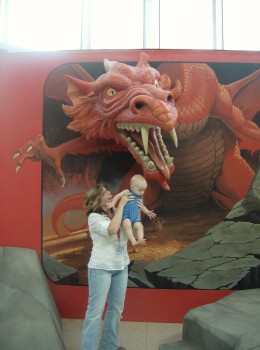
Did I say I was an unapologetic geek? My wife, Amber, offered our son to a dragon at GenCon!
I’m an unapologetic geek. I don’t just watch genre shows and read genre books, I immerse myself in them. The ones that stay with me, that I actually decide to devote myself to, linger with me, becoming part of the fabric of my internal world, the thought processes that help me deal with the mundane levels of reality. I analyze these cultural components, trying to pick them apart to figure out why the events unfolded the way they did and, more importantly, what I can learn from it. (For an example, consider how I found an excuse to talk about Thoron my Physics blog, using the film as a lesson in how to be a good scientist.)
Black Gate is also dedicated toward this sort of exploration, publishing not just fantasy fiction but also thoughtful commentary on the genre, in both the magazine and also on this blog. (At this point, I feel the need to point out Aaron Starr’s recent excellent post “The Gods Never Urinate,” which is an exceptional case of this.) Even on our Twitter feed, @BlackGateDotCom, we try to share as much of this sort of material as we can.
But let’s really think about what’s going on here. The genre of science fiction and fantasy, more than any other, reflect upon the fundamental nature of reality. They can do this literally, metaphorically, or (when at its best) in complex combinations of the two. So you have reality, and then you have the genre literature which is reflecting upon that reality.
And the truly motivated fans don’t just read the literature. Remember, the word “fan” comes from “fanatic.” If you don’t obsess at least a little bit, you aren’t a fan, you’re just someone who likes the show or the book. Fans go a step further, and we reflect upon the genre. We reflect in our own minds, and through the written word, both online and in print, in podcasts and vidcasts, and in person at gaming stores, comic shops, bookstores, conventions … or, let’s be honest, any time more than two of us are in contact with each other. The depth of the analysis can vary widely, of course, but that reflection on the genre is the defining trait of fandom.
Fandom is the process of reflecting upon the reflection of reality. …
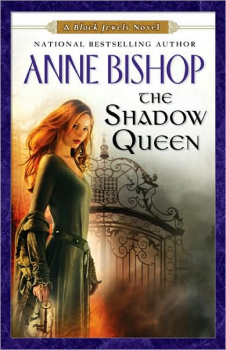
The Shadow Queen
Anne Bishop
Roc (368 pp, $7.99, March 2010 mmp (originally March 2009))
Reviewed by Thomas M. MacKay
Anne Bishop burst onto the fantasy scene in 2001, releasing 12 fantasy novels in the last 8 years. An accomplished epic story teller, her work features magic in strange and edgy forms, where power, sexuality and love become hauntingly bound with darker impulses. The critically acclaimed Black Jewels trilogy introduced a world of a power-stratified society where those with the most power seem to be the least stable, living on the knife-edge of control and constantly at risk of being overtaken by storms of rage and desire – and other more sanguinary passions.
The Shadow Queen marks the seventh novel in this series, and explores the issues faced by one of the lesser lands attempting to recover after the war of power and dominion between the Blood was conclusively ended by the magic of the Witch of Ebon, Askavi.
Theran Grayhaven is the last of his line, a Blood family that had ruled the land of Dena Nehele for generations until it was taken over by the corrupt Blood when Theran was just a small child. Raised in a rebel mountain camp, Theran only knows war, and finds himself at a loss when peace suddenly arrives. His war-torn country is on the edge of collapse, its people in chaos, the magic-less landen still chafing at the rule of the powerful Blood, and few of the Blood remaining in Dena Nehele to aid in the rebuilding. Theran knows he needs a Queen of the Blood, someone who follows the old ways, who believes in the responsibility of stewardship. He needs a Queen with the strength to deal with the struggle of rebuilding, the grace to evoke loyalty in a conflicted people, and the power to claim authority over the Blood. He only knows one place to ask for help in finding such a Queen, at the Keep at Black Mountain, where the most powerful and unpredictable Blood hold court.
I had a quiet day at work, but blimey! I got a lot done!
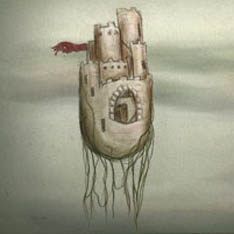
While I hauled boxes, processed books, priced, et cetera — so long as customers weren’t in the bookstore — I listened to four stories right off of Podcastle’s website, starting with two by Tim Pratt.
The first one was called “Cup and Table”, which was (and here I quote the man who recommended it to me), “so kick-ass and so much fun and kind of unbelievable how much is crammed into that story.” It was very time-bendy (timey-wimey, as the denizens of Doctor Who might say), its edginess and moroseness always tinged with the tongue-in-cheek. And the end? Surprised a huge grin outta me. I very much recommend it.
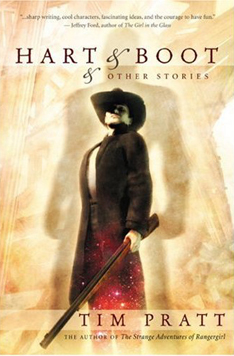
The second, “Hart and Boot”, was less structurally complex but even more to my taste. It was like something my buddy Patty might write after we watched a few too many episodes of Deadwood and we were in a gun-slinging, hip-swinging mood. Its protagonist, Pearl Hart, made me want to put on a pair of cowboy boots and shoot my way across the west. (‘Specially if naked men sort of slurped up from the mud every time I thought on ’em hard enough. Yummy.)
What I liked best was that even with Pearl’s foul mouth, her conniving mind, her selfishness and brazenness and remorseless use of people (especially, perhaps, of the one human she actually loved), she still had moments of rough tenderness that just… got me. Boot was great too, but there’s only so much you can do with a character that tired all the time.
Knight Errant
Anthony Reynolds
BL Publishing (411 pages, $7.99, 2008)
Reviewed by Bill Ward
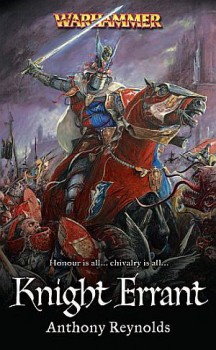
Every race or culture in Warhammer has fairly clear antecedents — Dark Elves are reminiscent of Moorcock’s Melnibonéans, Orcs and Goblins have their ultimate roots in Tolkien, and human societies like the Norsca and Kislivites have obvious historical counterparts. But it’s almost odd that the Bretonnians, a society modeled on Medieval France, have received as little attention as they have because, when most people think of secondary world fantasy, it is Medieval Europe that immediately springs to mind as the foundation for such worlds. Not so in Warhammer, which overwhelmingly focuses on the territory of the Empire, a society modeled on the Renaissance principalities of Germany.
But with Knight Errant, Anthony Reynolds sets out to give the Bretonnians their due, with what is obviously the first book of a planned series chronicling the adventures of a young knight named Calard. Calard is the first son and heir of the Lord Garamont, castellan of Bastonne, one of the primary dukedoms of the realm of Bretonnia. Bretonnia is patterned on Medieval France, with similar names, chivalric code, heraldry, emphasis on mounted combat, and feudal structure. But this is also the world of Medieval romances such as the Song of Roland and Le Morte D’Artur, complete with a Lady in the Lake, magic weapons, and knights who have sworn to quest for the Holy Grail.
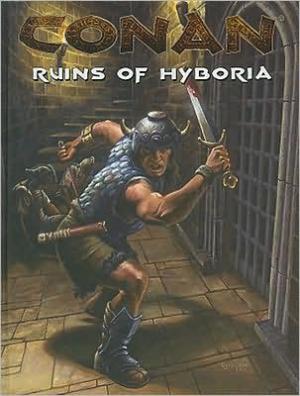
Conan is one of the most influential characters in all of fantasy. His influences has always been felt in the background, but he’s getting a lot more press lately due to an upcoming film adaptation (complete with new trailer). This supplement, reviewed by Jeff Mejia, focuses not on the man so much as the setting … or rather, a type of setting which is woven into many of the greatest Sword and Sorcery tales (and games).
Vincent N. Darlage
Mongoose publishing (156 pages, $29.95, June 2006)
Reviewed by Jeff Mejia
Like many of you, I’m one of those who actually read The Lord of the Rings decades before the movie came out. I would get the books out every couple of years and reread them, and as I did so I would wonder what this locale would look like or how to create that character using my favorite gaming system. When Peter Jackson’s epic movie trilogy came out I was an instant fan; sure they left out a couple of favorite characters and missed a few beats here and there, but for all of that I finally had a glimpse of Middle Earth beyond the Brothers Hildebrandt calendars. For me Jackson’s The Lord of The Rings was a feast for the eyes. And such is the case with Ruins of Hyboria.
From Conan to Thundarr, Ruins have been a staple of Sword and Sorcery fiction. In Ruins of Hyboria by Vincent Darlage, we are not only provided with a system to help create and flesh out ruins of our own creation, we are also treated to full descriptions of some of the more famous ruins in the Conan saga.
The Archangel Castiel is confronted about his recent actions.
This week begins with the Archangel Castiel praying in a cemetery, recounting to God some of the wonders he’s encountered over the ages: a fish crawling from the water, the Tower of Babel (there’s only so high you can pile dung), Cain/Abel, David/Goliath, Sodom/Gomorrha, and so on … up until the Apocalypse, which “was averted by two boys, an old drunk, and a fallen angel. The grand story and we ripped up the ending and the rules and destiny, leaving nothing but freedom and choice.” (A lot of good dialogue in this one, so it’ll be a quote-heavy review.)
Except now Castiel has doubts, that maybe he’s made the wrong choice, and he’s seeking guidance from God, so he begins to tell his story.
With the Winchesters, Castiel is still pretending that he doesn’t know whether or not the demon Crowley is alive. In reality, not only is Crowley alive, but he’s currently dissecting Eve’s corpse. “Eve’s brain, dead as a tin kipper, and yet, for some reason, she keeps laying eggs.” Creepy, fish-like eggs, which he pulls out of her guts. And when he electrocutes her brain, it causes seizures in a vampire they have tied up (just for these sorts of experiments, apparently).
Crowley’s concerned that Castiel is distracted, that his affection for the Winchesters is putting their plans to open Purgatory in danger. They’re bickering like an old married couple. “The stench of that Impala is all over your overcoat. I thought we’d agreed, no more nights out with the boys.”
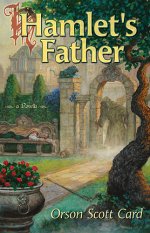 No doubt somewhere someone is writing a vampire series based on Hamlet (there is, alas, a Romeo and Juliet and Vampires novel) but, for now, they are separate categories for two of my reviews posted on the current (mid-May) SF Site.
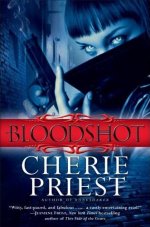 The second is Cherie Priest’s kickoff of an “urban fantasy” (a term which I take to mean “vampires who live and suck blood in cities”) called Bloodshot, featuring Raylene Pendle (aka Cheshire Red), and thief for hire who also happens to be a slightly neurotic vampire.
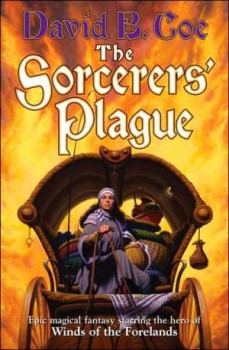 The Sorcerers’ Plague
 If you’re in the mood for some good horror encounters with the dark forces of the Great Old Ones, then the new Age of Cthulhu line from Goodman Games may be of interest. Vincent Darlage reviewed the first installment in this set of game modules. (Links to other Cthulhu resources at the bottom of this post.)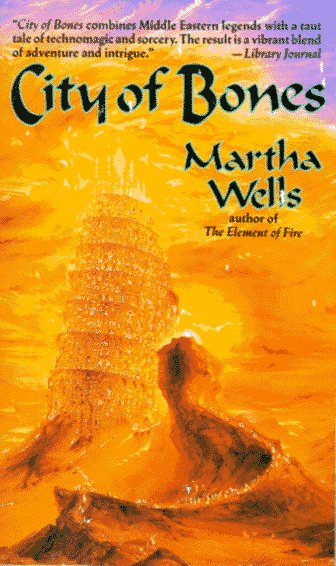
 The Shadow Queen
 I had a quiet day at work, but blimey! I got a lot done!
 The second,
  Knight Errant