Browsed by
Category: Reviews

Red Sonja 2

Red Sonja 2

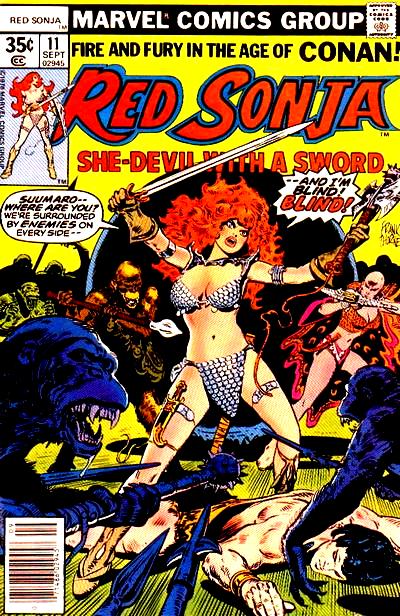
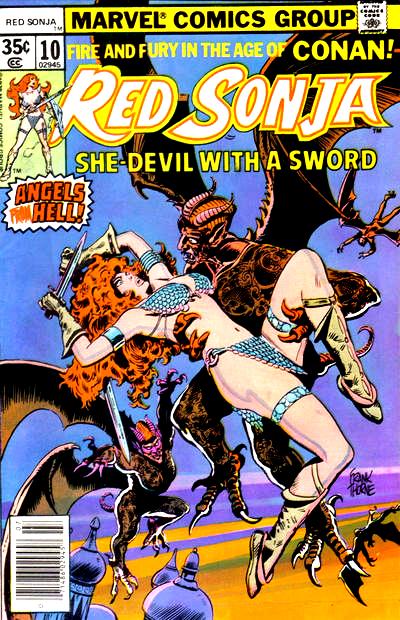
red-sonja-2-coverHonestly, I’ve tried twice to summarize “The Demon in the Maze,” and I just can’t figure out how. It’s a psychedelic mess of gonzo insanity. It reads as if co-writers Roy Thomas and Clara Noto just switched off writing pages without any idea of where the story was heading or how it would end. The whole thing is plenty of fun; but at the end, I still can’t figure it out.

It starts with Sonja finally reaching Venzia (which she’s been heading towards since Marvel Feature 6). The first thing she sees when she’s in sight of its famous canal is two trading ships crashing into one another and sinking. Even though the ships are less a minute’s swim from shore on either side of the canal, none of the sailors survive the crash.

Sonja doesn’t really have time to consider this mystery before she happens upon a woman being attacked by three bandits. She easily kills the trio in less than a page, but a fourth bandit, hiding in the shadows, knocks her unconscious and drops her to an underground mirror maze. The mirrors mess with her head to the point where she first hallucinates herself as a withered old woman (rendered only a little hilarious by the fact that she’s still wearing the chain mail bikini), then watches as her arms transform into snakes that begin to strangle her. Realizing that it’s an illusion, Sonja calms down and lets her mind “go limp,” at which point a passage out of the maze opens up. She leaves the maze and walks into the plot of the story.

An old man (who is never named) lies dying on the ground and explains that the underground chamber is the prison for an evil wizard (also unnamed) who wants to rule the world. Apparently, the chamber is also the prison of a demon (once again, unnamed) who can only be freed by a human hand. But not any human hand (otherwise, his cell-mate the evil wizard would just free him). The demon can only be freed by a human of exceptionally strong will (translation: the evil wizard is a wimp). The demon created the mirror maze as a test: anyone with a will strong enough to see through its illusions would have a will strong enough to free the demon. The fact that the maze is littered with bones implies that a lot of other women have been trapped down here.

Read More Read More

Edgar Rice Burroughs’s Mars, Part 11: John Carter of Mars

Edgar Rice Burroughs’s Mars, Part 11: John Carter of Mars

john-carter-of-mars-canaveralSo it ends here, not with a climatic epic, but with a bit of house cleaning almost fifteen years after the author’s death. The final book in Edgar Rice Burroughs’s career-spanning Barsoom saga is a slender volume containing two unrelated novellas.

I’ve called this review series “Edgar Rice Burroughs’s Mars,” but that title is a smidgeon deceiving when discussing the two stories here. One doesn’t take place on Mars, and the other was not written by Edgar Rice Burroughs. My apologies going forward.

Our Saga: The adventures of Earthman John Carter, his progeny, and sundry other natives and visitors, on the planet Mars, known to its inhabitants as Barsoom. A dry and slowly dying world, Barsoom contains four different human civilizations, one non-human one, a scattering of science among swashbuckling, and a plethora of religions, mystery cities, and strange beasts. The series spans 1912 to 1964 with nine novels, one volume of linked novellas, and two unrelated novellas.

Today’s Installment: John Carter of Mars (1964)

Previous Installments: A Princess of Mars (1912), The Gods of Mars (1913), The Warlord of Mars (1913–14), Thuvia, Maid of Mars (1916), The Chessmen of Mars (1922), The Master Mind of Mars (1927), A Fighting Man of Mars (1930), Swords of Mars (1934–35), Synthetic Men of Mars (1938), Llana of Gathol (1941)

The Backstory

Edgar Rice Burroughs died in 1950, two years after the publication of Llana of Gathol. Two novellas from the Mars series remained orphaned, having only appeared in magazines: “The Skeleton Men of Jupiter” and “John Carter and the Giant of Mars.” It wasn’t until 1964 that Canaveral Press published them together under the deceivingly archetypal title John Carter of Mars.

Read More Read More

Galaxy Science Fiction, November 1950: A Retro-Review

Galaxy Science Fiction, November 1950: A Retro-Review

galaxy-science-fiction-november-1950-smallI’m slowly making my way through my collection of Galaxy Science Fiction, continuing with the second issue, dated November 1950.

“Honeymoon in Hell” by Fredric Brown: In the futuristic year of 1962, due to some unknown cause, all of Earth’s babies are born as females. With their own ideas running out, the U.S. government turns to Junior – the largest cybernetic computer in the nation. The computer hypothesizes there could be something local to the planet causing the issue.

It suggests testing the theory by sending married couples to the moon – to see if conception in a different environment would produce males. The government chooses Ray Carmody, a former rocket pilot who was one of the few people ever to land on the moon.

To Carmody’s dismay, the U.S. teams up with Russia for the first of multiple missions, and he is married remotely to Anna Borisovna, also a rocket pilot. They land separately in Hell Crater and begin assembling a shelter, but their work is interrupted by unexpected arrivals.

This is a story that gives away its age with numerous details, but it moves along really well. It’s an interesting idea, and I liked how the plot unfolded.

“Forgotten Missionary” by Isaac Asimov: Humans land on Saybrook’s Planet, taking caution to establish a barrier between themselves and the indigenous species. Because they must. The previous explorers, under Saybrook’s guidance, found that the planet was like a single organism, and it wanted to add new species to its body. Given the opportunity, the planet’s organisms could impregnate other species, which would later birth scions with green patches of fur where their eyes should be.

When the barrier fails for a brief moment, one of the planet’s organisms sneaks aboard, disguising itself as part of the ship. Its mission is to wait until it encounters the humans’ home world before affecting all other specimens of life – otherwise, the humans would simply destroy themselves as their first explorers had.

Read More Read More

Red Sonja 1

Red Sonja 1

red-sonja-1-coverFinally, after four years of guest appearances and Marvel Feature auditioning, Red Sonja gets her very own title. And judging from the cover, it’s going to be some opening story. We’ve got a wizard, a giant snake that’s about to bite her leg (even though its head’s already been cut off and guts are spilling out of its neck stump), a giant dead spider, some little gray goblin-looking guy in the background, and a unicorn. And Sonja herself is walking past her own title banner, seemingly ready to step out of her issue, bloody sword in hand, to kill YOU. “To the death” is always a good bad-ass line for an action hero, so we’re ready to see everything on this cover that isn’t Red Sonja dead by issue’s end.

Well, first of all, there’s no giant snake. There’s no giant spider. There’s no goblin. It’s just a mean-looking wizard and a unicorn. Just so you know.

The story begins with Sonja having to kill her horse after it breaks a leg. She’s still feeling pretty bad about it a few hours later when she stumbles on a group of men with torches surrounding a horse, apparently intent on killing it. Coming closer, she realizes that they’ve cornered a unicorn. Seeing a mob abusing a “helpless proud creature” bothers her to the point that she starts cutting through a dozen men to free it. Jumping on the unicorn’s back, the two of them ride away. During the struggle, the unicorn’s horn was broken off, so that it just looks like a horse with a head injury; but Sonja’s quite happy to have the beast as her companion.

So, for those who are reading Red Sonja on a subtextual level, the woman who’s sworn a vow of de facto chastity rushes to help the mythic representation of purity only after its phallic symbol is removed. Of course, there’s no reason to read any symbolism in a naked woman and a symbolically castrated beast bathing together, sleeping together, or leaning against one another in a picaresque sunset. And there’s certainly nothing about the nervous creature growing a new horn, “even more beautiful than the other,” as it gets to know Sonja. Nor is there anything to the bitter old man inciting ignorant villagers into a fury over the unnatural union of Red Sonja and the unicorn.

Read More Read More

Adventure on Film: Could Holy Grail be the Funniest Film Ever?

Adventure on Film: Could Holy Grail be the Funniest Film Ever?

arthur-kingJust as an older generation recalls with perfect clarity where they were when they heard of Kennedy’s assassination, I know precisely where I first saw Monty Python and the Holy Grail (1975): perched on the floral-print sofa in my parent’s house, watching the film on a poor, weather-impacted PBS broadcast. I also remember falling right off that sub-par couch in paroxysms of laughter when the animator saved King Arthur’s band by conveniently suffering a heart attack.

I’d never seen anything like it.

And you know what? I’ve never seen anything like it since –– except perhaps Brian’s rollercoaster romp aboard a purple-people-eater’s spaceship in another Python outing, Life of Brian. (That one I saw in a theater, with my church-going mother sitting next to me. She laughed her head off.)

What I didn’t know back when I fell of that couch, as I’m fairly sure I do now, is that comedy is little more than tragedy plus time.

Read More Read More

Analog, July 1961: A Retro-Review

Analog, July 1961: A Retro-Review

analog-july-1961This is one of the earlier issues after Astounding completed its name-change to Analog. (The issues from February through September 1960 showed both titles on the cover – so October 1960 was the first purely Analog issue.)

Its Table of Contents is familiar to readers of the magazine even to the present day – there’s an editorial, there’s In Times to Come, there’s The Reference Library (book reviews), there’s the letter column (Brass Tacks). There is also a Science Fact article, and a serial, two novelettes, and two short stories.

The only item you won’t find in most present-day issues is The Analytical Laboratory, which ranks the stories from the issue two months earlier based on reader votes. (This was discontinued some time after I became a subscriber in the ’70s – I remember sending in my postcard with my votes a number of times.)

At any rate, for the April issue the number one story was the opening of Clifford Simak’s serial “The Fisherman”, better known these days by the book title, Time is the Simplest Thing.

The cover shows an asteroid mining setup. It’s by Thomas, who did a few covers for Analog in 1961 and 1962, and nothing much else I can find. I don’t even know his first name. Interiors are by Douglas, John Schoenherr, and H. R. Van Dongen.

Read More Read More

Edgar Rice Burroughs’s Mars, Part 10: Llana of Gathol

Edgar Rice Burroughs’s Mars, Part 10: Llana of Gathol

llana-of-gathol-1st-edBack on Mars, and closing in on its finale, after my short sabbatical… What can I say? It seems Synthetic Men of Mars will suck out the desire to keep trudging forward from even the most dedicated ERB enthusiast.

Llana of Gathol is the first of the two story collections that close out the published Barsoom epic: it contains four novellas chronologically linked together to produce an episodic novel… one that hopefully improves upon the failed previous book.

Our Saga: The adventures of Earthman John Carter, his progeny, and sundry other natives and visitors, on the planet Mars, known to its inhabitants as Barsoom. A dry and slowly dying world, Barsoom contains four different human civilizations, one non-human one, a scattering of science among swashbuckling, and a plethora of religions, mystery cities, and strange beasts. The series spans 1912 to 1964 with nine novels, one volume of linked novellas, and two unrelated novellas.

Today’s Installment: Llana of Gathol (1941)

Previous Installments: A Princess of Mars (1912), The Gods of Mars (1913), The Warlord of Mars (1913–14), Thuvia, Maid of Mars (1916), The Chessmen of Mars (1922), The Master Mind of Mars (1927), A Fighting Man of Mars (1930), Swords of Mars (1934–35), Synthetic Men of Mars (1938)

The Backstory

I discussed at length ERB’s decision to write novellas he could later gather into episodic novels in my review of Escape on Venus, one of the three collections he wrote simultaneously, rotating through settings. Escape on Venus was a massive bust, but part of the reason for its failure is that Venus is a minor location in ERB’s canon. The Earth’s core fared better with Savage Pellucidar. And what of Mars, so far Burroughs’s most consistent setting for quality? Could changing writing methods rescue readers from the mistakes that made Synthetic Men of Mars a glaring black mark on the series?

Read More Read More

Marvel Feature: Red Sonja 7 (plus Conan the Barbarian 66, 67, and 68)

Marvel Feature: Red Sonja 7 (plus Conan the Barbarian 66, 67, and 68)

marvel-feature-7-coverSo the next issue blurb at the end of Marvel Feature 6 was just a bit misleading. After you went back to the comic shop (or newsstand or drug store or wherever people went in 1976 to get comics), paid your thirty cents for Conan the Barbarian 66, and got the issue back home, you would discover that it wasn’t a continuation of the story from Marvel Feature 6 at all. No, “Daggers and Death-Gods!” instead told the story of Conan and Belit docking in Massantia to trade some “honest loot, freely plundered.” After some tense negotiating, they are told of a missing page from the Book of Skelos being kept in the Temple of a Thousand Gods. There’s a hefty reward being offered by an unknown client (who works through a middleman) to anyone who can steal the page from the temple. Conan and Belit make their way through the temple and, after nearly killing eachother, thanks to a caretaker’s spell, they find the page … and Red Sonja. So issue 66 actually tells a story parallel to the one we just finished, with the promise that the next part will, for real this time, be told in issue 67.

Well, we’ve already invested sixty cents into this story, so we might as well invest another thirty to find out where it ends. Issue 67 opens with four pages of re-caps to the stories we read in Marvel Feature 6 and Conan the Barbarian 66. After the recaps, Sonja and Belit have exactly one panel of dialogue before Belit draws her sword and tries to kill her. Red Sonja called her a serving wench and that was all it took because, as Belit is fond of reminding us, she’s actually the daughter of the death-goddess Derketa (Belit believes this because Belit is crazy). The fight lasts for three panels before Belit concedes that Red Sonja is a better swordswoman and throws her sword aside. But she hasn’t conceded the fight, only changed weapons. Apparently, Belit (like all crazy girlfriends) carries a knife. At this point, Red Sonja probably realizes that Conan has enough problems with his delusional knife-wielding girlfriend, so she opts instead to grab the page, slice through the torch that lights the chamber, then flee under cover of darkness. Because Red Sonja only has crazy delusions of grandeur after watching her entire family murdered. For Belit, it’s a lifestyle.

The rest of the issue is Conan promising Belit that he’ll track down Sonja and the page, then getting sidetracked when he discovers an old friend has been imprisoned for murdering one of the town guard (which he’s done so many times, you’d think he’d be surprised to find that some people actually get arrested for it). After killing a half-man/half-tiger (honestly, no one’s even surprised by this sort of thing any more), he frees his friend and discovers that he was locked in the cell next to the man who originally stole the page (small world, Roy Thomas, awfully small world). He meets back up with Belit and they take in this new bit of information just as Red Sonja races past them on horseback. We’re told that the story will be continued in Marvel Feature 7.

Read More Read More

Venture, March 1957: A Retro-Review

Venture, March 1957: A Retro-Review

venture-science-fiction-march-1957-smallAnother magazine from 1957, at the cusp of the Space Age, though this one appeared several months before Sputnik. Venture was a companion magazine to F&SF, intended to focus on pure Science Fiction. Ten bi-monthly issues appeared beginning in January 1957. It was revived in 1969, and six quarterly issues appeared from May 1969 through August 1970. I’ve always thought it a shame they couldn’t (it would seem) make a go of it, though I must say I’d never read a copy until now.

The look and feel of the magazine is similar to F&SF: 132 pages (including the covers), same font and column layout. Unlike F&SF, there are interior illustrations (by John Giunta). There are no features except for a sort of editorial (called “Venturings”) on the inside front cover.

The cover illustration, for Leigh Brackett’s “The Queer Ones”, is by Dick Shelton and it’s a bit odd: in two colors (red and olive green, plus black and white), showing a woman shooting a sort of raygun. It does accurately (if in a slightly symbolic way) depict a scene from the story.

As I said, no features, so let’s get right to the fiction. The stories are:

“Too Soon to Die” by Tom Godwin (15,100 words)
“The Lady was a Tramp” by Rose Sharon (6,700 words)
“Friend for Life” by Gordon R. Dickson (5,200 words)
“The Queer Ones” by Leigh Brackett (14,000 words)
“Blind Alley” by Charles L. Fontenay (2,600 words)
“Vengeance for Nikolai” by Walter M. Miller, Jr. (7,700 words)

Read More Read More

New Treasures: Dead in the Water, a Warhammer 40K Audio Drama

New Treasures: Dead in the Water, a Warhammer 40K Audio Drama

dead-in-the-water-sandy-mitchellLast week, I wrote a brief introduction to the Warhammer 40K universe, under the guise of a review of The Achilus Assault gamebook. It was a cheap gimmick, I know, but life is short and filled with great things you need to know about.

In the comments section Joe H wrote:

I love the WH40K setting, the thing that bothers me is that they have this vast sprawling galaxy full of wonders and terrors and way too much of the content seems to boil down to Space Marines vs. Space Orks… That’s why I was so intrigued by Rogue Trader — a WH40K setting that’s not just about FOR THE EMPEROR! I just wish we’d get more of that kind of thing in the novels. Are there any current novels that move outside of the Space Marine paradigm?

I love these kinds of questions. The kinds I actually have an answer to, I mean. And the answer in this case is yes.

There are several great series I could point you to, but because it’s after 9:00 pm and my family is impatiently waiting for me to start our family movie, I’m going to limit it to one: You should try the Ciaphas Cain novels by Sandy Mitchell. Commissar Cain is a revered hero of the Imperium, a man who’s seen action in some of the deadliest hot spots in the galaxy… and he’s pretty much done with that. All he wants to do is keep his head down and serve out his tour of duty… but alas, fate has other plans.

Cain is an entertaining rogue in a universe of dark horrors, and it’s a winning combination. There are several excellent omnibus collections of his novels available, but I recommend you start the same way I did: with Dead in the Water, a terrific one-hour audio drama that serves as the perfect intro to both Cain and the Warhammer 40K universe.

Cain is enjoying a quiet posting to a backwater river world when a squad on a routine mission goes missing. Pressed into investigating by his commanding officer, Cain quickly discovers that all is not what it seems… and a sinister opponent is manipulating events behind the scenes. The action is quick, the characters memorable, and the narration by Toby Longworth is excellent. The production quality of these Black Library Audio Dramas — with their dead-on sound effects, moody original music, and tight plotting — has been consistently excellent, and they have quickly become highly collectible. Already the early releases are out of print and starting to command collector’s prices on Amazon.com. I suggest you grab this one while you can.

Dead in the Water was published by Black Library in June, 2011.  It is one hour on a single CD, priced at $17.