Browsed by
Category: Reviews

Brian Catling and The Vorrh

Brian Catling and The Vorrh

The VorrhRaymond Roussel was a French surrealist writer who died in 1933, aged 56; one of his most famous works, Impressions of Africa, was a self-published novel (later turned into a play) depicting a fantastical African land based on no actual place, which contained a forest called the Vorrh. Late last year, the English sculptor and poet Brian Catling published his second novel, a story based on Roussel’s work: The Vorrh, first of a projected trilogy, described on its back cover as an epic fantasy. It’s a powerful book, precise and unexpected in its use of language and its plot construction, a dizzying and straight-faced blend of history and the unreal.

But beyond that, what is it, exactly? How are we to approach this book? Sure, you could call it ‘epic fantasy’ if you like — it’s very long, and there is fantastic matter in it, though no secondary world — but it’s so different from most other epics, and most fantasy as a whole, that the term is effectively useless. It’s mostly set in the years after World War One, but although there are scenes with peculiar Victorian technology and bakelite automata, it mostly avoids any feel of either steampunk or such recently-coined retrofantasies as dieselpunk or decopunk. It’s a little like the New Weird, but again that’s a category elastic enough as to mean very little, and the implication of a conscious distinction between the work at hand and a larger field of fantastic fiction seems misplaced; this is not a novel that seems to have been written out of an inherent interest in fantasy traditions, but a work that was written because it had to be. So while one can say that the Vorrh of Catling’s novel — a massive forest in which time is confused and myths wander — recalls Robert Holdstock’s Mythago Wood, the feel is something quite different.

So much for taxonomy. Leave aside what to call it. What’s the nature of the thing? What is the experience of reading it? The writing is focussed, highly sensory, unpacking each passing moment; it has the concentration of that fiction which is called ‘literary.’ This careful observation produces fragments of experience from a range of characters; as we go along in the book, their connections to each other become clear. And then as we go further, the structures that define their lived experience, the myths and the communities and the economies, become obvious; interrelations implied. Go to the end, and the whole thing coheres as a connected narrative.

Read More Read More

Red Sonja 6

Red Sonja 6

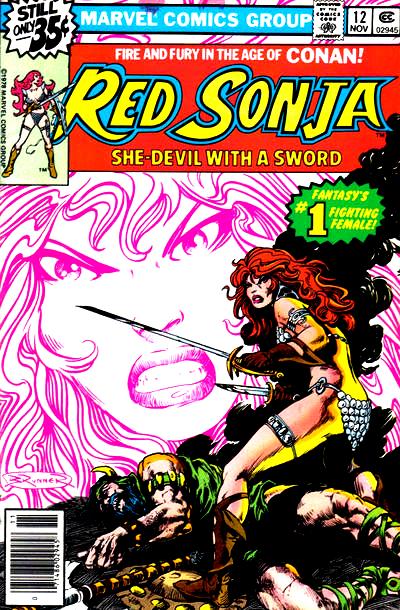
Red Sonja 6 coverWhen we last left our heroine, she’d just watched a crazy wizard get killed by a bell. Deciding to get out of the bell tower before anyone started asking her questions, she stole the nearest horse and made her way to the Singing Tower, which was more or less next door to the bell tower. Her traveling companion of the last couple issues, Mikal, is being held prisoner there and if crazy wizards and killer bells are in the tower where they keep guests, who knows what’s in the tower where they keep prisoners.  And we’re off on another psychedelic sword & sorcery adventure.

On page one, we get our first glimpse of the Singing Tower and it is certainly … suggestive. A thick cylinder with a bulbous tip, the tower’s shape is more than a little reminiscent of, oh, let’s say a mushroom. A mushroom surrounded by enticing flowers whose slimy nectar Sonja is compelled to smear across her half-naked body in a state of pure ecstasy. Until she passes out from the sheer pleasure of the act.

Mushroom.

Her unconscious body is picked up by a pair of insect people (because, really, why not insect people?) and taken inside the tower. Before they can do much more than lay her out on a stone slab, Sonja’s awake again and drawing a dagger. The insect men vomit silk onto themselves until they’re wrapped in protective cocoons. So far, this is more or less a typical day in the life for the Hyrkanian harridan.

And then she sees a giant woman tied to a wall. Upon closer inspection, it’s obvious that the giantess is tied to the lattice-work of the wall by her own over-grown hair. When Sonja tries to free her from her own hair, she finds that it grows back faster than she can cut it.

Not that she has much of a chance to cut, since a swarm of tiny bee people attack her, stinging her back to unconsciousness, then forcing her mouth open to feed her more of the nectar that had knocked her out earlier. When she wakes up once again, she finds that her hair has begun to grown like the giantess, binding her to the same lattice-work wall.

Read More Read More

New Treasures: The Haunted Land of Carcosa

New Treasures: The Haunted Land of Carcosa

Carcosa-smallI’ve been enjoying the recent renaissance in retro-D&D gaming. For one thing, it’s brought back great memories of the adrenalin-filled dungeon crawls of my youth, without all the trouble and expense of getting a bunch of middle-aged gamers scattered across two countries back together around a table.

The first role-playing adventures, from Blackmoor to Descent Into the Depths of the Earth, were many and varied, but in large part they followed a similar theme: you crawled into a hole in the ground and killed stuff.

Sure, there were thrills and surprises aplenty — strange subterranean civilizations, weird magic and weirder creatures, and magical treasures of all kinds — but in general the concept wasn’t much different from the piñata. You hit things, and goodies fell out. To get a sense of those early dungeons, imagine wandering through an underground J.C. Penny’s where every cashmere sweater, discount steak knife, and toaster is enchanted and the floor staff have spears and a surly attitude, and you pretty much get the idea.

We thrilled to those early adventures, and at the same time we yearned for something closer to the fantasy novels we were reading. Gradually, the industry responded by producing more sophisticated products with cohesive storylines, real characters, and dungeons that made some kind of functional sense, and the old adventures — with their frog temples, endless magical fountains, and chatty vorpal blades — went the way of the dinosaur.

Of course, no sooner did that happen than we started yearning for the simple games of our youth. Go figure.

That in a nutshell is the story of the resurgence of OE (Original Edition) Dungeons and Dragons games like Astonishing Swordsmen & Sorcerers of Hyperborea, Dungeon Crawl Classics, Labyrinth Lord, and even the recent first edition AD&D reprints. And now that they have arrived — and the marketplace has embraced them — compatible adventure modules have started to pop up as well. I’ve rarely seen any as ambitious and as well thought-out as Geoffrey McKinney’s Carcosa.

Read More Read More

Three Against the Stars Blasts Off for Intergalactic Adventure

Three Against the Stars Blasts Off for Intergalactic Adventure

3 against starsn21422Three Against the Stars is the second book I’ve read by Joe Bonadonna. Unlike his sword & sorcery work, this marks a venture into pure space fantasy. My knowledge of the genre is admittedly spotty. I was unfamiliar with the works of Edmond Hamilton and E. E. “Doc” Smith, who are both cited as influences, but part of the joy of genre fiction is that one does not need to have an encyclopedic knowledge of all that has gone before since the influences are so pervasive, much of it strikes one as easily recognizable.

This tale of space marines calls to mind the works of Robert Heinlein, while the space war itself strongly reminded me of Malcolm Hulke’s early seventies Doctor Who serial, “Frontier in Space” with the Earth Empire brought to the brink of war with the lizard-like Draconian Empire thanks to acts of terror committed by the apelike Ogrons. What sets Bonadonna’s work apart from so many others who share similar influences is that he is able to authentically capture the fun and innocence without sacrificing intelligent commentary on war and imperialism.

This is an Airship 27 publication and art director Rob Davis does his usual stellar job of ensuring that their titles stand out as the most eye-catching on the market today. Laura Givens’s cover art perfectly captures the space fantasy artwork from publishers like Ace, Lancer, Del Rey, and Ballantine from decades past. Interior black & white illustrations by Pedro Cruz have a classy retro-style that one associates more with slicks than pulps. The decision to go with a more sophisticated style of illustration is well-suited to Bonadonna’s story, which has familiar elements, but offers a more philosophical dimension than one generally finds in pulp fiction.

Read More Read More

Seize Control of the Galaxy with Eclipse

Seize Control of the Galaxy with Eclipse

Eclipse by AsmodeeI spent the better part of last year trying to track down this game. I first heard about it via the excited chatter at BoardGameGeek, where it bubbled near the top of their Board Game Rank, displacing such beloved games as Settlers of Catan, War of the Ring, and Civilization.

And, of course, it was no longer available. Released in 2011, the first printing sold out in record time and what few copies were still in the channel were commanding $200 or more. Publisher Asmodee announced it would not be available again until the second edition (which fixed some minor gameplay and production issues) was ready in late 2012.

It was a long wait. And the temptation to spring for one of those rapidly vanishing first edition copies was strong – especially as the year rolled on and there was no sign of the new edition. But patience is its own reward, or something. Anyway, it finally arrived, and I now have a copy in my hot little hands.

Eclipse is a game of interstellar conquest and intrigue, meaning you move starships around a colorful board and blow stuff up. That’s really all I needed to know to want a copy more than life itself. But we have a little room left, so I’ll pad this out by copying some stuff from the back of the box.

Apparently you can play as one of several races. I’m guessing the chubby green guy, blue alien, and bald supermodel on the cover are just a few of the choices. I picture my race of supermodels conquering the galaxy in slender battlecruisers, crushing all opposition beneath their stiletto heels, and suddenly I understand why copies were going for $200. I mean, damn. Now I want two copies.

Read More Read More

Red Sonja 5

Red Sonja 5

Red Sonja 5 coverThis issue follows up from the last one, in which Red Sonja vowed to find the leader of the Lake People, who was imprisoned in the Singing Tower (just called “the tower” last issue). She is still accompanied by Mikal, the mysterious traveler from issues three and four, who, rather remarkably, has not yet tried to seduce her. The issue opens with the two of them hiding behind their horses and watching a procession of warriors in the middle of the night.

Now, if I wanted to trick someone into thinking a road is unoccupied, I wouldn’t leave a pair of saddled horses in plain sight. (“Hey, let’s hide behind the biggest clue we can find!”) Curiously, none of the riders seem to the notice the horses standing just to their right (no doubt experiencing the same lack of peripheral vision suffered by Imperial Storm Troopers and every single Doctor Who villain).

Of course, Sonja and Mikal are so pre-occupied with hiding in plain sight that they fail to notice the approach of the truands, who are basically forest-dwelling dwarves. Yes, this issue, Red Sonja fights a gang of unarmed dwarves. Unarmed dwarves dressed like pixies. Because, honestly, at this point the chain mail bikini isn’t politically incorrect enough.

Well, it should be no surprise that she easily defeats the little people, keeping one under foot for questioning. She asks him only one question: Where can she find the Singing Tower? His answer is that she should follow the dark riders. The dark riders she was following before the truands attacked. Meaning that the attack really served no narrative purpose other than to fill two pages. Ah well.

So Sonja and Mikal catch up with the riders, who seem to be moving just slow enough to make following them easy. Eventually, they lead our heroes into a valley, where they discover that (best Admiral Ackbar voice) it’s a trap. They are easily captured and Mikal is taken away. Sonja is taken to a bell tower, which is apparently the capital building of Bor Ti-Ki, the City of Bells. If you’re thinking the bell tower is the Singing Tower, Red Sonja makes the same mistake. But this is apparently a completely different tower.

Read More Read More

Teresa Edgerton’s Goblin Moon

Teresa Edgerton’s Goblin Moon

Goblin MoonI’ve mentioned before that I’ve an idea that there’s a lot to be learned from some of the overlooked fantasies of the 1980s. Teresa Edgerton’s Goblin Moon was published in 1991, and it’s less obscure than some — in fact, it’s just come out as an ebook (you can find a trailer here) — but it’s still a good example of what I have in mind. And a fine and delightful tale in its own right.

Goblin Moon is the only book I’ve read by Edgerton. From what I’ve found online, she began writing with a series of alchemical fantasies, the Celydonn trilogy: Child of Saturn and The Moon in Hiding in 1989, followed by The Work of the Sun in 1990. Goblin Moon came out in 1991, as did its sequel, The Gnome’s Engine; the two books together make up the “Masks & Daggers” duology. A second Celydonn trilogy followed (The Castle of the Silver Wheel in 1993, The Grail and the Ring in 1994, and The Moon and the Thorn in 1995), but after 2001’s The Queen’s Necklace, the vagaries of the publishing industry led Edgerton to assume a pseudonym. Under the name Madeline Howard, she’s published two books of a projected trilogy — The Hidden Stars and A Dark Sacrifice. Having acquired the electronic rights to her older books, she’s begun re-releasing them as ebooks and print-on-demand paperbacks. Goblin Moon’s now available at her website, with The Gnome’s Engine apparently planned to re-appear in a few months.

Moon’s an intricate and surprising book. The plot follows the fortunes of several characters: river scavengers who make a surprising find, an old used bookman who thinks he knows how to use said find, his granddaughter who is the best friend of an ailing upper-class cousin, and a mysterious nobleman with strange and possibly dreadful secrets. These plot strands run into each other unexpectedly, branch out in surprising directions, and finally more or less dovetail into a conclusion. There are elements in Goblin Moon of romance, mystery, and adventure out of Dumas or Orczy. But what really makes the book stand out is its setting, an elaborate secondary world. Most of the book takes place in and around Thornburg, a pseudo-German city in an eighteenth century filled with magic, fairies, dwarves, gnomes, trolls, and a moon whose orbit brings it visibly closer to the earth at its full. The outlines of Thornburg and the wider world are familiar, evocative of the exploits of Casanova or Cagliostro, but the details are specific, unique, and highly detailed: Edgerton’s imagined her world’s folkways and superstitions, its magic and iconography, its habits of thought and obsessions.

Read More Read More

Review of K. Bird Lincoln’s Tiger Lily

Review of K. Bird Lincoln’s Tiger Lily

Tiger Lily cover
Tiger Lily cover

About a month and a half ago on this blog, I solicited submissions of self-published novels for review.  I know firsthand how difficult it is to sell fiction on your own, so I wanted to give some attention to books that are often underappreciated, both by the industry and by readers.  I received more than a few submissions–not so many that I was completely swamped, thankfully, but enough that I had to sort through the entries and decide on the one that I thought was most promising. That one was Tiger Lily by K. Bird Lincoln.

I selected this novel because the sample chapter was well-written and the premise was unique and intriguing. However, I was going out of my comfort zone in choosing it. Tiger Lily could be best described as a fantasy historical romance taking place in feudal Japan.  I’ll readily admit that that is not my normal reading material.  Since I am not as familiar with this subgenre, it’s quite possible that common and accepted tropes of it struck me the wrong way, and that I completely missed things that would bother the normal audience.  So in this review, I’ll just point out what worked for me and what didn’t, and those with more familiarity with the subgenre can take what I say with a grain of salt.

The title, Tiger Lily, refers to the main character, Lily-of-the-Valley, who was born in the year of the Tiger, which she blames or credits for every stubborn and rebellious decision she makes.  She’s unmarriageable, she’s a failure as a dutiful daughter, and worst of all, she keeps the old ways of Jindo, rather than the new Buddhist religion embraced by the Emperor.  The author admits that she sharpened the conflict between Buddhism and Jindo in the novel, as compared to the historical competition between the two faiths in Japan. Though it may be more fantasy than history, this conflict is effective as the driving force in the novel.  It’s the main motivation for Lily to keep her connection to the spirits, or kami, hidden, and is the ultimate reason behind the war she finds herself embroiled in, between the Buddhist Emperor and the Jindo-following rebels.

At the beginning of the novel, Lily doesn’t consider herself a follower of Jindo so much as of her vanished mother, who was a true practitioner. She merely enjoys walking alone in the forest, singing the forbidden songs that her mother taught her.  Until one day she runs into the local lord’s son, Prince Ashikaga, injured in the forest, and she must protect him from the fox spirit rebels.  Her songs are what allow the prince to fight and defeat the rebels in the early skirmishes.  Soon she’s swept up in the war against the Jindo rebels, where the prince sees her as the key to success, and maybe as something more.  But as they become closer, she learns that the prince has his own secrets. I won’t reveal that here, but if you know that he has a secret (which the book description tells you straight out), it’s fairly obvious what it is.

Read More Read More

Red Sonja 4

Red Sonja 4

red-sonja-4-coverLast issue, Red Sonja competed in the Games of Gita, won, then killed the Queen of Athos. This issue, she’s still hanging around the city. Apparently, the queen wasn’t that popular. So her new friend, Mikal, is showing her the sights, which include a dark lake infested with shambling actors. “(T)hese strange beings, whose limbs are an eldritch mixture of beast and fowl and lowly reptile.” They slowly make their way to the aptly named “Theatre of Monsters.”

Walking into the Theatre, Sonja finds that the performances consist of monsters, who are clearly monsters wearing human masks, performing surreal renditions of standard plays. Of course, the actors behave with more dignity than the howling human audience around them. At one point, they invite Red Sonja to join their performance in exchange for a purse of gold.

Since Sonja is perpetually broke, she accepts the offer and takes the stage. But since it’s pretty much her fate to be perpetually broke, the offer of gold was a ruse and the monster performers try to kill her immediately. Several monster-corpses later, their leader is begging for mercy and offering to explain what just happened.

At this point, Mikal joins Sonja, having apparently been using the bathroom while she was fighting for her life on stage. The two of them are escorted to the lake, where the waters are parted Moses-style so that they can follow the monsters down to their underwater crystal city. There, she is told the story of how the monsters are descended from aliens whose ship crashed in the lake. After adopting water-breathing forms, they began to interbreed with various Earth animals (um, yuck) until the succeeding generations were the monsters that now occupy the city. Apparently, their leader was captured by the people of Athos and they are forced to perform as circus entertainers in order to ensure that he stays alive.

Read More Read More

New Treasures: Dungeon Command: Curse of Undeath and Tyranny of Goblins

New Treasures: Dungeon Command: Curse of Undeath and Tyranny of Goblins

dungeon-command-curse-of-undeath-smallBack in August, I made some excited noises about the new head-to-head skirmish game from Wizards of the Coast, Dungeon Command.

At the time, only two Faction Packs were available: Heart of Comyr, including a human ranger, halfling sneak, dragon knight, dwarven defenders, and copper dragon; and the Sting of Lolth, which contained the drow assassin, priestess, wizard, spiders, and umber hulk.

Now, if you’re like me, you probably wondered what a “Faction Pack” was, and how a “head-to-head skirmish game” might work. But that was really secondary, because all the cool toys packed inside were more than worth the money.

If you had to justify the purchase, you could do it on those alone — Dungeon Command components are fully compatible with the Wizards of the Coast games you’re already playing. The miniatures and dungeon tiles can be used with the D&D RPG, and the unique cards provided with each miniature can be used with D&D Adventure System board games like Castle Ravenloft, Wrath of Ashardalon, and The Legend of Drizzt.

dungeon-command-tyranny-of-goblins-smallYou don’t have to be an expert on head-to-head skirmish games to appreciate that they’re a lot more fun with a variety of miniatures. So I was intrigued to see the recent arrival of two new factions: Tyranny of Goblins, containing a complete goblin warband — including bugbears, wolf riders, a feral troll, and a hobgoblin sorcerer — and Curse of Undeath, which includes the gravehound, lich necromancer, and dracolich.

Dungeon Command features themed miniature factions designed to play as unified war bands. The game eliminates luck-driven mechanics in favor of player-driven skill, creativity, and quick thinking. Each faction comes in its own box, with a dozen miniatures, a set of unique cards, dungeon tiles, and the game rules.

I’m already hearing reports that the miniatures — and the new rules set — have found favor among roleplayers looking for a quick and refined combat system. Stay tuned for further reports as we experiment with the rules here at the Black Gate rooftop headquarters. Assuming we ever stop playing with the cool minis long enough to read the rules, that is.

Both Tyranny of Goblins and Curse of Undeath retail for $39.99. They were released by Wizards of the Coast in October and November, respectively.