A review of Chase the Morning, by Michael Scott Rohan
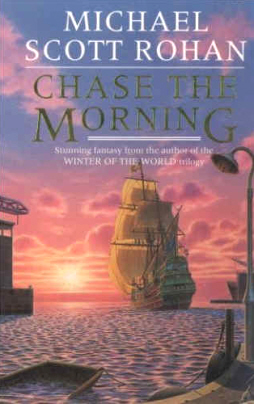 Steve is a very normal man, perhaps even a bit boring. He works at an English shipping company, handling inventories and looking forward to a career in politics once he climbs the business ladder as far as it will take him. One day, for no particular reason, a sudden fit of discontent sends him down to the docks looking for something different, perhaps a restaurant he hasn’t visited. In an alley, he sees a man being attacked . . .
Chase the Morning, by Michael Scott Rohan, doesn’t have all that much in common with modern urban fantasies like The Dresden Files. It does, however, feature a magic world hiding in the shadows and back streets of this one, so it may fit the category. The setting of Chase the Morning is easily my favorite part of the book — not because the rest of the book is bad, but because the setting touches my sense of wonder.
It’s nicely built up, too. The man Steve rescues is named Jyp, and as Steve’s wounds are stitched up in an old-fashioned gaslit pub, Jyp casually discusses his ship’s exotic cargo: black lotus, conqueror root, merhorse hide. But the pub proves elusive the next time Steve searches for it, the sailing ships he saw at the dock don’t exist, and as for the cargo, Steve actually finds it in his computer — on a ship from 1868. Ass he slips in and out of the mundane world, he keeps seeing an illusory landscape in the clouds — the same landscape. The magical world starts intruding into Steve’s world, to find out who he is and why he’s interfering; this culminates in the kidnapping of his secretary, Clare, by not-quite-human savages called Wolves. In search of Clare, in search of Jyp’s help, he manages to locate the magical version of the docks, the one that’s packed with sailing ships from all eras. And then, too desperate to be skeptical, he watches a ship sail off into the sky, into the landscape of clouds.
 Early on in this film we see Bruce Willis with hair and looking young, and not Die-Hard bashed up, and we wonder absently if this time he’ll actually finish the film as scar-free as he began it. The Willis we begin with is quickly established as a ‘surrogate,’ the robot avatar of the real Willis character, Tom Greer, and it doesn’t take long for both Greer and his surrogate to get bashed up in familiar form.
 On the whole, I’m not opposed to traveling with boys. Generally speaking they are amusing companions particularly when refusing to ask directions, thereby winding you through mildly interesting places while attempting to locate the desired destination sans MapQuest. Along the route, in an effort to distract their hapless passengers from all the pointless meandering, they can generally be counted on for lively and revealing conversation about former girlfriends, prior arrests and entirely icky things done in frat houses; all of which become prime blackmail fodder for later use.
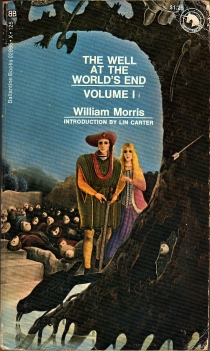 Who was the first person to write high fantasy?
 The second issue of Bull Spec, Samuel Montgomery-Blinn’s quarterly print magazine of Speculative Fiction, arrived last week, with a spectacular cover by Vladimir Krizan.
 There are indeed urban legends at work in the Collector’s market. For example, the entire print order of George Alec Effinger’s first novel, What Entropy Means to Me (Doubleday, 1972) was supposedly pulped before publication (almost certainly untrue).
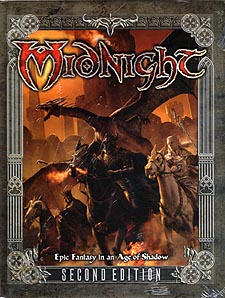 “Imagine if Frodo had died during his journey and the One Ring had returned to Sauron.”

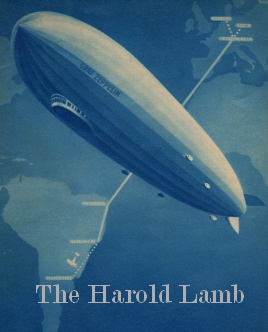 There’s a temporary lull in operations and the skies are clear over Oklahoma, so I thought I’d take the time to set the record straight about our expedition to Dragon*Con via the Black Gate zeppelin, the Harold Lamb. John described the