Lost Classics of Pulp: Guy Boothby’s Dr. Nikola and Pharos the Egyptian
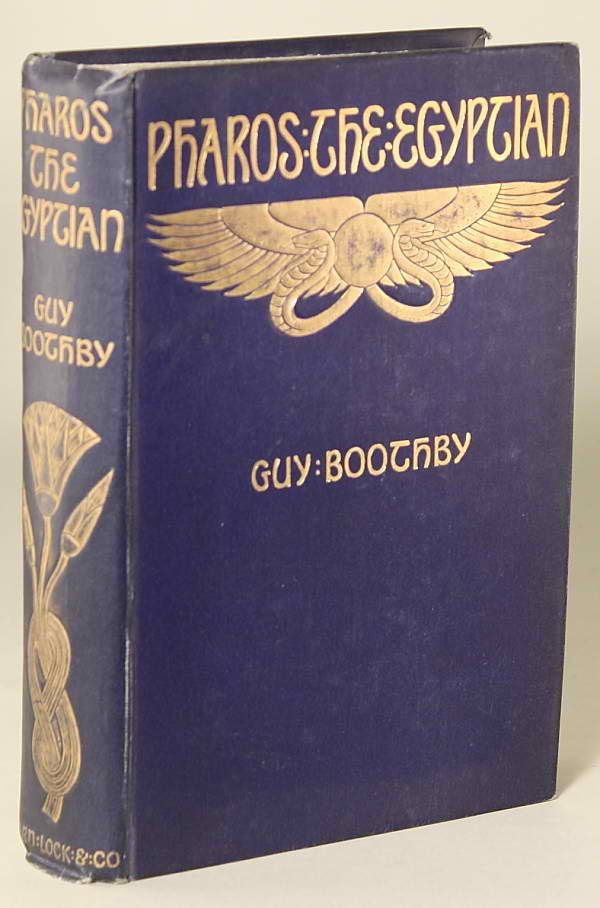 One doesn’t have to dig very far to discover my devotion to the works of Sax Rohmer. Peter Haining was, I believe, the first commentator to propose that Australian writer Guy Boothby’s works were a likely influence on Rohmer in the excellent survey, The Art of Mystery and Detective Stories. I first stumbled upon Boothby’s name and that of his most famous creation, Dr. Nikola courtesy of Larry Knapp’s brilliant Page of Fu Manchu website. Finally, it was a very informative piece written by that eminent Sherlockian, Charles Prepolec that convinced me I had to read the Nikola series for myself.
Five Nikola books were published between 1895 and 1901. The best editions available today are in the two-volume The Complete Dr. Nikola published by Leonaur Press. Dr. Nikola is a criminal mastermind with an occult twist. Think Conan Doyle’s Professor Moriarty (introduced only one year before Nikola) eerily anticipating Aleister Crowley and you have a pretty good idea of Boothby’s ambitions.
Like much fantastic fiction of the Victorian era, the books are more about how others fall into Nikola’s web than they are about the sinister doctor himself. This was the same approach taken by Bram Stoker with Dracula and Rohmer with his Fu Manchu series. The Nikola books are also globe-trotting adventures that move rapidly from Australia to Europe to Egypt to London to Africa to Tibet. The sense of mystery that pervades these exotic settings in those imperialist days of empire-building is part of the books’ nostalgic appeal today.

 This week Black Gate picks up where we left off in


 Literary traditions are useful things. They’re constructions of literary critics, sure, but useful constructions. A well-articulated tradition can show how different writers deal with the same idea or theme, demonstrating different approaches to a given problem or artistic ideal. It can show affinities between writers, sometimes bringing out resemblences between different figures in such a way as to cast new light on everyone involved. At the grandest level, the whole history of writing in a given language or from a given nation can be seen to be part of a tradition, showing the evolution of a language or the concerns of a people.