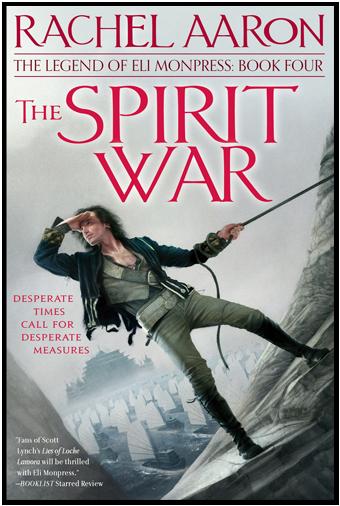
New Treasures: Rachel Aaron’s The Spirit War
 Always nice to see a new fantasy series succeed. In particular, it’s nice to see a non-traditional series succeed — i.e. one that doesn’t feature vampires, werewolves, or a stake-wielding heroine with an all-leather wardrobe. And it’s especially nice to see a genuine sword & sorcery series succeed, one whose protagonist is not a swordsman, prince, or naive young hero… in fact, he may not be a hero at all.
Rachel Aaron’s first novel The Spirit Thief (October, 2010) kicked off The Legend of Eli Monpress, a series that has now run to four volumes. The most recent, The Spirit War, was just released last month.
Eli Monpress is vain. He’s cocky. And he’s a thief.
But he’s a thief who has just seen his bounty topped and he’s not happy about it. The bounty topper, as it turns out, is his best friend, bodyguard, and master swordsman, Josef. Who has been keeping secrets from Eli…
Family drama aside, Eli and Josef have their hands full. The Spirit Court has been usurped by the Council of Thrones and someone calling herself the Immortal Empress is staging a massive invasion. But it’s not just politics — the Immortal Empress has a specific target in mind: Eli Monpress, the greatest thief in the world.
Here’s what our buddy John Ottinger III at Grasping for the Wind said about the first novel:
The Spirit Thief is a work of sword and sorcery that will appeal to readers of Jim C. Hines, Karen Miller, Jon Sprunk, and Piers Anthony. It is a thrill ride of a novel, delightfully amusing, based on an original magic system… I loved it.
Missed out on the first volumes? No problem. Orbit has just released all three — The Spirit Thief, The Sprit Rebellion, and The Spirit Eater — in a single handsome omnibus edition for $15 ($9.99 for the digital version).
 Back on Mars already?
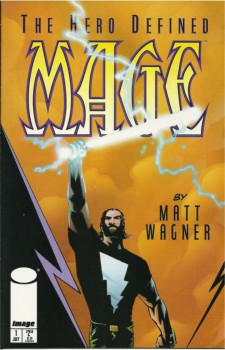 Matt Wagner began writing and illustrating the first Mage series in 1984 at the age of twenty-two. At the time, he was a relatively unknown creator struggling both to find his voice and make a place for himself in the comics industry. His subsequent work on Grendel and Sandman Mystery Theatre had garnered many awards and critical acclaim; but in interviews there was always the obligatory question of “When are you going back to Mage?”
 A lot of writers I know are pretty good at self-sabotage. It’s not that writing is hard, exactly, except that it is. Physical labor and exercise isn’t required, and it sure doesn’t look like you’re doing much when you’re