The Least-Expected Trumpet of Apocalypse: Leonora Carrington’s The Hearing Trumpet
 A little while ago, I followed a retweeted link to a blog post by writer Sofia Samatar, presenting the syllabus for a class on weird world fiction she’ll be teaching this semester. It was an interesting list. Some names were new to me, so I set about looking them up. And found a library near me had a book by one of these writers: The Hearing Trumpet by Leonora Carrington. Which turned out to be a constantly surprising read, a short book that opened doors to places I didn’t expect.
Carrington died in 2011 at the age of 94. She was primarily known as a painter; as a young artist she left school to live with Max Ernst, and with him became a part of the Surrealist movement. When the German Ernst was arrested by the French government in September of 1939, Carrington suffered a mental breakdown and, after fleeing France, was institutionalised in Spain. She ultimately fled to Mexico, where she lived for the rest of her life, producing paintings, sculptures, novels, plays, and short stories. (You can see a selection of her works at her page at wikipaintings.org.)
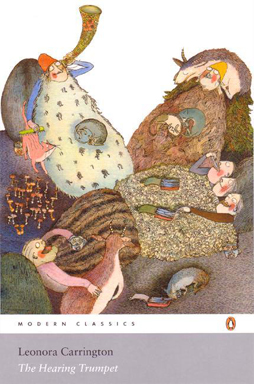
The Hearing Trumpet may have been first written in 1950, or perhaps in the early 1960s; it was first published in French in 1974, then in Engish in 1976. It’s a story about a 92-year-old woman, Marian Leatherby, given a hearing trumpet by her friend Carmella (a character widely believed to be based on Carrington’s close friend, the surrealist painter Remedios Vero — see more of her work here). The trumpet sharpens Marian’s hearing to a fantastic degree and she at once hears her family planning to put her in a home for old women. This institution turns out to be marked by strange architecture — buildings in the shape of “toadstools, swiss chalets, railway carriages, one or two ordinary bungalows, something shaped like a boot, [and] another like what I took to be an outsize Egyptian mummy,” with the main building a castle at the centre — and is run by highly idiosyncratic Christians. A picture of a one-eyed female saint seems to grin mockingly in the dining hall. Strange things follow: one of the other inmates dies, perhaps murdered; Marian is given a peculiar book outlining the history of the painted saint and her quest for the Holy Grail; and then things get much, much weirder.