Browsed by
Category: Vintage Treasures

Goth Chick News: Logan Returns – In a Big Way

Goth Chick News: Logan Returns – In a Big Way

Logans Run Centipede Press-smallLong before the dystopias inhabited by Peeta and Katnis, or Tris and Four, there was life under the domes with Logan 3 and Jessica 6.

Originally published in 1967, Logan’s Run is a classic science fiction novel that has rarely been out of print in the subsequent years. It has also been a movie (and about to be a remake), a television show, several iterations of comics, music and even a computer game.

In the world of 2116, a person’s maximum age is strictly legislated: twenty one years, to the day. When people reach this “Lastday” they report to a “Sleepshop” in which they are willingly executed via a pleasure-inducing toxic gas. A person’s age is revealed by their palm flower crystal embedded in the palm of their right hand that changes color every seven years, yellow (age 0-6), then blue (age 7-13), then red (age 14-20), then blinks red and black on “Lastday”, and finally turns black at 21. The story follows the actions of Logan, a Sandman charged with enforcing the rule, as he tracks down and kills citizens who run from society’s lethal demand, only to end up running himself.

Logan’s Run has been one of my favorite books since I first discovered a dog-eared paperback at a library book sale in high school. Since then I’ve never not had a copy on my shelf and periodically go back to reread it – the story never ceases to entertain.

That is why I could not have been more excited a couple months back to learn about a new edition distributed by Centipede Press. I nearly burned up my keyboard preordering a copy.

This new edition of Logan’s Run features striking dustjacket art, and over a dozen full page and spot black & white interiors, by artists Jim and Ruth Keegan. It has a new introduction by Jason V Brock, two bonus stories in Logan’s Return and The Thunder Gods, a gallery of old editions of the novel, excerpts from the original manuscript, and a few images from William F. Nolan’s personal notebook.

Read More Read More

Werewolves, Ancient Alien Evil, and Babylonian Witches: Tales of the Werewolf Clan by H. Warner Munn

Werewolves, Ancient Alien Evil, and Babylonian Witches: Tales of the Werewolf Clan by H. Warner Munn

Weird Tales July 1925 The Werewolf of Ponkert Munn-small Weird Tale July 1927 The Return of the Master Munn-small Weird Tales October 1928 The Werewolfs Daughter-small

In the March 1924 issue of Weird Tales, a letter by H. P. Lovecraft appeared proclaiming that:

Popular authors do not and apparently cannot appreciate the fact that true art is obtainable only by rejecting normality and conventionality in toto, and approaching a theme purged utterly of any usual or preconceived point of view… Take a werewolf story, for instance — who ever wrote a story from the point of view of the wolf, and sympathizing strongly with the devil to whom he has sold himself?

Enter young Harold Warner Munn, who took up the elder author’s challenge by submitting a story with the curious title of “The Werewolf of Ponkert” to editor Farnsworth Wright at Weird Tales.

The story appeared in the magazine’s July 1925 issue, the first of fifteen tales penned by Munn set in the same cycle, which have all recently been collected by Altus Press and published in a handsome omnibus edition titled Tales of the Werewolf Clan.

Read More Read More

Vintage Treasures: Through the Reality Warp by Donald J. Pfeil

Vintage Treasures: Through the Reality Warp by Donald J. Pfeil

Through the Reality Warp-smallI have friends who wonder why I bother with old paperbacks. If there’s one thing tablets have made obsolete, it sure seems to be the need to collect books. Of course, I collect old paperbacks because I love them, not because it’s the only way to enjoy them. But in many cases, it really is the only way to get a copy of an old book. I type the words “There is no digital edition” at the bottom of at least a third of these Vintage Treasures posts (and about 15% of New Treasures, now that I think about it.)

The latest example is Donald J. Pfeil’s 1976 space adventure Through the Reality Warp. Pfeil is a minor SF writer with a brief career and only two other novels to his name, Voyage to a Forgotten Sun (1975) and Look Back to Earth (1977). Not one of his books was ever reprinted. If you have a Kindle or a Nook, Pfeil will remain ever a mystery. But copies of the Ballantine paperback start at $0.01 online — cheaper than that digital book you were going to order.

“You mean even if I succeed, it’s still a suicide mission?”

Latham Billiard stared at the four men standing before him… the four men who could not meet his eyes, the four men who were asking him to navigate a ship through a one-way black hole — into an alien universe — to destroy something totally unknown.

Billiard could not believe what he was hearing!

“If you don’t succeed,” the Guild General said, “It’s death for every living thing in our universe.”

What could a soft-hearted, thick skinned, cracker-jack mercenary like Billiard say? After all , it wasn’t every day a man was asked to save a universe he would never see again…

An Exciting Space Adventure

Through the Reality Warp was published by Ballantine Books in February 1976. It is 164 pages, priced at $1.50 in paperback. The cover is by Boris Vallejo. It has never been reprinted, and there is no digital edition.

Alien Invasions, Transporters, and Restarting the Sun: A Review of Beyond Belief

Alien Invasions, Transporters, and Restarting the Sun: A Review of Beyond Belief

Beyond Belief Richard J Hurley-smallBeyond Belief
Edited by Richard J. Hurley
Scholastic Book Services (188 pages, $0.45, April 1966)

Given that Scholastic was the publisher of this anthology, it’s probably fair to assume that it was aimed at what was once called the juvenile demographic. I was in that demographic when the 1973 paperback edition was published.

However, as the publishing credits reveal, most of the stories are drawn from SF magazines of prior decades. None of which were geared to juveniles, as far as I’m aware. It’s a mixed bag, as anthologies often are, but for me the ups outweighed the downs by a bit.

Thumbs Up

“Phoenix,” by Clark Ashton Smith

When you’re listing writers who have a truly distinctive voice, Clark Ashton Smith should probably be near the top. I wasn’t aware that he wrote much science fiction, but this story of humans living on a cold Earth and striving to restart the sun fits the bill. The best story in the book, for me, and one of the best I’ve read for a long time.

“It’s Such a Beautiful Day,” by Isaac Asimov

An interesting effort from Asimov, set far enough in the future that no one goes outside anymore, instead getting from point A to B by using Doors. Any resemblance to transporters is coincidental, since Star Trek came along more than a decade after this story was published. The hook is that one day a young boy decides that he’d rather get around by using old-fashioned doors to go outside and walk from place to place. Naturally, his well-bred, high-toned mother is aghast over this turn of events.

Read More Read More

Vintage Treasures: Secret of the Lost Race by Andre Norton / One Against Herculum by Jerry Sohl

Vintage Treasures: Secret of the Lost Race by Andre Norton / One Against Herculum by Jerry Sohl

Secret of the Lost Race Andre Norton-small One Against Herculum-small

Time to get back to some Ace Doubles.

I’ve covered 20 in the series so far, which, as die-hard collectors will know, is only scratching the surface of this marvelous series. As long as we’re returning to our survey after a lengthy hiatus, we might as well return in style. And that means Andre Norton.

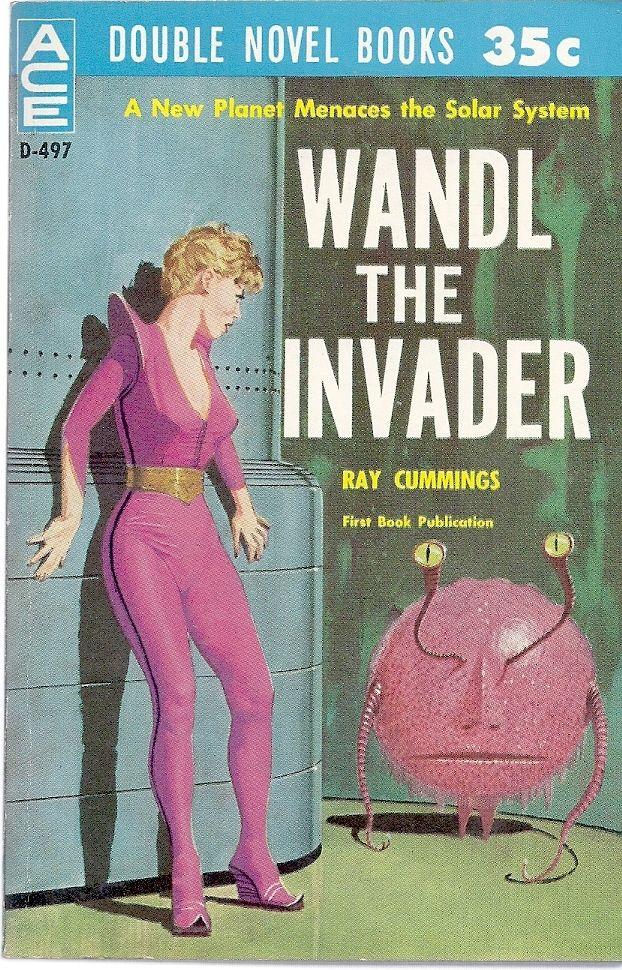
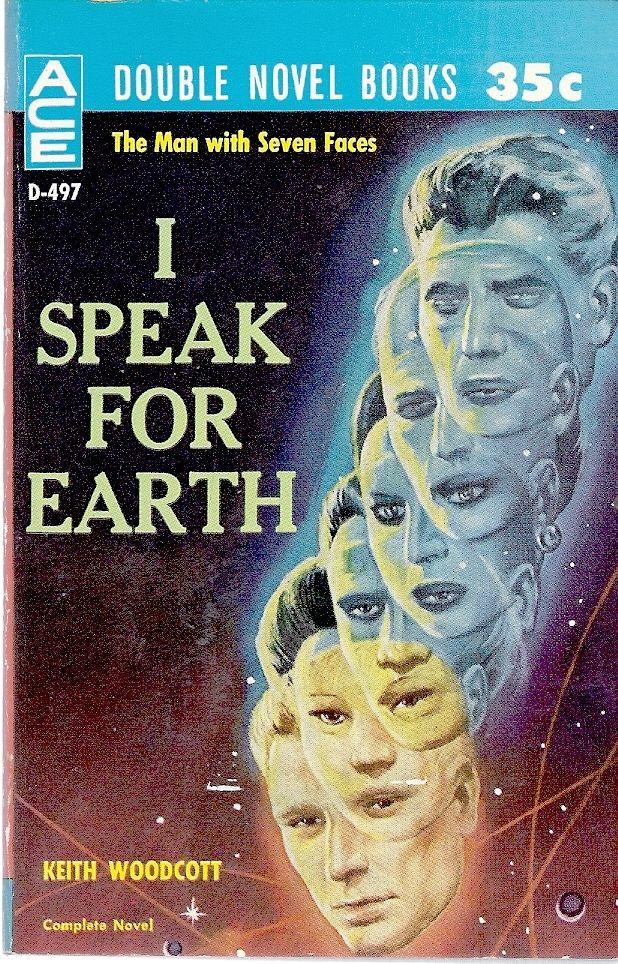
So today we’ll look at Secret of the Lost Race, one of her classic novels of space adventure, paired with an early novel by future Star Trek writer Jerry Sohl, One Against Herculum. It was published as Ace Double #D-381 in 1959. Both short novels were original publications.

Read More Read More

Death Angel’s Shadow by Karl Edward Wagner

Death Angel’s Shadow by Karl Edward Wagner

Best Kane cover ever – by Stan Zagorski

I’ve read  Karl Edward Wagner‘s Death Angel’s Shadow (1973), with its three stories of Kane, the Mystic Swordsman, numerous times since first finding it in my attic in the 1970s. Before Conan’s or Elric’s, Kane’s adventures sparked my interest in swords & sorcery. Only a few years ago, I wrote a long piece about Wagner and this book over at my site, Swords & Sorcery: A Blog. I figured it was time to give it a reread and review here at Black Gate.

For the uninitiated, Kane is, in Wagner’s own words, a villain-hero. Cursed with immortality, over the course of his career he’s been an evil wizard, a crime lord, a bandit, and the general of a demon cult’s army. Sometimes he’s up against someone more diabolical than he is, but he’s never the good guy, never the hero.

This description of him gives you a sense of the wrongness that clings to him even when he’s not embarked on some nefarious plan:

It was his eyes that bothered Troylin. He had noticed them from the first. It was to be expected, for Kane’s eyes were the eyes of Death! They were blue eyes, but eyes that glowed with their own light. In those cold blue gems blazed the fires of blood madness, of the lust to kill and destroy. They poured forth infinite hatred of life and promised violent ruin to those who sought to meet them. Troylin caught an image of that powerful body striding over a battlefield, killer’s eyes blazing and red sword dealing carnage to all before it.

The three Kane novels, Darkness Weaves, Bloodstone, and Dark Crusade, are decent enough, but it’s in the short stories that Wagner’s immense talents shine most brightly. Two years ago I reviewed the collection, Night Winds (1978) at Black Gate. That book contains some of the best and darkest S&S stories ever set to paper. I cannot recommend it highly enough.

Read More Read More

Adventures In Shape-Shifting: Robert Stallman’s The Orphan

Adventures In Shape-Shifting: Robert Stallman’s The Orphan

The Orphan Robert Stallman-smallI write this on an emotional high, a plateau from which I never wish to descend, for I’ve just managed the impossible: I’ve gone back in time. The vehicle employed? A book, prose, a worn paperback. It’s Robert Stallman’s The Orphan.

I first encountered this title somewhere in the Dark Ages, probably around 1980. I re-read it perhaps two years later, along with its two sequels, The Captive and The Beast. Even though large swaths of plot have faded from my mind over the years, I have never, ever forgotten the book’s opening lines.

I am and will be. There is no time when I am not.

This is the first lesson.

My need creates myself.

This is the second lesson.

Alone is safe.

This is the third lesson.

I’ve spent the last thirty-five years considering those quotes (and the ideas behind them), polishing each like a gem-cutter finishing off a jewel. I’ve road-tested them, too, as a survival mechanism when, in my earliest teens, I tried out (as actors might try a cape) the attitude of Kipling’s cat, the one that walked by himself. It was necessary, in a way, but also foppish, affected. Even so, I found in The Orphan echoes of that chilly, solo stance — the same adopted in Westerns by virtually every gunslinger known, from Joel McRae to John Wayne and back again.

So once upon a time, my time, these lines held great personal weight. They were talismans, of a sort, and in picking up this gorgeous, dangerous title afresh, I was face to face with my past and the self I have since become.

For a moment, I had to look away.

Read More Read More

Vintage Treasures: The Dream Lords by Adrian Cole

Vintage Treasures: The Dream Lords by Adrian Cole

The Dream Lords 1 A Plague of Nightmares-small The Dream Lords 2 Lord of Nightmares-small The Dream Lords 3 Bane of Nightmares-small

I don’t often hear of fantasy described as “In the tradition of Tolkien and Lovecraft!” Just seems like an odd mix to me. But that’s exactly how Adrian Cole’s first three novels, collectively known as The Dream Lords trilogy, are described.

Cole is a British writer also known for his four-volume Omaran Saga, and his more recent trilogy The Voidal, which Fletcher Vredenburgh called “an endless collection of interesting settings: universe-sized dimensions; monster-infested pocket worlds; a realm filled not with planets but islands that float in space.” But I was first introduced to him with The Dream Lords, which he reportedly wrote after reading Tolkien’s The Lord of the Rings while working in a library in the mid-seventies.

Interestingly, this series has no second volume. It has a first volume, A Plague of Nightmares, and two third volumes, Lord of Nightmares and Bane of Nightmares, but no second volume. That’s cool.

Read More Read More

The Omnibus Volumes of Steven Brust: The Adventures of Vlad Taltos

The Omnibus Volumes of Steven Brust: The Adventures of Vlad Taltos

The Book of Jhereg-small The Book of Taltos-small The Book of Athyra-small


The omnibus editions of The Adventures of Vlad Taltos from Ace Books, collecting

the first seven volumes: The Book of Jhereg (1999), The Book of Taltos (2002), and
The Book of Athyra (2003). Covers by Stephen Hickamn, Kinuko Y. Craft, Ciruelo Cabral

Steven Brust’s Vlad Taltos novels are unique in modern fantasy. They’re caper novels in which a supremely gifted assassin, Vlad Taltos, teams up with a group of like-minded companions (including pickpockets and vampires) to right wrongs, alter the course of destiny, and sometimes make a little coin. The odds are always against them, and things don’t always go their way, but Vlad, our protagonist and narrator, has a wry and self-deprecating sense of humor that makes the books highly entertaining. There are plenty of great reviews out there I could point you to, but one of my favorites is this concise one-paragraph bit from Amazon reviewer Wizard’s Apprentice:

Vlad is a human in a city dominated by eight-foot Dragaerans, who never have to shave and live to be a thousand. It’s their turf, and their rules, and they routinely conquer and abuse “Easterners” like Vlad. He’s not the type to take this, so he becomes a “Jhereg” assassin, working up the ranks of a criminal syndicate until he comes to boss dozens of Dragaerans around, befriending some and terrorizing others. He adopts a new-hatched mini-dragon or jhereg, finding that the cat-sized beast has a humanlike intelligence and a nasty sense of humor, and wins a grudging respect from the dominant species. All his friends are 900 years old, or undead vampires, or legendary thieves; but don’t hold it against them. Vlad solves mysteries and evades death, and cooks fiery fungus-laced omelets, in a bizarre semi-alien milieu. He finds love. He sharpens knives. He gloomily bandages his jhereg bites. He’d be right at home in a Zelazny novel, which is reason enough to buy this or any other Brust book.

Read More Read More

The Novels of Tanith Lee: The Secret Books of Paradys

The Novels of Tanith Lee: The Secret Books of Paradys

The Book of the Damned Tanith Lee-small The Book of the Beast Tanith Lee-small The Book of the Dead Tanith Lee-small The Book of the Mad Tanith Lee-small

We’re continuing with our look at the extraordinary 40-year career of Tanith Lee, who passed away on May 24th. We started with The Wars of Vis trilogy and her acclaimed Tales From the Flat Earth, and today we turn to her four-volume saga, The Secret Books of Paradys, published in the US by The Overlook Press between 1990-1993, with a striking series of covers by Wayne Barlowe (above).

Matthew David Surridge wrote a fine summary of the entire series for us two years ago, and I doubt I could do a better job of summarizing them than he did:

The fictive city of Paradys itself seems to accrue layers of meaning and complexity like a recurring landscape in a lucid dream. Above all, the books are weird with the weirdness of nightmare; though written with incredible technical skill, it’s difficult to articulate a single overall theme to the books, though multiple meanings suggest themselves.

Paradys is a city in northern France, originally a Roman settlement based around the exoploitation of soon-played-out silver mines. It developed over time into a major city, with a cathedral and taverns and damned poets and all the appurtenances of decadent gothic romance. The various stories of Paradys take place in different eras of the city’s life, told from different perspectives, using different styles. They’re linked by certain patterns of imagery — notably the ambiguous symbol of the moon — and a concentration on colour: each book, or long story, has a certain colour which defines it, and all colour-references within that story will refer either to white, black, or that specific hue. I can only imagine how difficult that technique is, but it’s incredibly effective at building distinct and distinctive atmospheres…

Read More Read More